




If your brand is showing up less often in ChatGPT, Google AI Overviews, Perplexity or Gemini than it does in traditional search, the problem usually is not a single ranking factor. What drives AI citations is a mix of source accessibility, entity clarity, content usefulness, trust signals and competitive context. Brands that understand that mix can move from guessing to engineering visibility.
That shift matters because citations are not just vanity metrics. In generative search, the source that gets cited is often the source that gets believed, repeated and clicked. If competitors are being referenced while your brand is absent, you are not just losing traffic. You are losing authority inside the answer itself.
What drives AI citations in practice
AI platforms do not cite content for the same reasons Google ranked pages ten years ago. They assemble answers from patterns across training data, retrieval systems, live web indexes and source selection layers that vary by platform. That means there is no universal checklist. There are, however, common drivers that repeatedly influence whether a brand becomes part of the answer.
The first is simple: the model needs to understand who you are and what you are relevant for. If your site, third-party mentions and supporting assets send mixed signals about your category, use case or geographic relevance, citation rates usually suffer. AI systems reward clarity. Ambiguous brands get skipped.
The second is source quality. A page can be well written and still fail to earn citations if it is thin, generic or structurally messy. AI systems prefer content that answers a distinct question, backs claims with specifics and is easy to parse. Clean headings, direct statements, factual density and well-scoped pages all help.
The third is corroboration. One page on your site saying you are the best at something is not enough. AI models tend to favour claims that appear across multiple trusted sources. That includes reviews, industry directories, editorial mentions, comparison pages, documentation, category pages and expert commentary. Repetition across the web turns a claim into a credible signal.
Entity clarity beats brand noise
A lot of marketers still treat AI visibility like an SEO variant. It is closer to entity competition. The platform is trying to determine whether your brand is a reliable answer for a topic, not just whether a page contains the right phrase.
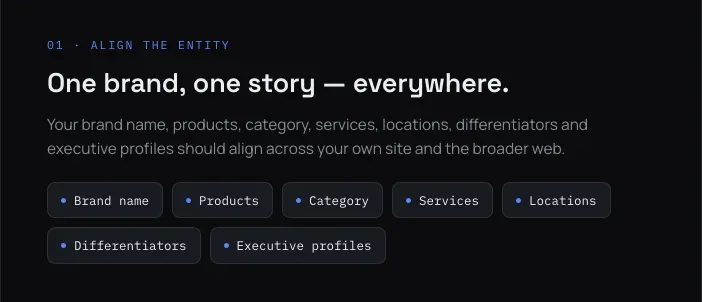
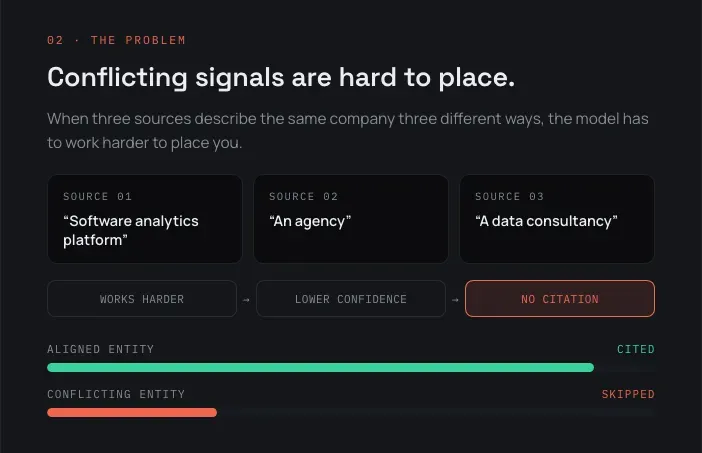
That is why entity clarity matters so much. Your brand name, products, category, services, locations, differentiators and executive profiles should align across your site and the broader web. If one source describes you as a software analytics platform, another as an agency, and a third as a data consultancy, the system has to work harder to place you. Harder usually means lower confidence, and lower confidence often means no citation.
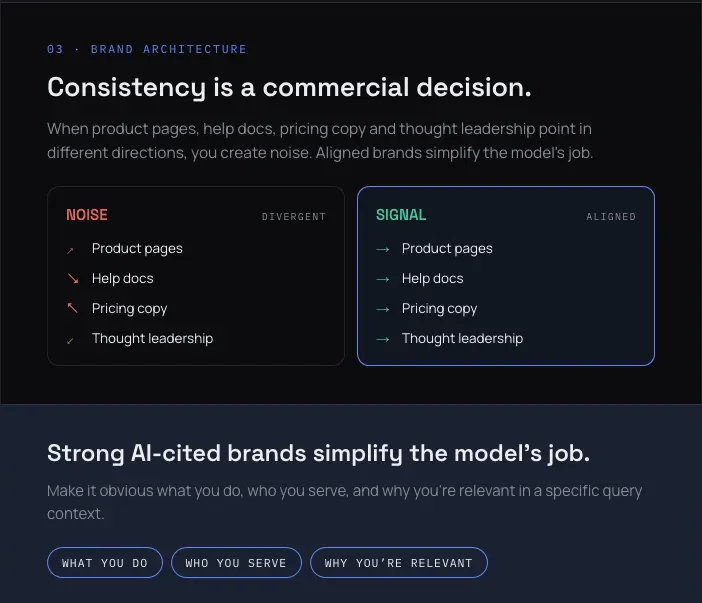
This is also where brand architecture becomes commercial. If your product pages, help docs, pricing copy and thought leadership all point in different directions, you create noise. Strong AI-cited brands simplify the model’s job. They make it obvious what they do, who they serve and why they are relevant in a specific query context.
Freshness helps, but relevance wins
There is a common assumption that newer content automatically gets cited more often. Sometimes it does, particularly in fast-moving categories like software, regulation or AI itself. But freshness on its own is overrated.
A highly relevant page published eighteen months ago can still outperform a fresh page that says very little. AI systems want useful, attributable source material. If your content is current but shallow, it will not carry much weight. If it is older but specific, well structured and still accurate, it can remain citation-worthy.
The real priority is maintenance. Brands that update key commercial and informational pages regularly tend to perform better than brands that publish constantly but rarely revisit their core assets. Product comparisons, service pages, glossary definitions, benchmark studies and category explainers all benefit from ongoing refinement.
Structure influences whether a source can be used
AI engines are not reading your site the way a human does. They are extracting passages, weighing snippets and trying to identify the cleanest source for a claim. That makes structure a performance variable.
Pages with vague headings, bloated intros and buried answers often underperform. Pages that lead with a direct answer, then expand with context and proof, are easier to cite. The same applies to schema, table formatting, FAQ blocks when genuinely useful, and concise definitions near the top of the page. Good structure reduces friction.
There is a trade-off here. Over-optimised content can become stiff, repetitive and obviously written for systems instead of people. That tends to weaken trust and engagement. The goal is not mechanical formatting. The goal is clarity with substance.
Authority is distributed, not isolated
One of the biggest mistakes brands make is treating their website as the only battlefield. AI citations are often influenced by distributed authority. Your site matters, but so do the places that mention, review, compare and contextualise your brand.
That means digital PR, category listings, expert roundups, earned media, industry reports and even consistent profile data can all contribute to citation likelihood. If your competitors are referenced across the web in commercially relevant contexts and you are not, they may become the default answer even when your product is stronger.
This is where many teams misread the market. They look at brand search demand or organic rankings and assume visibility is secure. But generative engines compress the journey. The system may cite whichever brand has the clearest and most reinforced footprint, not the brand with the biggest ad budget.
Query intent changes citation behaviour
Not every query produces citations in the same way. Informational prompts often reward educational depth. Commercial prompts may favour comparison pages, reviews and category summaries. Local or service-based prompts may draw more heavily on business listings, regional landing pages and reputation signals.
So when teams ask why they are not being cited, the right follow-up is: for which prompts? A brand might perform well for category definitions but disappear on best-software queries. It might dominate on product-specific questions but lose ground on use-case prompts. AI citation performance is uneven by intent.
That is why measurement matters. You need to know where citation gaps exist, which competitors own those prompts and which content formats are repeatedly selected. Without that visibility, optimisation turns into guesswork.
Trust signals still matter – just differently
Traditional authority signals have not vanished. They have been reframed. Backlinks still matter indirectly because they often correlate with discoverability and authority. Reviews matter because they reinforce reputation. Expert authorship, original data, transparent policies and strong documentation all help establish credibility.
What has changed is how these signals are combined. AI systems are not simply scoring a page. They are evaluating whether a source deserves to support an answer. That raises the bar for accuracy and consistency.
If your site makes inflated claims, hides specifics or lacks supporting detail, you create risk. Safer sources tend to win. In AI search, boringly credible often beats loudly promotional.
How to improve the signals behind AI citations
The fastest gains usually come from tightening a small number of high-value assets rather than producing dozens of low-quality pages. Start with the prompts that matter commercially. Then inspect which sources are being cited, what format those sources use and what evidence they provide.
From there, improve the pages most likely to compete. Clarify the primary topic of each page. Make the answer obvious early. Add specifics, examples, product facts, use cases and proof points. Remove fluff. Align terminology across site sections. Strengthen third-party validation where your market expects it.
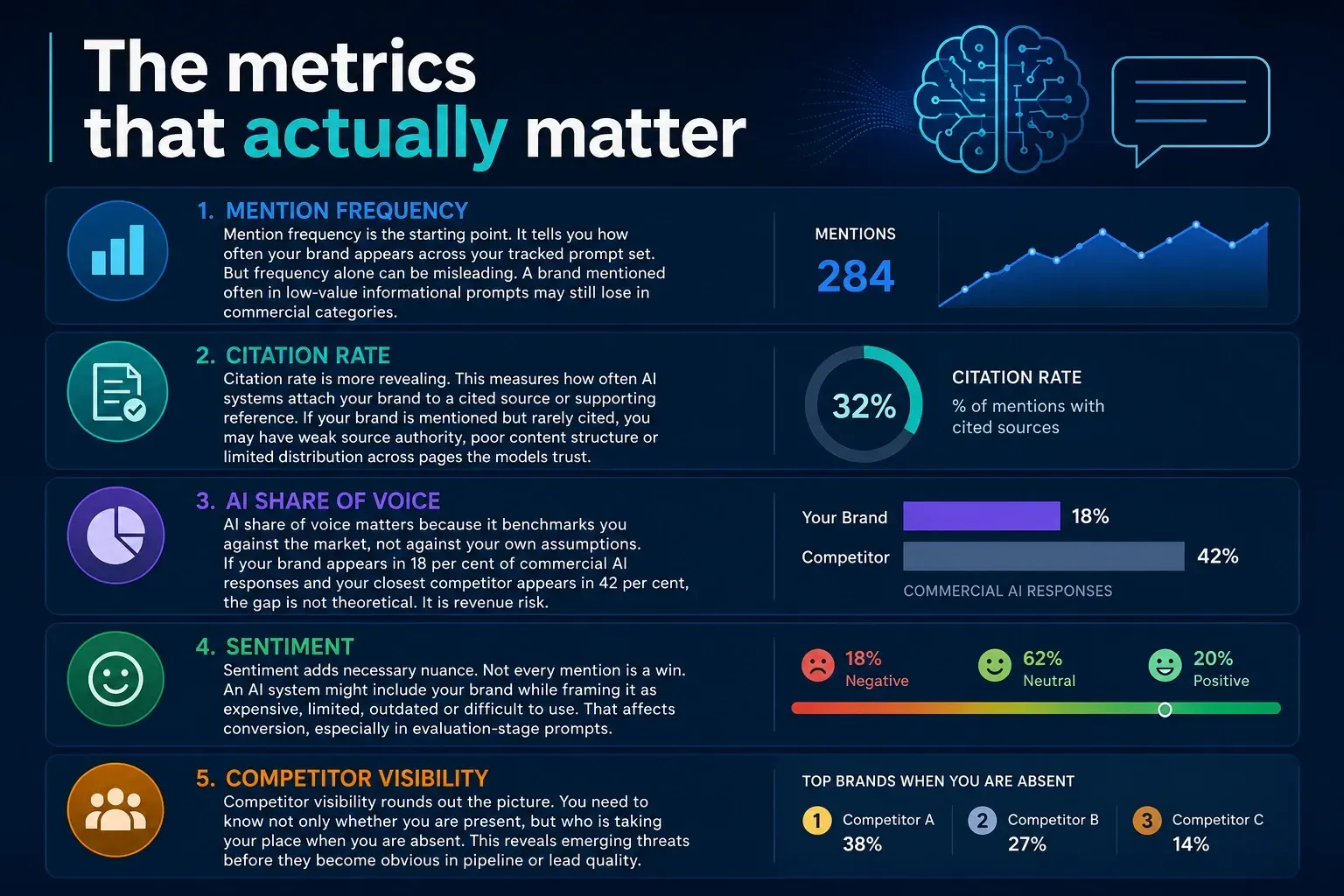
This is also where operational discipline becomes an advantage. Teams that monitor mention frequency, citation rate, sentiment, AI share of voice and competitor movement can prioritise with confidence. Instead of asking whether content is good, they can ask whether it changes visibility.
For many brands, that is the real unlock – not more content, but a clearer roadmap. Platforms like aigeo insights exist because GEO is now measurable. Once you can see which assets influence AI citations and where competitors are winning, optimisation becomes commercial strategy rather than content theatre.
The brands that win make themselves easy to cite
There is no single lever behind AI citations, and anyone selling one should be treated carefully. What drives AI citations is the combined strength of clarity, relevance, corroboration, structure and trust across your owned and earned presence. The brands that win are not always the loudest. They are the easiest to understand, verify and use.
That is the opportunity in front of marketers right now. Not to chase every platform tweak, but to build a brand footprint that AI systems can recognise with confidence. When your content is precise, your entity is clear and your proof exists beyond your own site, citations stop being random. They start becoming a repeatable advantage.
The battle for the answer is already under way, and the brands that move first will shape what the market hears next.
Related Posts
- How to Increase AI Citations and Win AI Search
Learn how to increase AI citations with content, entity signals and measurement that put your brand in more AI-generated answers…
Read more - ChatGPT Brand Monitoring That Drives Action
ChatGPT brand monitoring shows how often, where and why your brand appears in AI answers - so you can improve…
Read more - AI Citation Tracking Software That Wins Answers
AI citation tracking software shows where your brand appears in AI answers, which competitors are cited, and what to improve…
Read more