





If your brand is showing up on page one but disappearing inside AI answers, you have a visibility problem that standard search reporting will not catch. That is exactly why marketers now need to know how to measure brand visibility across both traditional search and generative platforms, because the battle has shifted from ranking on a results page to becoming part of the answer itself.
This change is not theoretical. Buyers are asking ChatGPT for vendor shortlists, checking Google AI Overviews for product recommendations, and using Perplexity to compare options before they ever reach your site. If your competitors are mentioned more often, cited more clearly, or framed more positively, they are winning attention before the click even happens.
What brand visibility actually means now
Brand visibility used to be relatively straightforward. You tracked impressions, rankings, branded search volume, media mentions, and maybe social reach. Those metrics still matter, but they no longer tell the full story.
In AI search, visibility means whether your brand appears in generated responses, how often it appears compared to competitors, whether the platform cites your site or a third-party source, and what kind of sentiment surrounds the mention. A brand can have strong SEO performance and still be nearly invisible in AI outputs. It can also have decent mention frequency but weak commercial positioning if AI platforms mention it as an afterthought rather than a preferred option.
That is the first shift to understand. Visibility is no longer just about being found. It is about being selected, cited, and described in ways that influence action.
How to measure brand visibility with the right metrics
If you want a useful measurement system, stop looking for one silver bullet metric. Brand visibility is a blend of presence, prominence, sentiment, and competitive position. The goal is to build a view that shows not only whether you appear, but whether your visibility is strong enough to drive preference.
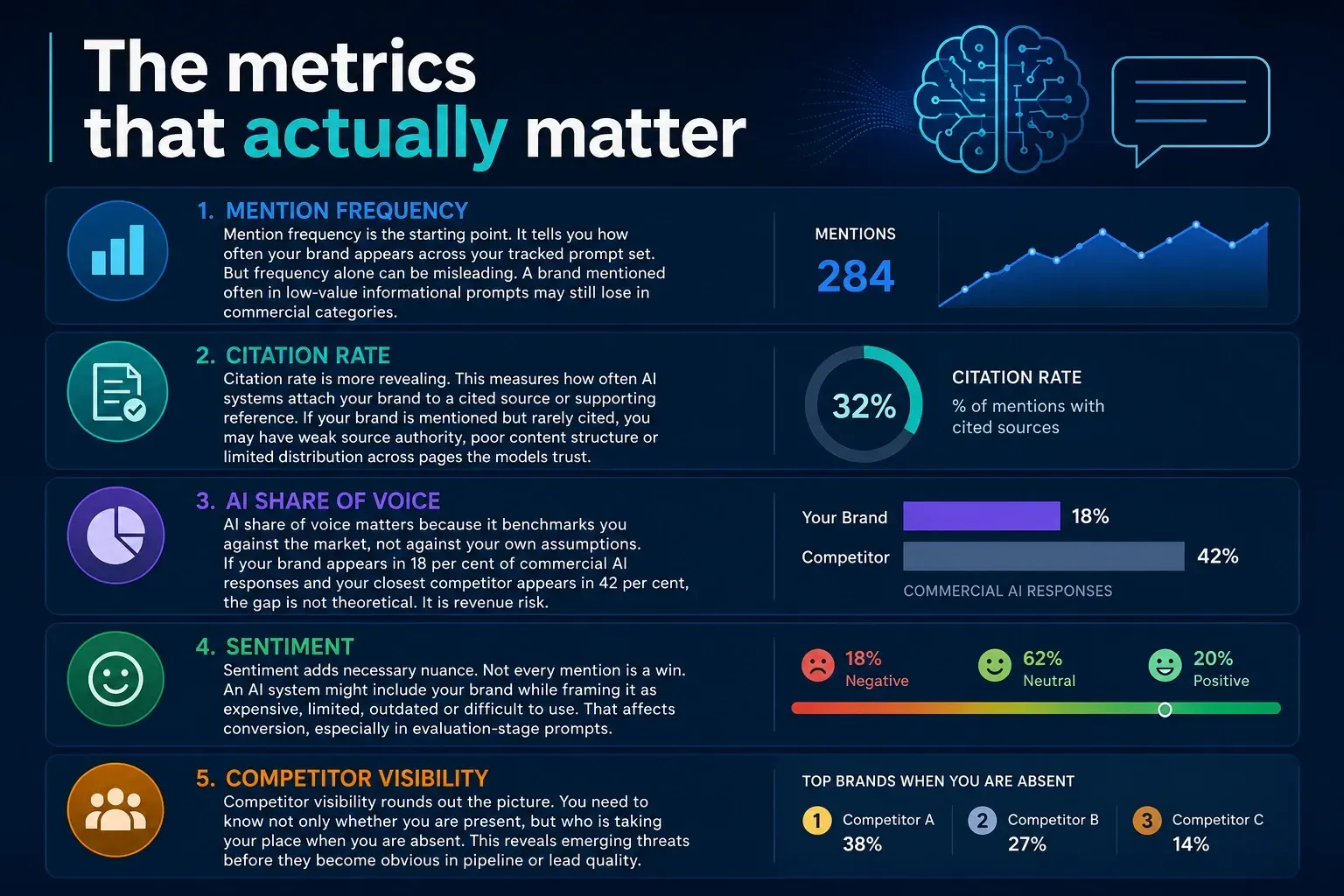
Brand mention frequency
Start with the simplest question: how often is your brand mentioned across the prompts that matter to your market?
This gives you a baseline for presence. If someone asks an AI platform for the best project management tools, top accounting software for small business, or leading agencies in your category, does your brand appear at all? And if it does, how consistently?
Mention frequency matters because a one-off appearance is not a pattern. You want repeated inclusion across commercial, informational, and comparative prompts. The trade-off is that mention count alone can flatter weak performance. A brand can be mentioned often but framed negatively or listed low in the response.
AI share of voice
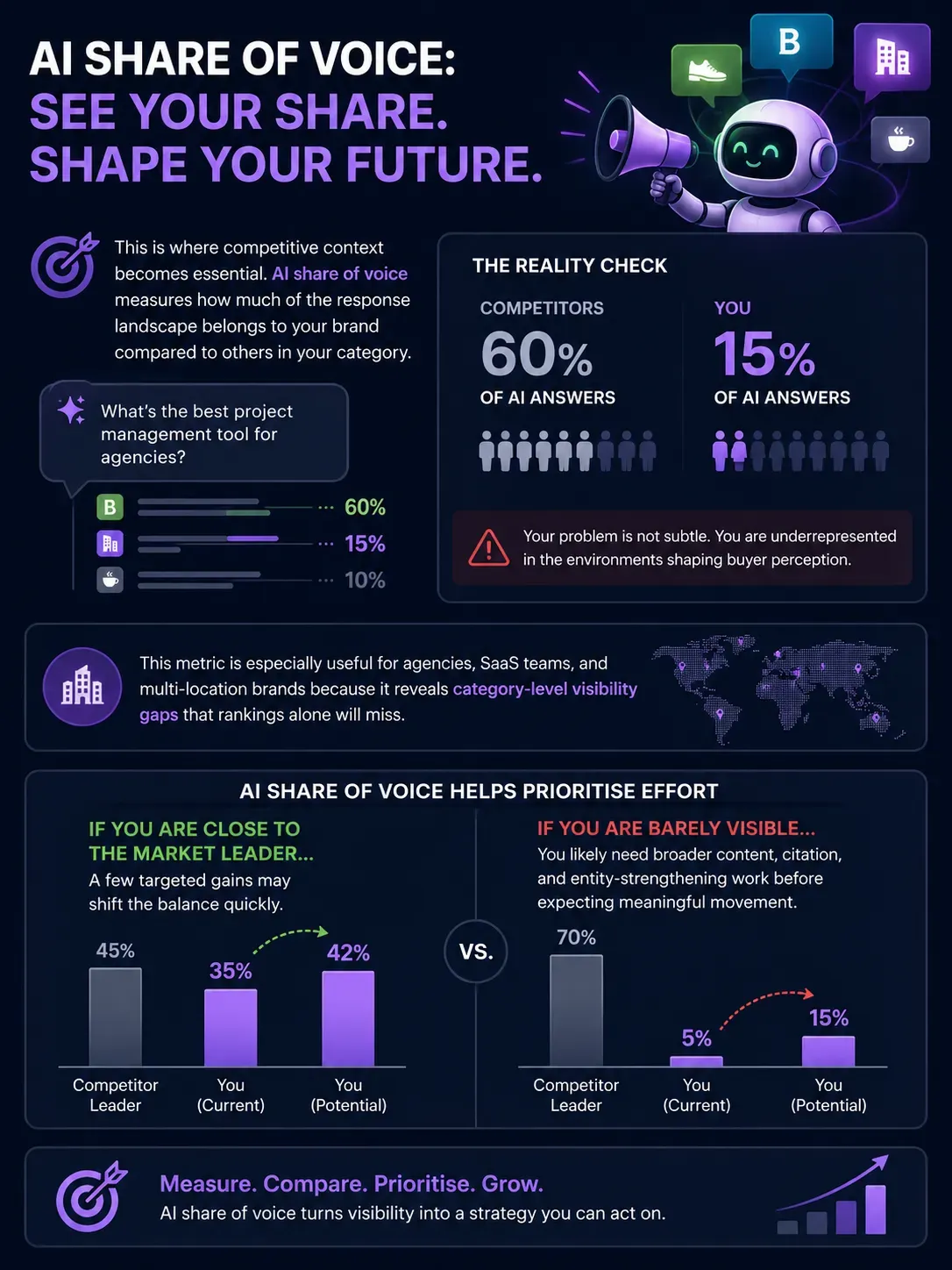
This is where competitive context becomes essential. AI share of voice measures how much of the response landscape belongs to your brand compared to others in your category.
If competitors appear in 60 per cent of relevant AI answers and you appear in 15 per cent, your problem is not subtle. You are underrepresented in the environments shaping buyer perception. This metric is especially useful for agencies, SaaS teams, and multi-location brands because it reveals category-level visibility gaps that rankings alone will miss.
AI share of voice also helps prioritise effort. If you are close to the market leader, a few targeted gains may shift the balance quickly. If you are barely visible, you likely need broader content, citation, and entity-strengthening work before expecting meaningful movement.
Citation rate
Being mentioned is good. Being cited is better.
Citation rate measures how often AI platforms reference your owned assets when they mention your brand. This matters because citations signal source trust, improve traffic potential, and usually indicate stronger alignment between your content and the model’s answer generation.
A low citation rate can mean your brand is being picked up from review sites, directories, forums, or other third-party sources instead of your own content. That creates risk. You lose control over positioning, proof points, and message accuracy. If AI platforms talk about your brand but rarely cite your site, visibility exists, but authority is leaking elsewhere.
Sentiment and framing
Not every mention helps you. You need to know whether AI systems describe your brand positively, neutrally, or negatively, and which attributes they attach to your name.
For example, if your brand is regularly mentioned as affordable but not enterprise-ready, that framing influences buyer expectations. If you are constantly linked to reliability, innovation, or strong support, that is a visibility advantage with commercial weight.
Sentiment analysis in AI search needs nuance. Models often use mixed or indirect language, so do not reduce everything to a simplistic positive or negative score. Look at the themes around your brand. What benefits are repeated? What objections keep surfacing? Which competitors are positioned as stronger alternatives, and why?
Platform-specific performance
You cannot treat AI visibility as one channel. ChatGPT, Claude, Gemini, Perplexity, and Google AI Overviews do not behave the same way.
Some platforms rely more heavily on web citations. Others synthesise broader patterns from their training and retrieval layers. That means your brand may perform strongly in one environment and weakly in another. If you only look at an aggregate visibility score, you can miss the operational reality.
Platform-level measurement helps you pinpoint where to act. If Gemini frequently cites publisher content in your category, digital PR and structured thought leadership may matter more there. If Perplexity rewards detailed, source-rich pages, then content depth and citation-friendly formatting become more urgent.
The inputs that actually influence visibility
Once measurement is in place, the next question is obvious: what drives these numbers up or down?
The biggest factors are usually content relevance, entity clarity, citation strength, brand consistency, and competitive saturation. AI systems need enough high-quality signals to understand what your brand does, when it should be recommended, and why it belongs in the answer.
That means your measurement model should not stop at reporting outcomes. It should connect visibility shifts to the assets behind them. Which pages are cited most often? Which topics generate mentions? Which formats underperform? Are your comparison pages being used? Are your category pages too thin? Are competitors being referenced because they have clearer proof, stronger definitions, or better distributed content?
This is where many teams get stuck. They collect visibility data but cannot turn it into a prioritised action plan. A useful system closes that gap by linking metrics to specific GEO tasks, such as updating category pages, improving entity signals, publishing sourceable research, tightening page structure, or strengthening third-party corroboration.
How to measure brand visibility consistently
Consistency matters more than snapshots. AI outputs shift based on model updates, retrieval changes, trending sources, and prompt framing. If you only check visibility occasionally, you will misread the market.
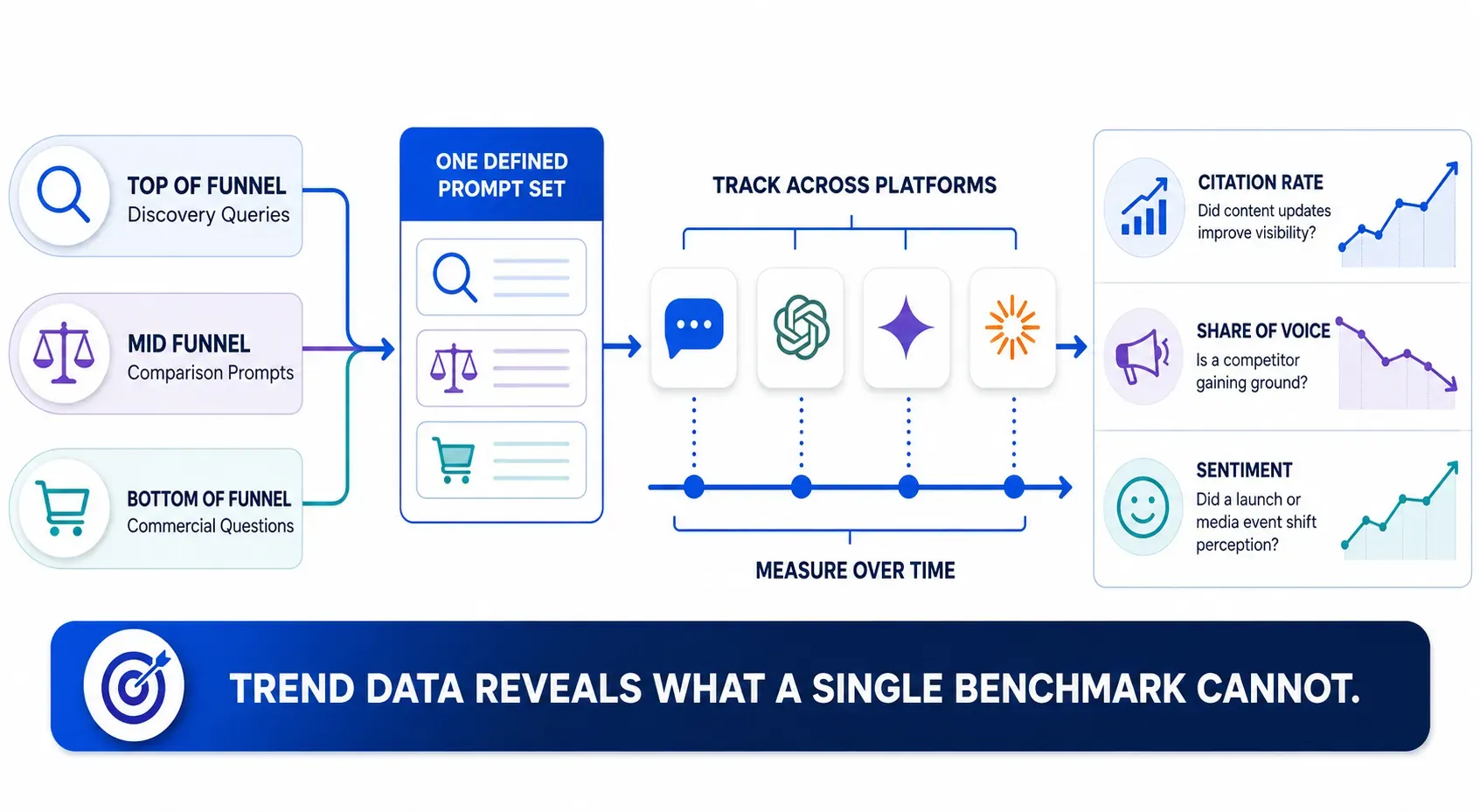
Build measurement around a defined prompt set that reflects real buyer behaviour. Include top-of-funnel discovery queries, mid-funnel comparison prompts, and bottom-of-funnel commercial questions. Then track the same set across platforms over time.
This gives you trend data, which is far more valuable than a single benchmark. You can see whether a content update improved citation rate, whether a competitor is gaining share of voice, or whether sentiment changed after a product launch or media event.
It also keeps teams honest. Without a repeatable measurement framework, visibility conversations become anecdotal. Someone pastes one AI response into Slack, everyone panics, and no one knows whether the issue is real or isolated. A structured tracking system removes that noise.
What good measurement looks like in practice
A strong brand visibility framework answers five commercial questions clearly. Are we being mentioned in the prompts that influence revenue? Are we being cited from the assets we control? Are we gaining or losing AI share of voice against direct competitors? Is sentiment helping or hurting conversion? And which actions are most likely to improve the next reporting cycle?
That final question matters most. Measurement without action is just expensive observation.
This is why the sentimentstack platform designed by aigeo insights are gaining traction. The market does not need more dashboards that tell you you have a problem. It needs systems that identify where visibility is weak, which competitors are outranking you inside AI answers, and what to fix first to win back ground.
The mistake to avoid
The biggest mistake is treating AI visibility like a rebranded SEO report. It is related to search, but it is not the same game.
Rankings still matter. Traffic still matters. Branded demand still matters. But if buyers are increasingly making decisions inside generated answers, then visibility has to be measured where those decisions are being shaped. That means tracking mentions, citations, share of voice, sentiment, and platform-specific performance as a connected system, not as disconnected vanity metrics.
Brands that do this early will build an advantage that compounds. They will understand where they are trusted, where they are absent, and where competitors are taking the answer before the click. Everyone else will keep reading traditional reports while the market shifts under their feet.
The smartest move now is simple: measure visibility where the buyer is actually looking, then act faster than the brands still pretending this shift can wait.
Related Posts
- What an AI Search Visibility Tool Should Do
See what an AI search visibility tool should track, why rankings miss the point, and how brands can lift citations,…
Read more - How to Track Brand Mentions in AI Search
Learn how to track brand mentions in AI search, measure AI share of voice, citations, sentiment and competitor visibility across…
Read more - AI Brand Visibility Tracker Explained
See how an AI brand visibility tracker measures mentions, citations, sentiment and share of voice so brands can win more…
Read more