





A prospective customer asks ChatGPT for the best payroll platform, a trusted cyber security provider, or a local accounting firm. The answer names three brands. If yours is missing, a first-page Google ranking may not save the opportunity. AI citation tracking software gives growth teams a way to see that loss, measure its commercial impact and respond before competitors turn AI visibility into market share.
The battle for the answer has begun. Generative search platforms do not simply display a page of blue links for users to compare. They synthesise an answer, select sources and often frame a small group of companies as credible options. That shift changes what marketers need to monitor. Rankings still matter, but being cited, mentioned and favourably described inside AI responses is now a separate performance channel.
What AI citation tracking software must measure
A useful platform does more than count brand mentions. A mention can be neutral, accidental or even negative. It can also appear in an answer that has little buying intent. The goal is to understand whether your brand is being chosen as an authority when a customer asks questions that influence consideration, selection and purchase.
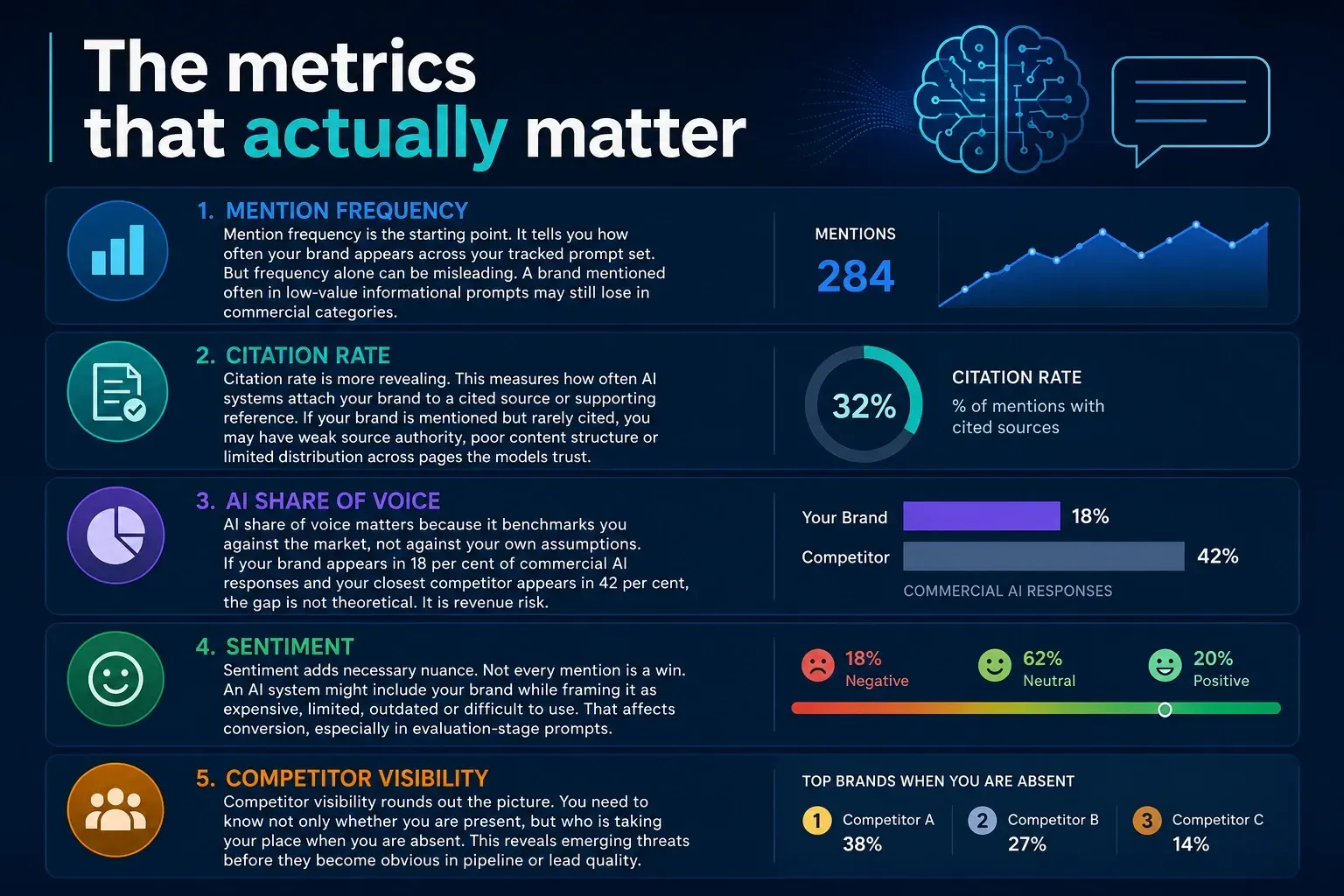
Start with citation rate. This shows how often AI systems reference your owned content or other sources that substantiate claims about your brand. A low citation rate may signal that your material is difficult for models to interpret, lacks supporting evidence or is being outperformed by competitor content and third-party sources.
Then measure AI share of voice. This compares your visibility with the businesses you actually compete against across a defined set of prompts. It answers the question that matters in the boardroom: when buyers ask AI for recommendations in our category, how often are we part of the answer?
Sentiment adds the necessary context. A brand may be regularly mentioned because customers ask about complaints, price disputes or product limitations. Tracking whether AI describes your company as trusted, specialist, expensive, innovative or difficult to use helps teams protect reputation as well as reach.
Platform-level reporting is equally important. ChatGPT, Claude, Gemini, Perplexity and Google AI Overviews do not retrieve, evaluate or present information in identical ways. Your brand could lead on one platform and disappear on another. Combining every result into one headline figure hides the strategic work required to close those gaps.
The core metrics should include:
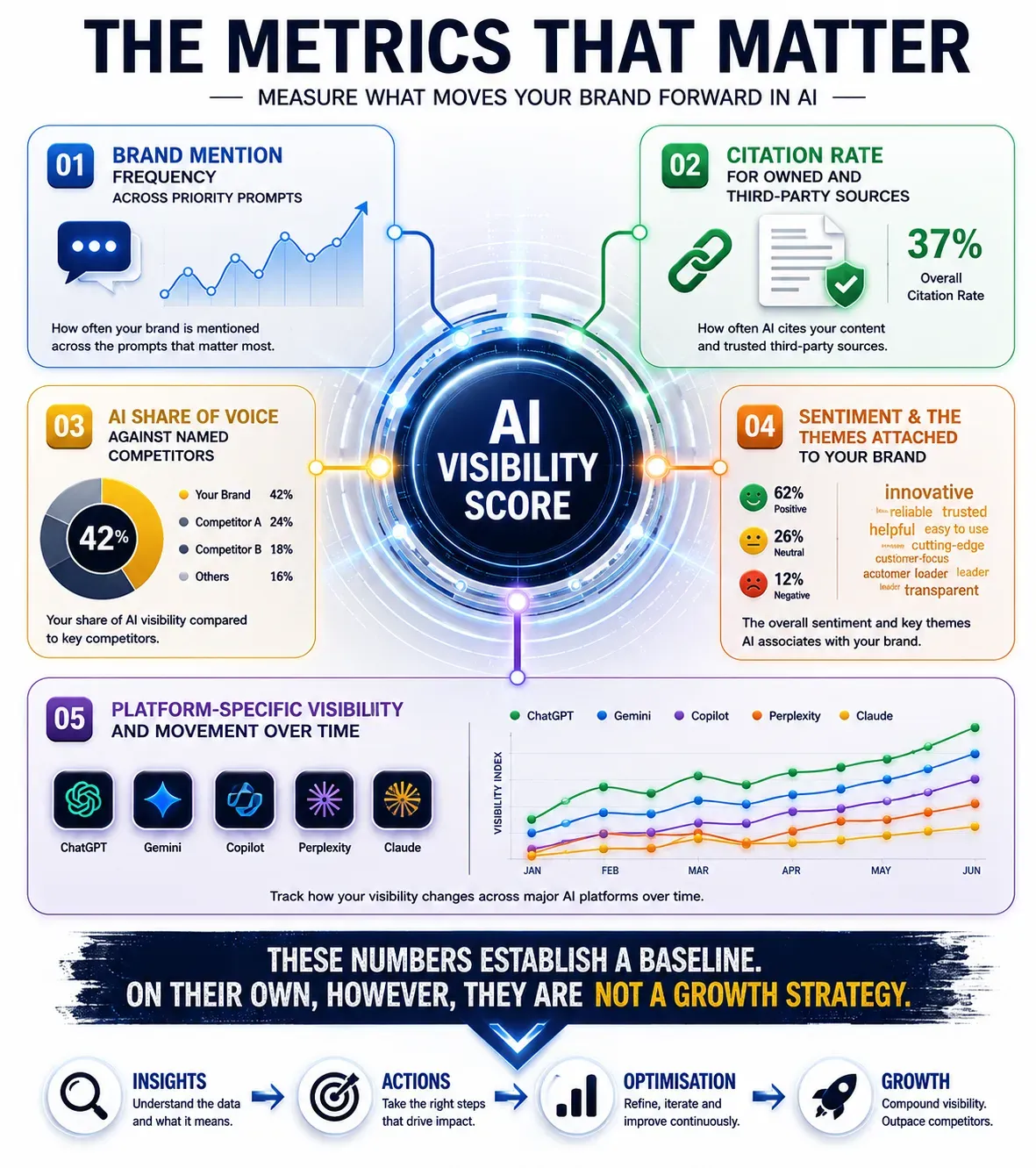
- brand mention frequency across priority prompts
- citation rate for owned and third-party sources
- AI share of voice against named competitors
- sentiment and the themes attached to your brand
- platform-specific visibility and movement over time
These numbers establish a baseline. On their own, however, they are not a growth strategy.
Tracking is only valuable when it creates action
Many teams already have dashboards. Their problem is not a lack of charts. It is the delay between spotting a visibility issue and knowing what to do about it.
If a competitor is cited for a topic you want to own, the right response is rarely to publish another generic blog post. First, inspect the prompt, the answer structure and the sources being selected. The competitor may have a direct comparison page, a well-supported methodology, current pricing information, original research or stronger third-party validation. The visibility gap is a clue about the asset you need to build or improve.
This is where AI citation tracking software should become an optimisation system. It should identify the queries where your brand is absent, show the competitors gaining ground and translate evidence into prioritised tasks. For example, it may reveal that product pages are cited for high-intent questions while your educational articles dominate only broad awareness queries. That is not a content volume problem. It is a commercial content gap.
A productive roadmap may recommend updating outdated claims, adding clear entity information, publishing expert-led comparison content, strengthening evidence on key pages or earning relevant mentions from credible publishers and industry sources. Each task should be tied to a prompt cluster, visibility opportunity and expected value. Otherwise, GEO becomes another vague marketing initiative that nobody owns.
Build your monitoring around buying questions
The quality of your reporting depends on the quality of your prompt set. Tracking random questions that contain your category keyword produces noisy data and a false sense of progress. Build prompt groups around the decisions real buyers make.
For an agency, that may include questions such as which performance marketing partner suits a growing ecommerce brand, how to compare agency pricing models, or what capabilities matter when choosing a paid media provider. For a B2B software company, prompts could focus on alternatives, integration requirements, security concerns, implementation timeframes and fit by company size.
Include branded prompts, non-branded discovery prompts, comparison prompts and problem-based prompts. Branded queries show how accurately AI represents your company. Non-branded queries reveal whether you are winning category demand before a buyer knows your name. Comparison and alternative queries are often the most commercially important because the customer is already evaluating options.
Prompt design should reflect Australian search behaviour and your real service area. An Australian buyer may ask for local compliance expertise, local support hours, Australian pricing or providers that understand a specific industry. If you sell nationally, test state and city modifiers where they affect intent. If you serve a narrow niche, use the language your buyers use, not only the language your internal team prefers.
Read the gaps, not just the score
A rising AI share of voice is encouraging, but the most valuable insight often sits beneath the average. Look for patterns in where and why results change.
If your visibility drops after a competitor publishes an extensive guide, it may indicate a content depth or freshness issue. If AI mentions your brand but does not cite your website, your entity reputation may be stronger than your owned content. That can be useful, but it also means you have limited control over how the story is told.
If your brand appears in recommendation answers but with cautious wording, investigate the source material behind the caveat. AI can surface old reviews, outdated policies and inconsistent descriptions long after a business believes the issue has been resolved. Marketing, product, customer success and PR may all need to contribute to the fix.
Do not overreact to a single answer. Generative platforms can vary by model version, location, query wording and available sources. The signal comes from repeatable patterns across a well-defined prompt set. Track movement over time, monitor the same competitors and focus on material changes in high-value question groups.
Choose software that supports GEO decisions
The market will fill with tools that promise an AI visibility score. Treat a score as the start of the conversation, not the purchase criterion. The stronger choice is software that makes the underlying evidence accessible and converts it into decisions your team can execute.
Look for reliable prompt tracking across the AI platforms your audience uses, competitor benchmarking, source-level citation analysis, sentiment context and clear reporting by topic. Make sure the platform can separate your most valuable questions from low-intent noise. A tool that treats a generic informational query the same as a high-conversion comparison query will distort priorities.
Also assess how quickly the platform turns a finding into a workflow. Can your content team see which pages need revision? Can an agency explain movement to a client without manual spreadsheet work? Can leadership understand whether increased mentions are positive, defensible and connected to commercial intent? The answers determine whether monitoring becomes operational or remains a monthly report.
aigeo insights is built around this distinction: visibility intelligence should lead to a dynamic optimisation roadmap, not a passive dashboard. For teams competing in crowded categories, that connection between measurement and action is where the advantage is created.
Make AI visibility a regular growth discipline
AI search is not a channel to check once per quarter. Competitors publish new material, platforms change their retrieval behaviour and the information that shapes answers evolves constantly. Set a regular review cadence, but reserve deeper analysis for major shifts in share of voice, sentiment or citations on high-intent prompts.
Assign ownership as well. SEO can lead the measurement, but content teams need to create the assets, product teams need to validate claims and brand teams need to ensure the resulting representation is accurate. Agencies should bring the same discipline to AI visibility that they bring to search reporting: baseline performance, identify opportunities, execute improvements and prove the movement.
The brands that win AI answers will not be the ones with the loudest claims about artificial intelligence. They will be the ones that consistently give generative systems clear, credible and current reasons to cite them. Start by measuring the answers buyers see, then make every visibility gap a specific piece of work your team can own.
Related Posts
- How to Increase AI Citations and Win AI Search
Learn how to increase AI citations with content, entity signals and measurement that put your brand in more AI-generated answers…
Read more - What Drives AI Citations for Brands?
What drives AI citations? Learn which content, signals and entity factors shape brand visibility in AI answers and how to…
Read more - Competitor Tracking in Generative Search
Your competitors can outrank you without ranking above you. That is the shift most teams still underestimate. Competitor tracking in…
Read more