A brand can appear in AI answers every day and still lose the market. That sounds backwards until you look at citation rate in AI search. Mentions are nice. Citations are stronger. If your brand is named but not used as a source, you are visible without being trusted, and in AI search that gap matters.
For marketers, SEOs, agencies, and growth teams, this metric is quickly becoming one of the clearest signals of whether a brand is actually influencing the answer. AI platforms do not just retrieve links. They synthesise, rank, interpret, and decide which sources deserve to support the response. That means the brands winning AI search are not always the ones with the most traffic, the biggest budget, or even the highest rankings in classic search. They are often the ones the model repeatedly treats as citable.
What citation rate in AI search actually measures
Citation rate in AI search measures how often your brand, site, or content is cited within AI-generated answers relative to how often it could have appeared across a defined set of prompts, topics, or platform queries. Put simply, it tells you how frequently AI systems choose your content as evidence.
That distinction matters. A brand mention tells you that the model knows you exist. A citation tells you the model sees your content as useful enough to reference when constructing an answer. In a generative environment, that is a much stronger commercial position.
The exact calculation can vary depending on the tracking method. Some teams measure citations per 100 prompts. Others track citations by topic cluster, intent type, or platform. The right method depends on your goals. If you only sell in one category, broad averages can hide performance gaps. If you compete across multiple service lines, a blended citation rate may look healthy while your highest-margin offering is barely being referenced.
Why this metric matters more than simple visibility
A lot of businesses still treat AI visibility as a volume game. They ask whether they are being mentioned by ChatGPT, Gemini, Claude, Perplexity, or Google AI Overviews. That is a start, but it is not enough.
Citation rate tells you whether your visibility has weight. A passing mention can disappear in the next answer variation. A citation usually indicates the model found a document, domain, or content asset worth grounding the response in. That affects credibility, repeat appearance, and downstream traffic potential.
It also changes how you think about performance. If a competitor is cited twice as often as you on commercial prompts, they are not just louder. They are shaping the buyer’s frame of reference. In practical terms, they are more likely to become the default recommendation.
This is why the battle for the answer has begun. Traditional rankings still matter, but they no longer tell the whole story. In AI search, the question is not only whether you rank. It is whether you are the source the model trusts enough to cite.
What a strong citation rate in AI search looks like
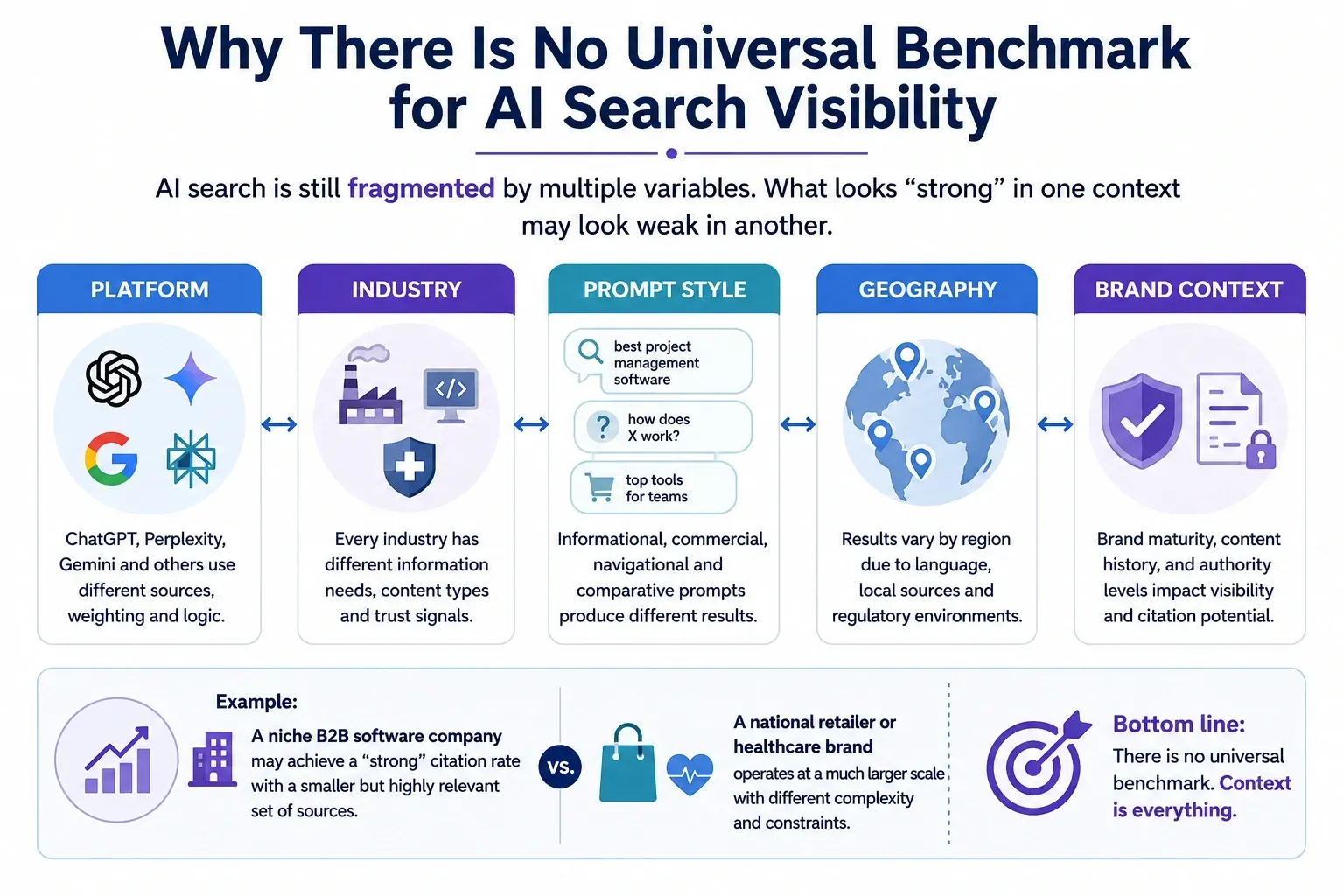
There is no universal benchmark because AI search is still fragmented by platform, industry, prompt style, and geography. A strong citation rate for a niche B2B software company will not look the same as one for a national retailer or a healthcare brand with strict content constraints.
What matters more is relative strength. Are you being cited more often than key competitors on high-intent prompts? Are you improving month on month across the topics that drive pipeline? Are citations concentrated on a few pages, or distributed across your commercial and informational content?
A healthy pattern usually includes three signals. Your brand is cited consistently across multiple AI platforms. Your citation share holds up on both broad and specific prompts. And your citations map to content that supports real commercial outcomes, not just vanity visibility.
If your rate is high on top-of-funnel educational prompts but weak on comparison, solution, or purchase-intent queries, you have awareness without conversion power. That is useful to know, but it is not winning.
Why some brands get mentioned but not cited
This is where many teams get caught. They assume brand awareness will naturally convert into AI citations. It often does not.
Models cite sources for a reason. The content tends to be clearer, more structured, more directly aligned to the question, and easier to extract factual support from. Pages that are vague, bloated, overly promotional, or thin on substance are less likely to be used as grounding material.
Authority also plays a role, but not in the simplistic way many people assume. A strong domain can help, yet AI systems also respond to content quality, entity clarity, topic depth, and consistency across the web. A smaller brand with tight, well-structured content can outperform a bigger player whose site is messy or generic.
There is also a formatting problem. Plenty of websites publish decent information but bury it under weak headings, muddled page intent, duplicated copy, or unclear authorship. Humans might tolerate that. AI systems are less forgiving when deciding what to extract and cite.
The main factors that influence citation rate
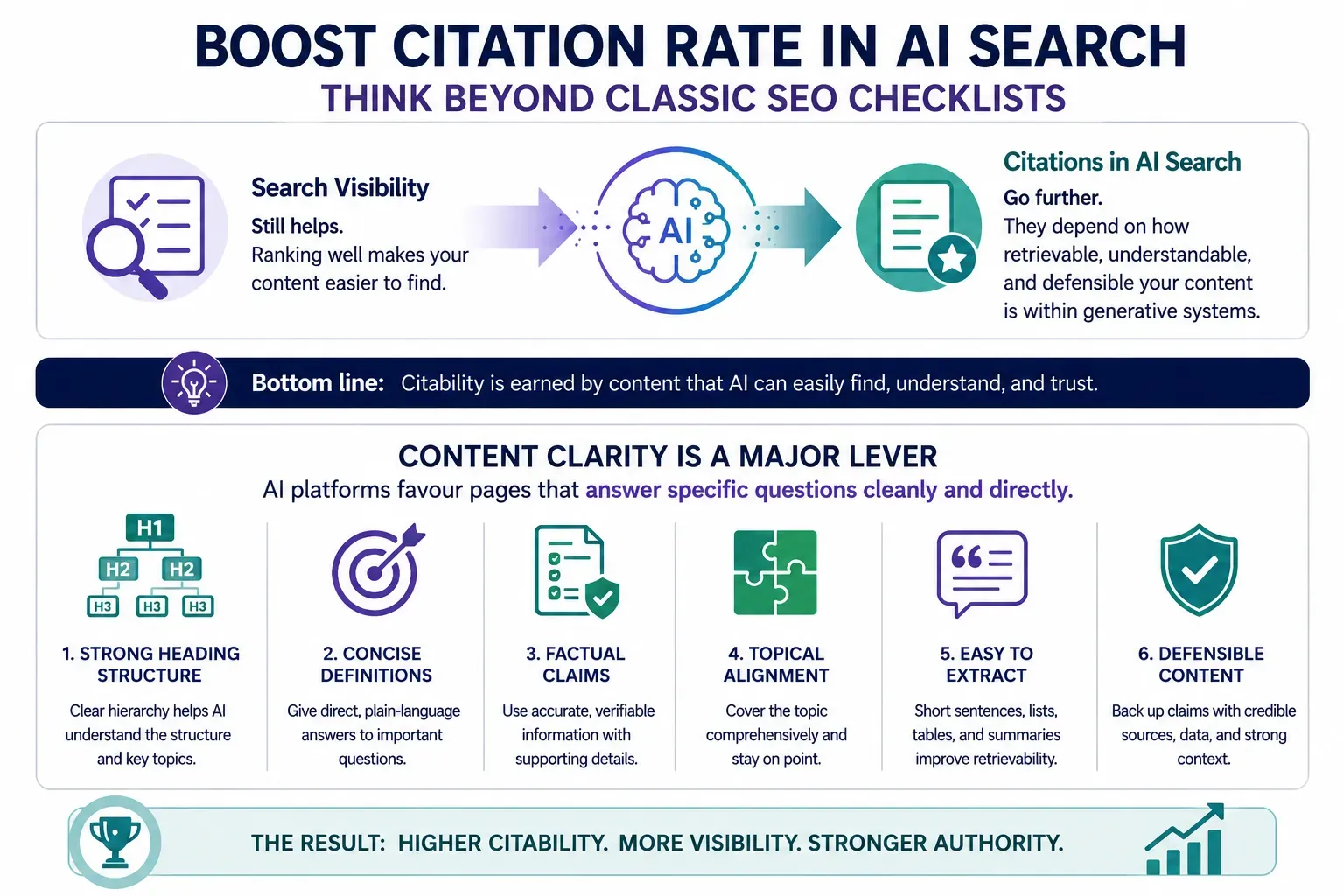
If you want to improve citation rate in AI search, you need to think beyond classic SEO checklists. Search visibility still helps, but citations are shaped by how retrievable, understandable, and defensible your content is within generative systems.
Content clarity is a major lever. AI platforms favour pages that answer specific questions cleanly and directly. Strong heading structures, concise definitions, factual claims, and obvious topical alignment all improve the odds of being cited.
Coverage depth matters too. Thin pages rarely become dependable sources. If your content only skims the surface, the model may mention your brand but rely on another site for evidence. The goal is not word count for its own sake. It is informational completeness.
External reinforcement is another factor. If your brand, product claims, expertise, and category relevance are supported across third-party sources, AI models have more confidence in your legitimacy. That does not mean chasing random mentions. It means building a credible, consistent footprint.
Freshness can help, but it depends on the topic. For fast-moving areas like software, finance, or AI itself, recent updates carry more weight. For evergreen topics, structure and authority may matter more than recency alone.
How to improve your citation rate without guessing
The fastest way to waste budget in GEO is to optimise blindly. If you do not know which prompts, platforms, and content assets influence your citation rate, you end up making random changes and hoping for lift.
Start with measurement. Track citation performance by platform, topic, competitor set, and intent level. You need to know where you are being cited, where you are absent, and where competitors are outrunning you. Broad averages hide too much.
Then look at the assets behind the performance. Which pages are earning citations? Which are close but not quite there? Which prompts trigger competitor citations instead of yours? That analysis usually reveals a pattern. Sometimes you need stronger category pages. Sometimes the gap is comparative content, expert explainers, or more explicit schema and page structure.
From there, prioritise actions that can move the metric, not just tidy the site. Rework content that already has topical relevance but weak extractability. Expand pages that answer the right question too shallowly. Build supporting assets around the prompt themes where AI systems already show demand.
This is where a platform-driven approach matters. Tools that only tell you your brand was or was not mentioned are not enough. You need a system that translates citation data into an optimisation roadmap – what to create, what to update, what to consolidate, and where competitors are taking answer share. That is the difference between passive reporting and actual GEO execution.
Common mistakes teams make
One mistake is chasing mentions instead of influence. A brand can inflate visibility numbers with broad awareness content and still fail to win high-value citations.
Another is treating all AI platforms as the same. They are not. Perplexity, ChatGPT, Gemini, Claude, and Google AI Overviews can behave differently in sourcing, answer composition, and citation patterns. If your strategy ignores those differences, your gains may not transfer.
The third mistake is assuming SEO success automatically becomes AI search success. There is overlap, but not equivalence. Many high-ranking pages were built for clicks, not for extraction into AI answers. Those are different jobs.

Citation rate is becoming a boardroom metric
This metric is moving beyond the SEO team. As more discovery shifts into generative interfaces, citation rate starts affecting brand preference, lead quality, and competitive positioning. If the AI answer names your competitor as the source of truth, that has commercial consequences long before a click ever happens.
That is why serious teams are starting to treat citation rate as part of their market intelligence stack, not just a niche search metric. It helps explain who owns authority in AI search, where trust is being assigned, and which content investments are actually changing visibility.
For brands that want to dominate AI search, the takeaway is direct. Stop asking whether AI can see you. Start asking whether it trusts you enough to cite you. That is where the real fight is, and the brands that act on that signal early will shape the answer before everyone else realises the answer is the market.
Related Posts
- Generative Search Strategy for Marketers
Build a generative search strategy for marketers that measures AI visibility, earns citations and turns competitive insights into practical, fast…
Read more about Generative Search Strategy for Marketers - Citation-Worthy Content Planning Guide for AI Search
Use this citation worthy content planning guide to build AI-ready assets, measure gaps, and earn more brand mentions in generative…
Read more about Citation-Worthy Content Planning Guide for AI Search - Citation Tracking Platforms for AI Search
Citation tracking platforms show where AI engines source, mention and recommend your brand, then turn lost visibility into a clear…
Read more about Citation Tracking Platforms for AI Search