A competitor starts appearing in ChatGPT answers for your core category, and your team does not notice until pipeline softens. That is the real risk ChatGPT brand monitoring solves. This is no longer a reputation exercise alone. It is a visibility, demand, and conversion problem happening inside the interface people now trust to shortlist products, compare providers, and make buying decisions.
If your brand is absent, misrepresented, or only weakly cited in AI-generated responses, you are already losing ground. Traditional rank tracking will not catch it. Web analytics will not explain it clearly enough. And manual spot checks are too slow, too inconsistent, and too shallow for a market that shifts by the prompt.
What ChatGPT brand monitoring actually means
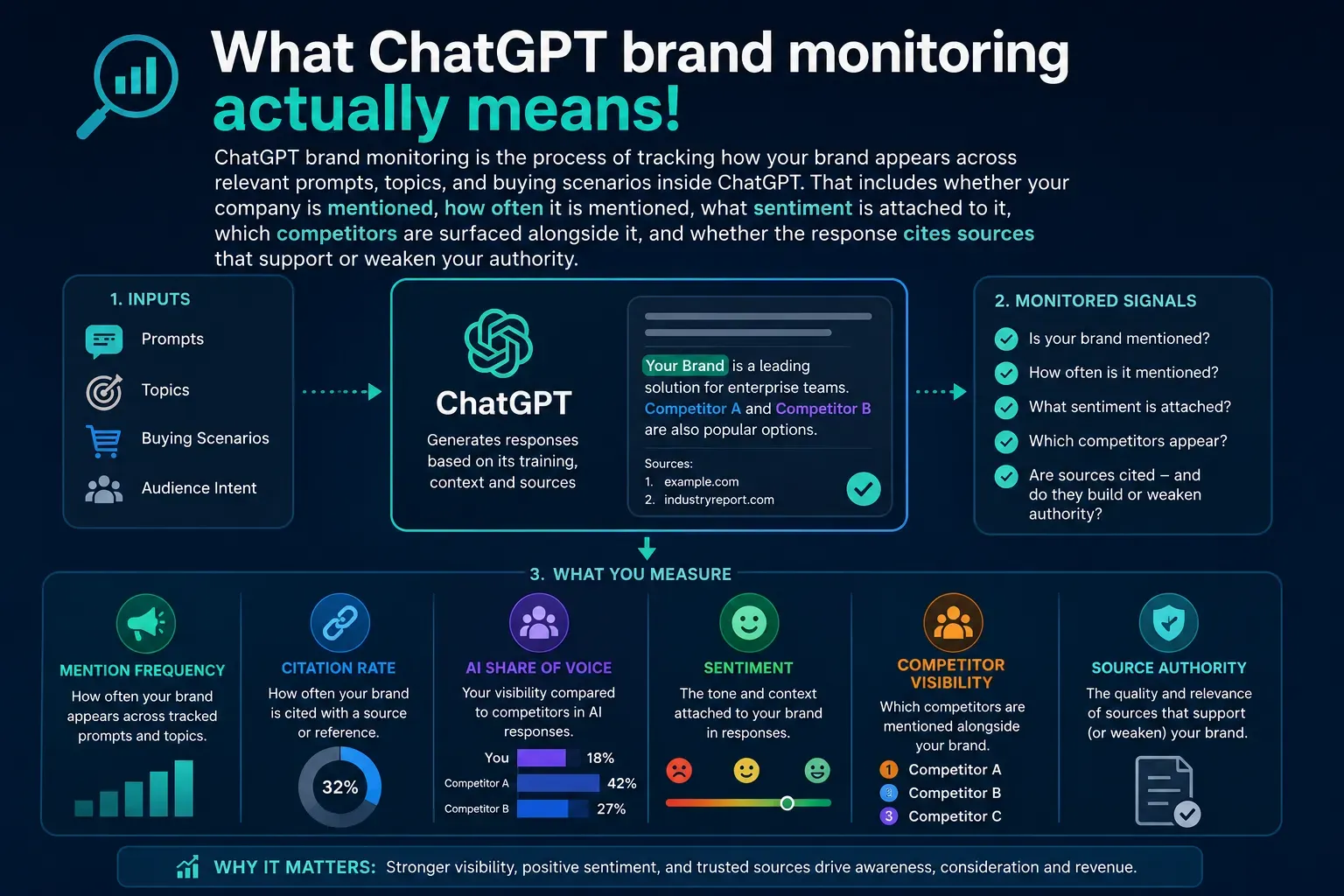
ChatGPT brand monitoring is the process of tracking how your brand appears across relevant prompts, topics, and buying scenarios inside ChatGPT. That includes whether your company is mentioned, how often it is mentioned, what sentiment is attached to it, which competitors are surfaced alongside it, and whether the response cites sources that support or weaken your authority.
That sounds simple until you look closer. AI answers are not static search listings. They are synthesised responses shaped by prompt wording, context, recency, training patterns, retrieved sources, and category-level authority signals. A brand can appear strongly in one prompt set and disappear in another that looks nearly identical on the surface.
That is why serious monitoring has to go beyond basic mention checks. You need repeatable tracking across prompt clusters, categories, geographies, and stages of the customer journey. You also need to understand the difference between visibility and influence. A mention is useful. A favourable mention with supporting citations in a high-intent prompt is what moves commercial outcomes.
Why ChatGPT brand monitoring matters now
The battle for the answer has already started. Buyers are using AI tools to compress research, compare options, and filter the market before they ever click a website. When ChatGPT recommends a shortlist, frames a category, or names the “best” providers, it is shaping demand earlier than most analytics systems can detect.
For marketers, that changes the scoreboard. The old question was where do we rank. The new question is whether AI includes us when a buyer asks for a recommendation. If the answer is no, you are invisible at the exact moment intent is forming.
This shift also changes how brand risk shows up. In search, weak visibility might mean fewer clicks. In AI, weak visibility can mean your competitor becomes the default answer. Worse, your brand may appear with outdated positioning, incomplete product information, or sentiment pulled from low-quality sources. That is not just a messaging issue. It can redirect revenue.
The metrics that matter in ChatGPT brand monitoring
Not every metric deserves a dashboard. The useful ones tell you whether your brand is earning presence, authority, and preference inside AI responses.
Mention frequency is the starting point. It shows how often your brand appears across tracked prompts. On its own, though, it can be misleading. A brand mentioned occasionally in high-intent commercial prompts can outperform one mentioned broadly in low-value informational queries.
AI share of voice gives the competitive lens. It measures your presence relative to competitors across the prompt set that matters to your market. This is where patterns get commercially useful. If a rival is consistently gaining share in product comparison prompts, that is a growth threat. If you dominate informational prompts but disappear in purchase-intent queries, that is an optimisation gap.
Sentiment matters because AI does not just mention brands, it frames them. Are you described as trusted, affordable, innovative, niche, premium, difficult to use, or only suitable for certain segments? Those associations shape buyer perception before a sales conversation even begins.
Citation rate is another signal too many teams miss. If ChatGPT responses reference sources that mention or support your brand, that is often a sign your digital footprint is helping AI validate your relevance. If competitors are cited more often, they are likely feeding the model a stronger evidence base.
The strongest monitoring systems also track platform-specific variance. A brand can perform one way in ChatGPT and very differently in Claude, Gemini, Perplexity, or Google AI Overviews. That matters because AI visibility is not one market. It is several overlapping answer environments with different retrieval and response patterns.
Where most teams get it wrong
The most common mistake is treating AI visibility like a one-off audit. Someone checks a few prompts, takes screenshots, and declares the brand either visible or invisible. That is not monitoring. That is anecdotal research.
The second mistake is focusing only on branded prompts. Yes, you should know what happens when users ask directly about your company. But the bigger opportunity sits in unbranded category prompts, comparison prompts, alternatives queries, and problem-based questions. That is where new demand is captured or lost.
The third mistake is separating monitoring from action. A report that tells you visibility dropped is only half useful. Teams need to know why it dropped and what to do next. Which content assets are underperforming? Which pages need restructuring? Which topics lack authoritative coverage? Which competitor narratives are being reinforced by AI?
This is where GEO starts to matter. Generative Engine Optimisation is not about gaming models. It is about increasing the odds that AI systems can find, trust, and cite the right brand information when generating answers. Monitoring tells you the gap. Optimisation closes it.
How to make ChatGPT brand monitoring commercially useful
Start with prompt design. Track the prompts your customers would actually use, not just the terms your internal team likes. Include awareness questions, comparison queries, use-case prompts, objections, alternatives, and recommendation-style language. If you only monitor a narrow slice of prompts, you will get a false sense of security.
Next, segment by business value. Not all prompts deserve equal weight. A query like “best project management software for agencies” should matter more than a broad educational prompt with weak purchase intent. Weighting prompt groups lets you see where visibility is tied to pipeline, not just attention.
Then connect response data to content and brand assets. If ChatGPT mentions your competitor when discussing a feature you also offer, ask what evidence the AI is finding. Is your product page too thin? Is your schema weak? Are third-party mentions carrying more authority than your owned content? The right question is never just “did we appear”. It is “what information environment produced this result”.
This is why platforms that combine monitoring with recommendations are outperforming basic trackers. A system like aigeo insights does more than count mentions. It translates AI visibility data into a practical roadmap – what to create, what to update, what to structure better, and where to strengthen distribution so your brand earns more citations and more presence in the answers that matter.
ChatGPT brand monitoring is not just for enterprise teams
There is a myth that AI visibility tracking is only relevant for large brands with sprawling search programs. That is outdated thinking. Smaller businesses are often more exposed because they have less brand momentum to fall back on. If ChatGPT pulls category recommendations from the strongest visible entities and your business is missing from that set, you can disappear fast.
For agencies, this is becoming a client expectation. Brands want to know not only how they rank, but how AI talks about them. For in-house teams, it is quickly becoming part of performance reporting. And for business owners, it is one of the clearest ways to understand whether AI is helping or hurting discoverability.
The scale of the program should match the stakes. A local service business may only need focused prompt tracking around core buying scenarios. A national SaaS company may need competitor benchmarking, sentiment analysis, and cross-platform reporting. The principle is the same: measure where AI is shaping demand, then act faster than the market.
What good looks like over time
Strong ChatGPT brand monitoring creates a feedback loop. First, you identify where your brand is absent, weak, or framed poorly. Then you improve the underlying signals – content depth, entity clarity, topic coverage, citation support, and competitive positioning. After that, you watch whether mention frequency, share of voice, and sentiment improve across priority prompts.
The gains are rarely linear. Some changes produce quick lifts, especially when obvious content gaps are fixed. Others take longer because AI systems need stronger evidence over time. That is why consistency matters more than one-off wins.
The brands that will dominate AI search are not the ones guessing hardest. They are the ones measuring visibility with discipline, interpreting the data properly, and turning every insight into action. If ChatGPT is already influencing your buyers, brand monitoring is not optional. It is how you stop being omitted from the answer and start competing to become it.
The next move is simple: stop asking whether AI search matters, and start measuring where your brand stands before the gap gets more expensive to close.
Related Posts
- GEO Dashboard Comparison That Drives Action
Use this GEO dashboard comparison to assess AI visibility platforms, track share of voice and citations, and turn AI search…
Read more about GEO Dashboard Comparison That Drives Action - What Drives AI Citations for Brands?
What drives AI citations? Learn which content, signals and entity factors shape brand visibility in AI answers and how to…
Read more about What Drives AI Citations for Brands? - Answer Engines Are Reshaping Brand Discovery
Answer engines are changing how Australians discover, compare and trust brands. Learn what to measure and how to earn visibility…
Read more about Answer Engines Are Reshaping Brand Discovery