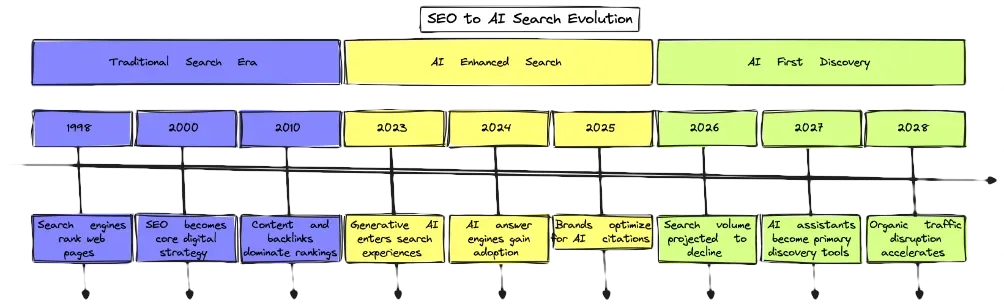
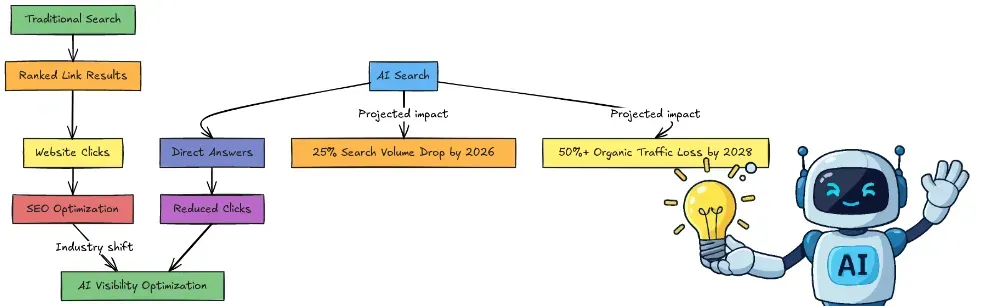
Some SEO and AI search facts. Gartner says traditional search engine volume will drop 25% by 2026 because people are skipping the list of links and going straight to the answer (Gartner, 2024). By 2028, that same firm projects brands will lose 50% or more of their organic search traffic as consumers lean harder into generative AI-powered search (Gartner, 2023). Those are enormous numbers, and the logic of search itself is changing.
For roughly three decades, search worked on one principle. You typed a query, Google served you a ranked list of sources, and you picked one. The search engine was a librarian handing you a bibliography. You still had to do the reading. That model shaped an entire industry. SEO, or search engine optimization, which basically means designing content and websites so that search engines rank them as high as possible in those lists. Get to page one. Get the click. Drive the traffic. That was the game.
AI search the game with a new rule set
When someone asks ChatGPT, Perplexity, or Google’s AI Overview a question, they don’t get ten links. They get a synthesized answer. A single response assembled from multiple sources, with some of those sources cited and most of them invisible. The search engine has become a ghostwriter, pulling from your work without necessarily sending anyone to your door. GEO generative engine optimization enters the picture here.
GEO is the practice of optimizing content so that AI systems cite, reference, or include it in generated answers. Where SEO asks, “how do I rank on Google?”, GEO asks, “how do I become the source an AI pulls from?” The outputs look similar on the surface, both want visibility. But the mechanics are meaningfully different, and conflating them is how marketers end up invisible on both.
Content quality is the foundation of both
The similarities between GEO and SEO are real and worth taking seriously. Content quality is the foundation of both. A page stuffed with keywords and thin information won’t rank on Google, and it won’t be cited by an AI either. Authority matters in both worlds and building credibility through consistent, accurate, well-structured content has always been the right move, and it still is. Technical hygiene transfers too: fast-loading, crawlable, mobile-friendly pages are easier for both search engine bots and AI training pipelines to process. The E-E-A-T framework Google developed and experience, expertise, authoritativeness, trustworthiness, is a blueprint for the kind of content LLMs, or large language models, prefer to pull from Informa TechTarget, 2024). If you’ve been playing the long game in SEO, you’re not starting from zero.
But the differences are sharp enough that treating GEO as just “SEO with a new label” will get you into trouble.
SEO optimizes for ranked lists. You want to appear at position one, two, or three on a search engine results page, because those positions capture the most clicks. Success is measured in rankings, impressions, and traffic volume. GEO optimizes for synthesis. You want your content to be the source an AI reaches for when constructing an answer. Success is measured in citations, brand mentions within AI responses, and inclusion. You can be invisible in Google’s search results and still be the most-cited source in every AI answer about your topic. That’s a fundamentally different distribution model.
The query shape has changed too. Traditional SEO was built around keyword optimization in short, stripped-down phrases like “best project management software” or “how to fix leaky faucet.” AI search runs on conversational prompts. People ask full questions, describe scenarios, provide context. According to Gartner, 71% of consumers who changed their research habits due to AI now phrase queries more specifically and conversationally and 18% use AI tools to engineer their prompts before they even run a Google search (Gartner, 2025). Content optimized for short keywords doesn’t map naturally to how people talk to AI. Writing that directly answers the full question, in clear and structured prose, does.
Backlinks, long one of SEO’s most powerful ranking signals matter considerably less for GEO. AI systems evaluate content for factual precision, clarity, and internal coherence. A page with modest domain authority but exceptionally well-structured, accurate, source-backed content can get cited regularly in AI answers while underperforming in traditional search (Search Engine Land, 2024). The inverse is also true: a page with thousands of backlinks but vague or thin content may rank fine on Google while rarely appearing in AI-generated responses.
So do you drop SEO and go all-in on GEO? The data doesn’t support that and probably won’t for years.
Only one-third of consumers currently believe generative AI chatbots are as effective as search engines for learning new information (Gartner, 2025). More than two-thirds of users still scroll past Google’s AI Overview and continue into the regular search results (Gartner, 2025). Traditional organic search traffic is down roughly 2.5% year over year that is significant, but not collapse (Search Engine Land, 2025). The commercial search queries that drive purchasing decisions “buy,” “review,” “compare,” “pricing” are still dominated by traditional SEO. GEO shows up strongest for informational queries, exactly where AI Overviews are most likely to appear.
The realistic picture is dual optimization, and the brands getting this right aren’t treating GEO as a replacement. They’re running SEO for the commercial and transactional queries where clicks still flow, and building GEO-ready content for the informational and research queries where AI summaries are eating the clicks.
GEO-ready content has a few consistent traits. Factual precision is non-negotiable. AI systems are tuned to pull from content that states things accurately and specifically, not content that hedges everything. Structured, direct answers to explicit questions outperform dense prose. If someone asks “what is GEO?”, the content that gets cited tends to answer that question in the opening paragraph, not the fifth. Citing primary sources increases AI citation rates, ironically, the same credibility markers that good journalists use (Semrush, 2024). Long-tail, conversational content that mirrors how people phrase AI prompts surfaces more frequently than content optimized purely for short keywords (Writesonic, 2024).
The visibility shift is measurable and already underway. Ahrefs data from early 2025 found that queries where AI Overviews appear see roughly 34.5% lower average click-through rates and by early 2026, some query categories were showing closer to 58% lower CTR (Basis.com, 2026). For informational content the kind that drives brand awareness and top-of-funnel discovery that is a material decline. The counterpoint worth examining: Semrush found that AI search visitors convert at 4.4 times the rate of traditional organic search visitors (Semrush, 2024). Traffic volume from AI search is lower. Visitor quality is significantly higher. The ROI math may favor GEO-optimized content even at lower traffic volumes, if you’re tracking the metrics that matter.
This reframes the threat. The narrative around AI killing SEO is mostly wrong. What AI is doing is killing low-effort, thin, keyword-stuffed content that was never truly valuable to begin with. The content that survives and gets cited is clear, authoritative, specific, and structured to answer real questions well. That’s a higher bar on a standard that always existed.
User behavior is shifting faster than the platforms themselves. 51% of consumers say their research habits have changed due to generative AI (Gartner, 2025). That shift isn’t waiting for AI search to reach market saturation it’s happening now, with existing tools. People are already querying differently. They’re asking longer questions, providing more context, expecting synthesis rather than a list. Brands still writing for 2019 keyword behavior are writing for an audience that has already left.
AI search vs SEO projected impact 2028
What GEO gets you, when done well, is a different kind of presence. Answer level authority instead of page one rankings. When an AI synthesizes an answer and cites your content, you’re not competing with nine other results. You’re either in the answer or you’re not. That’s a binary visibility outcome, and it concentrates authority in a way that traditional search never did. The brands that establish that authority early will be disproportionately hard to displace once AI search becomes users’ primary default because AI systems, trained on patterns of citation and authority, tend to reinforce the sources they already trust.
Start by auditing your existing content and identifying which pieces are informational (GEO territory) versus commercial or transactional (SEO territory). For informational content, restructure it to directly answer the specific questions your audience asks. Add citations. Tighten factual claims. Build in the clarity and structure that makes AI synthesis easy. For commercial content, keep the SEO discipline but ensure the page has the authority signals depth, accuracy, specificity that make it credible to both human readers and AI systems processing it downstream.
None of this is overnight work, and that’s the point. GEO rewards the same fundamentals that serious SEO has always rewarded: genuine expertise, consistent publishing, authoritative sourcing, and writing that respects the reader’s intelligence. The optimization layer changes. The underlying discipline doesn’t.
Semrush projects that AI search visitors will surpass traditional organic search visitors in volume by early 2028 (Semrush, 2024). That’s less than two years away. The brands that treat this as a future problem will find themselves building authority in a compressed window while early movers are already entrenched. I think the brands integrating GEO into their content strategy in 2025 will look back at this moment the same way early adopters of content marketing in 2010 look back at theirs as a window that closed relatively fast once the mainstream caught up.
Related Posts
- What Affects AI Brand Mentions in AI Search?
Learn what affects AI brand mentions across ChatGPT, Gemini and Google AI Overviews, then turn visibility data into a sharper…
Read more about What Affects AI Brand Mentions in AI Search? - SEO Tools Versus GEO Tools for AI Search
SEO tools versus GEO tools measure different battles: rankings in results and visibility in AI answers. Learn where each fits…
Read more about SEO Tools Versus GEO Tools for AI Search - How to Improve AI Search Visibility Fast
Learn how to improve AI search visibility with practical GEO tactics that lift mentions, citations, sentiment and share of voice…
Read more about How to Improve AI Search Visibility Fast