
A brand can hold position one for a high-value keyword and still be absent when ChatGPT, Gemini or Perplexity recommends a provider. That is the gap behind SEO tools versus GEO tools. One category tells you how visible your website is in a list of search results. The other tells you whether your brand is becoming part of the answer itself.
For growth teams, this is not a debate about replacing a familiar stack with the next shiny dashboard. It is about measuring the places where buyers now make decisions. Search rankings still matter. AI-generated answers now matter as well, especially for comparison, recommendation and research-led queries where a user may never click through to a traditional results page.
SEO tools versus GEO tools: the core difference
SEO tools are built for the traditional search engine model. They monitor keyword rankings, backlinks, technical errors, organic traffic, search volume, competitor domains and on-page optimisation opportunities. Their central question is straightforward: can your site earn visibility and clicks in search results?
GEO tools are built for generative search environments. They assess how AI platforms describe, cite and recommend your business across prompts that mirror real buyer questions. Their central question is more commercially urgent: when an AI engine answers the question, is your brand included, accurately represented and positioned ahead of competitors?
The distinction matters because a ranking is not an AI mention, and an AI mention is not always a citation. A model may name your brand without linking to your site. It may cite a third-party review, an industry publication or a competitor’s comparison page while recommending your product. It may also present outdated claims, flatten your differentiation or omit you altogether.
SEO platforms are excellent at explaining a website’s search performance. They were not designed to measure AI share of voice, sentiment in generated responses, brand recommendation frequency or platform-by-platform citation patterns. GEO platforms address those blind spots.
| What you need to know | SEO tools | GEO tools |
|---|---|---|
| Primary visibility surface | Search result pages | AI-generated answers and overviews |
| Core signals | Rankings, traffic, links, technical health | Mentions, citations, sentiment, AI share of voice |
| Main competitive question | Who outranks us? | Who does AI recommend instead of us? |
| Typical action | Improve pages to earn rankings | Improve evidence, content and distribution to earn inclusion |
Why rank tracking alone no longer protects visibility
Traditional search gives users a menu of links. Generative search increasingly gives them a shortlist, a synthesis or a direct recommendation. That shift changes the value of being visible. If an AI answer names three accounting platforms, cybersecurity providers or agencies, the brands left out are not merely lower on a page. They are outside the buying conversation.
This is particularly significant for businesses selling considered products and services. A buyer might ask which platform is best for a particular use case, compare alternatives, request pricing guidance or seek a provider in their sector. These prompts are rich with commercial intent, but they rarely map neatly to a single keyword.
An SEO tool can show that your comparison page ranks well for a term. It cannot reliably show whether Claude describes your competitor as the category leader, whether Google AI Overviews cites an old article with incorrect positioning, or whether Perplexity repeatedly uses a third-party source that fails to mention you.
That does not make SEO irrelevant. Strong technical foundations, authoritative content, clear information architecture and earned coverage all influence the sources AI systems can retrieve and cite. The point is that SEO performance is now an input to a broader visibility system, not the entire scoreboard.
What GEO tools measure that SEO platforms miss
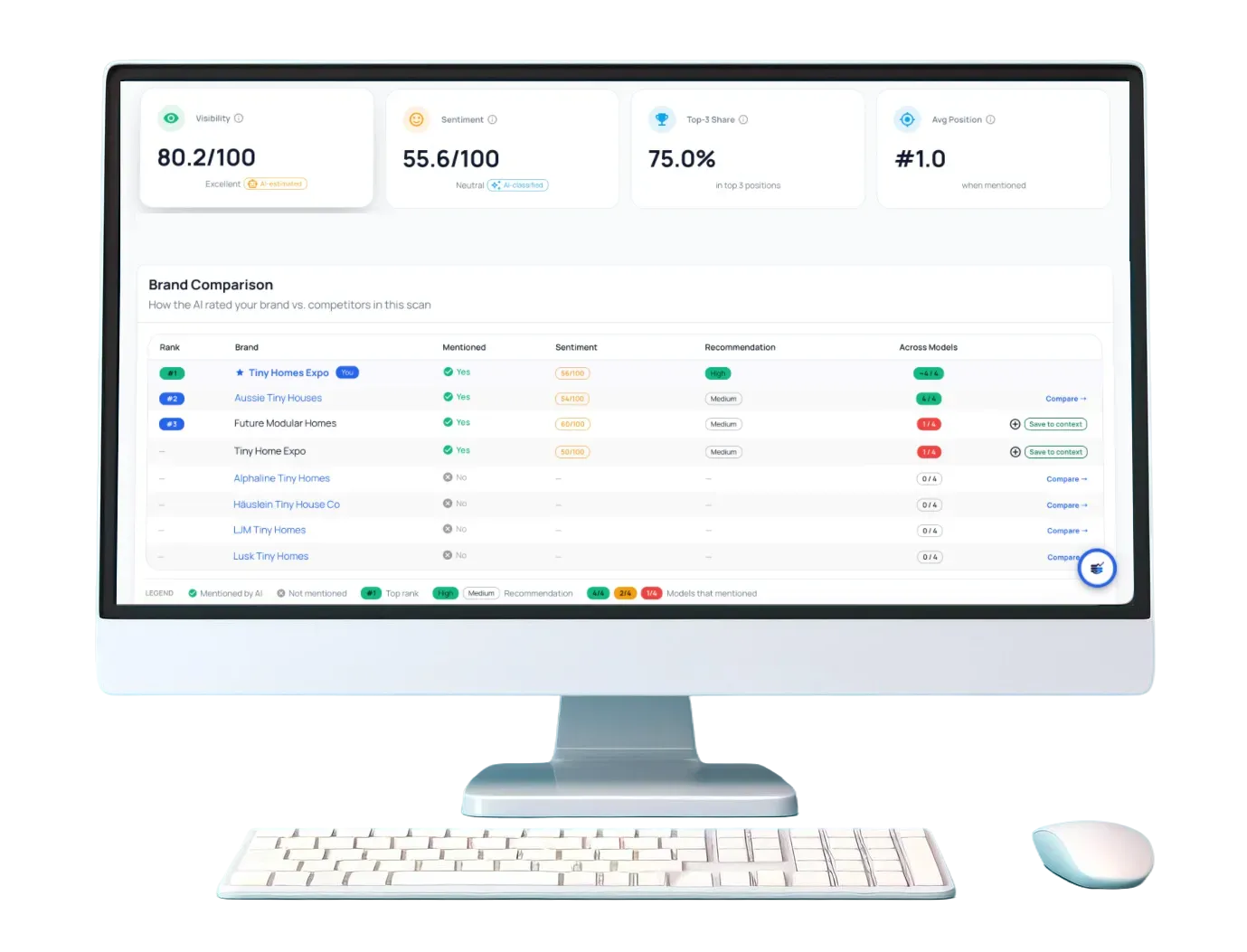
A useful GEO platform does more than run a few prompts and count branded mentions. It creates a repeatable benchmark across the questions your audience actually asks, the competitors they compare and the AI surfaces where demand is forming.
AI share of voice
AI share of voice measures how often your brand appears in relevant generated answers compared with competitors. It reveals whether you are leading, trailing or disappearing across a defined prompt set. This is more revealing than a one-off brand search because the answer economy is shaped by category, use case and audience context.
For example, a project management company may appear frequently for general queries but be invisible when buyers ask about compliance, agency workflows or enterprise reporting. The aggregate number matters, but so do the gaps underneath it.
Citation rate and source quality
Citation rate shows how often AI platforms support statements about your brand with a source. More importantly, source analysis identifies which assets are driving that visibility. Your own website may be cited, but so might review platforms, media coverage, partner pages or independent expert content.
This changes content planning. Instead of publishing more articles because a keyword has search volume, teams can identify missing proof points and create the specific assets AI systems appear to need: product explainers, use-case pages, comparison content, original research, implementation documentation or independently validated coverage.
Sentiment and message accuracy
Being mentioned is not automatically a win. An AI engine can include your brand with lukewarm language, incorrect pricing, an outdated feature description or a category label that weakens your positioning.
GEO monitoring assesses the quality of representation. Are you framed as a leader, a specialist, a budget option or an alternative? Are the claims accurate? Does the platform understand who you serve and what differentiates you? These are reputation questions as much as search questions.
Platform-specific performance
AI platforms do not produce identical answers or rely on the same sources. A brand can perform strongly in Google AI Overviews and poorly in ChatGPT, or earn citations in Perplexity while missing from Gemini recommendations. Treating generative search as one channel hides these differences.
Platform-level reporting lets teams prioritise. If the audience relies heavily on a particular environment, that is where the visibility deficit becomes a revenue risk first.
The operational difference: insights versus action
The real test of SEO tools versus GEO tools is not the dashboard. It is what your team does on Monday morning.
SEO workflows often begin with a keyword, an existing URL or a technical issue. The team optimises a page, earns links, fixes crawlability or improves internal linking. Those actions remain valuable and should continue.
GEO workflows begin with the answer. Which commercially relevant prompts exclude the brand? Which competitors are repeatedly recommended? What source is being cited? Which claims or formats are missing from your content ecosystem? The resulting work may include updating a core product page, publishing a comparison resource, clarifying structured information, strengthening expert evidence or earning authoritative third-party mentions.
The key is prioritisation. A raw list of AI mentions is interesting but not useful enough. Teams need to know which opportunity is large, which action is likely to shift visibility and which gaps affect high-intent buyer journeys. That is where a platform such as aigeo insights earns its place: it turns mention, citation and competitor data into a practical optimisation roadmap rather than leaving teams to interpret scattered signals.
When SEO tools are enough, and when they are not
If your business depends mainly on local discovery, straightforward transactional searches or a tightly defined organic search programme, traditional SEO reporting may remain the immediate priority. Rankings, traffic, conversions and technical performance are still hard commercial measures.
But SEO tools alone are no longer enough when buyers ask AI for recommendations, when competitors are winning category narratives, or when leadership needs proof of how the brand appears in emerging search environments. They are also insufficient when a team cannot explain why visibility has changed despite stable rankings.
The strongest approach is not SEO or GEO. It is a joined-up search intelligence model. Use SEO data to protect discoverability, technical quality and demand capture. Use GEO data to track recommendation presence, answer quality and competitive position where AI systems increasingly shape the shortlist.
Build a measurement system for the answer economy
Start with a focused set of prompts that reflect real commercial decisions, not vanity questions. Include category queries, alternative and comparison queries, use-case questions, pricing considerations and problem-led searches. Track the same prompts consistently across relevant AI platforms so movement means something.
Then connect the findings to clear ownership. Content teams should know what needs creating or updating. PR and partnerships teams should understand where independent validation is missing. Product marketers should review inaccurate claims and sharpen positioning. Search specialists should use source and citation patterns to strengthen the assets most likely to influence both organic search and AI answers.
The battle for visibility is no longer limited to blue links. Measure where your buyers receive answers, act on the gaps and make sure your brand is the one AI has reason to recommend.
Related Posts
- GEO Versus SEO Strategy for Modern AI Search
Compare GEO versus SEO strategy, learn what each measures, and build a visibility plan that earns rankings, citations and AI…
Read more about GEO Versus SEO Strategy for Modern AI Search - Generative Search Content Optimisation Guide
This generative search content optimisation guide shows Australian marketing teams how to earn AI citations, lift share of voice and…
Read more about Generative Search Content Optimisation Guide - 7 Best LLM Content Audit Tools for AI Visibility
Compare the best LLM content audit tools for tracking AI mentions, citations, sentiment and competitors, then turn gaps into a…
Read more about 7 Best LLM Content Audit Tools for AI Visibility