
A prospect asks ChatGPT which provider to choose. Gemini recommends three competitors. Perplexity cites a review site but misses your strongest proof points. None of those moments appears in your conventional rank tracker, yet each can shape a buying decision before a customer ever visits your site.
That is why AI optimisation services have become a growth priority. Brands are no longer competing only for blue-link rankings. They are competing to be mentioned, cited and recommended inside AI-generated answers. The battle for the answer has begun, and passive reporting will not win it.
What AI optimisation services actually do
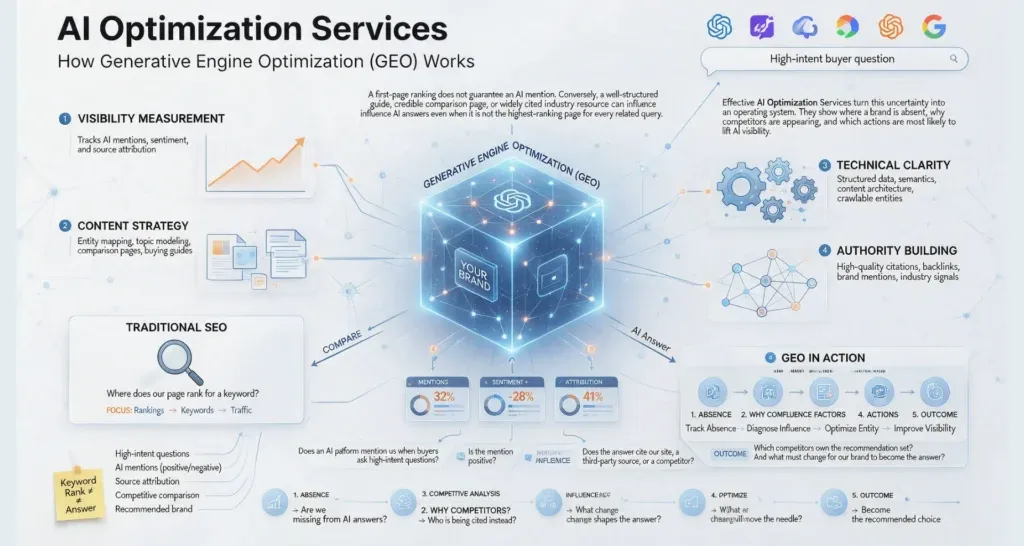
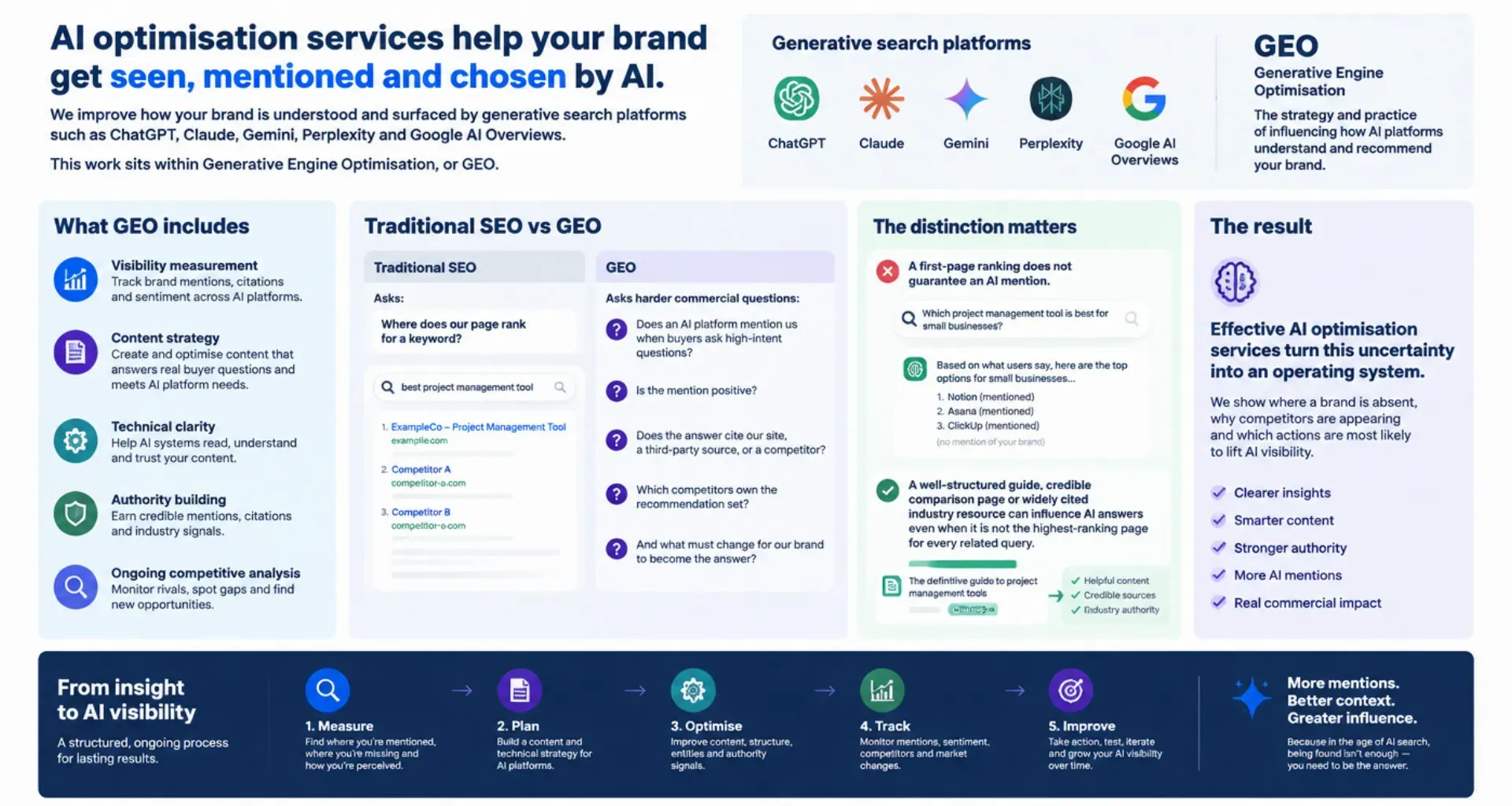
AI optimisation services improve how a brand is understood and surfaced by generative search platforms such as ChatGPT, Claude, Gemini, Perplexity and Google AI Overviews. The work sits within Generative Engine Optimisation, or GEO. It combines visibility measurement, content strategy, technical clarity, authority building and ongoing competitive analysis.
Traditional SEO asks: where does our page rank for a keyword? GEO asks harder commercial questions: does an AI platform mention us when buyers ask high-intent questions? Is the mention positive? Does the answer cite our site, a third-party source, or a competitor? Which competitors own the recommendation set? And what must change for our brand to become the answer?
The distinction matters. A first-page ranking does not guarantee an AI mention. Conversely, a well-structured guide, credible comparison page or widely cited industry resource can influence AI answers even when it is not the highest-ranking page for every related query.
Effective AI optimisation services turn this uncertainty into an operating system. They show where a brand is absent, why competitors are appearing and which actions are most likely to lift AI visibility.
The metrics that separate activity from impact
A service that merely reports whether your brand appeared in a few prompts is not enough. Generative platforms are variable, answers shift by query framing and results can differ between platforms. Teams need a repeatable benchmark that measures movement over time.
The core metrics should include brand mention frequency, citation rate, AI share of voice, sentiment and competitor visibility. Mention frequency reveals whether your business appears at all. Citation rate shows how often AI systems point to your owned content as a source. AI share of voice compares your presence against the companies buyers are also being shown.
Sentiment adds necessary context. Being mentioned as an expensive, limited or risky option is not the same as being recommended as a leading choice. Platform-level reporting matters too. A brand may perform strongly in Google AI Overviews while being almost invisible in ChatGPT, where a different source mix and answer format can drive the result.
For agencies and growth teams, the commercial value is clear: visibility can be tied to categories, competitors, locations, products and buying-stage questions. Instead of reporting broad impressions, you can identify where the pipeline is being influenced before the click.
Prompt coverage needs to reflect buyer intent
A useful prompt set does not consist of vanity questions such as “What is [brand name]?” It includes the questions real buyers use when they are narrowing options: best providers, alternatives, pricing expectations, use cases, implementation requirements, reviews, local availability and category comparisons.
The prompt set should also reflect Australian search behaviour where relevant. Local terminology, service areas, regulatory expectations and industry language can alter who gets cited. An Australian business should not assume that an answer shaped around US sources will accurately represent its market.
How the optimisation work turns into visibility gains
Measurement is the starting point, not the deliverable. Once the gaps are clear, AI optimisation services should produce a prioritised roadmap with specific work attached to each opportunity.
A typical roadmap begins with content gaps. If competitors are repeatedly cited for “best accounting software for small businesses” while your brand is absent, the fix may be a definitive buyer guide, a transparent comparison resource or stronger use-case pages. If an AI answer describes your offer inaccurately, it may signal unclear positioning across your site and third-party sources.
Next comes evidence. Generative engines favour information they can interpret and corroborate. Product claims need proof. Expertise needs visible authorship or business credentials. Statistics should be current and attributable. Customer outcomes, pricing logic, methodologies, FAQs and product specifications should be easy to find, clearly labelled and consistent across key pages.
Technical structure supports that work. AI systems do not reward schema simply because it exists, and structured data is not a shortcut to citations. But clean page architecture, descriptive headings, accessible copy, accurate entity information and well-maintained technical foundations reduce ambiguity. They help search systems understand what the page says, who it is for and why it deserves trust.
Finally, distribution closes the loop. Owned content is only one source of authority. High-quality editorial coverage, credible directories, expert contributions, reviews and partner pages can all affect how a brand is represented. The objective is not to scatter mentions across low-value sites. It is to build a consistent, verifiable information footprint that supports the claims AI systems make about you.
Where services often waste budget
The wrong approach treats GEO as a one-off content sprint. Publish ten AI-written articles, add a few schema fields and expect ChatGPT to change its view of the market. That is not how brand representation works.
Generic volume creates more pages but not necessarily more authority. In some categories, a smaller number of deeply useful assets will outperform a large content library. A cybersecurity firm may need rigorous technical explainers and independent validation. A local service business may need accurate location pages, strong review signals and clear service detail. An ecommerce brand may need product facts, comparison content and reliable third-party coverage.
There is also a trade-off between chasing every platform and focusing on commercial relevance. If your buyers increasingly use Google AI Overviews and Perplexity during research, those platforms may deserve immediate attention. If enterprise stakeholders use ChatGPT to build shortlists, prompt visibility there becomes more valuable. The right priority depends on your audience, deal size, sales cycle and category.
Another common waste is reporting without ownership. A dashboard that reveals a competitor has gained AI share of voice is useful only if someone can turn that finding into a task, assign it, complete it and measure the outcome. Visibility intelligence must feed the content calendar, technical backlog, digital PR activity and leadership reporting.
A practical framework for choosing AI optimisation services
Start by asking whether the provider can measure your current position across multiple generative environments, not just simulate occasional prompts. You need historical tracking, competitor benchmarks and enough query coverage to distinguish a real trend from random answer variation.
Then assess the quality of its recommendations. Strong providers do not stop at “improve your content”. They identify the page, topic, claim, format or authority gap behind the recommendation and score the likely impact. This allows lean teams to focus on the actions that can move visibility rather than spreading effort across an endless GEO checklist.
Ask how the service handles attribution. AI search does not always produce a neat last-click pathway, so the goal is not perfect attribution from day one. It is a defensible visibility model that connects priority prompts, answer presence, citations, referral patterns and commercial outcomes. Over time, that model becomes a leading indicator for demand capture.
Finally, decide whether your team needs software, implementation support or both. An in-house SEO or content team may want a platform that makes opportunities visible and helps them organise the work. A time-poor business may need specialist support to shape the roadmap and execute it. aigeo insights is built around this model, combining AI brand visibility tracking with an action-led optimisation plan rather than leaving teams with data alone.
What a 90-day AI visibility programme should deliver
The first 30 days should establish the baseline. This includes priority prompt groups, platform tracking, competitor selection, current mention and citation rates, sentiment patterns, and an audit of the assets AI systems currently rely on.
By day 60, the programme should have a ranked action plan in motion. That may include refreshing high-value pages, creating missing comparison or category resources, tightening entity and product information, correcting inconsistent claims and building external validation around strategic topics.
By day 90, teams should be able to see movement at the prompt and platform level. Not every category will show instant gains. Generative systems change, competitors respond and some authority work compounds slowly. But the business should have clear evidence of what is improving, what remains contested and where the next investment belongs.
The brands that win AI search will not be the ones making the most noise about AI. They will be the ones that measure how the market is being described, act on the gaps quickly and make it easy for every generative engine to recognise why they deserve to be recommended.
Related Posts
- How to Map Brand Entities for AI Search Visibility
Learn how to map brand entities, connect the signals AI uses, find gaps and build a stronger path to citations,…
Read more about How to Map Brand Entities for AI Search Visibility - How to Measure Brand Visibility in AI Search
Learn how to measure brand visibility across AI search, track share of voice, citations and sentiment, and turn visibility gaps…
Read more about How to Measure Brand Visibility in AI Search - Generative Search Content Optimisation Guide
This generative search content optimisation guide shows Australian marketing teams how to earn AI citations, lift share of voice and…
Read more about Generative Search Content Optimisation Guide