
A prospect asks ChatGPT which payroll platform suits a 50-person Australian business. Or they ask Gemini for the best agency for a rebrand. The response may name three companies before the prospect ever reaches a traditional search result. If your brand is absent, accurate content alone is not enough. You need the best content formats for chatbots: assets that make it easy for generative engines to retrieve, interpret and cite your expertise.
This is the new battleground for visibility. Chatbots do not reward content because it is long, polished or packed with keywords. They favour information that answers a clear question, shows its working and can be verified against other credible sources. For growth teams, that changes the content plan from “publish more” to “publish the evidence AI can use”.
What makes content usable by chatbots?
Generative engines assemble answers from patterns, sources and structured facts. Their systems vary, and no format guarantees a mention. But content is more likely to earn a citation when it is specific, current, attributable and easy to extract without guessing.
That means a page should establish who is making the claim, define the scenario it applies to, include the underlying methodology where relevant, and separate facts from opinion. A vague statement such as “we offer great support” gives an AI little to work with. “Australian support team available 8 am to 6 pm AEST, with a median first-response time of 12 minutes in Q2 2026” is a usable claim.
The commercial implication is straightforward: format is part of your AI search strategy. The right asset can influence recommendations, comparisons and purchase research. The wrong one leaves your category narrative to competitors.
The 7 best content formats for chatbots
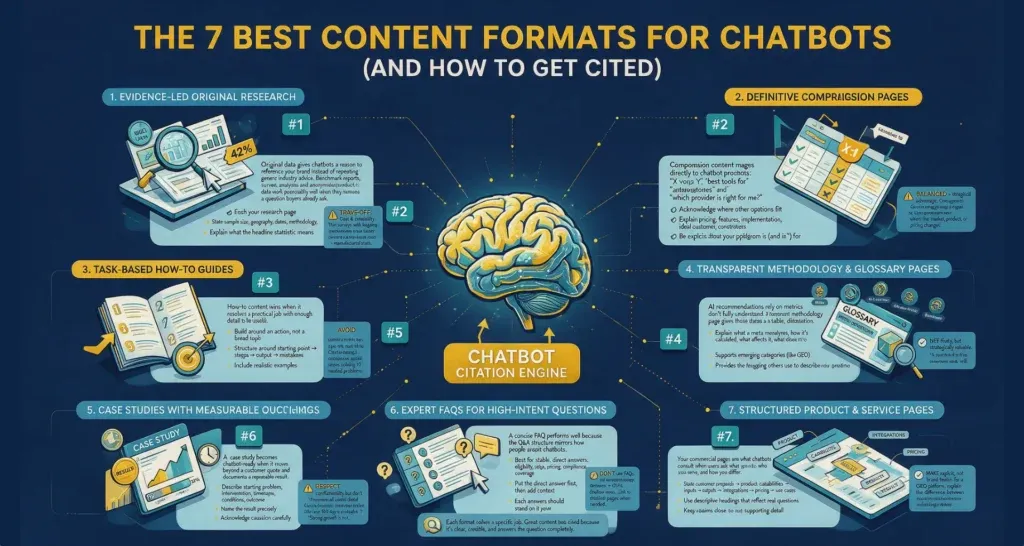
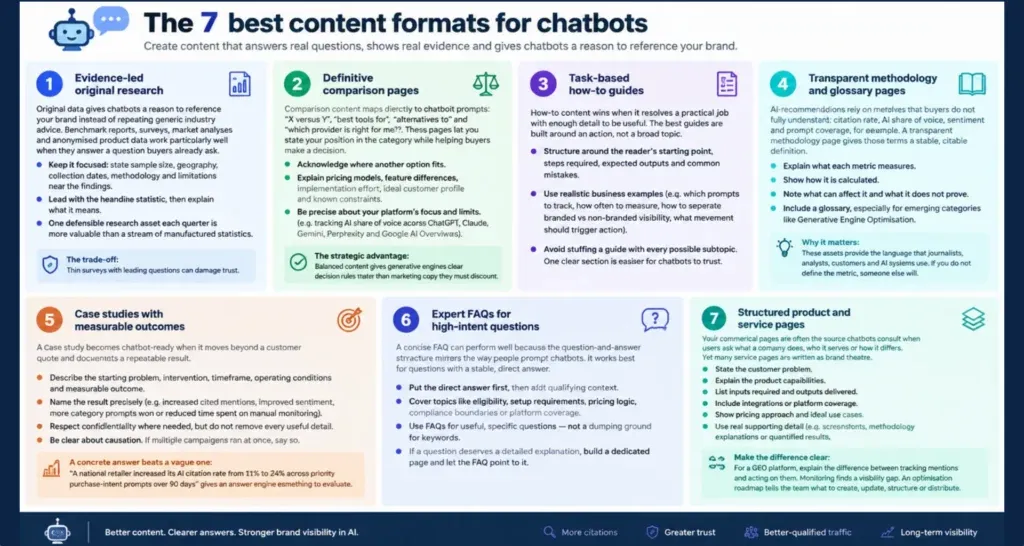
1. Evidence-led original research
Original data gives chatbots a reason to reference your brand instead of repeating generic industry advice. Benchmark reports, surveys, market analyses and anonymised product data work particularly well when they answer a question buyers already ask.
Keep the research page focused. State the sample size, geography, collection dates, methodology and limitations near the findings. Present the headline statistic in plain language, then explain what it means. A report claiming that “42% of Australian B2B buyers shortlist vendors using AI-generated comparisons” is far more citeable when readers can see how that figure was calculated.
The trade-off is cost and credibility. Thin surveys with leading questions can damage trust. One defensible research asset each quarter is generally more valuable than a stream of manufactured statistics.
2. Definitive comparison pages
Comparison content maps directly to chatbot prompts: “X versus Y”, “best tools for”, “alternatives to” and “which provider is right for me?” These pages let you state your position in the category while helping buyers make a decision.
The strongest comparisons acknowledge where another option fits. Explain pricing models, feature differences, implementation effort, ideal customer profile and known constraints. If your platform is built for teams tracking AI share of voice across ChatGPT, Claude, Gemini, Perplexity and Google AI Overviews, say exactly that. Do not pretend it is the right fit for a business seeking a basic social listening tool.
Balanced content has a strategic advantage. It gives generative engines clear decision rules rather than marketing copy they must discount. Update comparisons whenever the market, product or pricing changes. Old comparison pages are an easy way to lose trust and visibility at the same time.
3. Task-based how-to guides
How-to content wins when it resolves a practical job with enough detail to be useful. The best guides are built around an action, not a broad topic. “How to measure brand mentions in AI answers” is stronger than “The future of AI branding”.
Structure each guide around the reader’s starting point, the steps required, expected outputs and common mistakes. Include examples using realistic business conditions. An agency does not need a vague reminder to monitor AI search. It needs to know which prompts to track, how often to measure them, how to separate branded from non-branded visibility and what movement should trigger action.
Avoid stuffing a guide with every possible subtopic. A chatbot may extract a concise answer from one clear section, but it struggles to trust a page that tries to solve ten unrelated problems.
4. Transparent methodology and glossary pages
AI recommendations increasingly rely on metrics that buyers do not fully understand: citation rate, AI share of voice, sentiment and prompt coverage, for example. A transparent methodology page gives those terms a stable, citable definition.
Explain what each metric measures, how it is calculated, what can affect it and what it does not prove. This protects your brand from overclaiming while establishing authority. A glossary can support this work, particularly for emerging categories such as Generative Engine Optimisation, where terminology is still settling.
These assets are not flashy, but they are strategically valuable. They provide the language that journalists, analysts, customers and AI systems use when describing your category. If you do not define the metric, someone else will.
5. Case studies with measurable outcomes
A case study becomes chatbot-ready when it moves beyond a customer quote and documents a repeatable result. Describe the starting problem, intervention, timeframe, operating conditions and measurable outcome. Name the result precisely: increased cited mentions, improved sentiment, more category prompts won or reduced time spent on manual monitoring.
Respect confidentiality where needed, but do not remove every useful detail. “A leading business achieved strong growth” is empty. “A national retailer increased its AI citation rate from 11% to 24% across priority purchase-intent prompts over 90 days” gives an answer engine something concrete to evaluate.
Causation needs care. If multiple campaigns ran at once, say so. Credible caveats make a case study stronger, not weaker.
6. Expert FAQs for high-intent questions
A concise FAQ can perform well because the question-and-answer structure mirrors the way people prompt chatbots. It works best for questions that have a stable, direct answer, such as eligibility, setup requirements, pricing logic, compliance boundaries or platform coverage.
Each answer should stand on its own. Put the direct answer first, then add qualifying context. For instance, “Can AI visibility be measured?” should not lead with a sales pitch. It should explain that measurement depends on a defined prompt set, selected platforms, competitor set and consistent tracking period.
Do not use FAQs as a dumping ground for keywords. Ten useful answers are better than 60 shallow ones. If a question deserves a detailed explanation, build a dedicated page and let the FAQ point readers towards that topic in your site architecture.
7. Structured product and service pages
Your commercial pages are often the source chatbots consult when users ask what a company does, who it serves or how it differs. Yet many service pages are written as brand theatre: broad claims, unclear deliverables and no proof.
Make the page explicit. State the customer problem, the product capabilities, inputs required, outputs delivered, integrations or platform coverage, pricing approach and ideal use cases. Use descriptive headings that reflect real questions. Keep product claims close to supporting detail, whether that is a screenshot, a methodology explanation or a quantified customer result.
For a GEO platform, that means explaining the difference between tracking mentions and acting on them. Monitoring identifies a visibility gap. A prioritised optimisation roadmap tells the team which content to create, update, structure or distribute to close it. That distinction is commercially meaningful and easy for a chatbot to communicate.
Build a content portfolio, not a pile of pages
No single format owns every prompt. Research can earn citations for market facts; comparison pages can influence vendor selection; guides can capture operational queries; and product pages can confirm your relevance. The right mix depends on where your brand is currently missing from AI answers.
Start with your highest-value prompts. Group them by intent: definitions, recommendations, comparisons, implementation questions and proof requests. Then match the gap to a format. If AI systems mention competitors when users ask for alternatives, publish a fair comparison. If they quote industry statistics without naming you, invest in original data. If they misunderstand your offer, strengthen the product page and methodology.
Measure the outcome at prompt level. Track mention frequency, citation rate, sentiment, competitor visibility and AI share of voice across the platforms that matter to your buyers. Aigeo insights can turn that visibility data into a prioritised roadmap, so content decisions are tied to the gaps most likely to affect pipeline rather than vanity publishing metrics.
The answer economy will not wait for the next annual content refresh. Publish the evidence your market needs, keep it current, and make every important claim clear enough for an AI to carry it into the conversation.
Related Posts
- 7 Best LLM Content Audit Tools for AI Visibility
Compare the best LLM content audit tools for tracking AI mentions, citations, sentiment and competitors, then turn gaps into a…
Read more about 7 Best LLM Content Audit Tools for AI Visibility - Why Brands Disappear From Chatbots and How to Respond
Why brands disappear from chatbots: the data, content gaps and reputation signals that decide whether AI assistants mention, cite or…
Read more about Why Brands Disappear From Chatbots and How to Respond - 9 best generative engine optimisation tools
Compare the best generative engine optimisation tools for tracking AI visibility, citations, sentiment, and competitor share of voice.
Read more about 9 best generative engine optimisation tools