
AI answers do not cite a brand because it added a few lines of JSON-LD. They cite sources that are clear, credible, current and easy to interpret. The best schema for AI citations is therefore not one schema type. It is a connected set of structured signals that makes your entity, expertise, products and claims easier for generative engines to verify.
That distinction matters. ChatGPT, Gemini, Claude, Perplexity and Google AI Overviews do not operate like a traditional rankings report. They assemble answers from sources they judge relevant to a prompt. If your pages leave ambiguity around who you are, what you offer, where you operate or why a claim is trustworthy, a competitor with cleaner signals can become the answer instead.
The best schema for AI citations starts with entity clarity
For most brands, Organisation schema is the foundation. It tells machines that the company behind a website is a distinct entity, rather than a collection of disconnected pages. Include the legal or trading name, logo, website, same-as profiles where appropriate, contact details and a concise description of what the business does.
This is not cosmetic metadata. Entity consistency helps AI systems reconcile the brand on your site with mentions across the wider web. The name on your homepage, your business profiles, expert bylines and media mentions should match. If one page calls the company “ABC Digital”, another uses “ABC Growth Pty Ltd”, and external profiles use a third variation, you have created unnecessary uncertainty.
Local businesses should add LocalBusiness schema or the most specific relevant subtype. Service areas, addresses, opening hours and phone numbers need to reflect reality. National brands should not manufacture local locations merely to appear more relevant. AI systems are increasingly capable of spotting thin location pages and conflicting business data.
Use the schema that matches the page’s job
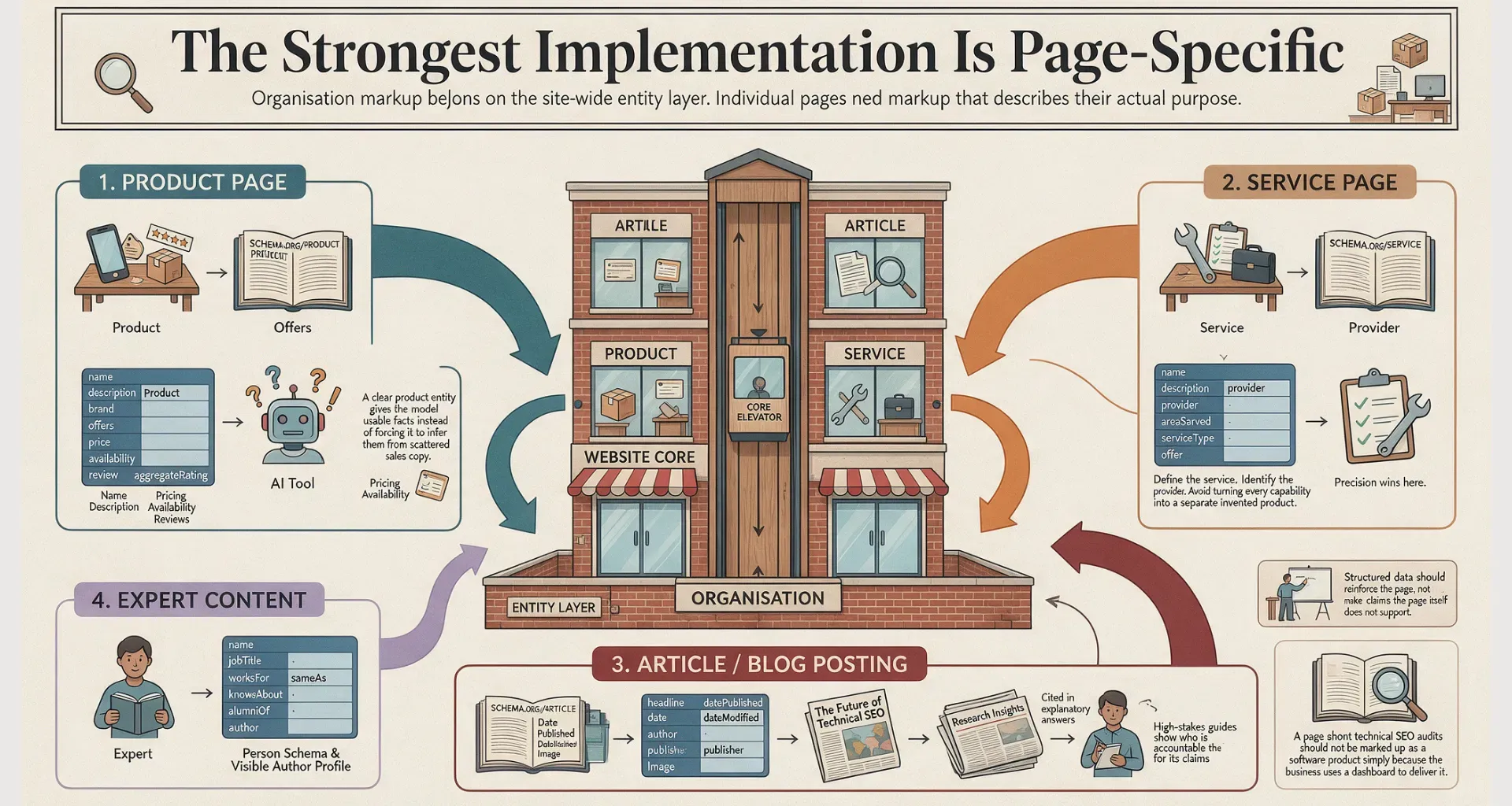
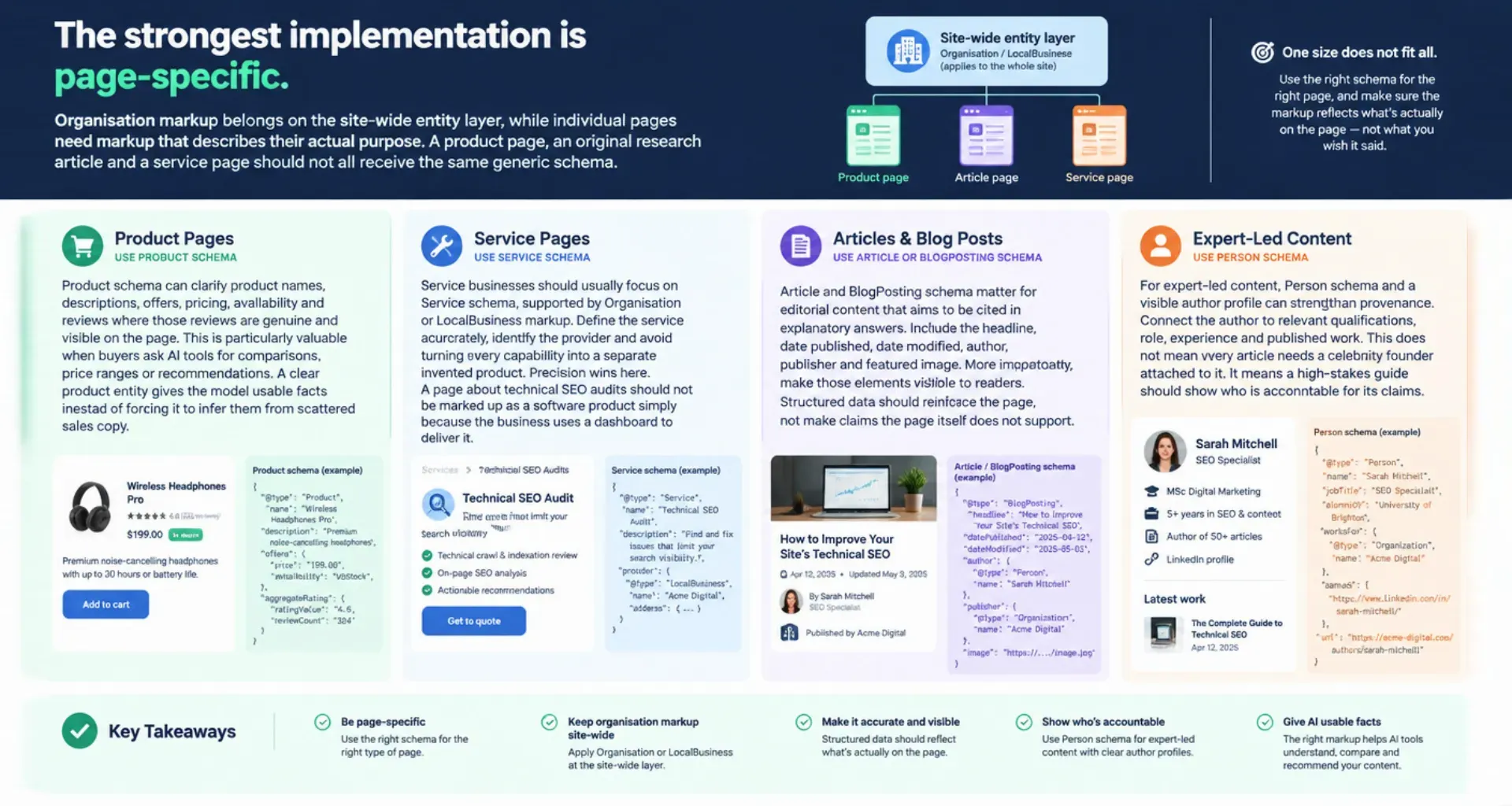
The strongest implementation is page-specific. Organisation markup belongs on the site-wide entity layer, while individual pages need markup that describes their actual purpose. A product page, an original research article and a service page should not all receive the same generic schema.
For commercial pages, Product schema can clarify product names, descriptions, offers, pricing, availability and reviews where those reviews are genuine and visible on the page. This is particularly valuable when buyers ask AI tools for comparisons, price ranges or recommendations. A clear product entity gives the model usable facts instead of forcing it to infer them from scattered sales copy.
Service businesses should usually focus on Service schema, supported by Organisation or LocalBusiness markup. Define the service accurately, identify the provider and avoid turning every capability into a separate invented product. Precision wins here. A page about technical SEO audits should not be marked up as a software product simply because the business uses a dashboard to deliver it.
Article and BlogPosting schema matter for editorial content that aims to be cited in explanatory answers. Include the headline, date published, date modified, author, publisher and featured image. More importantly, make those elements visible to readers. Structured data should reinforce the page, not make claims the page itself does not support.
For expert-led content, Person schema and a visible author profile can strengthen provenance. Connect the author to relevant qualifications, role, experience and published work. This does not mean every article needs a celebrity founder attached to it. It means a high-stakes guide should show who is accountable for its claims.
FAQ schema helps only when the questions are real
FAQPage schema remains useful for organising genuine question-and-answer content, especially where customers repeatedly ask the same decision-stage questions. It can make the intent of a page unambiguous: this page answers questions about eligibility, implementation, pricing mechanics or product fit.
But FAQ markup is not a citation shortcut. Publishing a wall of keyword-stuffed questions, then marking them up, will not make an AI model trust the answers. It may also create a poor on-page experience. Use it when each answer is specific, helpful and maintained. If a question needs a nuanced response, give it one rather than reducing it to a sales slogan.
The same principle applies to HowTo schema. Use it for a real, repeatable process with clear steps, materials or tools where relevant. Do not force it onto a thought-leadership article just to add another schema type.
Claims need evidence before markup
Schema can label a claim. It cannot make an unsupported claim credible. This is the point many teams miss when they ask which markup will earn more AI citations.
If your page states that your platform improves conversion rates by 40 per cent, show the source, timeframe, sample and conditions. If you publish original market data, explain the methodology. If you list an award, certification or customer result, make sure it can be substantiated. AI systems look beyond structured data to the surrounding text, source reputation and corroborating evidence.
This is why original research, useful benchmarks and detailed comparison content often outperform generic brand pages in generative answers. They give the model something concrete to reuse. Schema makes those assets legible, but the evidence creates the reason to cite them.
A practical schema stack for citation-ready content
For a brand building visibility across AI search, the priority is usually straightforward:
- Organisation or LocalBusiness schema establishes who the brand is.
- WebSite and WebPage schema clarify the relationship between the site and each page.
- Article, Product or Service schema describes the primary content or offer.
- Person schema connects expert content to accountable authors.
- FAQPage, HowTo, Review or VideoObject schema is added only when the visible page genuinely supports it.
This stack is deliberately restrained. More markup is not better markup. Adding every eligible schema type can create duplicates, contradictions and maintenance problems. A product price that changes on-page but remains stale in JSON-LD is worse than no price markup at all because it weakens data reliability.
Use JSON-LD where possible, keep it generated from the same source of truth as the visible content, and validate it whenever templates change. Technical correctness is the baseline. The commercial opportunity comes from ensuring structured data represents your most citation-worthy assets.
Build pages AI systems can quote
Schema works best alongside content architecture that reduces ambiguity. Put the direct answer near the top of the page, then support it with definitions, evidence, examples, limitations and decision criteria. Use descriptive headings that mirror real buyer questions, not vague labels such as “Our approach”.
Tables can be useful for comparisons when the information is genuinely comparable. Named statistics, dates, methodology notes and clear product specifications also help. A model cannot safely cite “industry-leading results” because the phrase has no stable meaning. It can cite a well-defined benchmark with a source and scope.
Keep content current. Generative platforms may favour newer or recently verified information for questions involving pricing, regulations, product features and market changes. Add visible update dates only when a meaningful review has occurred. Changing a date without improving the content is not a strategy.
Measure citations, not just schema coverage
A valid schema report does not tell you whether your brand is winning the answer economy. The metric that matters is whether your company is mentioned, recommended or cited for the prompts that lead to revenue.
Track citation rate by topic, AI share of voice against competitors, sentiment, platform differences and the source pages that recur in answers. A page may perform strongly in Google AI Overviews yet remain absent from Perplexity or ChatGPT. That is useful intelligence, not a reason to assume one channel behaves like another.
Then connect the gap to an action. If competitors are cited for implementation questions, publish a more useful implementation resource. If they dominate category comparisons, build a fact-led comparison page with transparent criteria. If your brand is mentioned but not cited, strengthen the supporting evidence and entity signals around the claims being repeated.
aigeo insights helps teams turn those visibility patterns into an optimisation roadmap, so schema work becomes part of a measurable GEO programme rather than a technical box-ticking exercise.
The battle for the answer will not be won by the biggest schema library. It will be won by brands whose facts are easiest to verify, whose expertise is easiest to attribute and whose content gives AI systems a better answer to choose.
Related Posts
- How to Increase AI Citations and Win AI Search
Learn how to increase AI citations with content, entity signals and measurement that put your brand in more AI-generated answers…
Read more about How to Increase AI Citations and Win AI Search - 9 best generative engine optimisation tools
Compare the best generative engine optimisation tools for tracking AI visibility, citations, sentiment, and competitor share of voice.
Read more about 9 best generative engine optimisation tools - 7 Best Content Formats for Chatbots That Get Cited
Learn which best content formats for chatbots earn AI citations, shape recommendations and help your brand win visibility across generative…
Read more about 7 Best Content Formats for Chatbots That Get Cited