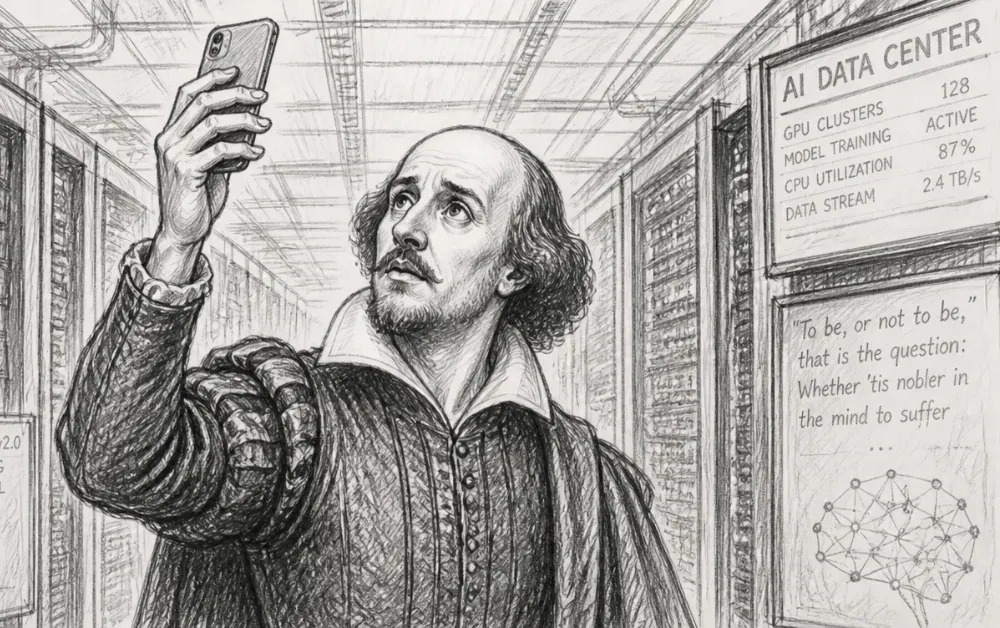
The New Rules of AEO, GEO, and AI Search Visibility
AI search is quietly stealing your organic traffic and most businesses have no idea it’s happening yet.
Gartner projects traditional search engine volume will drop 25% by 2026 and organic search traffic by 50% or more by 2028. AI is answering questions before anyone clicks a link. The businesses that understand this shift, specifically, why Perplexity and ChatGPT cite sources that barely overlap are quietly pulling ahead. The rest are still optimizing for a search engine that’s no longer the whole game.
A small marketing agency called Meridian spent years building a solid content library with blog posts, landing pages and comparison guides. Their Google rankings were decent. Traffic was steady. Then, sometime in 2024, something shifted. Their traffic didn’t collapse. It just… quietly softened. New leads slowed down. The phone still rang, but less. They ran their usual reports. Rankings looked fine. Nothing broken, nothing penalized. But the leads weren’t there.
What Meridian was experiencing doesn’t show up in Google Search Console. It shows up in the space between where a user types a question and where they decide to click or not click at all.
Nearly 60% of Google searches in the U.S. already end without a click to any website. That was already the reality before AI Overviews started appearing. Now you layer in ChatGPT, Perplexity, and Google’s own generative AI answers and the question is no longer just “can you rank?” It’s “will AI even mention you when someone asks about your industry?”
AI Search Visibility will AI even mention you
That’s the real shift. And it has a name now. Two of them, actually.
Answer Engine Optimization in short AEO is the practice of structuring your content so that AI-powered platforms like ChatGPT, Perplexity, and Google AI Mode select and cite your material when generating answers. The goal is citation, not ranking. That’s a different goal than search engine optimization in short SEO which has historically been about earning a spot in a list of links. AEO is about being the source an AI quotes when it skips the list entirely.
The related concept is GEO generative engine optimization which researchers from Princeton University introduced in a 2024 paper as a formal framework for making web content more visible inside AI generative systems. Think of AEO as the practitioner’s term and GEO as the academic one. They’re describing the same underlying shift.
Most AEO explainer content gives you the definition, lists a few tactics, and leaves you with the impression that AEO is basically SEO with some extra steps. The data makes that look wrong.
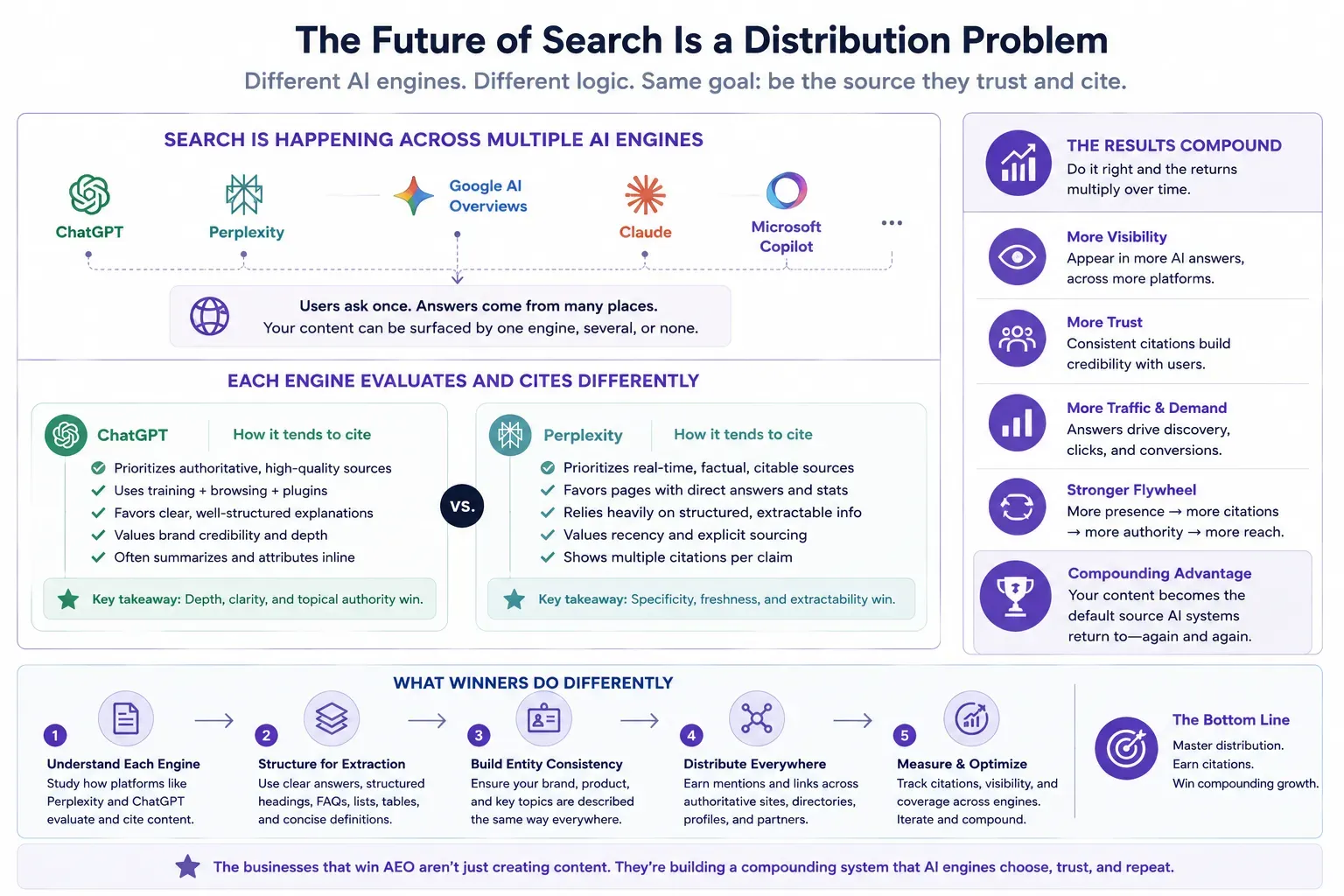
BrightEdge research found that 60% of Perplexity’s citations overlap with Google’s top 10 results. So Perplexity, at least, rewards the same authority signals Google does. You’re probably fine there if your SEO is solid. But ChatGPT? Analysis of 41 million results from Profound and Ahrefs found that ChatGPT’s results overlap with Google’s SERPs by only 11 to 12 percent. Meaning 28% of ChatGPT’s most-cited pages have zero organic visibility in Google whatsoever.
More than a quarter of the pages ChatGPT cites most often can’t be found in Google’s top results at all.
“Do good SEO and you’ll be fine in AI search” is only half true and only for one engine. Perplexity plays closer to the Google rulebook. ChatGPT is operating on almost entirely different signals. If you tune for one, you’re missing the other.
AI Visibility: AEO rewards a specific structure
On the content side, AEO rewards a specific structure. AI systems whether ChatGPT or Perplexity are looking for content that answers questions directly and concisely, often within the first 40 to 60 words of a response. That’s closer to a mechanical requirement than a soft preference. If your answer to “what is [your product category]?” takes three paragraphs to get to the actual answer, AI systems will skip it or fragment it in ways that strip your brand context entirely.
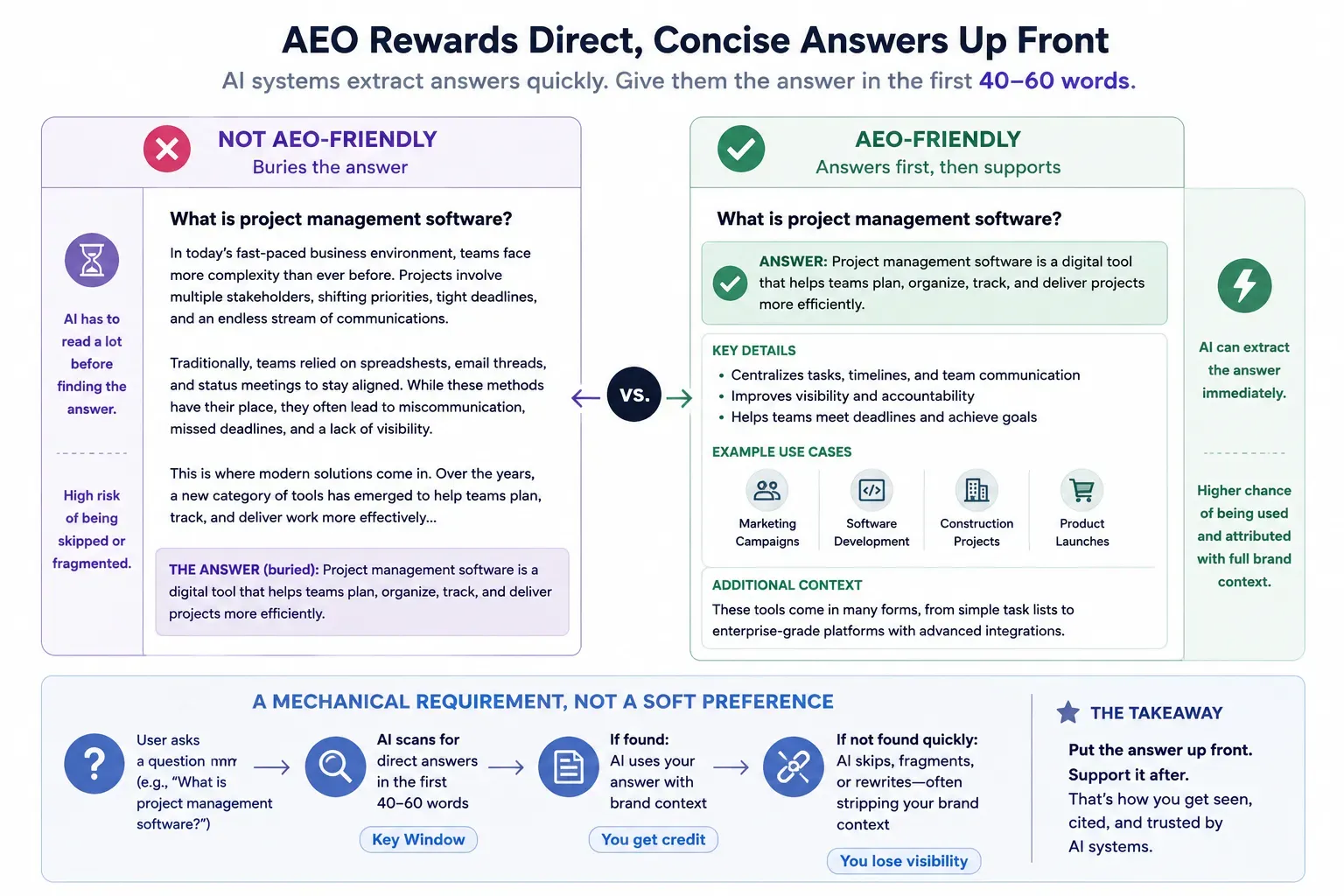
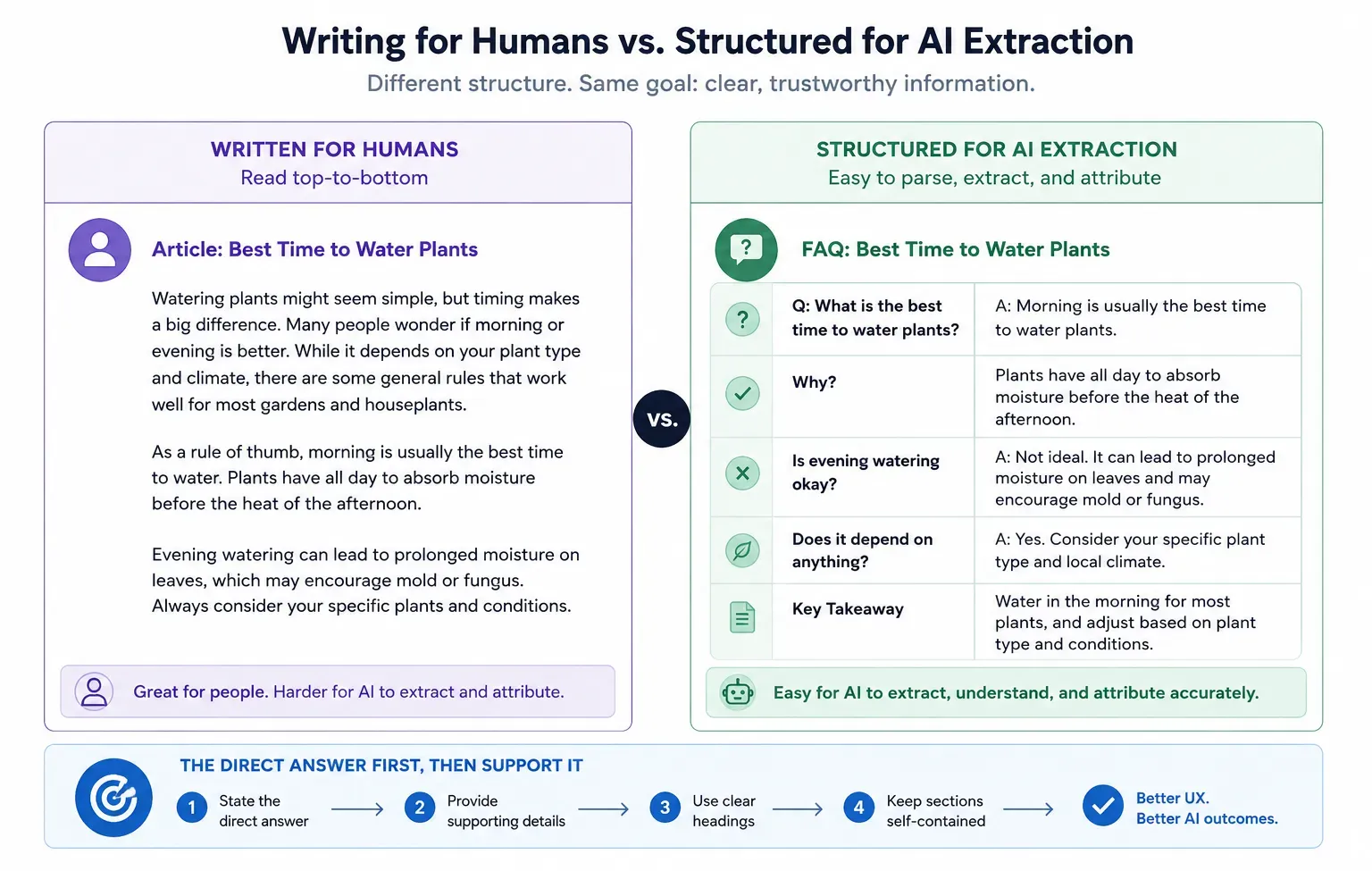
What works better: answer-first content. State the direct answer. Then support it. FAQ formats, structured headings, self-contained sections these aren’t just good UX practice anymore. They’re how AI systems extract and attribute content. A piece written for a human to read top-to-bottom and a piece structured for AI extraction look pretty different from each other.
The other piece is entity consistency. Your brand name, your product names, the specific topics you want to be associated with these need to appear consistently across your own content and across third-party mentions. AI systems build a model of “what is this entity about” from everything they’ve indexed or crawled. If your brand is described differently across your website, your LinkedIn, your press coverage, and your partners’ sites, that model is murky. Murky entities don’t get cited confidently.
Perplexity in particular uses what’s called entity reranking it has a preference for content that clearly establishes what something is, who made it, and why it’s relevant. Authoritative “best of” lists account for 64% of Perplexity’s general recommendation citations. So being mentioned in a roundup article on a high-authority site matters more for Perplexity than almost any other signal.
AI Visibility: Building a pattern of associating your brand with a topic
On the distribution side, the urgency is sharpest for businesses still treating AEO as a future concern. The $80 billion SEO industry is actively repricing itself around these signals. Early-moving businesses are already getting cited in AI answers at the expense of slower-moving competitors. The gap compounds. An AI system that cites you today is building a pattern of associating your brand with a topic. That association gets stronger over time.
But waiting has a cost. AI Overviews appear in a fraction of Google searches today not the majority. ChatGPT’s search feature is growing but still a fraction of Google’s daily volume. If your business runs primarily on local search, e-commerce with high-intent queries, or very specialized technical content, the AEO shift might be slower-moving for you than for a generalist content business.
The businesses that built strong Google authority early didn’t do it by watching Google’s market share tick up until it felt safe to invest. They built the asset before it was obviously necessary. AEO is the same dynamic. You’re building the citation footprint that will matter when 2028 arrives and the Gartner projection starts looking prescient.
If you want to implement this without building out a full-time content operation, the core workflow is: identify the questions your audience is asking, structure answers that AI systems can extract cleanly, monitor whether your content is appearing in AI-generated responses, and adjust. The most time-intensive part is the audit and monitoring step. Knowing which AI platforms are citing you, which competitors are getting cited instead of you, and which content pieces are close to being extracted but not quite making the cut. That’s not something you can do manually at scale.
Tools built specifically for AI visibility tracking can surface those gaps and give you a list of specific changes: which pages need answer-first rewrites, which entity mentions need to be amplified, which FAQ sections are missing entirely.
Build a content structure that ages well across multiple AI engines
The point is to know where you stand, fix the most significant gaps, and build a content structure that ages well across multiple AI engines not just the one with the biggest market share today.
Meridian, the hypothetical agency from earlier if they ran an AEO audit today, they’d probably find two things. Their long-form blog posts bury the answers too deep for AI extraction. Their brand entity is inconsistently described across their web presence, which makes it harder for AI systems to confidently associate them with their specialty. Neither of those is a catastrophic problem. Both are fixable.
Take AI SEO seriously because the information layer is fracturing. Google isn’t dying and ChatGPT won’t replace every search query. But there are now multiple AI systems with partially overlapping, partially divergent citation patterns that influence whether your brand shows up in the answers people get. Being visible on one doesn’t guarantee visibility on the others.
The future of search is a distribution problem across several AI engines, each with its own logic. The businesses that understand the distinction between how Perplexity cites versus how ChatGPT cites, that structure their content for extraction rather than just for reading, and that maintain consistent entity presence across the web those are the ones building something that compounds.
Related Posts
- 7 Best LLM Content Audit Tools for AI Visibility
Compare the best LLM content audit tools for tracking AI mentions, citations, sentiment and competitors, then turn gaps into a…
Read more about 7 Best LLM Content Audit Tools for AI Visibility - What Affects AI Brand Mentions in AI Search?
Learn what affects AI brand mentions across ChatGPT, Gemini and Google AI Overviews, then turn visibility data into a sharper…
Read more about What Affects AI Brand Mentions in AI Search? - SEO Tools Versus GEO Tools for AI Search
SEO tools versus GEO tools measure different battles: rankings in results and visibility in AI answers. Learn where each fits…
Read more about SEO Tools Versus GEO Tools for AI Search