





A buyer asks ChatGPT for the best payroll platform, Perplexity for reputable solar installers, or Google AI Overviews for an answer to a complex question. If your brand is absent from the response, your strongest traditional rankings may not matter at that moment. Learning how to increase AI citations is now a commercial priority: you are competing not only for a click, but for a place in the answer itself.
AI citations are not won by publishing more pages and hoping a model notices. Generative engines select sources they can identify, understand, verify and confidently use to support a response. The brands gaining ground treat this as a measurable visibility system, not a content guessing game.
What AI citations actually measure
An AI citation occurs when a generative search platform references a source while producing an answer. Depending on the platform and query, that reference might appear as a visible source link, a publisher name, a product recommendation, or an attributed claim. A brand mention is different: the model may name your business without linking to your site. You need to track both.
Citations indicate that a platform found a particular page useful enough to ground its answer. Mentions indicate that the model recognises your brand as relevant to the category. Neither is guaranteed by a high Google ranking, although sound SEO still provides a powerful foundation.
The opportunity varies by query. Research-heavy, comparison-led and high-consideration searches often create the strongest citation opportunity. A generic question may draw on large publishers, while a specific question about implementation, pricing, compliance or local availability may favour the company with the clearest first-party evidence.
Start with the prompts that drive revenue
Do not measure AI visibility with a random collection of broad keywords. Start with the questions that appear before a purchase, renewal, shortlist or enquiry. These are the prompts where being cited can change pipeline, not merely inflate a dashboard.
Map prompts across the buying journey. Early-stage prompts expose category visibility, such as what software is best for a certain use case. Mid-stage prompts reveal whether you appear in comparisons and alternatives. Late-stage prompts show whether AI platforms can accurately explain your pricing, features, service area, proof points and suitability.
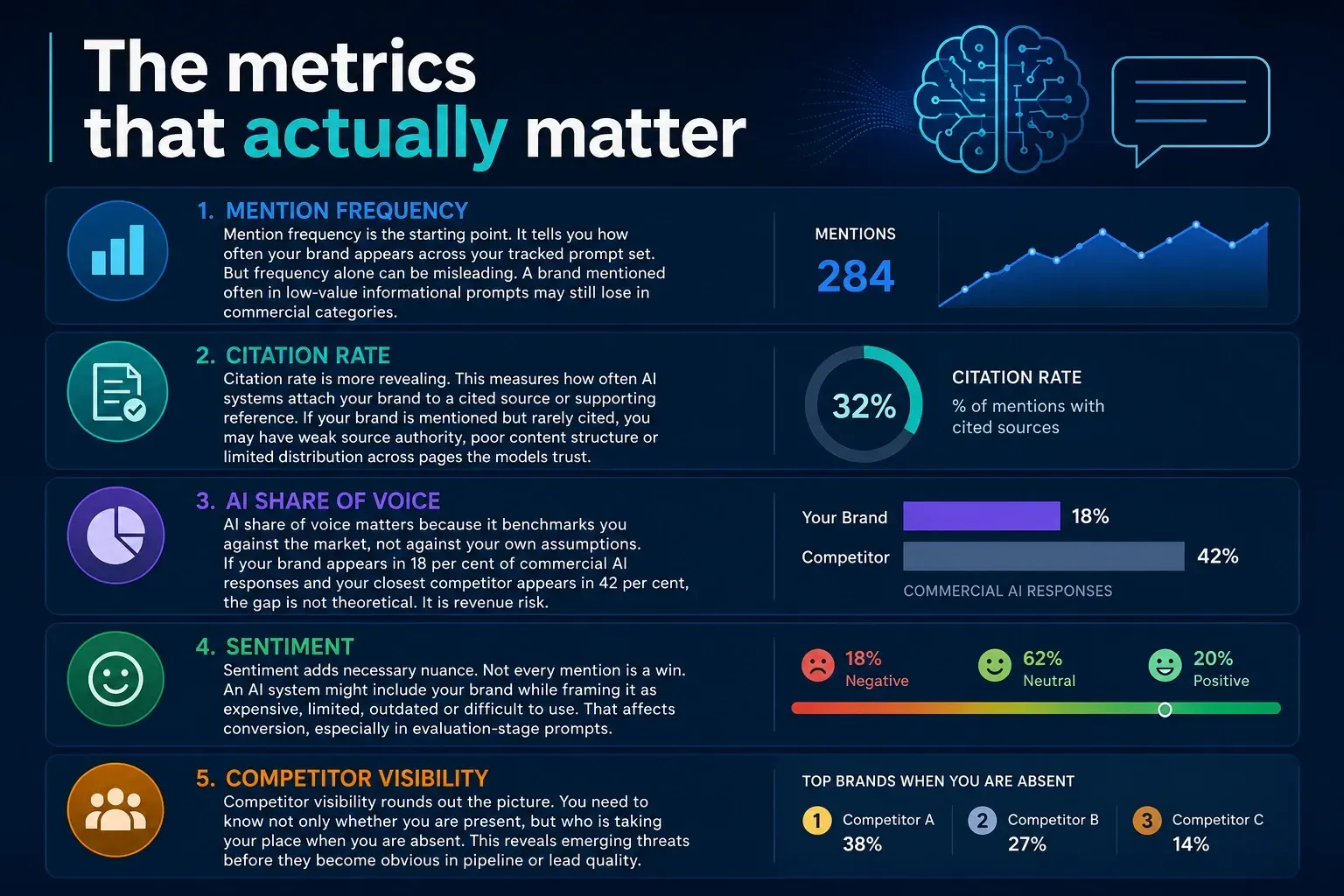
For each prompt, record which brands appear, which sources are cited, the response sentiment, and whether the answer gets key facts right. Then compare your visibility against the competitors taking space you should own. A competitor may outrank you in AI answers not because it has better products, but because it has published clearer evidence for the exact questions buyers ask.
This is where an AI visibility tracker earns its keep. Rather than checking isolated prompts by hand, teams need a repeatable view of citation rate, mention frequency, AI share of voice, sentiment and platform-level performance across ChatGPT, Claude, Gemini, Perplexity and Google AI Overviews.
Build citation-worthy source pages
Generative engines need useful material to retrieve and cite. Thin service pages, vague thought leadership and recycled product language give them little to work with. Your priority is to create pages that answer a defined question with evidence, context and a clear point of view.
The strongest candidates are often not your homepage. They are practical guides, detailed product pages, comparison pages, implementation explainers, industry research, original data and customer evidence. A page should make a claim, explain it, show how it works and give the reader enough detail to assess it.
For example, a B2B software company should not stop at saying it offers reporting. It should explain which reports exist, who uses them, what inputs they require, how long setup takes, what limitations apply and where the product differs from alternatives. Specificity makes content more helpful for people and easier for AI systems to represent accurately.
Original evidence is especially valuable. Proprietary survey findings, benchmark data, documented methodology, expert commentary and concrete case study results create information that cannot be copied from ten other websites. You are giving generative platforms a reason to cite your source instead of a generic aggregator.
Structure pages so machines can interpret them
Clear writing alone is not enough. Citation-ready pages are easy to parse. Use descriptive headings that match real questions, place the direct answer near the top, and support it with concise explanatory sections. Keep definitions, product specifications, pricing conditions and claims consistent across your site.
Where relevant, use tables for genuine comparisons, FAQs for recurring customer questions and structured data to clarify page type, organisation details, products, reviews and articles. Structured data does not force a citation, but it reduces ambiguity. So does a clean technical foundation: crawlable pages, sensible internal linking, stable URLs and fast mobile performance.
Avoid hiding essential information in images, gated PDFs or interactive tools that search systems may struggle to interpret. If a fact matters to a buyer, publish it in accessible page copy as well.
Strengthen the entity behind the content
AI systems do not assess pages in isolation. They build a picture of entities: your company, products, leaders, locations, customers and category relationships. If that picture is fragmented or contradictory, your content may be harder to trust and less likely to surface.
Make core brand facts consistent everywhere you control. That includes your business name, description, product names, founder or expert bios, service locations, contact details and claims about awards or certifications. The same standard applies to third-party profiles, industry directories, review platforms and media coverage.
Credibility also comes from independent corroboration. Earned coverage, expert contributions, analyst references, quality reviews and reputable partner pages can validate the claims on your own site. Do not chase mentions for their own sake. A weak directory listing will not carry the same weight as a credible source that explains why your business is relevant.
This is an area where trade-offs matter. Some brands overinvest in top-of-funnel publishing when their factual business information is inconsistent. Others chase every external placement while their own product pages remain vague. Fix the foundation first, then build authority around the topics where you need to win.
Optimise for each AI platform without creating five strategies
The platforms do not behave identically. Perplexity is visibly source-led, so timely, well-structured pages with clear evidence can have a direct path to citations. Google AI Overviews often reflects the wider search ecosystem, making technical SEO, topical authority and helpful content critical. ChatGPT, Gemini and Claude may produce answers from different retrieval systems, model knowledge and connected search experiences.
That does not mean producing separate content for every platform. It means monitoring where performance differs and investigating why. If your brand is cited in Perplexity but missing from Google AI Overviews, the issue may be search visibility or page accessibility. If you are mentioned positively but not cited, you may need stronger owned resources that substantiate the claims the model already associates with your brand.
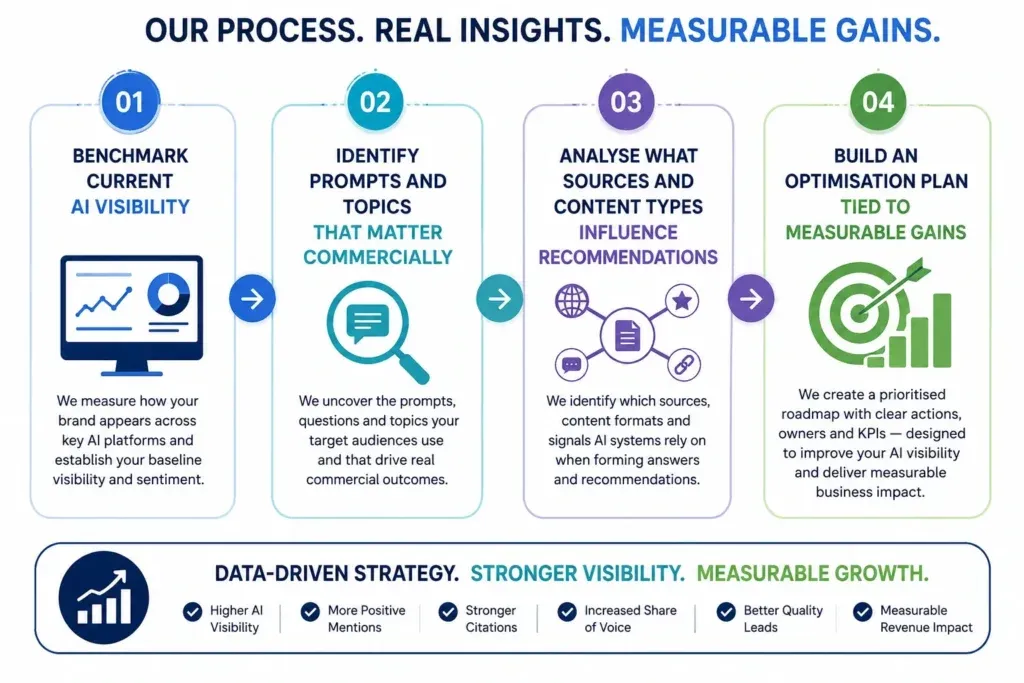
One operating model is enough: identify high-value prompt gaps, improve or create the best source asset, strengthen the relevant entity signals, then measure the response by platform. Repeat based on movement, not assumptions.
Turn competitor citations into an action plan
Your competitors are showing you which information AI platforms currently reward. Review the pages cited for competitor brands and look beyond the obvious domain authority. What question do they answer? Which facts are included? Is the page a comparison, a data study, a review, a documentation page or a third-party article?
Then identify the gap you can credibly fill. You may need a clearer comparison page, a more detailed implementation guide, current pricing explanations, customer proof for a disputed claim, or a piece of original research. Do not imitate a competitor’s wording. Build the source that is more accurate, more current and more useful for the decision-maker.
Prioritise work by commercial value and likelihood of impact. A missing citation for a high-intent prompt deserves more attention than a broad informational query with no connection to revenue. aigeo insights can translate these visibility gaps into a scored optimisation roadmap, helping teams decide what to create, update, structure or distribute next.
Measure gains, then protect them
AI visibility is volatile. Platforms change their source selection, competitors publish new assets and facts become stale. A page that earns citations this quarter can disappear next quarter if it is no longer the best available answer.
Track citation rate, brand mention frequency, AI share of voice, sentiment, competitor movement and the accuracy of responses over time. Segment results by prompt category, product line and platform. This reveals whether your work is improving the answers that matter or merely generating activity.
When a citation appears, inspect the page and preserve what is working. When it disappears, check for content changes, technical issues, new competing sources or a mismatch between the prompt and your page. GEO is not a set-and-forget project. It is a performance discipline built around evidence, iteration and speed.
The battle for the answer has begun. Publish the clearest proof, measure where your brand is missing, and give AI platforms a better reason to cite you than anyone else.
Related Posts
- GEO Versus SEO Strategy for Modern AI Search
Compare GEO versus SEO strategy, learn what each measures, and build a visibility plan that earns rankings, citations and AI…
Read more - How to Measure Brand Visibility in AI Search
Learn how to measure brand visibility across AI search, track share of voice, citations and sentiment, and turn visibility gaps…
Read more - What an AI Search Visibility Tool Should Do
See what an AI search visibility tool should track, why rankings miss the point, and how brands can lift citations,…
Read more