
A prospect asks ChatGPT for the best payroll platform, a trusted solar installer or a B2B cybersecurity provider. Your brand may have page-one rankings, strong reviews and a healthy paid search budget. But if the AI response names three competitors and skips you, you have lost the moment that matters.
AI visibility is the measure of how often, how positively and in what context your brand appears in AI-generated answers. It is fast becoming a commercial metric, not a future-facing experiment. As generative search becomes part of how buyers research, compare and shortlist, brands are competing to become the answer rather than simply earn the click.
AI visibility changes the rules of discovery
Traditional search rewards the page that ranks. Generative engines assemble an answer from many possible sources, then decide which brands, claims and citations deserve inclusion. The result may contain no blue links at all, or it may cite only a handful of sources. That changes what visibility means.
A high organic ranking still matters, but it is no longer a guarantee of recommendation. A brand can rank well for a commercial query and remain absent from ChatGPT, Gemini, Claude, Perplexity or Google AI Overviews. Conversely, a competitor with clearer product information, stronger third-party validation and more useful comparison content can appear repeatedly, even when its conventional rankings are less impressive.
This is the battle for the answer. Buyers increasingly receive a compressed version of the market before they visit a website. The brands named in that first answer gain familiarity, authority and a place on the shortlist. The brands excluded must work harder to recover consideration later in the journey.
What to measure beyond mentions
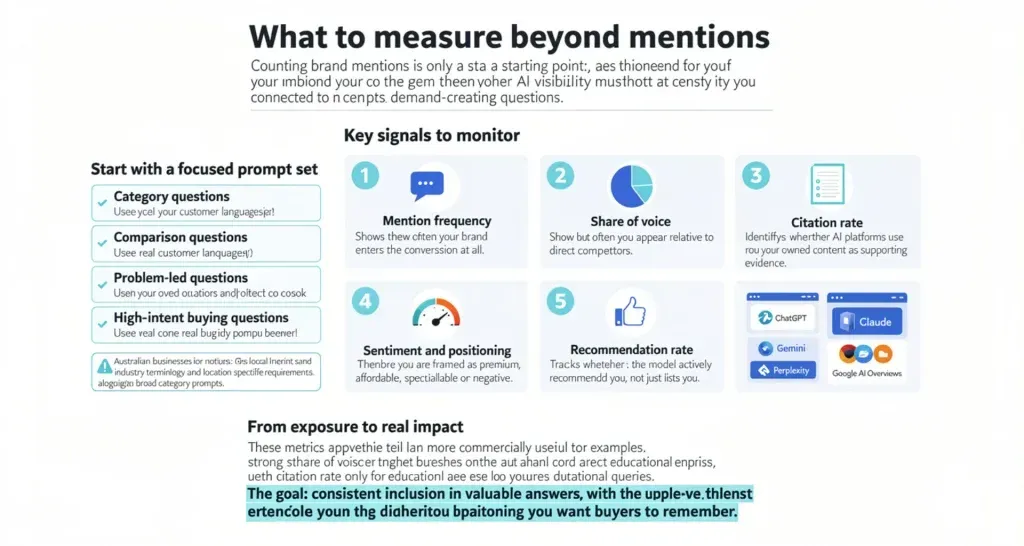
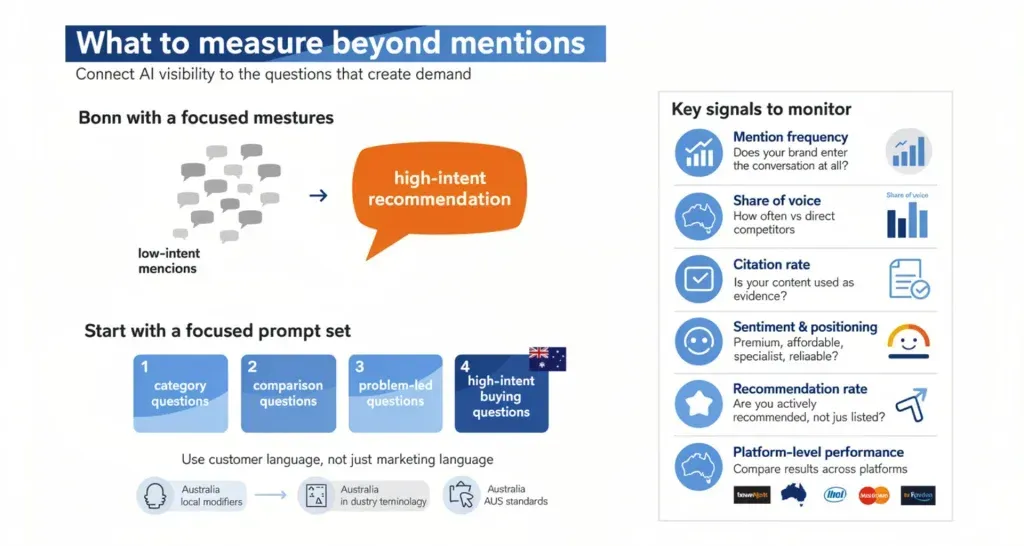
Counting brand mentions is a useful starting point, but it is not enough. Ten passing mentions in low-intent prompts may be less valuable than one recommendation when a buyer asks which provider is best for their exact use case. The right measurement system connects AI visibility to the questions that create demand.
Start with a focused prompt set: category questions, comparison questions, problem-led questions and high-intent buying questions. Include the language customers use, not just the language used inside marketing plans. For an Australian business, that can mean testing local modifiers, industry terminology and location-specific requirements alongside broad category prompts.
Then monitor several signals together:
- Mention frequency shows whether your brand enters the conversation at all.
- AI share of voice reveals how often you appear relative to direct competitors.
- Citation rate identifies whether AI platforms use your owned content as supporting evidence.
- Sentiment and positioning show whether you are described as premium, affordable, specialist, reliable or something less helpful.
- Recommendation rate tracks whether the model actively puts you forward, rather than merely listing you.
- Platform-level performance exposes the gap between ChatGPT, Claude, Gemini, Perplexity and Google AI Overviews.
These metrics tell a more commercially useful story. A brand may have a strong share of voice but weak sentiment. Another may be cited often but only for educational queries, not buying decisions. The goal is not generic exposure. It is consistent inclusion in valuable answers, with the positioning you want buyers to remember.
Why platform differences matter
There is no single AI search result. Each platform retrieves, interprets and presents information differently. One may favour recent editorial coverage. Another may cite structured product pages, review sites or authoritative explainers. Google AI Overviews sits especially close to the established search ecosystem, while conversational platforms can produce broader recommendations based on the way a question is framed.
That means a single score can hide the problem. If your brand performs well in Perplexity but is absent from Gemini, the next action may not be more content. It may be improving page structure, clarifying product entities, strengthening supporting evidence or addressing an information gap that a competitor has already filled.
The assets that earn AI citations
Generative engines need material they can interpret with confidence. Thin category pages, generic thought leadership and polished but unsupported claims give them little to work with. The strongest assets reduce ambiguity and make the case for your brand in plain language.
For most teams, the first priority is the commercial core of the website. Product and service pages should clearly explain who the offering is for, the problem it solves, key capabilities, pricing approach where appropriate, implementation details and meaningful proof. Avoid making visitors – or models – infer the basics.
Comparison content is equally powerful because buyers ask comparative questions. Pages that fairly explain alternatives, use cases, limitations and decision criteria can help shape the recommendation set. The word ‘fairly’ matters. Overblown claims and competitor-bashing weaken credibility. A useful comparison acknowledges trade-offs and shows where your offer fits best.
Evidence is another visibility lever. Publish case studies with specific outcomes, original research, expert perspectives, customer proof and clear methodology. If you claim faster implementation, better reporting or lower total cost, support it. AI systems are designed to synthesise information, and specific, well-supported information is easier to reuse than vague marketing copy.
Finally, make important information easy to extract. Clear headings, direct answers, consistent terminology, structured FAQs where they genuinely answer customer questions, and properly maintained company details all help. This is not about writing for a robot. It is about removing friction for every reader and system trying to understand your business.
Turn visibility data into an operating plan
The common failure is treating AI monitoring as another dashboard. A chart may prove that competitors are gaining ground, but it does not tell the content team what to do on Monday morning. Visibility intelligence only becomes valuable when it creates a prioritised action plan.
Look for gaps with revenue potential. If competitors are regularly recommended for a high-intent query and your brand is not mentioned, investigate the sources behind the answer. Do they have a dedicated use-case page? Better independent validation? A clearer explanation of integrations, compliance or pricing? The answer may point to a content update, a new page, stronger distribution or a reputation issue that needs attention.
Prioritise work by expected impact, not by publishing volume. Updating one weak solution page that influences a cluster of buying prompts can outperform ten broad blog posts. Likewise, a new comparison page may be worthwhile if prospects repeatedly ask a question your site does not answer. The best GEO programmes connect each task to a measurable visibility opportunity.
This is where a platform such as aigeo insights changes the workflow. Instead of merely reporting mention gaps, it can translate cross-platform data, competitor movement, citations and sentiment into an optimisation roadmap. Teams can see what to create, refresh, structure or distribute, then track whether those actions improve their presence in the answers that matter.
Avoid the shortcuts that damage trust
AI visibility is not won by stuffing pages with model names, manufacturing citations or publishing hundreds of lightly edited articles. Those tactics create noise, and they can undermine the quality signals your brand needs to earn lasting recommendation.
It also pays to resist the temptation to chase every prompt. A national retailer, a specialised consultancy and a local service business will each have different visibility priorities. The right prompt universe depends on where demand originates, how long the buying cycle is and whether the customer needs broad education or immediate provider selection.
Treat AI answers as a live market signal. They can be wrong, incomplete or inconsistent, so do not blindly optimise to every output. Test patterns over time, validate the claims being made about your business and competitors, and use human judgement to decide what deserves action. The objective is not to manipulate a single response. It is to build a body of clear, credible information that earns inclusion repeatedly.
The brands that win this shift will not wait for traffic reports to reveal the damage. They will measure where they appear, understand why competitors are being recommended, and improve the assets that influence the next answer a buyer receives. Start with the questions your customers are already asking. That is where visibility turns into demand.
Related Posts
- AI Optimisation Services for AI Search Visibility
AI optimisation services turn brand visibility data into the content, authority and technical actions needed to win citations in AI…
Read more about AI Optimisation Services for AI Search Visibility - How to Map Brand Entities for AI Search Visibility
Learn how to map brand entities, connect the signals AI uses, find gaps and build a stronger path to citations,…
Read more about How to Map Brand Entities for AI Search Visibility - How to Measure Brand Visibility in AI Search
Learn how to measure brand visibility across AI search, track share of voice, citations and sentiment, and turn visibility gaps…
Read more about How to Measure Brand Visibility in AI Search