
A buyer asks ChatGPT for the best payroll platform, a Gemini user compares agencies, or a prospect checks Perplexity before booking a demo. In each case, the answer may shape the shortlist before anyone reaches a traditional search result. That is why essential generative search metrics are now commercial intelligence, not a nice-to-have reporting layer.
Ranking reports cannot tell you whether AI systems mention your brand, describe it accurately, cite your content, or recommend a competitor instead. Generative Engine Optimisation requires a different scoreboard – one that measures presence, authority and perception inside the answers people actually receive.
Why traditional SEO metrics leave a gap
Organic traffic, keyword rankings and backlinks still matter. They show whether your site can be found and whether its authority is growing. But generative search changes the journey: users often receive a synthesised answer without clicking through to any source at all.
A page can rank well and still fail to appear in AI answers. Equally, a smaller but highly specific asset may earn citations because it answers a question cleanly, contains credible evidence and is easy for a model to interpret. The gap between ranking and being recommended is where brands can quietly lose market share.
The goal is not to replace SEO reporting. It is to add the measurements that reveal whether your authority survives the move from a list of links to a single generated response.
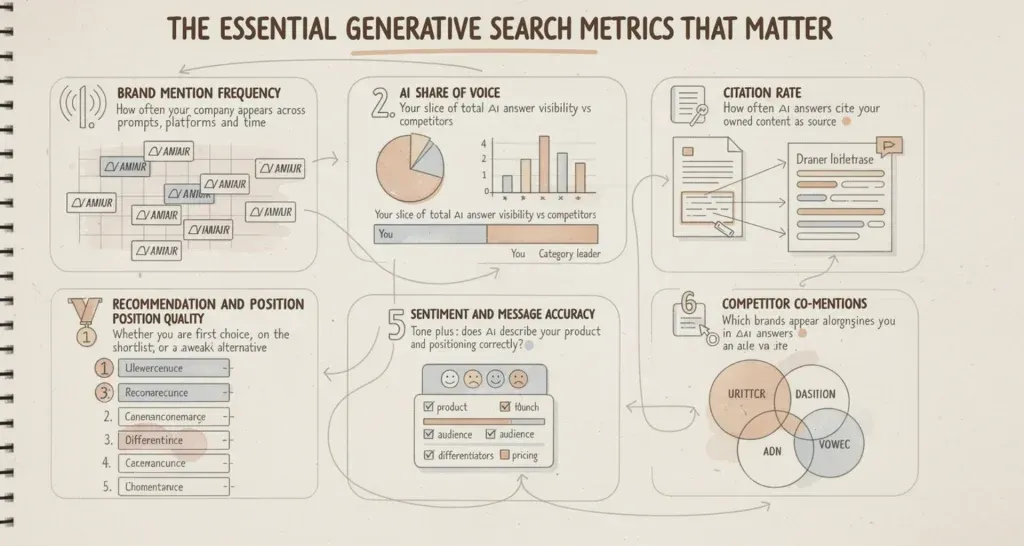
The essential generative search metrics that matter
1. Brand mention frequency
Brand mention frequency measures how often your company appears across a defined set of prompts, platforms and reporting periods. It is the most direct indicator of whether your brand is participating in the answer economy.
Track mentions by prompt category, not just as one blended total. A B2B software company may appear frequently for broad category questions but disappear when buyers ask implementation, pricing, migration or compliance questions. Those gaps are where revenue leaks.
Frequency alone is not a win. A passing mention in a long list is less valuable than inclusion in a shortlist or direct recommendation. Still, it is the baseline: a brand that is never mentioned cannot influence consideration.
2. AI share of voice
AI share of voice shows how much of the available brand visibility your business owns compared with competitors. If your brand appears in 20 of 100 tracked answers and the category leader appears in 55, you have a clear competitive benchmark rather than a vague sense that they are “winning AI”.
This metric becomes especially useful when segmented by topic. You might lead in service-related prompts while losing badly on comparison, best-of or problem-solving prompts. That distinction tells the team whether to build category education, strengthen proof points or publish clearer comparison content.
Treat share of voice as directional intelligence, not a vanity percentage. Prompt sets need to reflect real customer questions, buyer stages and the language used in your market. A poorly chosen prompt library creates a neat-looking dashboard with very little commercial value.
3. Citation rate
Citation rate measures how often AI platforms use your owned content as a source when generating answers. It is one of the strongest signals that your content is being recognised as evidence, not merely that your brand name is known.
A high citation rate can support trust, referral traffic and future visibility. More importantly, it exposes which assets are earning authority. Look for patterns in cited pages: original research, detailed product documentation, expert explainers, clear pricing information, local pages and structured comparison content can all perform differently depending on the category.
Do not assume every platform cites sources in the same way. Perplexity is citation-forward, while other models may surface brands without showing a visible source. Measure citation behaviour platform by platform, then use those findings to guide content priorities.
4. Recommendation and position quality
Being mentioned is not the same as being recommended. Position quality measures where and how your brand appears in an answer: first choice, included shortlist, neutral reference, caveated option or excluded alternative.
This is where qualitative review matters. If a model consistently positions your company as “best for small teams” while you are targeting enterprise buyers, your visibility may be high but strategically wrong. If the answer pairs your brand with outdated limitations, the issue is reputation and message clarity, not reach.
Use a simple scoring model that reflects your goals. A direct recommendation should carry more weight than an unqualified mention, while negative context should reduce the score. This makes performance movement meaningful for leadership, not just interesting for the search team.
5. Sentiment and message accuracy
Sentiment tracks the tone associated with your brand, but generative search demands more than positive, neutral or negative labels. You also need message accuracy: does the platform describe your product, audience, differentiators and pricing model correctly?
An answer can be positive and still harmful. Calling an enterprise security platform affordable for sole traders, or describing a specialist service as a generalist provider, may attract poor-fit leads and confuse the market. Track recurring claims alongside sentiment so your team can identify what needs correcting.
Negative sentiment should be investigated quickly, especially when it is tied to product reliability, security, customer service or pricing. Some issues require better content and stronger third-party validation. Others point to an operational problem that content cannot fix. The data should trigger the right response, not a cosmetic one.
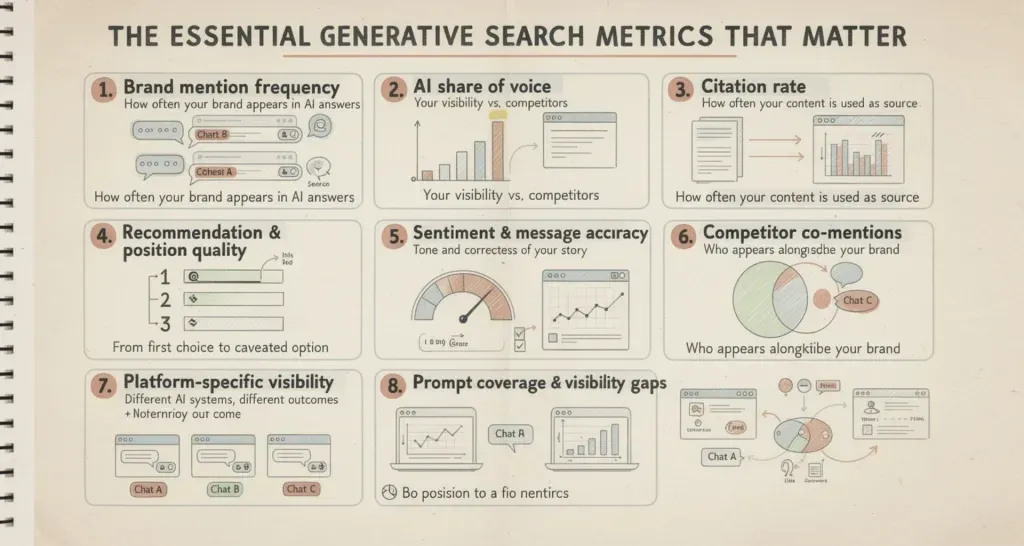
6. Competitor co-mentions
Co-mention analysis identifies which brands repeatedly appear beside yours. These are not always the competitors you expected. AI systems often group businesses based on use case, reputation, category language and content overlap rather than the competitor list in your board deck.
Watch for two signals. First, which competitors are included when you are not? Second, which competitors appear with you but receive the stronger recommendation? The first reveals visibility gaps; the second reveals positioning gaps.
This metric is particularly valuable for agencies and multi-product businesses. It can show whether each offer is competing in the right category, or whether the market is collapsing your distinct services into one generic bucket.
7. Platform-specific visibility
ChatGPT, Claude, Gemini, Perplexity and Google AI Overviews do not behave like one channel. Their source preferences, answer formats and degrees of citation visibility differ. A brand that performs well in one environment may be almost absent in another.
Reporting one aggregate score hides this reality. Break out mention frequency, citations, sentiment and share of voice by platform. If Google AI Overviews regularly surface your content but conversational models do not, investigate the content formats, entities and external signals driving that difference.
There is no universal platform winner for every business. The priority depends on where your customers research, the intent behind their questions and whether the platform produces visible citations or influences discovery earlier in the journey.
8. Prompt coverage and visibility gaps
Prompt coverage measures the proportion of strategically important questions where your brand appears. It turns a sprawling universe of possible AI queries into an accountable coverage map.
Group prompts by funnel stage and intent: category discovery, problem education, solution evaluation, comparisons, pricing, implementation and alternatives. Then identify the high-value groups where your visibility is weak. A 10-point improvement on decision-stage comparison prompts can be worth far more than a broad lift in early-stage awareness.
This is also the metric that makes optimisation practical. Instead of telling a writer to “improve GEO”, you can assign a precise brief: build evidence for a missing use case, update an outdated product page, create a comparison asset or add expert commentary to a topic where competitors dominate.
9. Visibility trend and action impact
Generative search is volatile. Models update, source pools shift and competitors publish new material. A single snapshot can mislead, so track change over time and connect it to the work your team has completed.
Measure visibility before and after a meaningful action: publishing original data, refreshing a key guide, improving schema, securing credible third-party coverage or clarifying product information. You will not always see an immediate lift, and attribution is rarely perfect. But consistent trend tracking helps separate productive work from activity that merely feels busy.
Aigeo insights brings these signals into one operating view, then turns the gaps into prioritised optimisation tasks. That matters because a dashboard without a next move is just another report.
Ready to get started?
A one-line nudge that earns the click below.
Turn generative search data into decisions
The strongest GEO programmes do not chase every mention. They focus on the prompt clusters that influence revenue, the platforms that matter to buyers and the competitors taking meaningful share of voice.
Start with a baseline across a focused, commercially relevant prompt set. Review where your brand is absent, misrepresented or cited less often than competitors. Then prioritise actions based on likely impact: strengthen the pages AI already references, create assets for high-value coverage gaps and resolve inaccurate claims before they harden into category perception.
The battle for the answer has begun. Measure what AI says when your team is not in the room, then give it better evidence to work with.
Related Posts
- Competitor Tracking in Generative Search
Your competitors can outrank you without ranking above you. That is the shift most teams still underestimate. Competitor tracking in…
Read more about Competitor Tracking in Generative Search - 7 Generative Search Trends Reshaping Brand Visibility
Generative search trends are changing how Australian brands earn mentions, citations and demand. Learn what to measure and where to…
Read more about 7 Generative Search Trends Reshaping Brand Visibility - Generative Search Content Optimisation Guide
This generative search content optimisation guide shows Australian marketing teams how to earn AI citations, lift share of voice and…
Read more about Generative Search Content Optimisation Guide