
AI search does not return a page of blue links and leave the buyer to decide. It actively frames the category, selects sources, names providers and often recommends a shortlist. This generative search audit guide shows how to measure whether your brand is part of that answer – or whether a competitor is capturing demand before your site receives a visit.
For Australian growth teams, the shift has real commercial consequences. A strong organic ranking still matters, but it no longer guarantees that ChatGPT, Gemini, Perplexity, Claude or Google AI Overviews will mention your company. Generative engines make their own decisions about which brands, claims and sources deserve inclusion. Your audit needs to reveal those decisions, then turn them into a prioritised optimisation plan.
What a generative search audit actually measures
A conventional SEO audit reviews crawlability, rankings, backlinks, content quality and conversion paths. A generative search audit examines a different outcome: how AI systems represent your brand when people ask commercial, comparative and problem-led questions.
The goal is not to chase a single position. AI responses vary by platform, prompt wording, location, user history and model updates. The goal is to establish a reliable visibility baseline across a prompt set that reflects real buyer intent, then identify repeatable gaps in your brand’s authority, coverage and representation.
A useful audit measures five connected signals: brand mention frequency, citation rate, AI share of voice, sentiment and competitor visibility. Together, they answer the questions that matter to marketing leaders: Are we being recommended? Are AI engines citing our assets? Is the description accurate? Which competitors appear more often? And where should the team act first?
Start with the questions buyers ask AI
An audit is only as useful as its prompt set. Tracking a handful of branded queries can create false confidence because an established customer may already know your name. The battle for the answer happens earlier, when a prospect asks AI to define a problem, compare options or choose a provider.
Build prompts around your sales funnel and the language customers use. For a B2B software company, that might include questions such as “What are the best customer data platforms for mid-market retailers in Australia?” or “How do I compare customer data platform vendors?” A local service business may focus on location and service intent, while ecommerce brands should test product category, use-case and alternatives queries.
Group prompts into four practical intent types:
- Discovery prompts, where users ask how to solve a problem or understand a category.
- Consideration prompts, where users request tools, providers, features or selection criteria.
- Comparison prompts, where users weigh your brand against named alternatives.
- Validation prompts, where users test reputation, pricing, suitability, security or reviews.
Include regional wording where it reflects your market. An Australian buyer may ask about GST, local compliance, delivery times or support hours. If your business sells nationally but competitors have stronger local relevance, those queries can expose a visibility gap that a global audit misses.
Run the audit across each major AI surface
Treat generative search as a fragmented channel, not a single ranking system. A brand may appear strongly in Perplexity because it cites editorial sources, yet disappear from Google AI Overviews where page structure and Google’s source selection behave differently. ChatGPT, Claude and Gemini can also describe the same company in sharply different terms.
For each prompt, record whether the brand appears, its position or prominence in the answer, the sentiment of its description and any source cited beside it. Capture the same evidence for your primary competitors. Screenshots and raw outputs are useful for quality review, but structured data is what turns observations into a management system.
Run tests repeatedly rather than treating the first output as fact. AI results are probabilistic. A single favourable mention may be noise; a recurring competitor recommendation across multiple prompts and platforms is a market signal. Set a regular cadence, especially after major content releases, product changes or competitor campaigns.
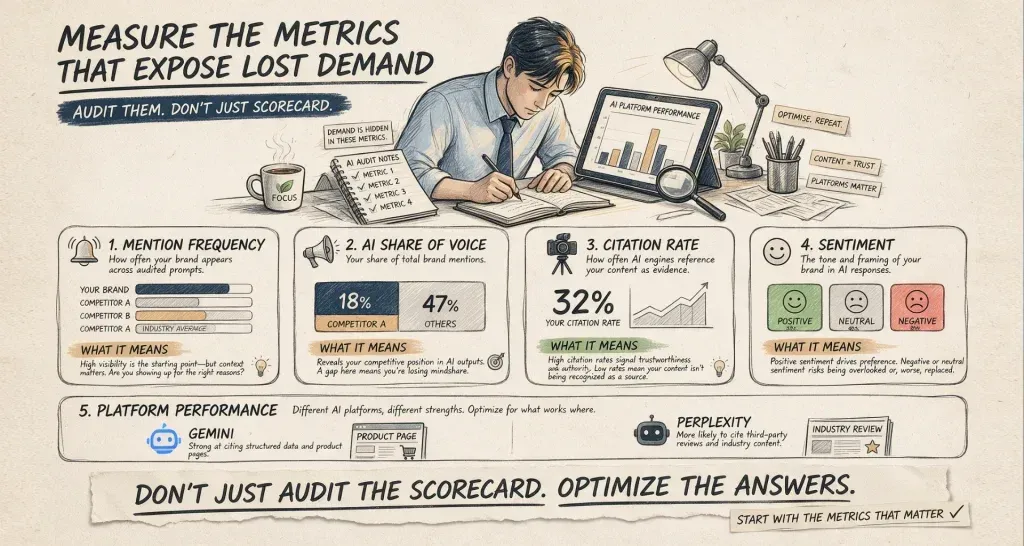
Measure the metrics that expose lost demand
The audit should not stop at a scorecard. Each metric needs a commercial interpretation.
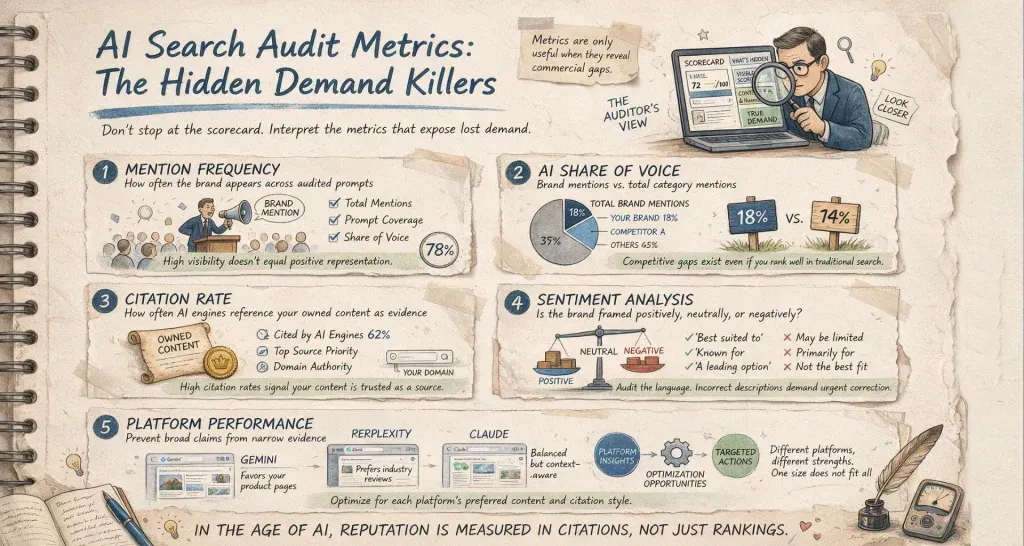
Mention frequency shows how often your brand appears across the audited prompts. It is the clearest starting point for visibility, but not proof of positive representation. A company can be mentioned only as an expensive alternative or a weak fit.
AI share of voice compares your mentions with the category’s total brand mentions. If your business appears in 18 of 100 brand references while a competitor receives 35, the competitive gap is clear even if you rank well in traditional search.
Citation rate measures how often AI engines reference your owned content as evidence. High citation rates signal that engines recognise your material as source-worthy. Low citations may indicate thin topical coverage, inaccessible content, weak supporting evidence or stronger third-party sources elsewhere.
Sentiment identifies whether the model frames your brand positively, neutrally or negatively. Audit the language itself. Phrases such as “best suited to”, “known for” and “a leading option” carry a different commercial weight from “may be limited” or “primarily for”. Incorrect descriptions demand urgent correction through clearer on-site content and credible external corroboration.
Platform performance prevents teams from making broad claims from narrow evidence. If Gemini consistently cites your product pages while Perplexity prefers industry reviews, you have two distinct optimisation opportunities rather than one vague GEO problem.
Find the source gap behind the visibility gap
When AI omits a brand, the answer is rarely “publish more content” without qualification. The problem may be relevance, evidence, structure, distribution or entity clarity. Your audit should compare the sources supporting competitor mentions with the sources available for your brand.
First, inspect the pages and third-party materials that AI engines cite for competitors. Are they detailed comparison pages, original research, customer case studies, directory profiles, expert reviews or publisher coverage? Look for patterns in how claims are supported. A competitor may win because independent sources repeatedly verify a capability that your website merely asserts.
Then review your own content against the prompt set. Does every high-value buyer question have a clear, current page that gives a direct answer? Are product features, pricing logic, industries served and differentiators explicit? Can a model identify who you are, what you offer, where you operate and why you are credible without inferring it from marketing language?
Structure matters, but it is not a shortcut. Clear headings, concise definitions, tables where comparison genuinely helps, schema markup and consistent entity details make content easier to interpret. They cannot compensate for unsupported claims or a lack of useful information. The strongest GEO assets combine extractable structure with specific expertise that competitors cannot cheaply copy.
Turn findings into a GEO action plan
The audit becomes valuable when it produces a ranked backlog, not a slide deck full of red flags. Score each opportunity by commercial value, current visibility gap, implementation effort and likelihood of improving AI representation.
Start with prompts that signal active consideration and have a significant competitor gap. If customers asking for “best” providers consistently receive three competitor names but not yours, build or strengthen the evidence needed for inclusion. This could mean refreshing a comparison page, publishing a use-case guide, clarifying product documentation, improving an expert profile or earning credible third-party coverage.
Next, fix representation issues. If AI mentions your brand but gets your audience, product capabilities or positioning wrong, update the pages that establish those facts. Use plain language. Repeated, consistent statements across product pages, help content, company information and reputable third-party profiles reduce ambiguity.
Finally, monitor the result at the prompt level. Do not declare success because one new page has been indexed or one model produced a favourable response. Look for sustained gains in mention frequency, citations, share of voice and sentiment over several measurement cycles.
This is where a platform such as aigeo insights changes the operating model. Rather than asking teams to manually collect inconsistent outputs, it tracks visibility across leading generative engines and translates gaps into prioritised actions. That matters when competitors can gain answer-share while a monthly SEO report still looks healthy.
Common audit mistakes that waste time
The most common mistake is auditing only branded prompts. It measures awareness, not category competitiveness. The second is treating all mentions as equal. A passing reference in a long response is not the same as being recommended first with a citation.
Teams also overreact to single AI outputs. Generative search is variable, so use repeated tests and patterns before shifting budget. At the other extreme, some teams wait for perfect attribution. You may not always know exactly why a model selected one source, but clear visibility trends are enough to prioritise better content, stronger proof and broader authority.
Do not separate GEO from the rest of your marketing either. Product marketing defines the claims, SEO improves findability, content supplies depth, PR builds independent validation and sales teams hear the objections buyers bring from AI research. The audit should give these teams a shared view of the answer economy, not create another isolated dashboard.
The brands that win AI search will not be those that publish the most pages. They will be the brands that repeatedly give generative engines credible, specific reasons to include them when the buying question is asked. Run the audit, act on the highest-value gaps and keep measuring – because the answer your buyer sees is now a competitive asset.
Related Posts
- Generative Search Content Optimisation Guide
This generative search content optimisation guide shows Australian marketing teams how to earn AI citations, lift share of voice and…
Read more about Generative Search Content Optimisation Guide - GEO Workflow Guide for Winning AI Search Visibility
This GEO workflow guide shows marketing teams how to measure AI visibility, prioritise fixes, and earn more brand mentions and…
Read more about GEO Workflow Guide for Winning AI Search Visibility - AI Optimisation Services for AI Search Visibility
AI optimisation services turn brand visibility data into the content, authority and technical actions needed to win citations in AI…
Read more about AI Optimisation Services for AI Search Visibility