
AI answers are already shaping which brands buyers notice, trust and contact. Yet most marketing teams still measure visibility through rankings, clicks and traditional referral traffic alone. LLM monitoring software closes that gap by showing how generative platforms describe your brand, whether they cite your content and which competitors are winning the recommendation.
For Australian growth teams, this is not a future-search problem. A prospect can ask ChatGPT for accounting software, Gemini for a local service provider, or Perplexity for a B2B platform comparison and form an opinion before visiting a website. If your brand is absent, inaccurately represented or consistently outranked in those answers, conventional SEO reporting will not tell you soon enough.
What LLM monitoring software actually measures
The phrase can mean two different things. Engineering teams may use LLM monitoring to track model latency, token costs, prompt failures and unsafe outputs within an AI application. That matters when you are operating your own AI product.
For marketers, agencies and commercial leaders, LLM monitoring software is about brand visibility inside AI-generated answers. It measures whether generative search platforms mention your company when people ask category, comparison, problem and purchase-intent questions. More importantly, it turns vague concern about “AI search” into a measurable competitive position.
A useful platform tracks several connected signals. Brand mention frequency shows how often your business appears across a defined prompt set. Citation rate shows whether AI systems reference your owned content or trusted third-party sources that feature you. AI share of voice compares your presence with named competitors. Sentiment reveals whether the wording around your brand is positive, neutral or negative.
Platform-level reporting matters as well. ChatGPT, Claude, Gemini, Perplexity and Google AI Overviews do not produce the same responses or rely on information in exactly the same way. A brand may be highly visible in one environment and virtually invisible in another. Combining those results into a single score without the underlying detail can hide the opportunity.
Why AI visibility needs a different measurement system
A top organic ranking is useful, but it is no longer the whole contest. In a traditional search result, the user sees a page of options. In an AI answer, the platform may narrow that field to two or three brands, provide a direct recommendation and explain why it made the selection.
That changes the commercial stakes. Being listed third in a standard result is not the same as being omitted from an answer that names two competitors as the obvious choices. The battle for the answer has begun, and visibility must be measured at the answer level.
It also changes how teams diagnose performance. A traffic decline may arrive weeks after a brand has lost AI share of voice. By then, a competitor may have strengthened its category associations, accumulated more citations and become the default recommendation for valuable prompts. Monitoring lets teams see that movement earlier and respond with evidence rather than guesswork.
The metrics that lead to action
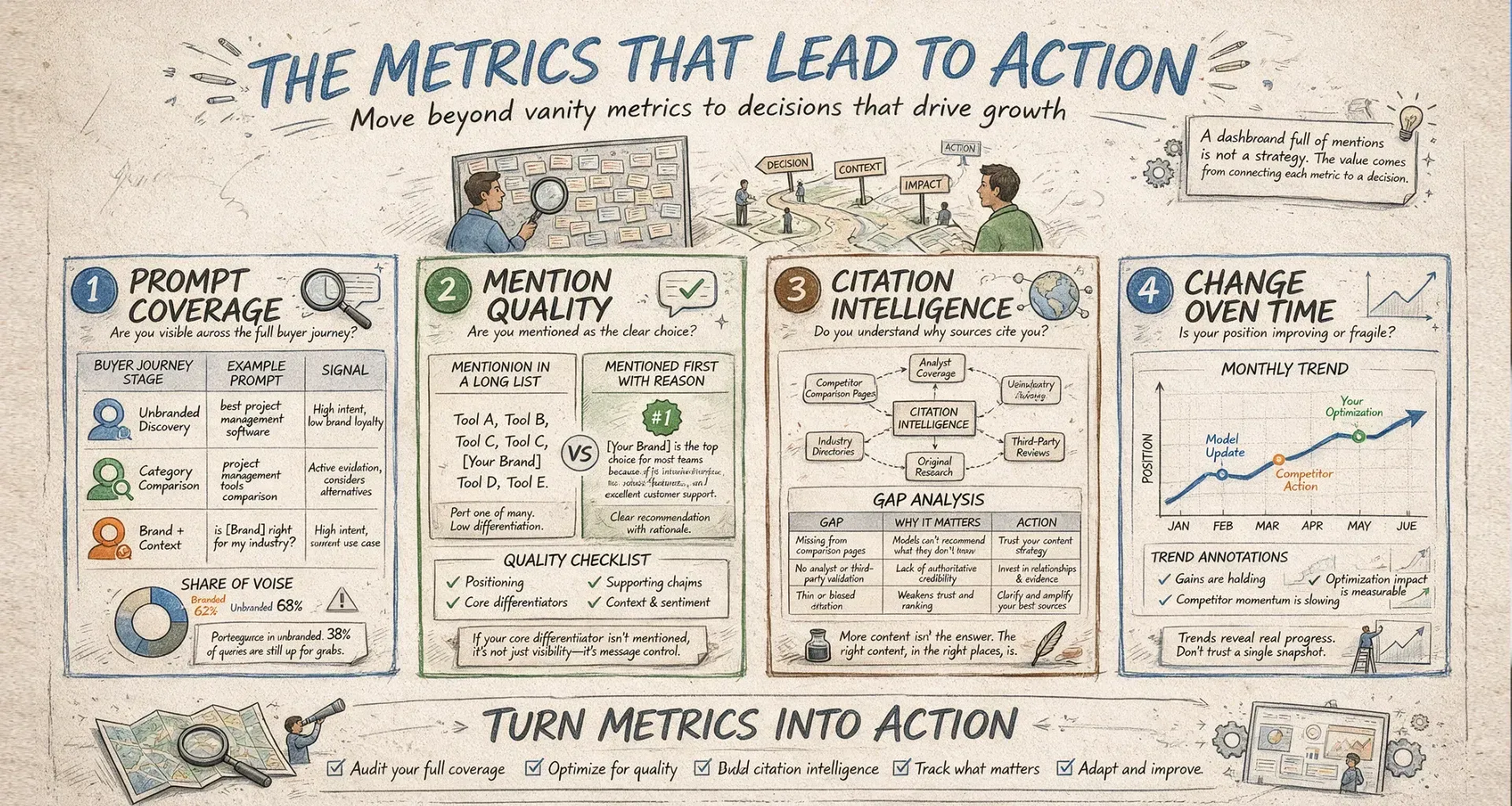
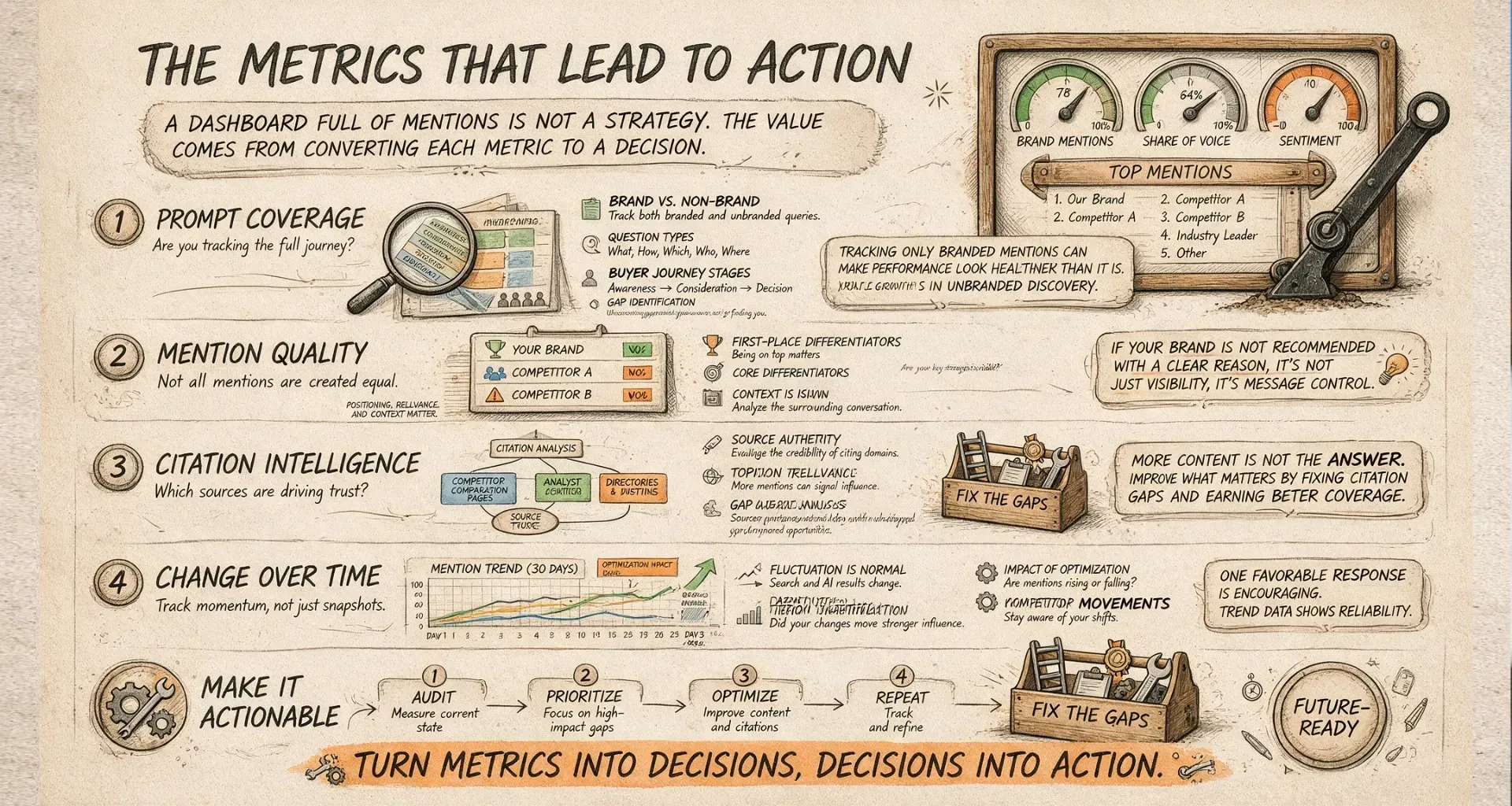
A dashboard full of mentions is not a strategy. The value comes from connecting each metric to a decision.
Start with prompt coverage. Your tracking should reflect the questions real buyers ask across the full journey: what a product category is, how to solve a specific problem, which providers are best, how alternatives compare, and which option fits a particular industry or budget. Tracking only branded prompts can make performance look healthier than it is. The highest-growth opportunity often sits in unbranded discovery questions where buyers have not chosen a supplier yet.
Next, examine mention quality. A brand name appearing in a long list is different from being recommended first with a clear reason. Analyse positioning, supporting claims and the context surrounding each mention. If an AI response says your platform is affordable but fails to mention your core differentiator, the issue is not merely visibility. It is message control.
Citation intelligence is equally commercial. When platforms cite competitor comparison pages, analyst coverage, directories or original research, those sources offer clues about what the model considers credible. Your response may involve improving an existing page, publishing missing evidence, earning authoritative third-party coverage or clarifying structured information. It depends on the gap. More content is not automatically the answer.
Finally, track change over time. One favourable response is encouraging, but it is not a reliable position. Prompt phrasing, model updates and changing source material can all alter results. Trend data shows whether a gain is holding, whether a competitor is accelerating and whether completed optimisation work is producing a measurable lift.
How to use LLM monitoring software without creating another reporting ritual
The strongest programmes run on a simple operating rhythm. Establish a baseline first. Define the market, competitors, products and high-value themes you want to own, then measure current performance across a representative prompt set. This gives every team a starting point that is specific enough to defend.
From there, prioritise gaps by commercial impact. A missing mention for a low-value informational query should not outrank a poor showing on a prompt used by buyers comparing providers. Score opportunities against intent, audience value, competitor advantage and the effort required to improve the underlying asset.
Assign action to the right owner. Content teams may need to expand a thin category page or create a comparison resource. SEO specialists may need to improve entity consistency, technical accessibility or internal content structure. PR and brand teams may need credible third-party validation to reinforce market positioning. AI visibility is cross-functional, so a report with no accountable next step is just expensive observation.
Then re-measure after changes are live. The aim is not to chase every wording variation a model produces. It is to build a repeatable feedback loop: identify a visibility gap, improve the information environment around your brand, and verify whether AI representation changes. This is how monitoring becomes Generative Engine Optimisation rather than passive analytics.
What to look for in a platform
Choose a system that supports decisions, not just screenshots. It should let you monitor priority prompts at scale, benchmark meaningful competitors and separate results by AI platform. You need historical performance, source and citation visibility, sentiment context and clear evidence of where rivals are gaining ground.
The action layer is the real divider. Some tools can tell you that a competitor was mentioned more often. Far fewer can translate that finding into a practical roadmap: which content to build, which pages to update, what claims need stronger support and where distribution could improve citation potential.
This is where aigeo insights is designed to help. Its SentimentStack-based tracking brings mentions, citation rate, AI share of voice, sentiment and competitor visibility into one view, then converts the data into prioritised GEO actions. Teams do not need another abstract AI score. They need to know what will move the score.
There are trade-offs to consider. Broad monitoring across hundreds of prompts offers market coverage but can dilute focus if your team cannot act on the findings. A narrow set of high-intent prompts is easier to operationalise but may miss emerging category language. Start with the commercial questions that matter most, then expand as your process matures.
The mistakes that cost brands visibility
The first mistake is treating AI answers as a side channel. If prospective customers use generative platforms to shortlist suppliers, these answers are part of your acquisition funnel and brand reputation.
The second is responding with generic content volume. AI systems need clear, credible, well-supported information, but publishing dozens of shallow articles will not create authority. Focus on the pages, proof points, comparisons and external signals that answer the questions buyers actually ask.
The third is relying on a single snapshot. Generative outputs vary, and the competitive landscape moves quickly. Consistent monitoring turns isolated observations into a strategic signal.
Your brand does not need to appear in every AI answer. It needs to be present, accurate and persuasive in the answers that influence revenue. Start by measuring those answers now, while there is still room to define the category rather than chase the competitors who already have.
Ready to get started?
A one-line nudge that earns the click below.
Related Posts
- How to Map Brand Entities for AI Search Visibility
Learn how to map brand entities, connect the signals AI uses, find gaps and build a stronger path to citations,…
Read more about How to Map Brand Entities for AI Search Visibility - LLM Analytics Review for Brands That Want Visibility
An LLM analytics review for marketers: assess AI visibility, citations, sentiment and competitors, then turn data into actions that grow…
Read more about LLM Analytics Review for Brands That Want Visibility - How to Measure Brand Visibility in AI Search
Learn how to measure brand visibility across AI search, track share of voice, citations and sentiment, and turn visibility gaps…
Read more about How to Measure Brand Visibility in AI Search