A prospect asks ChatGPT for the best payroll software, a trusted migration agent, or a B2B cybersecurity provider. Your brand may have a strong website, years of SEO work and excellent customer proof, yet never appear in the response. Citation tracking platforms expose that gap. They show whether AI engines mention your business, which sources they cite, how competitors win inclusion and where your next visibility gain is most likely to come from.
This is not a minor reporting upgrade. Search is shifting from a page of blue links to a generated answer that compresses research, recommendations and comparisons into a handful of sentences. If your brand is absent from that answer, conventional ranking reports cannot tell you the full story.
What citation tracking platforms actually measure
A citation tracking platform monitors AI-generated responses for defined prompts, then records the sources, brands and themes that appear. The best systems do more than count links. They translate each answer into a view of competitive visibility across ChatGPT, Claude, Gemini, Perplexity and Google AI Overviews.
For a brand or agency, the core question is simple: when people ask commercially meaningful questions, does the AI mention us, cite us, recommend us, or favour someone else?
That question breaks into several measurable signals. Mention frequency shows how often a brand appears. Citation rate measures how often an owned page or external source connected to the brand is cited. AI share of voice compares a brand’s presence with named competitors. Sentiment reveals whether the context is favourable, neutral or damaging. Platform-level performance shows where a brand is strong and where it is invisible.
These measures matter because an AI mention and an AI citation are not interchangeable. A model may name your company in a list without using your website as supporting evidence. It may also cite a high-authority review, industry publication or government page that validates your expertise without naming you directly. Both situations create different opportunities. One may require stronger owned content; the other may call for distribution, digital PR or better third-party coverage.
Why ordinary rank tracking misses the fight
Rank tracking remains useful. It tells you whether a page is competitive in traditional search results. But it cannot reliably explain how an AI model assembles an answer, which sources it trusts, or why a competitor is repeatedly recommended despite ranking below you for a familiar keyword.
Generative engines do not simply reproduce the first organic result. They synthesise information from multiple sources, interpret entities and assess the wording of a prompt. The response may prefer a detailed comparison page, a respected editorial mention, a well-structured help article, a current product listing or a niche source with exceptional topical relevance.
For Australian businesses, this complexity becomes sharper when the market has local requirements. A generic global answer is not enough for a buyer looking for Australian pricing, compliance, service areas, delivery terms or local support. If AI systems lack clear, credible information about those distinctions, they can default to larger overseas brands or local competitors with better source coverage.
The result is a new competitive battleground. Your SEO dashboard might look healthy while your AI share of voice falls. By the time a sales team notices prospects are arriving with competitor names already in mind, the visibility loss may have been building for months.
The metrics that turn monitoring into decisions
Not every metric deserves equal attention. Teams that monitor hundreds of prompts without a commercial framework create a large spreadsheet and little momentum. Start with prompt groups connected to real demand: category discovery, solution comparisons, use cases, problems, locations, pricing considerations and alternatives.
Then use the data to answer practical questions. Which high-intent prompts generate zero brand mentions? Which competitor owns the most recommendations? Which pages are repeatedly cited across platforms? Where does sentiment shift after a product change, campaign or customer issue?
A useful operating view includes four layers:
Visibility
Brand mentions, recommendation rate and AI share of voice for priority prompt groups.
Authority
Owned-domain citations, third-party citations and the sources most often used to support answers.
Competitive movement
Gains and losses against the competitors buyers actually see in AI responses.
Action value
The content, technical or distribution task most likely to improve a weak result.
The fourth layer separates a genuine GEO platform from passive analytics. A report that says your citation rate declined is informative. A roadmap that identifies the missing comparison content, outdated product documentation, weak entity signals or third-party proof needed to address that decline is commercially useful.
How to assess citation tracking platforms
The right platform depends on your market, prompt volume and how quickly your team can act. A small business may need a clear self-serve planner and a focused group of commercial prompts. An agency may need multi-brand reporting, competitor benchmarking and workflows that let strategists turn findings into client work. Enterprise teams may need governance, historical reporting and broad market coverage.
First, assess platform coverage. Tracking a single model is not enough because answer behaviour varies significantly. A brand can appear consistently in Perplexity yet be absent from ChatGPT or Google AI Overviews. The product should make those differences visible rather than burying them inside an overall score.
Next, inspect prompt methodology. Strong tools support custom prompts organised by funnel stage, topic and market. They should also capture the answer itself, not only a score. Your team needs to see the language, cited sources and competitor framing that produced the result.
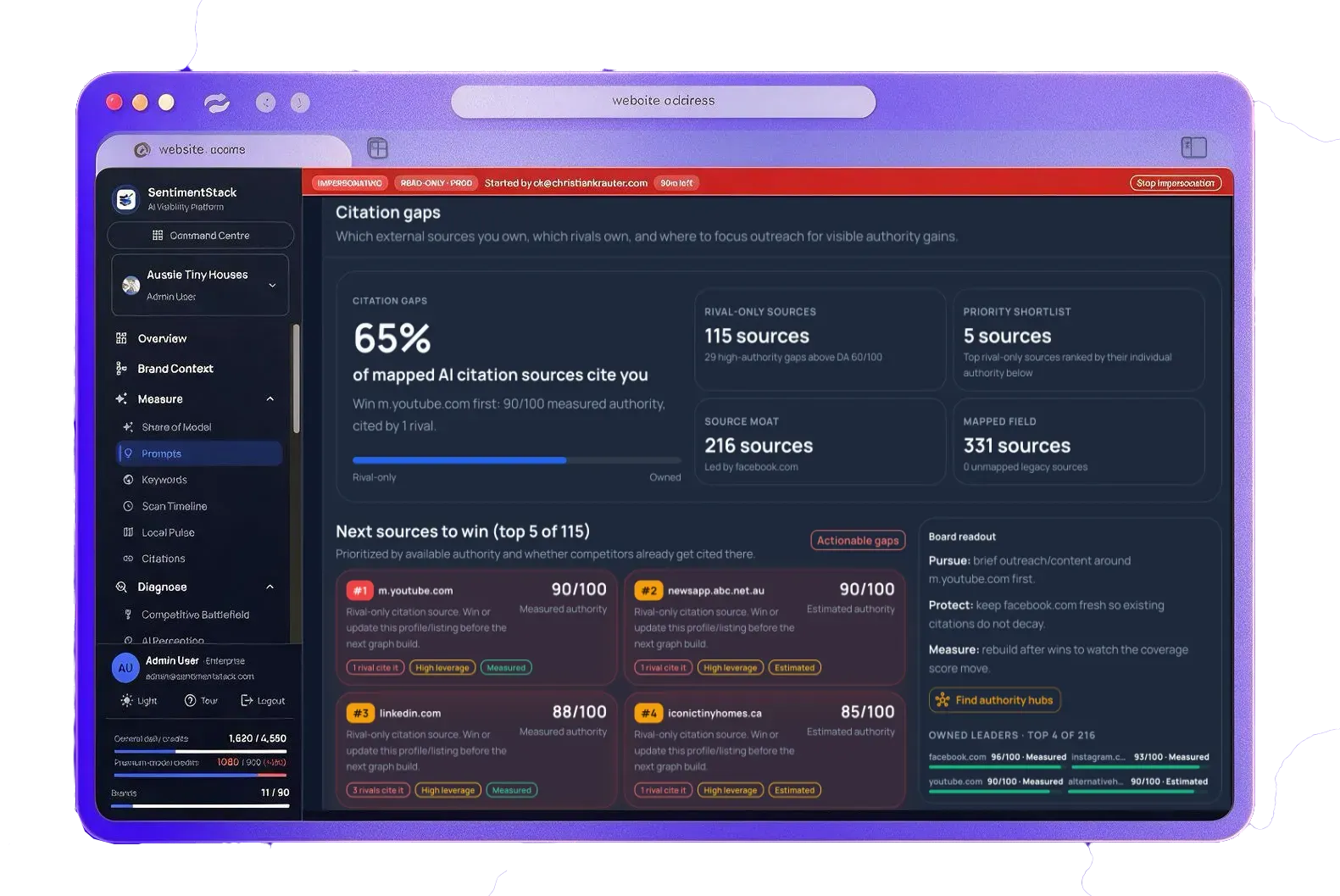
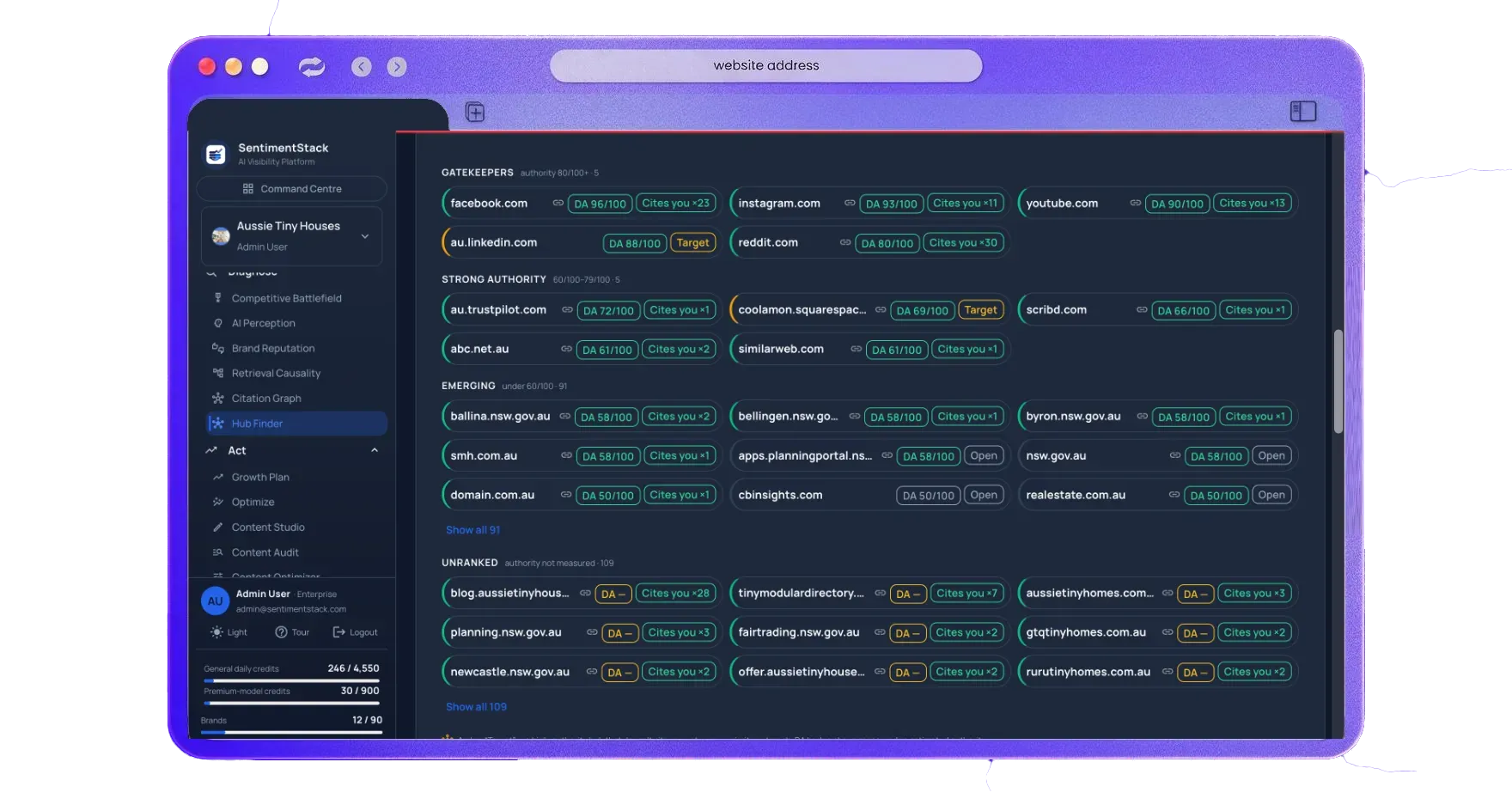
Source-level detail is essential. If a platform only reports that you were not cited, it leaves the diagnosis unfinished. You need to know who was cited, what format their content used and whether the source is owned, earned or a competitor asset. That evidence determines whether to build a new page, strengthen an existing one, earn coverage or correct inaccurate information.
Finally, test whether the product creates a practical route from insight to action. Can a marketer identify a weak prompt cluster, prioritise it by opportunity, assign a task and measure the impact over time? If the answer is no, the platform may be a useful research tool but not a growth system.
Turning citation data into a GEO roadmap
Measurement alone does not win the answer economy. The work begins when a platform identifies a gap.
Start with prompts where customer intent is high and visibility is low. A zero mention for a broad educational query may matter less than a missing recommendation for a query such as “best HR software for Australian construction companies”. Prioritise the prompts closest to revenue, then consider the gap between your visibility and the market leader’s.
Review the cited sources in each weak answer. Look for patterns rather than copying a competitor’s page format blindly. Are AI engines relying on structured comparison pages? Recent research? Clearly labelled pricing and feature information? Expert commentary? Local proof? The pattern tells you what evidence the answer ecosystem is rewarding.
Build or update assets that answer the underlying question directly. That can mean a genuinely useful alternatives page, a vertical solution page, an implementation guide, a product explainer with unambiguous facts, or a research asset worth citing. Use precise headings, plain language, visible authorship, current dates and claims you can support. Thin pages created solely to chase an AI mention rarely become durable sources.
Then improve distribution. Your website is only one part of the evidence environment. Trusted industry coverage, partner pages, customer case studies, directories and expert contributions can help establish the entity signals models encounter. The goal is not to scatter your brand across low-quality sites. It is to make accurate, consistent and credible information easy to verify.
Re-run the tracked prompts after meaningful changes and watch the trend, not a single response. Generative outputs can vary. A sustained increase in mentions, citations and favourable recommendation context is a stronger signal than one impressive result on one day.
Common mistakes that waste GEO budget
The first mistake is treating every prompt as equal. A long list of vague prompts produces noisy data and distracts from the questions that influence pipeline. Tie monitoring to customer language, sales objections and strategic categories.
The second is chasing citations without controlling the message. Being cited beside an outdated claim, an unfavourable comparison or a confused description of your offer is not a win. Citation tracking should sit alongside sentiment and answer-context analysis.
The third is separating SEO, content, PR and brand teams. AI visibility crosses all of them. The technical team may improve page accessibility, content may fill an information gap, PR may secure authoritative validation and brand may ensure the market recognises the same positioning everywhere.
This is where a platform such as aigeo insights earns its place: not by adding another dashboard, but by connecting brand visibility across AI engines to prioritised optimisation work. The winning system gives teams a clear view of where they are losing, why the loss is happening and what to do next.
The battle for the answer has begun. Choose the prompts that matter, monitor the sources shaping AI responses and make every content decision answer a visible competitive gap. Brands that build this discipline now will not have to guess why the market’s next buyer never saw them.
Related Posts
- How to Increase AI Citations and Win AI Search
Learn how to increase AI citations with content, entity signals and measurement that put your brand in more AI-generated answers…
Read more about How to Increase AI Citations and Win AI Search - AI Citation Tracking Software That Wins Answers
AI citation tracking software shows where your brand appears in AI answers, which competitors are cited, and what to improve…
Read more about AI Citation Tracking Software That Wins Answers - AI Referrals: The New Measure of Search Demand
AI referrals show which generative platforms send qualified visitors to your brand. Learn how to measure, improve and defend this…
Read more about AI Referrals: The New Measure of Search Demand