





A client can still rank first on Google and be absent from the answer their buyer receives in ChatGPT. That gap is now an agency problem. AI visibility reporting for agencies gives account teams a way to measure where brands appear, how they are described, which sources AI systems cite, and where competitors are taking the answer.
The battle is not for another dashboard metric. It is for the recommendation, the shortlist and the next enquiry. Agencies that can show clients how their brand performs across generative search will protect retainers, uncover higher-value work and lead a conversation most competitors are still avoiding.
Why traditional SEO reporting no longer tells the full story
Rankings, traffic and conversions still matter. They remain core signals of search performance. But generative engines do not simply reproduce the ten blue links. They synthesise answers from multiple sources, select brands to mention and frame those brands through their own interpretation of available information.
A brand may have strong organic visibility but receive few AI mentions for high-intent questions. Another may be mentioned regularly, but alongside weak sentiment or outdated positioning. A competitor with fewer rankings may become the preferred recommendation because its content is clearer, more frequently cited or better aligned to the prompts buyers actually use.
That is why a monthly rank tracker cannot be repurposed as an AI report with a few screenshots. Agencies need a separate measurement system built around answer visibility. It needs to explain not only whether a client appeared, but whether the appearance created commercial advantage.
What AI visibility reporting for agencies should measure
The strongest reports turn an unpredictable new channel into a set of client-ready performance indicators. Start with a defined prompt set that reflects how customers research the category: comparison questions, problem-led queries, local or market-specific requests, use-case questions and purchase-stage prompts.
Then track performance across the AI environments that matter to the client, including ChatGPT, Claude, Gemini, Perplexity and Google AI Overviews. Each platform has different behaviours, source preferences and answer formats. A brand winning in one environment cannot assume it is winning everywhere.
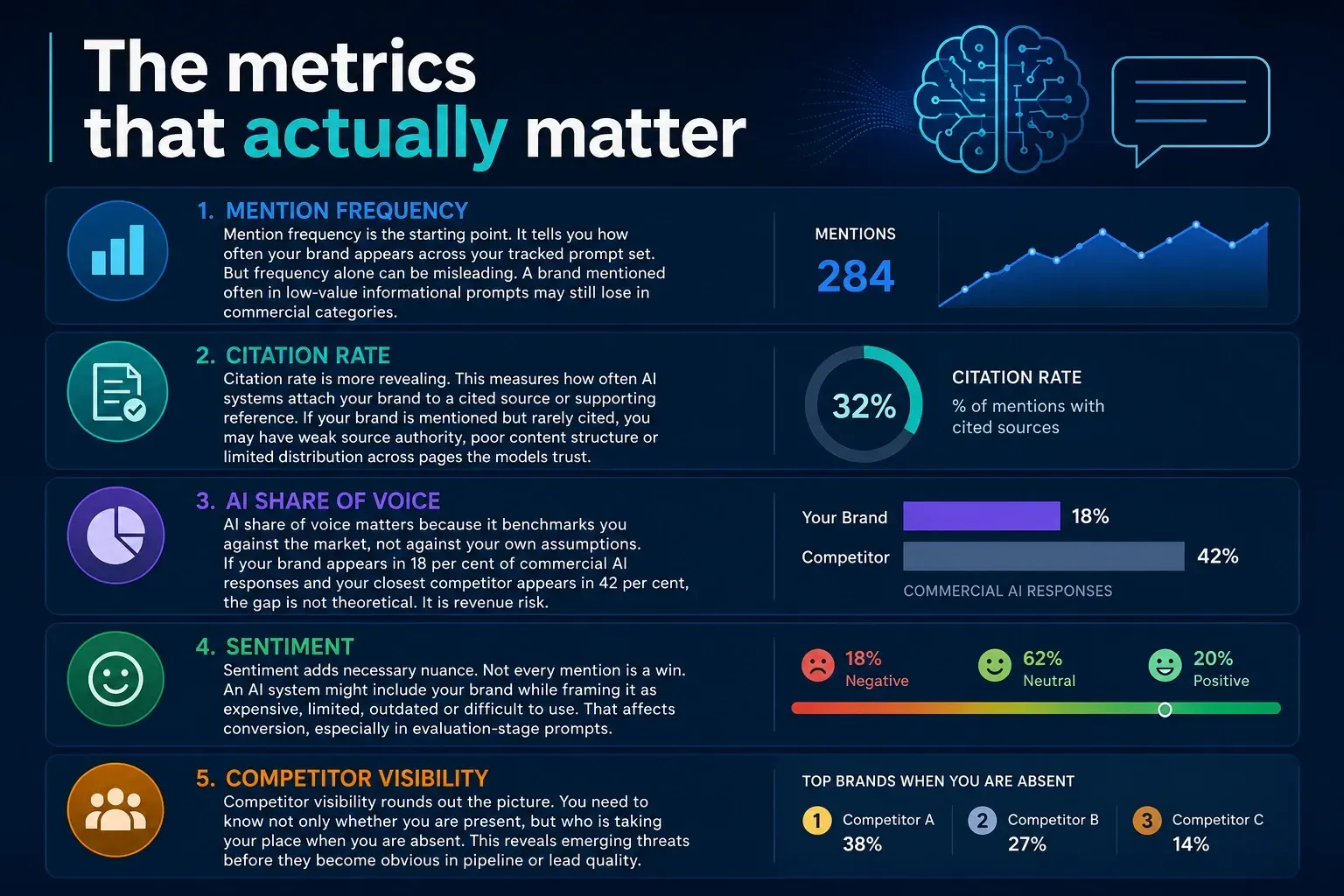
Four metrics make the commercial story clear:
- Brand mention frequency shows how often the client is included in relevant AI-generated answers.
- AI share of voice compares that presence with named competitors across the same prompt set.
- Citation rate identifies how often the client’s owned content or trusted third-party coverage is used as evidence.
- Sentiment and message accuracy reveal whether the model describes the brand in the way the client intends.
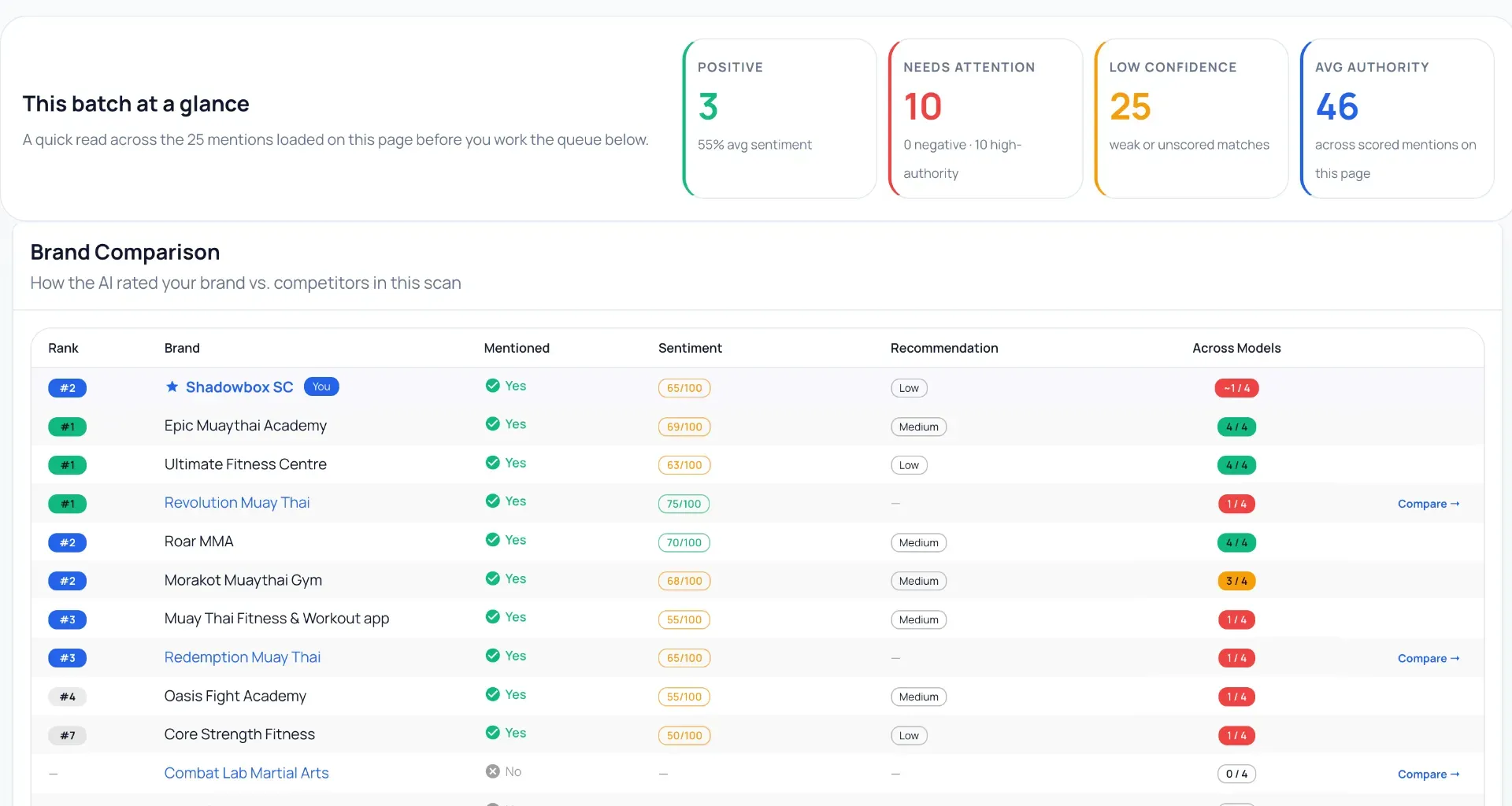
These metrics should be filtered by topic, service line, product, location and platform. A national retailer may be strong in general product comparisons yet absent in local discovery prompts. A B2B software client may dominate category definitions but lose every migration or implementation query to a competitor. The aggregate score is useful, but the opportunity sits in the detail.
Build reports around decisions, not observations
Clients do not need a long export of prompts and responses. They need a clear answer to three questions: What changed? Why did it change? What should we do next?
A useful agency report opens with the movement that matters. For example, a client’s AI share of voice may have risen from 18% to 27% for “best payroll software for small business” prompts, while its citation rate fell in Gemini. That tells a more valuable story than claiming visibility is generally improving. It shows progress, identifies a risk and creates a reason to act.
From there, connect the movement to source evidence. Did a new comparison page begin appearing in citations? Did an old product page disappear after a site restructure? Has a competitor earned repeated references through respected publications, customer reviews or structured documentation? This is where reporting becomes strategy.
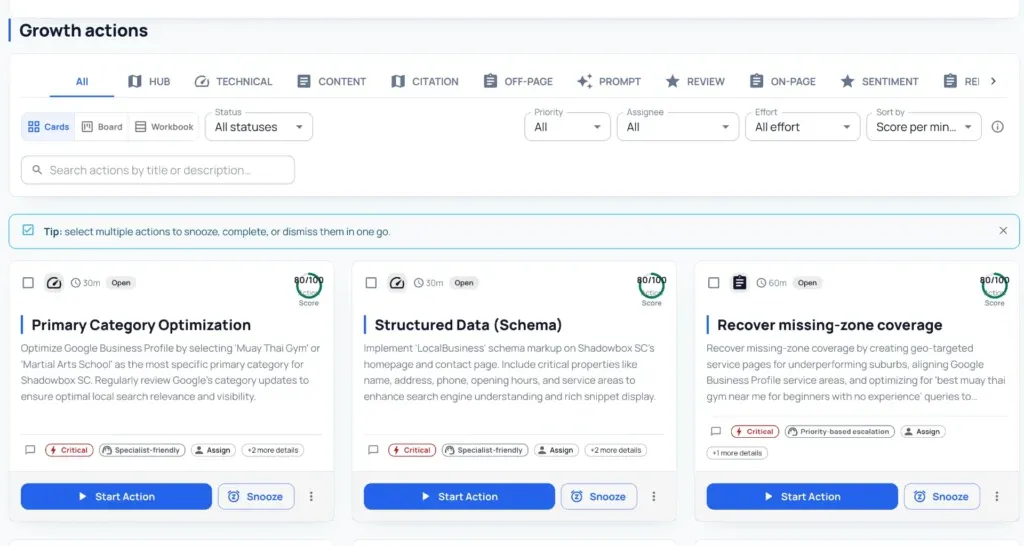
The final part of every report should be an optimisation roadmap, not a vague recommendation to “create more content”. Assign a specific action, expected impact and owner. The work might involve updating a product page with clearer entity information, publishing a comparison asset, improving expert attribution, correcting inconsistent third-party descriptions or distributing evidence to sources AI platforms already rely on.
The reporting cadence agencies need
AI answers can shift faster than conventional organic results, particularly when a platform changes its underlying model or source selection. Weekly monitoring gives agencies an early-warning system for meaningful movement. Monthly reporting remains the right cadence for most client conversations because it provides enough data to distinguish a genuine trend from normal variation.
For high-stakes categories such as finance, health, legal services or reputation-sensitive consumer brands, agencies may need tighter monitoring. It depends on the speed of the market, the number of priority prompts and the commercial cost of being misrepresented. A brand facing aggressive competitor campaigns should not wait until the end of the quarter to discover it has vanished from key recommendations.
Avoid promising that every answer will remain identical. Generative search is probabilistic. The goal is not to chase a single response or treat one prompt result as a verdict. The goal is to measure repeatable visibility patterns across a controlled prompt set, then improve the signals that make inclusion and citation more likely.
Make AI performance visible in the client relationship
The agency that owns AI visibility reporting earns a strategic position. Rather than reporting only on work already completed, it can identify the next threat and the next growth lever before the client asks.
That requires plain language. Explain AI share of voice as the proportion of relevant answers in which the client appears. Explain citation rate as the evidence trail behind an answer. Explain sentiment as the difference between being mentioned and being recommended. Senior stakeholders do not need a technical lecture on large language models. They need to understand whether the brand is present when buyers ask for help.
It also requires honest framing. If visibility is low, say so clearly, establish the baseline and show the path forward. If a competitor is ahead because it has stronger third-party validation, do not pretend a single blog post will close the gap. Good reporting creates confidence by making the trade-offs visible: owned content can be improved quickly, while authority-building and reputation repair take sustained effort.
For agencies managing multiple clients, standardisation matters. Use a consistent reporting framework, but never a generic prompt set. The framework should stay stable while the questions reflect each client’s audience, category language and commercial priorities. Otherwise, a clean-looking report can produce misleading conclusions.
From data to a GEO growth plan
Generative Engine Optimisation is where measurement becomes revenue. The data should tell the agency where to focus content, technical improvements, digital PR and brand messaging efforts. Without that connection, AI reporting becomes another passive analytics service that clients can cut when budgets tighten.
A platform such as aigeo insights can make this operational by combining brand mentions, citations, sentiment, competitor visibility and platform-level performance with prioritised actions. Instead of asking a strategist to interpret hundreds of AI responses manually, teams can see which opportunities are most likely to improve answer presence and assign work accordingly.
The best agency workflow is simple: establish a baseline, agree on the priority prompts, monitor movement, diagnose the source of change and execute the highest-impact action. Repeat that cycle. Over time, the report becomes a record of how content investment, authority and clearer brand information translate into stronger representation inside AI answers.
The opportunity is bigger than a new report
AI visibility reporting creates a new reason for clients to rely on their agency. It brings SEO, content, PR, paid media and brand strategy into the same commercial conversation: how does the market see us when it asks an AI for an answer?
The agencies that move first will not merely add an AI slide to the monthly deck. They will build an evidence-led service that identifies lost ground early, proves the value of optimisation and helps clients earn a place in the answers shaping buyer decisions. Start with the questions that drive revenue, measure the reality without spin, and turn every visibility gap into a clear next move.
Related Posts
- How to Measure Brand Visibility in AI Search
Learn how to measure brand visibility across AI search, track share of voice, citations and sentiment, and turn visibility gaps…
Read more - What an AI Search Visibility Tool Should Do
See what an AI search visibility tool should track, why rankings miss the point, and how brands can lift citations,…
Read more - AI Citation Tracking Software That Wins Answers
AI citation tracking software shows where your brand appears in AI answers, which competitors are cited, and what to improve…
Read more