
A prospect asks ChatGPT for the best payroll platform, a trusted solar installer or the right agency for a rebrand. The answer may name three competitors and omit your business entirely. That is the commercial reality of AI citations: your brand is no longer competing only for a blue link. It is competing to be included, referenced and recommended in the answer itself.
For marketers, agencies and growth teams, this changes the job. Ranking reports alone cannot tell you whether generative engines understand your offer, trust your claims or surface you when buyers ask high-intent questions. AI search visibility must now be measured as a market share problem.
What are AI citations?
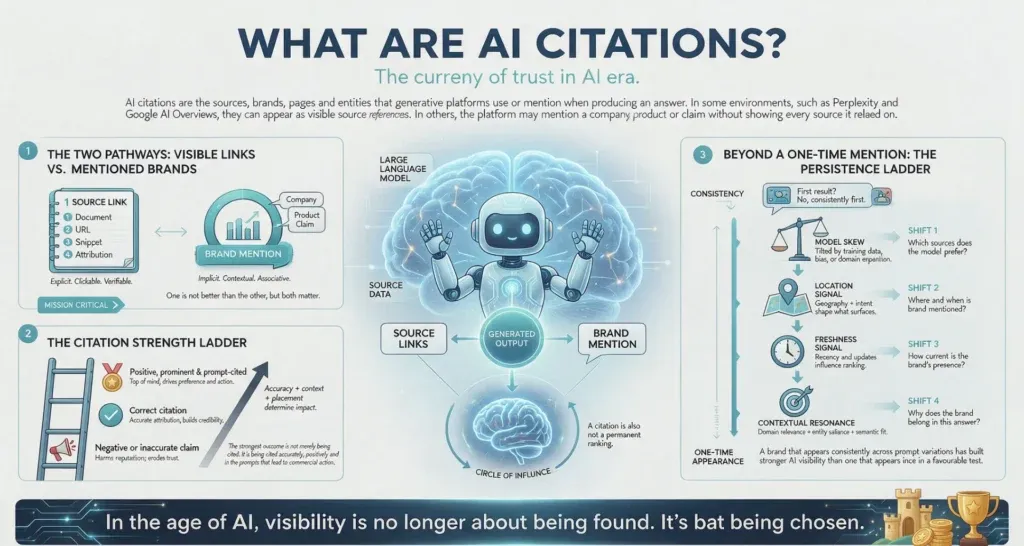
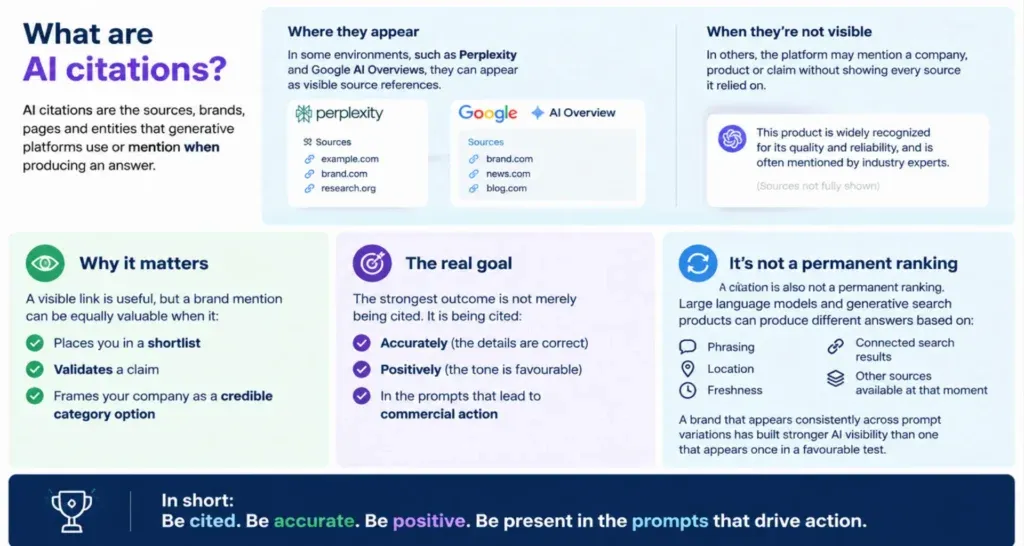
AI citations are the sources, brands, pages and entities that generative platforms use or mention when producing an answer. In some environments, such as Perplexity and Google AI Overviews, they can appear as visible source references. In others, the platform may mention a company, product or claim without showing every source it relied on.
That distinction matters. A visible link is useful, but a brand mention can be equally valuable when it places you in a shortlist, validates a claim or frames your company as a credible category option. The strongest outcome is not merely being cited. It is being cited accurately, positively and in the prompts that lead to commercial action.
A citation is also not a permanent ranking. Large language models and generative search products can produce different answers based on phrasing, location, freshness, connected search results and the other sources available at that moment. A brand that appears consistently across prompt variations has built stronger AI visibility than one that appears once in a favourable test.
Why AI citations are now a growth metric
Traditional SEO asks, “Where do we rank?” Generative Engine Optimisation asks a tougher question: “When a buyer asks for an answer, are we part of it?”
This is where citation performance becomes commercially relevant. If AI platforms repeatedly reference your competitors for comparison, recommendations or use-case questions, they are receiving attention before a prospect reaches a conventional results page. Their positioning is being reinforced at the exact moment a buyer is narrowing options.
For a B2B software firm, that might mean appearing in answers to “best CRM for mid-market sales teams in Australia”. For a professional services company, it might be inclusion in “which cyber security consultancies are suitable for financial services?” The prompt is the new shelf space.
Citation data also reveals problems that traffic data can hide. Your organic sessions may look stable while competitors gain a decisive advantage in AI-generated product comparisons. Or your brand may be mentioned frequently but paired with outdated messaging, weak sentiment or the wrong category. Visibility without accuracy can create demand you cannot convert.
What actually earns AI citations?
There is no single switch that forces an AI platform to cite a page. Generative systems draw from different retrieval methods, model knowledge, web indexes, trusted third-party sources and structured information. Tactics that work for one platform or query type may not deliver the same result elsewhere.
Still, the brands that win tend to make it easy for machines and people to verify what they do. They publish clear, specific information that answers a real question better than vague category copy does. They support claims with evidence. They maintain consistent facts across their site and credible external sources. And they give search systems a logical structure to interpret.
Build pages around buyer questions, not internal jargon
A product page built around “next-generation solutions” gives an AI engine little to work with. A page that clearly states who the product serves, what problem it solves, how it compares, what it integrates with and where it is available is far more citation-ready.
Start with the questions buyers ask before they shortlist: suitability, pricing approach, implementation time, alternatives, limitations, security, industry fit and expected outcomes. Then create or improve pages that answer those questions directly. The goal is not to write for a robot. It is to reduce ambiguity.
Comparison and alternatives content can be particularly valuable, but only if it is fair and useful. Empty pages that declare your business better than every rival are easy to dismiss. Specific distinctions, supported trade-offs and transparent fit criteria give generative engines material they can confidently reuse.
Make evidence easy to find and trust
Generative answers are more likely to reflect claims that are repeated and verifiable. That does not mean stuffing every page with statistics. It means connecting claims to proof: customer outcomes, documented methodologies, product specifications, independent recognition, expert commentary and current company details.
Keep the fundamentals accurate. A mismatch in product names, service areas, pricing language or leadership information across key pages can dilute entity confidence. The same applies to stale content. A useful article from two years ago may be less competitive if it does not reflect your current product, market or customer needs.
Use structure to remove friction
Clear headings, concise definitions, descriptive page titles, tables where comparisons genuinely benefit readers and well-maintained structured data all help systems interpret content. Structure is not a shortcut to automatic citations. It is a way to make strong information easier to retrieve, extract and validate.
Avoid burying your central claim beneath decorative copy. Put the answer near the question. Explain the conditions around it. Then add depth for readers who need it.
How to measure AI citations without fooling yourself
One screenshot of a favourable ChatGPT response is not an AI visibility strategy. The useful unit of analysis is a repeatable prompt set tied to your category, buyer journey and competitors.
Track questions across discovery, evaluation and decision stages. Include generic category prompts, comparison prompts, problem-led prompts and use-case prompts. Test meaningful wording variations, because “best accounting software for tradies” may produce a different result from “accounting platform for small construction businesses”.
For each platform, measure four connected signals:
- Brand mention rate: how often your brand appears across tested prompts.
- Citation rate: how often your owned assets or validated brand sources are referenced.
- AI share of voice: your visibility relative to competitors in the same answer set.
- Sentiment and message accuracy: whether the response describes you favourably and correctly.
These metrics should be segmented by platform. Perplexity may favour recently indexed editorial material, while Google AI Overviews can reflect a different mix of search signals. ChatGPT, Claude and Gemini can also vary in how and when they cite sources. Treating all platforms as one channel hides the actions that will move performance.
The next layer is competitive diagnosis. If a rival dominates recommendation prompts but not product comparisons, find out which source types, claims or content gaps explain the difference. If you have high mention frequency but low direct citation, determine whether your own pages lack depth or whether authoritative third-party validation is carrying the conversation.
This is the operational advantage of a platform such as aigeo insights: it turns mention, citation, sentiment and competitor data into a prioritised roadmap rather than another dashboard your team has to interpret from scratch.
Turn citation gaps into an action plan
The wrong response to weak AI visibility is to publish dozens of generic articles. Volume creates clutter when the real issue is missing evidence, unclear positioning or weak coverage of high-value prompts.
Prioritise work by likely commercial impact. First, identify prompts where buyers are actively choosing providers and where competitors are visible. Next, map the answer gaps: do you need a better use-case page, an accurate comparison, updated proof points, clearer entity details or stronger distribution through trusted industry sources? Then assign an owner, deadline and expected metric movement.
Content creation is only one lever. Updating a key service page may outperform a new blog post. Correcting inconsistent positioning across your site and external profiles may improve trust more than adding another keyword target. In regulated, technical or local categories, authoritative expert review and precise factual maintenance can matter more than publishing speed.
Re-test after changes, but allow for variation. Generative answers are probabilistic, so look for a sustained shift across a representative prompt set rather than demanding identical wording every time. The objective is reliable presence in the conversations that create pipeline.
The brands that get cited will shape the category
AI citations are becoming a competitive record of who the market considers worth mentioning. Brands that monitor this record, improve the evidence behind their claims and act on the highest-value gaps will gain ground while others wait for traffic reports to reveal the shift.
Pick ten buyer questions that matter to revenue, test them across the platforms your audience uses, and read the answers as your prospects do. The gap between what AI says about your brand and what you want it to say is your next growth plan.
Related Posts
- AI Response Optimisation: Win the Answer Economy
AI response optimisation helps brands measure, improve and defend visibility in ChatGPT, Gemini and AI search before competitors become the…
Read more about AI Response Optimisation: Win the Answer Economy - Answer Engine Analytics: Measure What AI Says
Answer engine analytics shows where AI mentions, cites and recommends your brand, so your team can act before competitors take…
Read more about Answer Engine Analytics: Measure What AI Says - Can AI Answers Misquote Brands? Yes, They Can
Can AI answers misquote brands? Learn why generative search gets claims wrong, how to spot risk, and what to do…
Read more about Can AI Answers Misquote Brands? Yes, They Can