If your brand still treats Google rankings as the whole game, you’re already giving away ground. The real shift is happening inside generated answers, where buyers ask a model for options, comparisons, recommendations and shortlists. That means learning how to improve AI search visibility fast is no longer a side project for SEO teams. It is now a core growth function for marketers, agencies and commercial teams that want to win the answer before a click even happens.
AI search visibility is not the same as ranking in ten blue links. Large language models assemble responses from patterns, sources, citations, brand familiarity, page structure, entity clarity and topical authority. A brand can rank reasonably well in traditional search and still be invisible in ChatGPT, Gemini, Claude, Perplexity or Google AI Overviews. That gap is where market share gets lost.
What AI search visibility actually means
AI visibility is your likelihood of being mentioned, cited or recommended when a user asks an AI platform a commercially relevant question. That can show up as a direct brand mention, a citation to your site, a product recommendation, a favourable sentiment signal, or a stronger share of voice than your competitors.
This matters because AI answers compress decision-making. If a model names three vendors and your brand is not one of them, the funnel narrows before the user ever reaches a search results page. That is why GEO is becoming a distinct operational discipline. The job is no longer just to rank content. The job is to shape what AI systems believe is worth mentioning.
How to improve AI search visibility with the right assets
The first mistake most teams make is assuming AI models only reward high-authority domains. Authority matters, but so does clarity. AI systems favour pages that make entities, claims and context easy to interpret. If your site is vague, thin, outdated or inconsistent, the model has less confidence in using it.
Start with your core commercial pages. Your homepage, product pages, category pages, solution pages, comparison content and key educational resources should all state clearly who you are, what you do, who you serve and what differentiates you. Use plain language. Name the problem, the audience and the outcome. A page that tries to sound clever often becomes harder for machines to parse.
Structured content also helps. That does not mean stuffing pages with schema and hoping for magic. It means making information scannable and explicit. Strong headings, concise explanations, FAQs where genuinely useful, pricing context, use cases, proof points and consistent terminology all increase the chance that an AI system can pull a clean answer from your page.
There is a trade-off here. Over-optimising for machine readability can flatten your brand voice if you are not careful. The goal is not sterile content. The goal is content that is both distinct and easy to interpret.
Build topical authority, not random volume
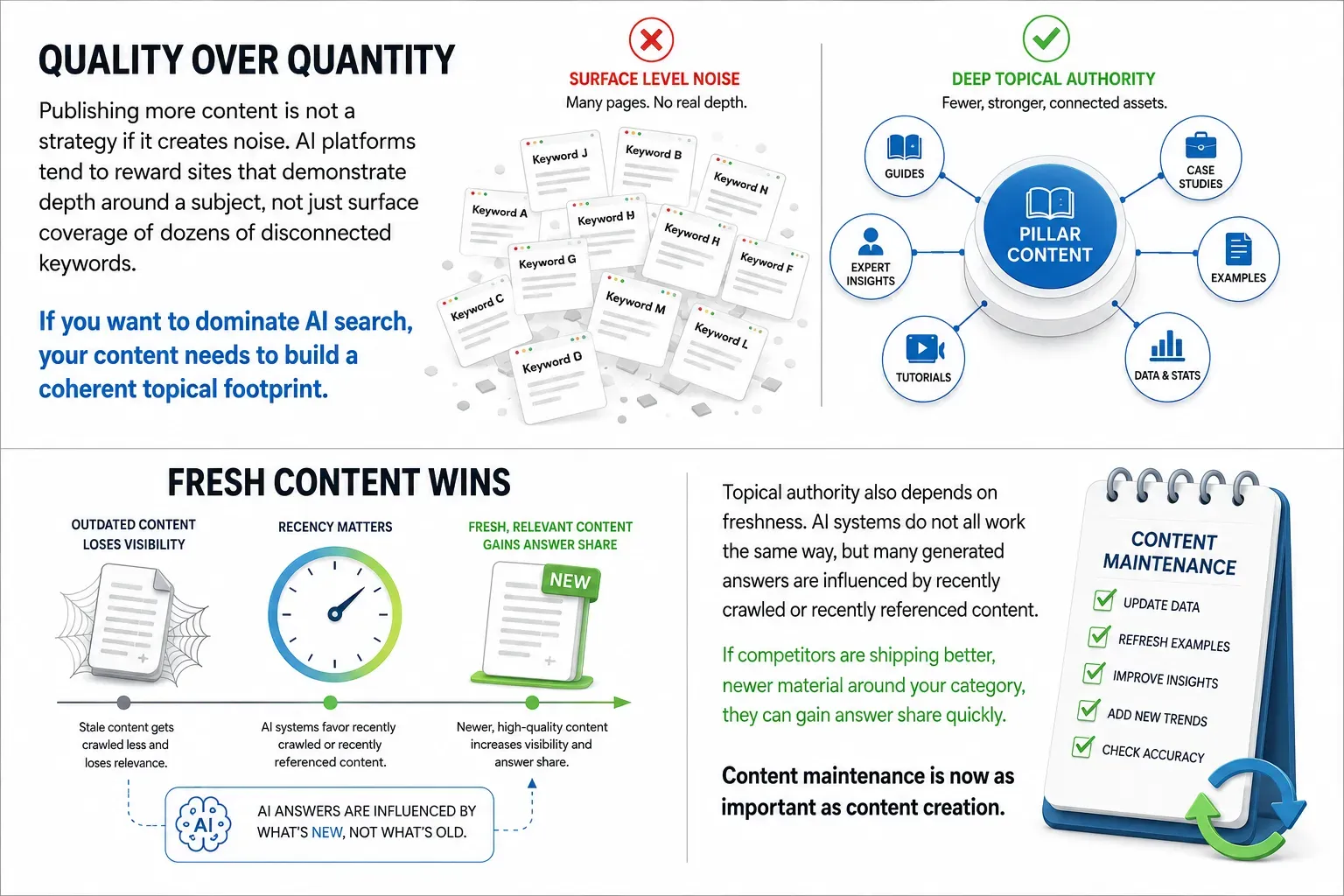
Publishing more content is not a strategy if it creates noise. AI platforms tend to reward sites that demonstrate depth around a subject, not just surface coverage of dozens of disconnected keywords. If you want to dominate AI search, your content needs to build a coherent topical footprint.
That means clustering content around the questions your market actually asks. Create pages that cover definitions, comparisons, implementation advice, pricing considerations, risks, alternatives and category trends. Then keep those assets aligned. If one page says your tool is for enterprise and another says it is best for small business, you are feeding mixed signals into the ecosystem.
Topical authority also depends on freshness. AI systems do not all work the same way, but many generated answers are influenced by recently crawled or recently referenced content. If competitors are shipping better, newer material around your category, they can gain answer share quickly. Content maintenance is now as important as content creation.
Citations are earned through evidence
If you want more citations in AI answers, give the model something worth citing. Original data, benchmark reports, product specifics, customer evidence and opinionated analysis outperform generic copy. AI platforms are more likely to reference pages that contain unique value rather than recycled definitions.
For marketers and agencies, this is where many GEO programs either accelerate or stall. Teams often publish polished content that says nothing new. It may read well, but it does not create citation gravity. A practical stat, a methodology, a market observation, a feature comparison or a clear framework can make your content far more referenceable.
The same applies to brand trust. Reviews, third-party mentions, founder visibility, digital PR and consistent off-site references all contribute to whether your brand feels known in the ecosystem. AI search does not operate in a vacuum. It draws from a broader web of signals.
Technical hygiene still counts
GEO does not replace technical SEO. It builds on it. If your site is hard to crawl, your pages load poorly on mobile, your canonicals are messy, or your content is hidden behind scripts that are not reliably rendered, you are reducing your odds of being understood and cited.
Clean site architecture matters because it helps search engines and downstream AI systems find the right pages. Metadata still matters because it reinforces relevance. Internal linking still matters because it shows content relationships. None of this is glamorous, but sloppy foundations weaken every visibility play that sits on top.
There is also a practical point here for non-technical teams. You do not need to rebuild your entire site to improve AI presence. In many cases, visibility gains come from tightening a relatively small set of high-value pages and fixing the content structure that supports them.
Measure the signals that matter
One reason teams struggle with how to improve AI search visibility is that they are measuring the wrong outcomes. Pageviews alone will not tell you whether your brand is being recommended inside AI answers. You need a visibility model that reflects how generative platforms actually behave.
Track brand mention frequency, citation rate, sentiment, share of voice, competitor presence and platform-level performance. A brand might perform strongly in Google AI Overviews and poorly in Perplexity. It might be mentioned often in ChatGPT but with weak commercial positioning. Those are very different problems, and they require different actions.
This is where operational GEO gets serious. Monitoring is useful, but monitoring without prioritisation creates another dashboard no one acts on. The better approach is to tie visibility changes to a roadmap. If citation rate drops, which pages need revision? If a competitor gains answer share, which topic cluster are they winning? If sentiment weakens, which external sources or message gaps are driving it?
Platforms such as sentiment stack designed and managed by aigeo insights are built around that exact shift from passive reporting to action. That matters because the brands that win AI search are not just watching the market move. They are responding faster than everyone else.
Platform differences change the playbook
A common mistake is treating all AI platforms as one channel. They are not. Each has different sourcing behaviour, product UX, citation patterns and thresholds for mentioning brands. Your strategy should reflect that reality.
Google AI Overviews often overlap with traditional search intent and web indexing behaviour, so strong SEO foundations can carry more weight there. Perplexity tends to make citations highly visible, which can reward well-structured, source-worthy content. ChatGPT and Claude may surface brands through a broader blend of training familiarity, web retrieval and contextual relevance depending on the query and environment.
The point is simple. If you are only looking at aggregate AI visibility, you can miss where the real opportunity sits. One platform may be your biggest growth lever while another is barely worth chasing for your audience.

What high-performing teams do differently
The teams making gains in AI visibility are not waiting for perfect rules. They are treating GEO like an iterative performance channel. They benchmark current presence, identify the prompts and topics that shape pipeline, improve the pages most likely to influence those answers, and review changes regularly.
They also align brand, content and search teams around commercial outcomes. That is a major advantage. AI search rewards consistency. If product marketing says one thing, sales says another and the website says a third, your visibility suffers. The strongest brands reduce that confusion and make their market position obvious across every source an AI system might encounter.
Most importantly, they accept that this is now a live competition. Your competitors are not only bidding on your terms or outranking your pages. They are trying to become the answer instead of you.
That is the real opportunity in front of every growth team right now. Start with clearer pages, stronger evidence, tighter topic coverage and sharper measurement, then keep refining. In AI search, visibility is not won once. It is defended every week.
Related Posts
- 7 Best LLM Content Audit Tools for AI Visibility
Compare the best LLM content audit tools for tracking AI mentions, citations, sentiment and competitors, then turn gaps into a…
Read more about 7 Best LLM Content Audit Tools for AI Visibility - What Affects AI Brand Mentions in AI Search?
Learn what affects AI brand mentions across ChatGPT, Gemini and Google AI Overviews, then turn visibility data into a sharper…
Read more about What Affects AI Brand Mentions in AI Search? - SEO Tools Versus GEO Tools for AI Search
SEO tools versus GEO tools measure different battles: rankings in results and visibility in AI answers. Learn where each fits…
Read more about SEO Tools Versus GEO Tools for AI Search