





A brand can still rank well in Google and quietly disappear inside AI answers. That is the shift most teams are only now clocking. An AI search visibility tool exists for this exact problem – not to track blue links, but to show whether ChatGPT, Gemini, Claude, Perplexity and AI Overviews are actually mentioning your brand, citing your content, and recommending you over the competition.
For marketers, agencies and growth teams, this changes the scoreboard. Traditional SEO told you where you appeared in search results. Generative search changes the game because users increasingly skip the results page and take the answer they are given. If your brand is not in that answer, your visibility, influence and pipeline can shrink before your standard dashboards even show a problem.
Why a standard SEO stack is not enough
Most SEO tools were built for rankings, traffic and backlinks. Those metrics still matter, but they no longer tell the full story. A page can rank well and still fail to get cited by an AI model. A competitor with weaker rankings can appear more often in generated answers because their content is clearer, more quotable, better structured or more trusted across the sources a model relies on.
That gap is where a lot of teams are getting caught. They can see keyword movement, but they cannot see brand mention frequency inside AI responses. They can monitor organic sessions, but they cannot measure AI share of voice. They can review backlinks, but they cannot tell which assets are driving citations across different generative platforms.
An AI search visibility tool should close that gap. It should tell you not just whether you are visible, but how visible, where, against whom, and why.
What an AI search visibility tool should actually measure
If a platform only shows a few screenshots of AI answers, that is not enough. Useful visibility tracking needs to be systematic, repeatable and tied to competitive decisions.
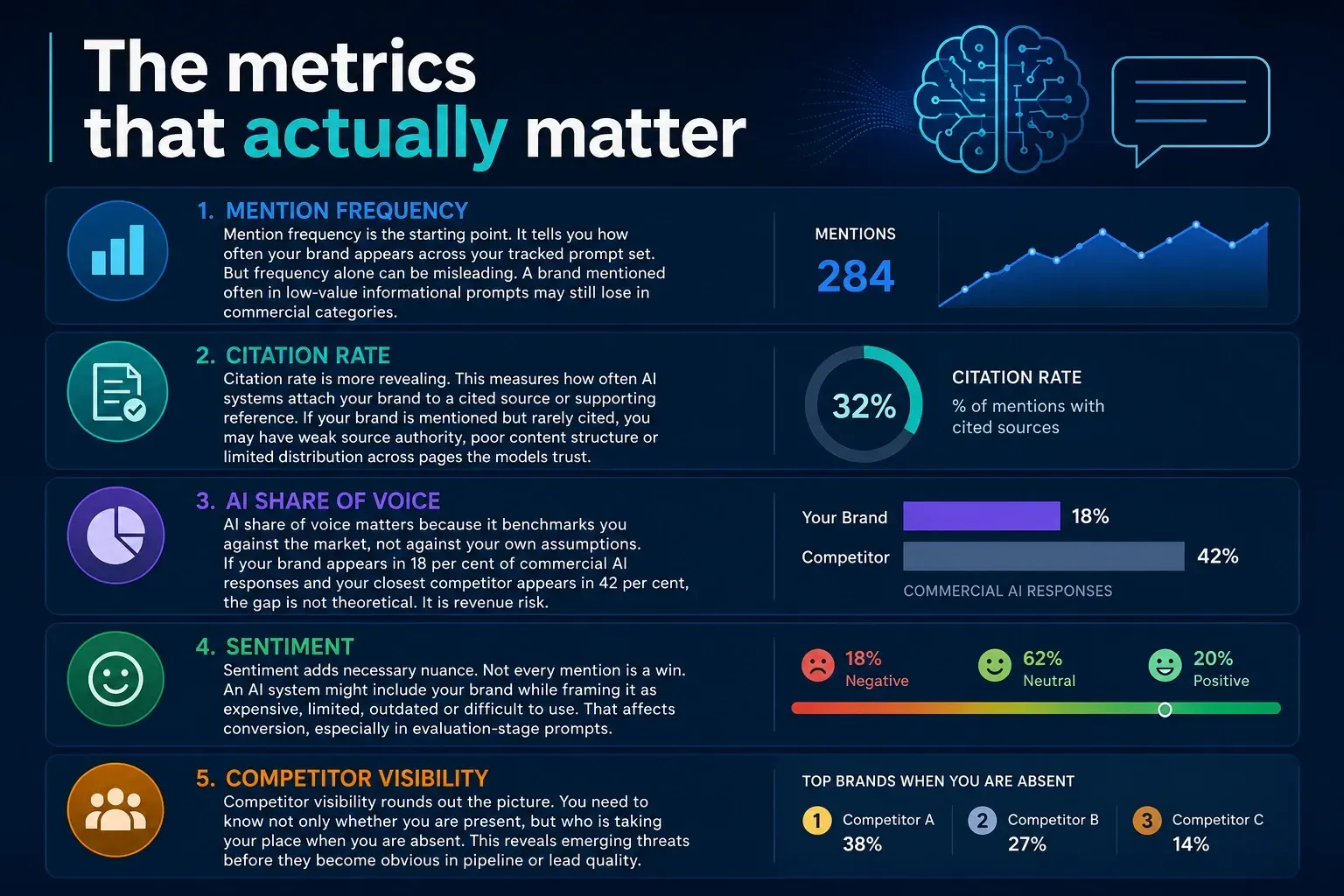
The first thing to measure is brand mention frequency. How often does your brand appear when users ask commercially relevant prompts in your category? This matters because mention volume is the first sign of whether AI systems recognise your brand as part of the answer set.
The second is citation rate. Mentions are useful, but citations carry more weight because they show which assets an AI system leans on as evidence. If your content is being cited, you are not just present – you are shaping the answer.
The third is AI share of voice. This is where visibility becomes a commercial metric rather than a vanity one. Share of voice shows how often your brand appears compared with direct competitors across a prompt set that reflects real buying behaviour. If your share is flat while a rival is climbing, that is an early warning sign.
Sentiment also matters. AI systems do not merely mention brands – they characterise them. If your brand appears with weak, generic or mixed framing while a competitor is consistently associated with stronger value signals, the issue is not only visibility. It is positioning.
Then there is platform-specific performance. ChatGPT does not behave exactly like Perplexity. Google AI Overviews do not source and summarise information the same way as Claude or Gemini. A serious tracking system must show where you are winning, where you are absent and where your content strategy needs to adapt by platform.
Visibility without context is noise
Raw data is cheap. Useful interpretation is not. If you can see that your brand was cited 12 times last month, that number means very little on its own. Was that up or down? Which prompts triggered those citations? Which pages were used? Which competitors gained more ground? Did product pages outperform comparison content, or was it the reverse?
This is why the best tools do more than monitoring. They connect performance to causes. That is what makes the difference between a dashboard and a growth system.
The real job of an AI search visibility tool
The market does not need another analytics layer that tells teams they have a problem. It needs a system that tells them what to do next.
That means the tool should translate visibility data into an optimisation roadmap. If your brand is under-cited in product comparison prompts, you should know which content types need to be created or reworked. If AI models keep citing outdated third-party pages instead of your owned assets, you should know which pages need stronger structure, fresher proof points or clearer entity signals. If competitor mention share is rising on one platform but not another, your team should be able to respond quickly rather than wait for a quarterly review.
This is where GEO becomes operational. Generative Engine Optimisation is not an abstract layer on top of SEO. It is the discipline of increasing the likelihood that AI systems mention, cite and frame your brand favourably. An AI search visibility tool should make that process measurable and executable.
What high-performing teams do with the data
The strongest teams treat AI visibility like paid media, SEO and brand tracking combined. They watch movement, test changes, and act fast when performance shifts.
In practice, that often means tightening content structure so key facts are easier for AI systems to extract. It can mean expanding category pages with clearer definitions, use cases and trust signals. It may mean publishing comparison content that answers the exact questions buyers ask in tools like ChatGPT and Perplexity. It can also mean improving distribution so high-value pages earn more references across the wider web.
There is no single fix because generative search is not one channel. It is a network of systems that synthesise from multiple sources. That is why broad advice like “write better content” is not enough. Teams need prompt-level visibility, asset-level attribution and competitor benchmarking.
Not every brand has the same GEO priorities
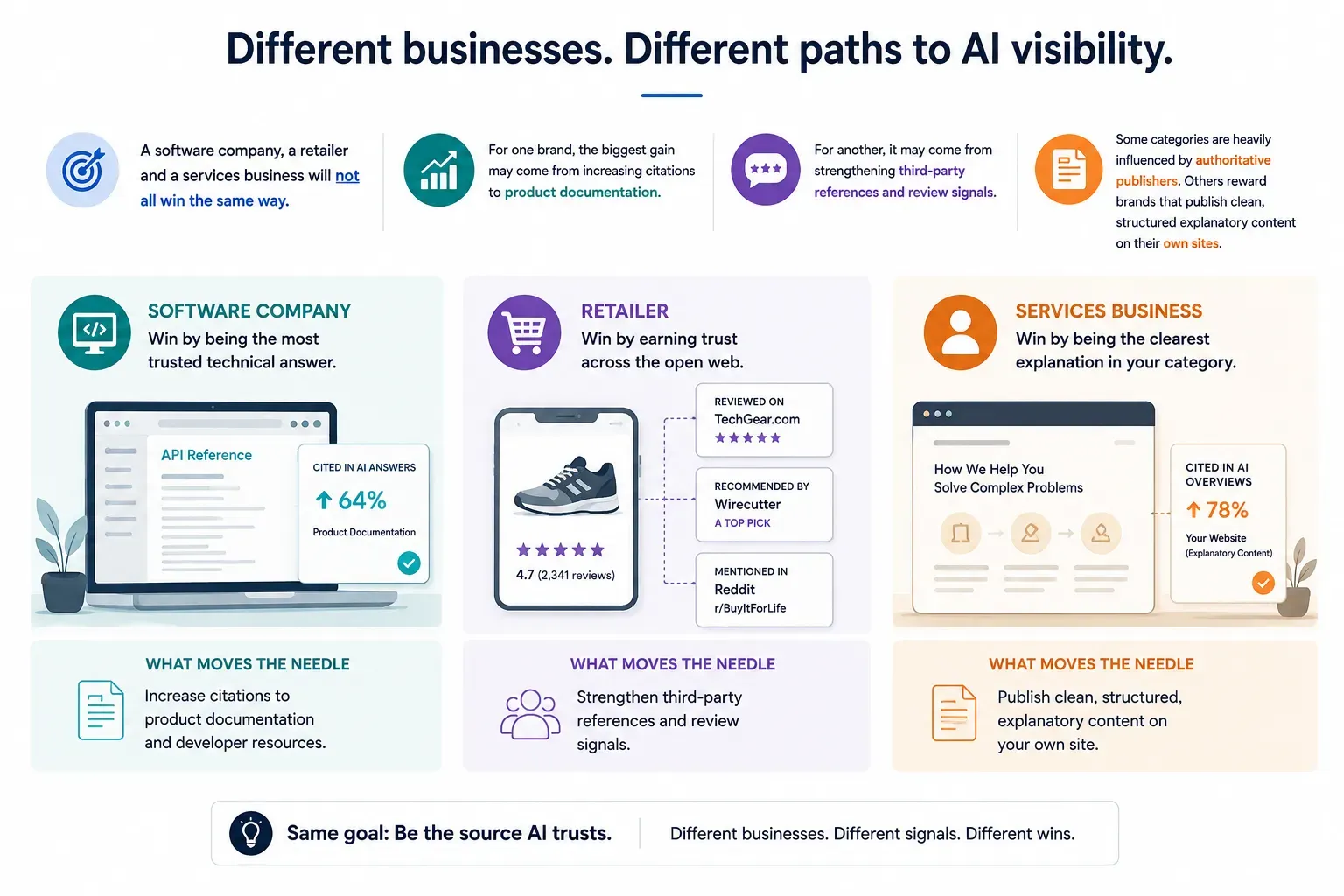
A software company, a retailer and a services business will not all win the same way. For one brand, the biggest gain may come from increasing citations to product documentation. For another, it may come from strengthening third-party references and review signals. Some categories are heavily influenced by authoritative publishers. Others reward brands that publish clean, structured explanatory content on their own sites.
That is also why trade-offs matter. Chasing broad mention growth can look good in a report, but if those mentions are disconnected from high-intent prompts, the business impact may be weak. Likewise, citation gains on a low-relevance platform may matter less than a modest lift inside Google AI Overviews if that is where your buyers are making decisions
How to evaluate an AI search visibility tool
If you are assessing platforms, ask a harder question than “does it track AI search?” Ask whether it helps you win it.
Look for coverage across the major AI environments your audience actually uses. Look for competitor benchmarking, not just isolated reporting on your own brand. Look for prompt tracking that reflects commercial intent rather than generic informational queries. Most importantly, look for actionability. If the platform cannot tell your team what to update, publish, improve or prioritise next, it is only solving half the problem.
You should also pay attention to how the tool presents data. If only specialists can interpret it, adoption will stall. The best systems make advanced GEO metrics usable for both search professionals and commercial teams. That is where platforms such as aigeo insights stand out – they turn AI visibility tracking into a practical workstream instead of another dashboard nobody acts on.

Why this matters now
The battle for the answer has already begun. Buyers are asking AI systems for vendor recommendations, product comparisons and category guidance before they ever land on a website. That means the old model of waiting for traffic data, then optimising months later, is too slow.
Brands need earlier signals. They need to know when competitor share is rising, when sentiment is shifting, when citations are dropping, and when their content is failing to influence the answer. That is the role of an AI search visibility tool. It gives teams a live read on whether they are being represented in the places where decisions are increasingly made.
The brands that act now will shape how AI systems talk about their category. The brands that wait will spend the next year wondering why demand softened while their rankings looked fine on paper.
If your market is moving from search results to generated answers, visibility is no longer about being found. It is about being chosen when the machine speaks.
Related Posts
- How to Measure Brand Visibility in AI Search
Learn how to measure brand visibility across AI search, track share of voice, citations and sentiment, and turn visibility gaps…
Read more - How to Increase AI Citations and Win AI Search
Learn how to increase AI citations with content, entity signals and measurement that put your brand in more AI-generated answers…
Read more - 9 best generative engine optimisation tools
Compare the best generative engine optimisation tools for tracking AI visibility, citations, sentiment, and competitor share of voice.
Read more