
A prospect asks ChatGPT for the best payroll platform, a buyer checks Perplexity before booking a demo, or Google AI Overviews answers a high-intent question without a click. Your brand may be cited, mentioned without a source, positioned behind a competitor, or absent entirely. If you cannot see which of those outcomes is happening, you cannot manage it.
To build an AI citation audit is to create a repeatable system for measuring where generative engines source your brand, how they describe it, and which competitors are winning the answer. This is not a conventional backlink audit with a new label. AI citations are selective, prompt-dependent and shaped by the quality, clarity and accessibility of the information models can retrieve.
The battle for the answer has begun. A strong audit gives your team the evidence to act before visibility losses turn into lost consideration and pipeline.
What an AI citation audit measures
An AI citation audit examines the sources and brands that appear in generated answers across platforms such as ChatGPT, Claude, Gemini, Perplexity and Google AI Overviews. Its purpose is not simply to count links. It shows whether your company is becoming part of the answer set buyers see when they research a category, compare vendors or look for a recommendation.
Start by separating four outcomes that are often lumped together:
- Brand mentions: Your name appears in an answer, with or without a source.
- Citations: A generative engine attributes a claim or recommendation to one of your owned pages or another source that features your brand.
- AI share of voice: Your visibility compared with named competitors across a defined prompt set.
- Sentiment and positioning: The language used around your brand, including whether it is framed as a leader, a niche option, expensive, easy to use or unsuitable for a specific need.
That distinction matters. A brand can have high mention frequency but weak citations, suggesting models know the name but do not find its owned material sufficiently useful or authoritative to support claims. Conversely, a cited page may be driving visibility while the answer describes the business inaccurately. Both require action, but not the same action.
Set the audit around commercial questions
The fastest way to produce noisy data is to test broad, generic prompts. “What is marketing software?” may be useful for trend tracking, but it rarely tells a growth team what to fix next.
Build your prompt library around the questions that sit closest to revenue. Include category discovery, solution evaluation, competitor comparison, use-case research and post-purchase trust questions. For an agency, that could mean queries such as “best SEO agency for ecommerce brands in Australia”, “how to choose a GEO platform”, or “alternatives to [competitor]”. A B2B SaaS company may focus on integration, pricing, security and implementation prompts.
Aim for 30 to 80 prompts in the first audit. That is usually enough to identify patterns without creating a reporting exercise nobody can maintain. Group each prompt by intent, funnel stage, product line, geography and audience. A local business should include suburb and city modifiers. A national brand should test the language buyers use in Australia, not only the terminology used in its US headquarters.
Also document the exact wording and the platform used. Generative responses can change as models update and retrieval systems select different sources. Consistency turns a one-off observation into a defensible benchmark.
Build the AI citation audit dataset
For every response, capture more than the citation URL. Record the prompt, date, platform, model or mode where visible, whether your brand was mentioned, its answer position, cited domains, competitor mentions, sentiment and the key claim made about each brand.
A practical spreadsheet can work for a pilot. Once prompt coverage expands, manual testing becomes slow and inconsistent. You need ongoing monitoring that can run the same question set across engines, preserve response evidence and calculate trend lines. That is where a dedicated GEO measurement platform earns its place.
Your dataset should answer commercially useful questions: Which prompts cite our product pages? Which third-party reviews influence recommendations? Which competitor appears most often when buyers ask for alternatives? Where is our brand present but described incorrectly? Which platforms are producing the largest visibility gap?
Do not treat every citation as equal. Assign a value score based on intent and answer prominence. A citation in a high-intent “best provider” answer should carry more weight than a passing source in a top-of-funnel explainer. Likewise, an answer that recommends your company in the first sentence is more valuable than one that lists it fifth with no differentiation.
Audit owned, earned and competitor sources
Source ownership reveals the path to improvement. Classify every cited domain as owned, earned, competitor-owned or neutral third party.
Owned sources include your website, help centre, documentation, founder content and official social profiles. Earned sources include industry publications, customer case studies, directories, review sites and expert roundups. Neutral third-party material may be a government guide, research report or editorial explainer that validates the category but does not directly promote a provider.
This classification makes weak spots obvious. If a competitor dominates through authoritative comparison pages, the answer is not to publish ten thin blog posts. You may need a more complete comparison asset, independent review coverage, clearer proof points or structured documentation that answers the claims buyers actually ask about.
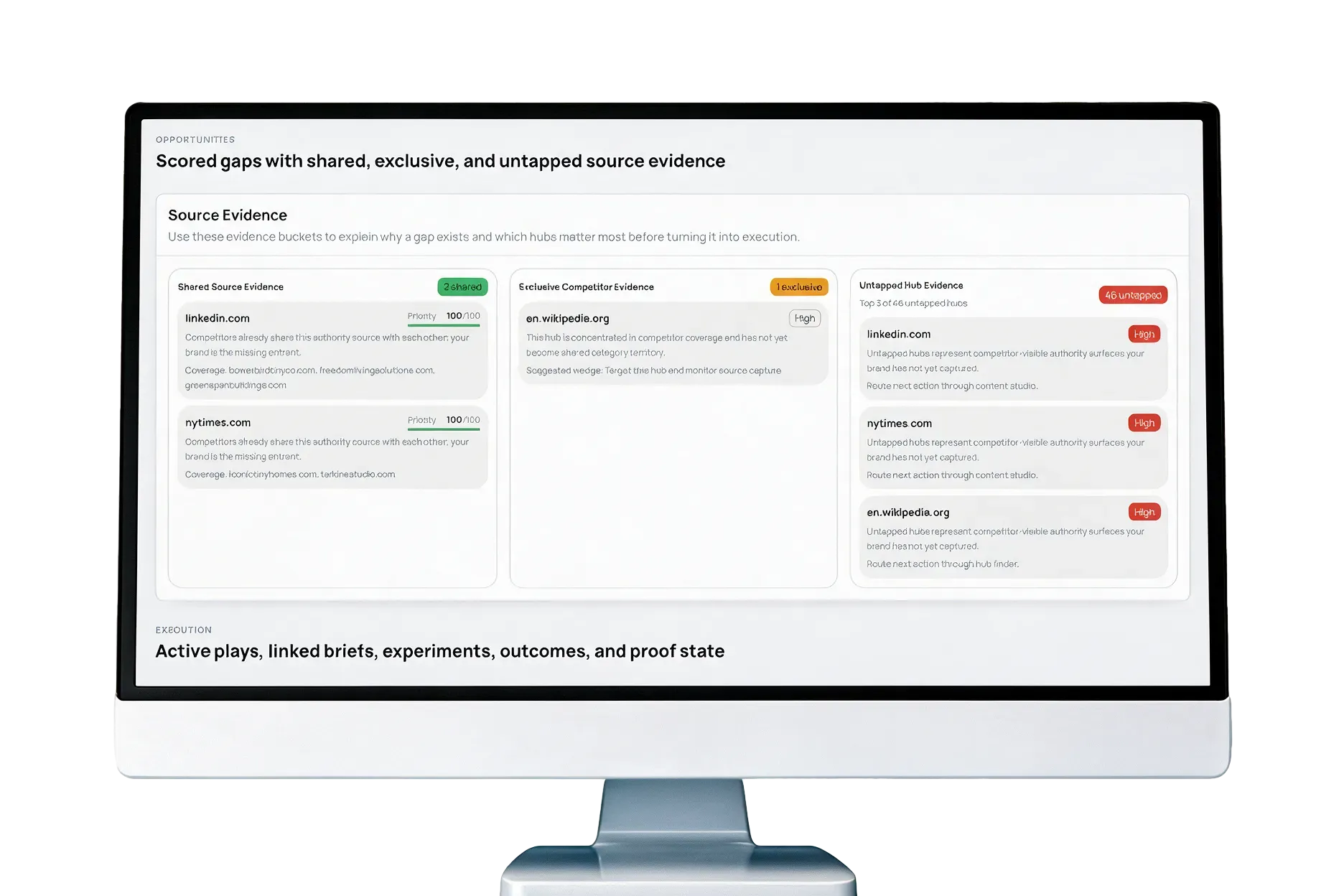
AI citation audit measures Sentimentstack Screenshot
Find the gaps behind the numbers
The most valuable audit output is a prioritised gap list, not a dashboard full of percentages. Read the responses closely and look for repeated failure patterns.
A content gap appears when models answer a recurring question using competitors because you have no credible page that addresses it. This often affects pricing, migration, integrations, industry use cases and comparisons. A clarity gap appears when the relevant page exists but buries the answer under vague marketing copy, inaccessible PDFs or conflicting statements.
An authority gap is different. Your content may be accurate and comprehensive, yet models repeatedly cite established publishers, review platforms or specialist analysts. In that case, improving owned content remains necessary, but distribution and third-party validation become the priority. You cannot write your way out of every credibility deficit on your own domain.
There are also technical gaps. Important content that is blocked, poorly rendered, duplicated, out of date or difficult to parse may never become a reliable source. Check whether key pages have clear headings, direct answers, supporting evidence, consistent product details and crawlable HTML. Structured data can assist search engines in interpreting page context, but it is not a guaranteed ticket into any AI response.
Turn findings into an optimisation roadmap
Every audit finding needs an owner, a priority and an expected visibility outcome. Otherwise, the report gets discussed once and parked.
Score recommendations on impact, effort and confidence. A high-impact, low-effort task might be updating an outdated product page that answers a heavily tested question but includes old pricing or unsupported claims. A high-impact, higher-effort initiative may be building an industry benchmark report that can earn credible third-party citations over time.
Your roadmap should typically include content creation, content refreshes, information architecture fixes and distribution work. For example, if AI answers cite competitors for “best [category] for mid-market teams”, create a genuinely useful mid-market solution page with implementation detail, limitations, proof and clear eligibility. If the model cites a review site instead, strengthen your profile there with accurate positioning and verified customer evidence.
Avoid chasing citations with exaggerated claims or pages created solely for models. Generative engines are increasingly good at surfacing contradictions. The durable strategy is simpler: publish specific, supported information that helps a buyer make a decision, then make it easy to retrieve and validate.
See how your brand appears in AI answers
Run the same six checks we use at the start of an AI visibility engagement.
Benchmark competitors by answer ownership
Traditional SEO reporting often focuses on ranking positions. AI visibility needs a different lens: answer ownership. A competitor that appears in 45 per cent of your tracked prompts is shaping category perception, even if it ranks below you for several conventional keywords.
Compare competitors across overall mention rate, citation rate, sentiment, average answer position, source diversity and platform performance. Source diversity is especially revealing. A rival cited through its own site, review platforms, editorial coverage and analyst content has a stronger visibility moat than one relying on a single comparison page.
Look for winnable territory rather than copying a competitor’s entire content strategy. If they dominate generic category prompts but disappear on regulated, local or technical use cases, that is an opening. If their sentiment weakens around support, cost or complexity, address those decision criteria with proof rather than opportunistic attack copy.
Monitor monthly, respond weekly
AI citation visibility is not static. New pages are indexed, publisher coverage changes, models are updated and competitors improve their own sources. A quarterly audit is useful for strategic planning, but too slow as the only monitoring rhythm.
Track core metrics monthly to establish direction: brand mention rate, owned citation rate, AI share of voice, positive sentiment rate and competitor movement. Review high-value prompt changes weekly. When a priority answer loses your brand or starts citing a rival, investigate the source shift quickly and decide whether the response is content, technical remediation or earned visibility work.
aigeo insights helps teams turn this monitoring into a practical GEO roadmap, connecting platform-level visibility data to the pages, claims and actions most likely to improve performance.
The goal is not to force your brand into every AI answer. It is to become the credible, well-supported answer when the question matches what you genuinely do best. Build the audit around that standard, and every citation gain will mean more than a number on a dashboard.
Related Posts
- AI Citation Tracking Software That Wins Answers
AI citation tracking software shows where your brand appears in AI answers, which competitors are cited, and what to improve…
Read more about AI Citation Tracking Software That Wins Answers - Citation Tracking Platforms for AI Search
Citation tracking platforms show where AI engines source, mention and recommend your brand, then turn lost visibility into a clear…
Read more about Citation Tracking Platforms for AI Search - How to Increase AI Citations and Win AI Search
Learn how to increase AI citations with content, entity signals and measurement that put your brand in more AI-generated answers…
Read more about How to Increase AI Citations and Win AI Search