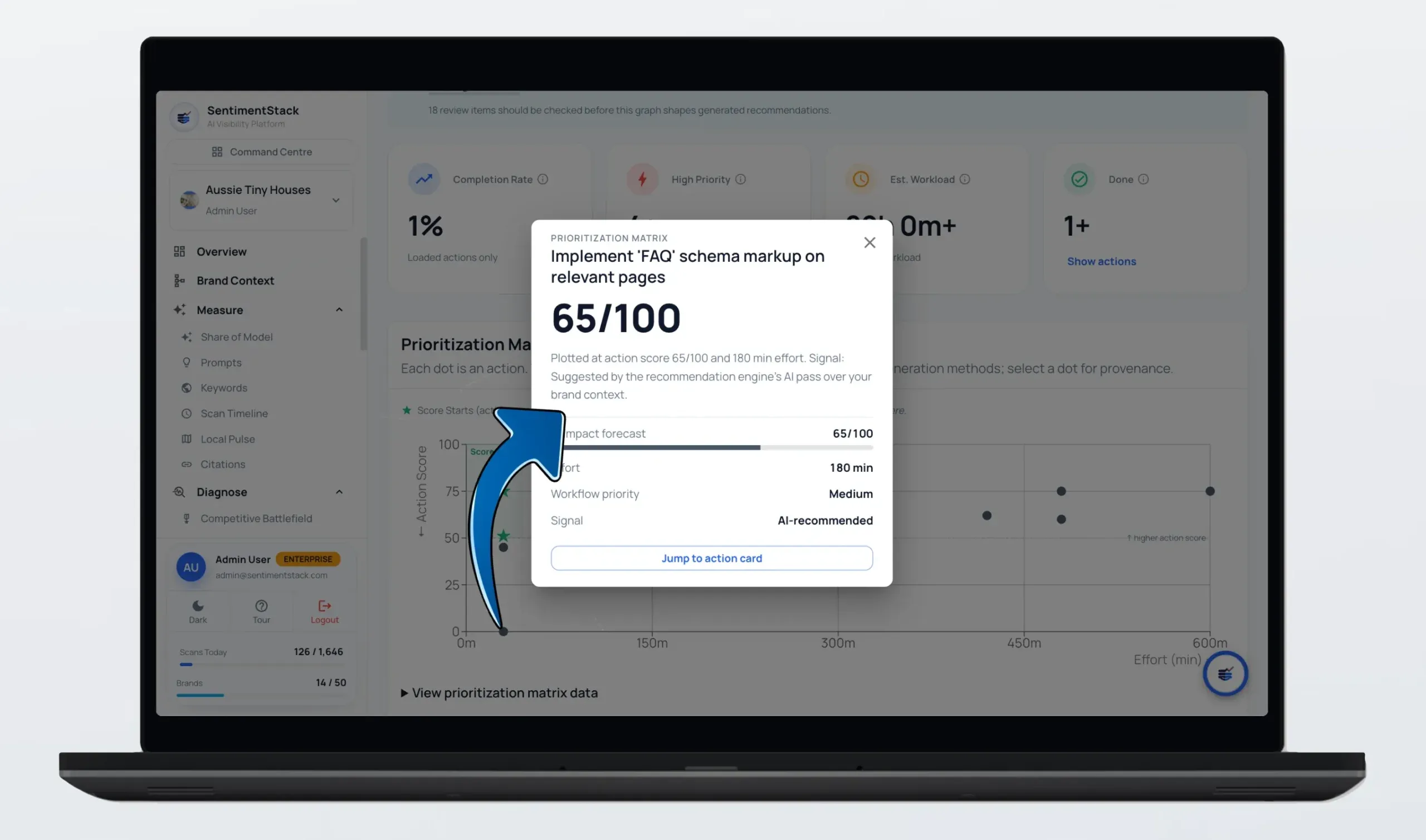
A competitor appears in ChatGPT’s recommendation for your category. Your brand does not. The instinct is to publish more content immediately, but that is how teams burn weeks on activity that never changes AI visibility. Knowing how to prioritise GEO tasks means identifying the few actions most likely to increase mentions, citations and positive representation in the answers customers actually see.
Generative Engine Optimisation is not a content volume game. It is a visibility and evidence game. AI platforms decide which brands, sources and facts to surface based on a changing mix of relevance, authority, structure, recency and corroboration. Your task is to direct finite resources towards the biggest visibility gaps before competitors turn their lead into a default position.
Start with the AI visibility gap, not the content backlog
Most marketing teams already have a backlog overflowing with blog refreshes, landing pages, PR ideas, technical fixes and social campaigns. That list is not a GEO strategy. It is a collection of possible work.
Start instead with the questions buyers ask generative engines before they choose a provider. These may be category prompts such as “best payroll software for small businesses”, comparison prompts such as “Brand A versus Brand B”, or problem-led prompts such as “how do I reduce customer churn?”. Then measure what happens across the platforms that matter to your market: ChatGPT, Claude, Gemini, Perplexity and Google AI Overviews.
For each prompt cluster, establish four facts: whether your brand is mentioned, whether your site is cited, the sentiment of the response, and which competitors own the answer. This turns a vague concern about AI search into an addressable gap.
A missing brand mention on a high-intent comparison prompt is usually more urgent than a weak citation rate on a low-value educational query. Likewise, a negative or inaccurate description of your business deserves attention even if your overall share of voice looks healthy. Visibility without control of the narrative can create a commercial problem, not solve one.
Score GEO work by impact, confidence and effort
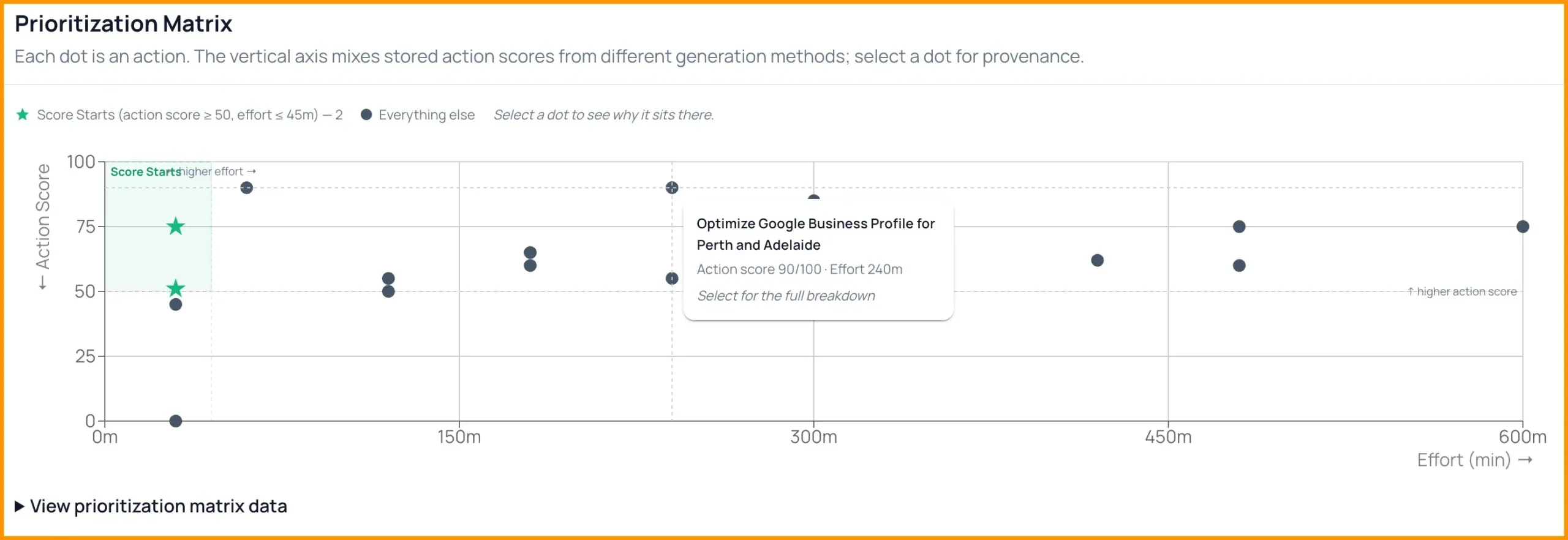
The fastest way to make GEO prioritisation operational is to give every proposed task a score. Do not use a scoring model to create false precision. Use it to make trade-offs visible and prevent the loudest stakeholder from setting the roadmap.
Score each task against three core dimensions:
Impact
How much could this change revenue-relevant AI visibility? Consider prompt volume, buyer intent, current competitor advantage and the likely gain in mentions or citations.
Confidence
How strong is the evidence that this task will help? A missing comparison page for a prompt where competitors are repeatedly cited has higher confidence than a speculative trend article.
Effort
How much time, expertise, approval and technical work will it require? Include the real cost of subject-matter input, legal review and distribution.
Urgency
Is a competitor gaining ground, is there inaccurate brand information in market, or is a seasonal campaign approaching? Urgency should elevate a task, but not excuse low-impact busywork.
A practical formula is: impact multiplied by confidence, divided by effort, with an urgency adjustment. The exact maths matters less than applying the same logic to every task.
For example, updating a high-traffic product page to answer common buyer questions, include clear product facts and address competitor alternatives may score highly. It supports commercial prompts, relies on an existing asset and can be completed quickly. Creating a broad thought-leadership report may still be worthwhile, but it should not jump the queue simply because it sounds ambitious.
How to prioritise GEO tasks by prompt intent
Not all AI mentions carry the same commercial value. Treat prompts as a portfolio, not a flat list.
Defend your branded territory first
Branded prompts are where the risk is clearest. If an AI response gets your pricing wrong, confuses you with another company, omits a key feature or recommends a competitor alongside your brand, fix the underlying evidence quickly.
Prioritise pages that establish definitive facts: product and service pages, pricing explanations, company profiles, support documentation, integration details and comparison content. Ensure facts are consistent across owned channels and credible third-party references. Generative engines are more likely to repeat clear, corroborated information than marketing claims that appear once and nowhere else.
This is also where reputation work belongs. A low sentiment score tied to a specific concern, such as implementation difficulty or poor support, is not merely a messaging issue. Find the source of the claim, determine whether it is accurate and respond with substantiated information. Do not attempt to bury legitimate criticism with generic content.
Attack high-intent category and comparison gaps
Category prompts can introduce your brand to buyers who have never searched for you. Comparison prompts can influence a decision already in motion. Both deserve priority when the audience is commercially valuable and competitors have a measurable lead.
Look for repeated patterns. If three competitors are cited whenever users ask for a solution in your category, inspect the sources and formats underpinning those answers. You may need a clearer category page, independently verifiable product information, expert commentary, customer evidence or a comparison page that addresses the decision criteria directly.
Do not create shallow “Brand X alternatives” pages for every competitor. They often read like search bait and offer little evidence an AI system can trust. Build comparison assets only where there is demonstrated prompt demand, a meaningful product distinction and enough proof to make the page genuinely useful.
Build educational authority where it supports future demand
Informational prompts matter, but they should not consume the entire roadmap. Educational content is often a longer-term play: it can earn citations, clarify your category and put your brand in the source set before purchase intent peaks.
Prioritise topics where your business has genuine expertise, where answers require explanation rather than a one-line definition, and where you can contribute original data, frameworks or practical examples. A well-supported guide to a buyer’s difficult problem can become a durable citation asset. A generic rewrite of what every competitor says will struggle to change the result.
Choose the right type of fix
A GEO roadmap should distinguish between creating, improving, structuring and distributing content. Treating every gap as a net-new article is expensive and often unnecessary.
An existing page may already cover the answer but bury it beneath vague copy, outdated claims or poor structure. In that case, improve the page rather than start again. Add direct answers, precise definitions, proof points, relevant FAQs where users genuinely need them, and clear page hierarchy.
Sometimes the gap is structural. Product data may be inconsistent, key pages may be inaccessible to crawlers, or essential information may live only in PDFs, images or gated assets. Technical and content teams need to work together here. An AI-friendly answer cannot be reliably represented if the source material is fragmented or hard to interpret.
Distribution is the right task when the content is strong but lacks independent reinforcement. Original research, expert perspectives, customer stories and accurate company information can be placed where credible third parties, journalists, communities and industry publishers can reference them. The aim is not to manufacture mentions. It is to make your best evidence discoverable beyond your own domain.
Use competitors as a prioritisation signal, not a content template
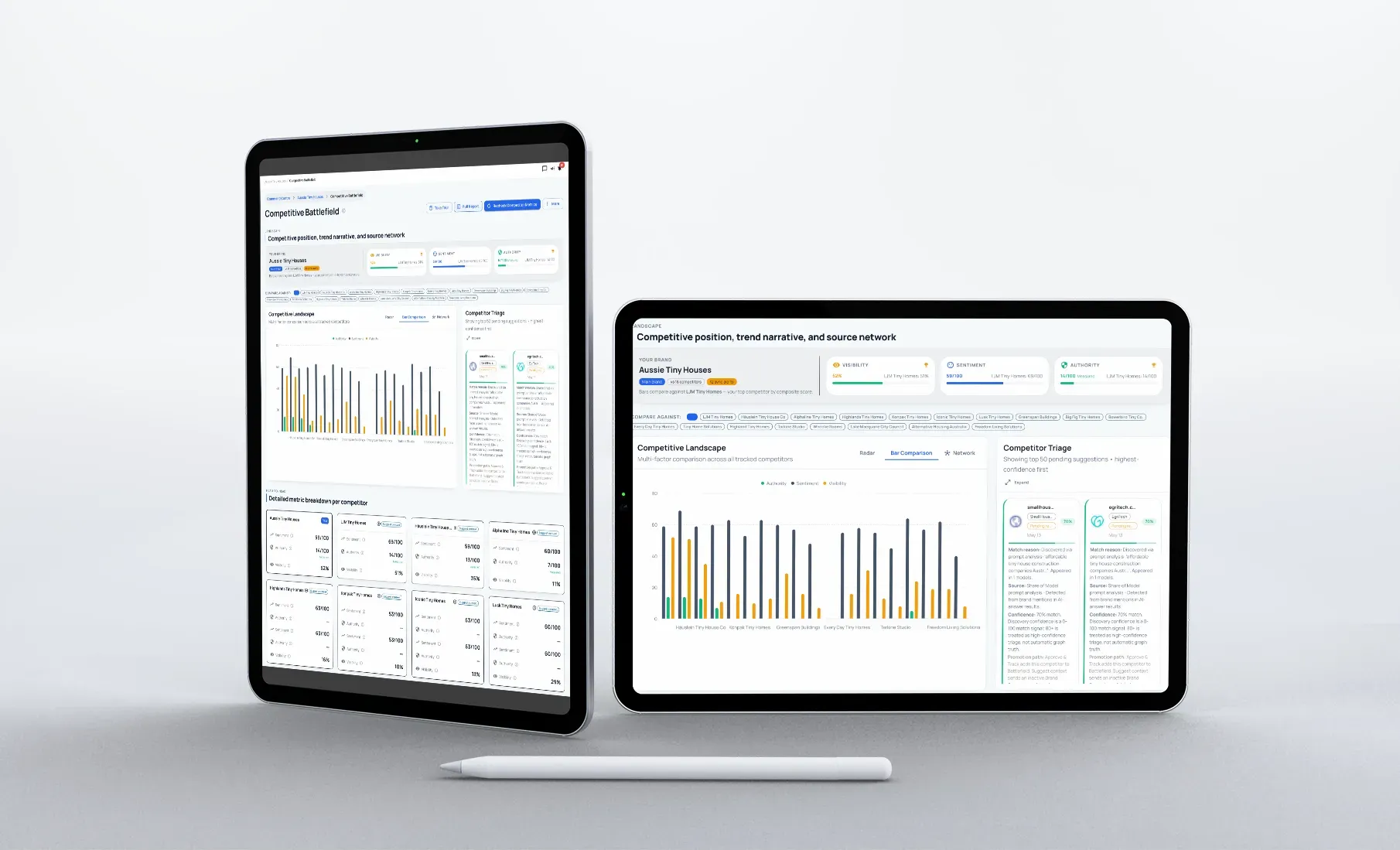
Competitor visibility data is valuable because it reveals where the answer economy is already moving. If a rival’s AI share of voice rises sharply on a set of prompts, investigate the change. Did they publish a definitive resource? Earn authoritative coverage? Clarify their positioning? Update core product pages?
But do not copy their content plan wholesale. Their visibility may be driven by a brand reputation, product category fit or third-party source profile you cannot replicate quickly. Your advantage may come from a different point of view, better evidence, stronger customer proof or a more useful way of framing the buyer’s problem.
The more useful question is not, “What did they publish?” It is, “What evidence is the AI using to favour them, and where can we credibly become the better answer?”
Run GEO as a weekly operating rhythm
AI responses can change quickly, particularly when platforms update models, sources or ranking behaviour. A quarterly report is helpful for leadership, but it is too slow to run the work.
Review priority prompts weekly. Check for movement in brand mentions, citation rate, sentiment and AI share of voice. Flag new competitor gains, lost citations and inaccurate answers. Then select a manageable set of tasks for the next sprint, balancing quick wins with larger authority-building work.
This is where a platform such as aigeo insights can reduce the manual burden: it connects cross-platform visibility tracking with task recommendations, so teams can see which action has the strongest rationale rather than working from a disconnected spreadsheet.
Give each task an owner, a due date and a success measure. “Refresh the integrations page” is not enough. Define the intended outcome: improve citation presence for integration prompts, correct an inaccurate capability claim, or increase positive mentions in a comparison cluster. Reassess after the work has had time to be discovered and reflected in AI responses. Some changes produce a fast result; others need sustained evidence and distribution.
The battle for the answer is not won by doing every GEO task on the list. It is won by acting first where buyer intent, evidence and competitive pressure meet – then using the result to decide the next move.
Related Posts
- Ecommerce Answer Visibility Is Now a Revenue Metric
Ecommerce answer visibility shows whether AI tools recommend your products. Learn what to measure, where competitors win, and how to…
Read more about Ecommerce Answer Visibility Is Now a Revenue Metric - LLM Analytics Review for Brands That Want Visibility
An LLM analytics review for marketers: assess AI visibility, citations, sentiment and competitors, then turn data into actions that grow…
Read more about LLM Analytics Review for Brands That Want Visibility - How to Measure Brand Visibility in AI Search
Learn how to measure brand visibility across AI search, track share of voice, citations and sentiment, and turn visibility gaps…
Read more about How to Measure Brand Visibility in AI Search