
A customer asks an AI assistant, “What are the best trail running shoes for wet conditions?” The response names three brands, compares grip and cushioning, and suggests where to buy. If your products are absent, your ecommerce answer visibility has already cost you consideration before the shopper reaches a search result, category page or retailer site.
That is the commercial shift ecommerce teams need to act on. Search rankings still matter, but they are no longer the whole contest. ChatGPT, Gemini, Claude, Perplexity and Google AI Overviews increasingly turn product research into a short list of answers. Brands now compete to be recommended, cited and accurately represented inside those answers.
What ecommerce answer visibility actually measures
Ecommerce answer visibility is the extent to which AI-generated responses mention, recommend, compare or cite your brand and products when shoppers ask commercially relevant questions. It is not a vanity metric. It shows whether your business is present at the precise moment AI narrows the field for a buyer.
Traditional SEO reporting can tell you that a category page ranks on page one. It cannot reliably tell you whether an AI assistant describes your product as a leading option, selects a competitor instead, gets your price point wrong, or omits you from a comparison altogether. Those outcomes influence preference long before a click happens.
For ecommerce operators, visibility should be measured across the prompts that reflect real purchase intent. That includes broad discovery questions, such as “best standing desk for a home office”, as well as tighter evaluation questions like “is Brand A better than Brand B for a small apartment?” and post-purchase queries such as “how do I assemble this desk?”. Each stage creates a different opportunity to enter the answer.
The stakes are especially high in categories where shoppers need help filtering options. Beauty, electronics, apparel, health products, homewares, travel and specialist B2B supplies all depend on product comparisons, compatibility checks and recommendation-led decisions. When the answer engine becomes the adviser, brand absence becomes a revenue risk.
Why AI recommendations are changing the ecommerce funnel
A conventional search results page gives a shopper multiple listings to assess. An AI response often performs that assessment for them. It synthesises product features, reviews, editorial guidance, retailer information and brand content into a direct recommendation.
That can reduce the number of brands a shopper considers. It can also accelerate decisions when the answer is credible, specific and easy to act on. The trade-off is obvious: AI may send highly qualified visitors to your site, but only if it has enough reliable evidence to choose you in the first place.
This is why generic product copy is no longer enough. Pages that merely repeat a product name, a few features and a promotional claim give AI systems little context to work with. Clear product specifications, use cases, comparison information, availability details, independently supported claims and helpful supporting content create a stronger evidence base.
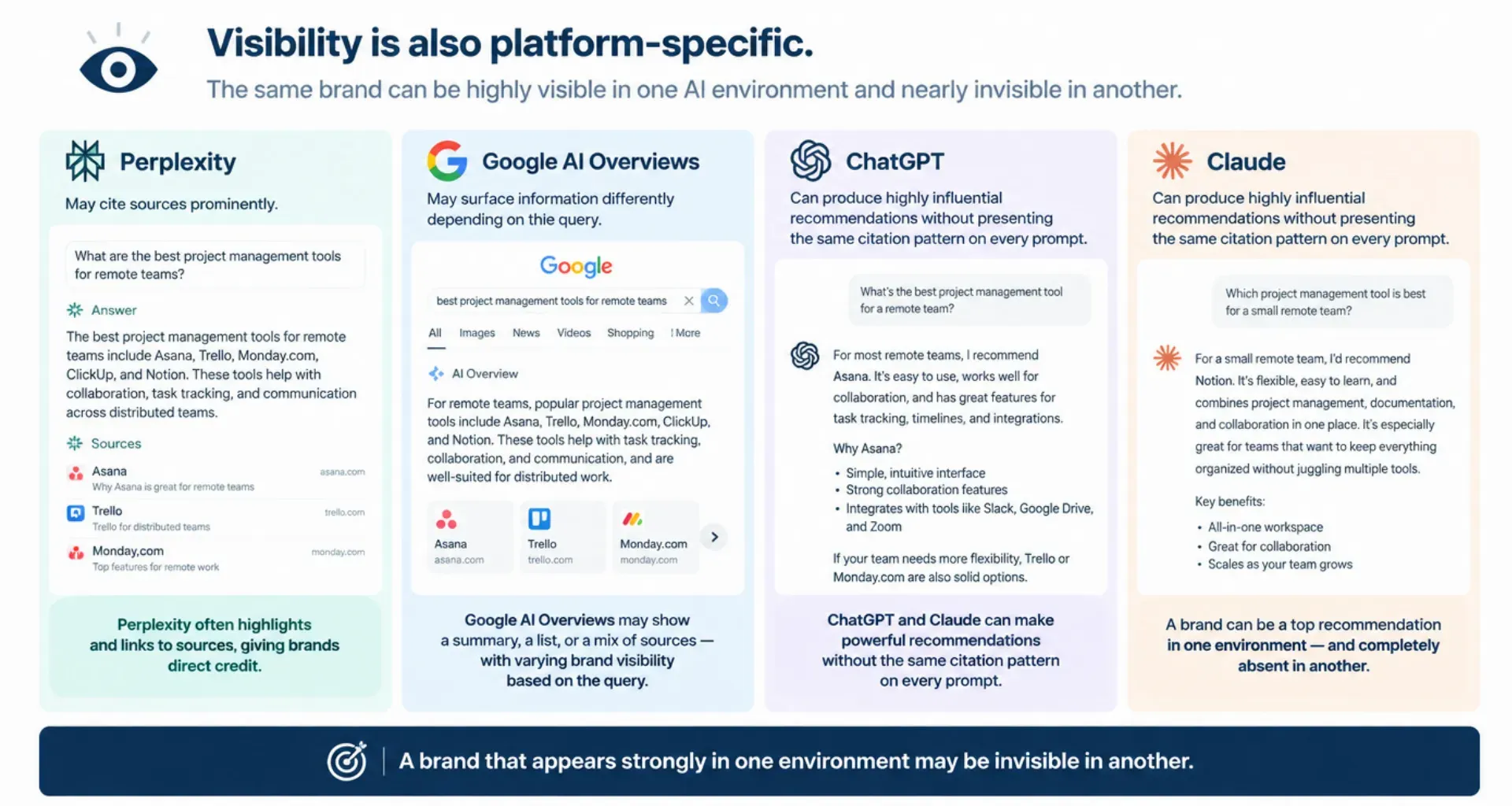
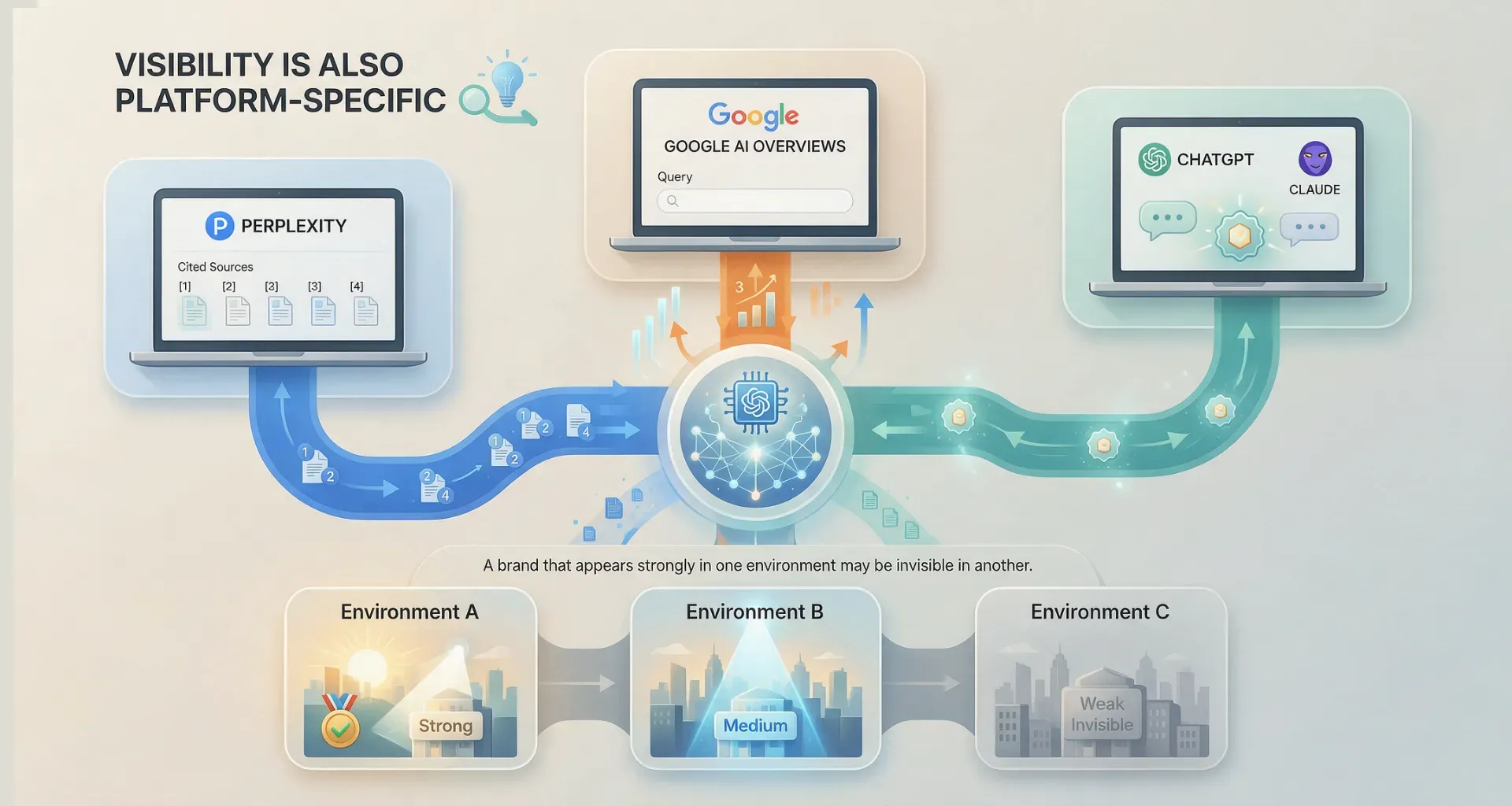
Visibility is also platform-specific. Perplexity may cite sources prominently. Google AI Overviews may surface information differently depending on the query. ChatGPT and Claude can produce highly influential recommendations without presenting the same citation pattern on every prompt. A brand that appears strongly in one environment may be invisible in another.
Treating “AI search” as one channel hides these differences. The winning ecommerce teams track performance by platform, query group, product line and competitor.
The metrics that show whether you are winning
The first metric is brand mention frequency. How often does your brand appear across the prompts that matter to your category? This establishes baseline presence, but it should not be read in isolation. A frequent mention with neutral or negative framing is not the same as a recommendation.
AI share of voice adds competitive context. If your brand appears in 18 per cent of tracked answers while a direct competitor appears in 44 per cent, the gap is clear. It tells your team where the battle for category authority is being lost.
Citation rate matters because citations reveal which sources AI systems trust enough to support an answer. Track whether your owned pages are cited, which third-party sources appear alongside them, and which competitor assets consistently earn references. A strong citation rate does not guarantee a sale, but it is a powerful indicator that your information is discoverable and credible.
Sentiment is equally important. AI can mention a retailer or product while framing it as expensive, difficult to return, unreliable or unsuitable for a certain use case. Monitor the language around your brand, not just the fact that it appeared. A mention without context can conceal a reputation problem.
Finally, measure recommendation position and product accuracy. Are you named as the first option, one of several alternatives, or a brand to avoid? Are product features, stock status, compatibility and pricing described correctly? Incorrect information is not simply a content issue. It can create support costs, returns and lost conversion.
How to improve ecommerce answer visibility
Start by building a prompt set from your actual commercial reality. Use search query data, customer service conversations, onsite search terms, sales objections and category research. Group prompts by intent: discovery, comparison, purchase, troubleshooting and brand-specific questions.
Avoid tracking only flattering prompts such as “best [your brand] products”. The more valuable test is whether you appear when the customer does not know you exist. Ask the questions buyers ask before they have made up their mind.
Then audit the pages and assets that should support those answers. Product pages need complete, factual information written in plain language. Include specifications, dimensions, materials, compatibility, care instructions, delivery and returns details, and specific use-case guidance where relevant. A shopper and an AI system should be able to understand exactly who the product is for and when it is not the right fit.
Category pages deserve the same attention. They should explain how to choose between product types instead of acting as a grid of items with thin labels. If you sell coffee machines, for example, explain the difference between automatic, manual and capsule options, the maintenance involved, and which household or workplace needs each type suits. This gives answer engines useful structure and gives shoppers a reason to trust you.
Comparison content can be highly effective, provided it is honest. Explain the differences between models, bundles, materials or price tiers. Address trade-offs directly. A premium item may offer better durability but be unnecessary for occasional use. A budget option may suit first-time buyers but lack a feature professionals need. Straight answers build the clarity that AI-generated recommendations depend on.
Do not overlook third-party validation. Expert reviews, reputable stockists, supplier documentation, industry publications and genuine customer feedback can all influence the wider information environment. You cannot control every source, but you can identify gaps between the claims you make and the evidence available online.
Turn monitoring into an operating rhythm
The mistake is treating AI visibility as a quarterly reporting exercise. Generative answers change as models, source material, products and competitors change. A competitor can publish a better buying guide, earn a prominent review or fix their product data, then take share before your next conventional SEO report signals a problem.
Set a regular cadence for tracking priority prompts and competitive movement. When a competitor gains visibility, investigate the reason. They may have stronger product documentation, better structured category content, more authoritative citations or a clearer answer to a common buyer question. The goal is not to copy their wording. It is to close the evidence gap with better information.
This is where a platform such as aigeo insights becomes operationally useful. Rather than producing another dashboard teams must interpret manually, it can connect mentions, citations, sentiment, AI share of voice and competitor performance to a prioritised optimisation roadmap. Your team can see which content to create, update, structure or distribute based on where answer visibility is actually being won or lost.
Prioritisation matters because not every missing mention deserves immediate action. Focus first on prompts with high commercial intent, significant category volume, strong competitor presence or recurring inaccuracies. A product comparison query close to purchase may be worth far more than a broad informational question with little conversion potential.
The answer economy does not reward the loudest brand. It rewards the brand with the clearest, most credible and most useful evidence when a customer asks for help. Build that evidence deliberately, measure whether AI systems recognise it, and make every visibility gap a practical next move.
Related Posts
- AI Discoverability Is Now a Revenue Metric
AI discoverability determines whether your brand appears in the answers buyers trust. Measure visibility, fix gaps and win AI search…
Read more about AI Discoverability Is Now a Revenue Metric - LLM Analytics Review for Brands That Want Visibility
An LLM analytics review for marketers: assess AI visibility, citations, sentiment and competitors, then turn data into actions that grow…
Read more about LLM Analytics Review for Brands That Want Visibility - Answer Engine Analytics: Measure What AI Says
Answer engine analytics shows where AI mentions, cites and recommends your brand, so your team can act before competitors take…
Read more about Answer Engine Analytics: Measure What AI Says