
A buyer asks ChatGPT which payroll platform suits a growing Australian business. Gemini compares project management tools. Perplexity explains the best options for a technical problem. In each case, the brands cited in the answer gain credibility before a prospect reaches a website. This citation worthy content planning guide shows how to plan for that moment deliberately, rather than hoping your existing SEO content makes the cut.
Generative search has changed the unit of competition. Ranking pages still matter, but brands now compete to supply the evidence, definitions, comparisons and first-party expertise that AI systems can turn into an answer. Content that earns citations is not simply well written. It is specific, structured, verifiable and closely matched to the questions that influence revenue.
What makes content citation-worthy?
AI platforms do not cite content because it has the most keywords or the longest word count. They select sources that help substantiate a response. That means your content needs to reduce uncertainty: state what something is, explain how it works, show who it is for and support material claims with clear evidence.
A citation-worthy asset usually has a narrow job. It may define a category term, compare implementation approaches, document a process, publish original benchmarks or answer a high-intent buyer question. Broad articles that attempt to cover an entire industry often create too much ambiguity for a model to extract and attribute a useful claim.
Authority matters, but it is not a blank cheque. A recognised brand can still lose visibility when a smaller competitor publishes the clearer, fresher and more directly relevant source. Conversely, an excellent piece will struggle if it has no identifiable author, no evidence of experience, or no accessible explanation of its methodology.
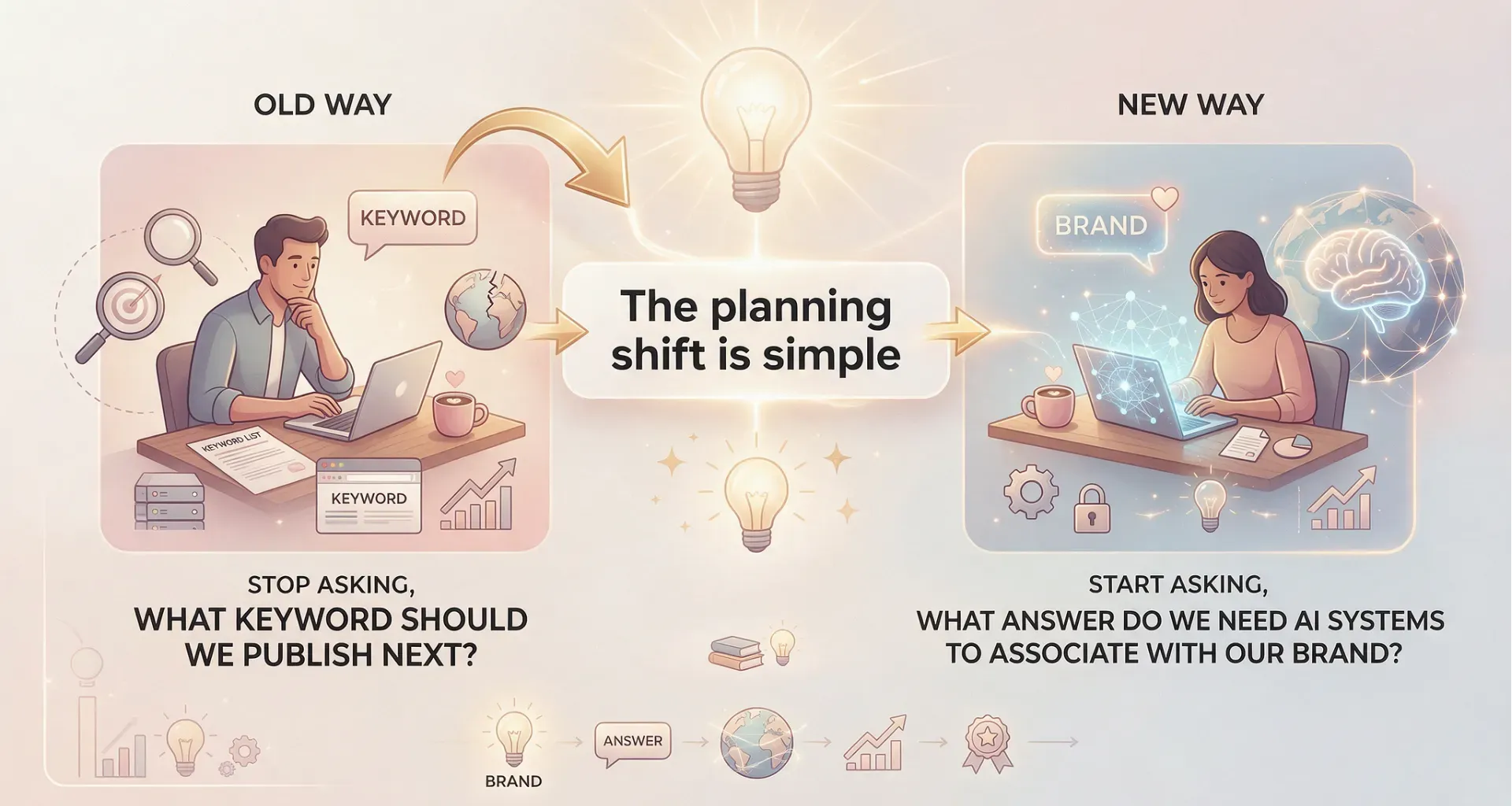
The planning shift is simple: stop asking, “What keyword should we publish next?” Start asking, “What answer do we need AI systems to associate with our brand?”
Build your citation-worthy content planning model
Start with visibility gaps, not editorial instincts
Most content calendars begin with internal ideas, seasonal themes and keyword volumes. That approach misses the AI search battleground because it cannot show where a brand is absent, misrepresented or outperformed in generated answers.
Map the prompts your prospects use across discovery, evaluation and decision stages. Include direct category queries such as “best CRM for small business”, but do not stop there. The higher-value prompts often include constraints: budget, industry, integrations, compliance requirements, migration concerns and alternatives.
For each prompt, record four signals: whether your brand is mentioned, whether it is cited, how competitors are positioned and which sources appear to support the answer. This reveals the difference between a brand awareness problem and a content evidence problem. If you are mentioned but not cited, you may need stronger owned proof. If competitors are repeatedly cited for a capability you also offer, you have a clear content gap.
This is where a platform such as aigeo insights earns its place in the workflow. Tracking citation rate, AI share of voice, sentiment and competitor visibility across platforms turns scattered observations into a prioritised optimisation roadmap.
Prioritise prompts by commercial leverage
Not every missing citation deserves a new article. A broad informational query may have high visibility but little buying intent. A niche comparison query may generate fewer impressions yet influence a purchase shortlist. The right priority depends on your sales cycle, category maturity and deal value.
Score content opportunities against commercial impact, current visibility gap, competitor strength and production effort. Give more weight to prompts that appear late in the buying journey or repeatedly shape category perception. For example, a cybersecurity provider may gain more from being cited in answers about compliance evidence and deployment models than from chasing a generic definition of cyber risk.
Be honest about the trade-off. Original research can create an exceptional citation asset, but it takes time and budget. A sharply structured product comparison or implementation guide can move faster. Your plan should contain both: fast improvements to important existing pages and larger evidence assets that build durable authority.
Assign one claim to each asset
The strongest content plans avoid vague briefs such as “write about AI visibility”. Instead, define the primary claim the page must credibly own. For example: “Australian retail teams can measure generative search visibility by tracking citations, mentions and sentiment across platforms.”
That claim should be supported by a small set of related questions. What is being measured? Why does it affect commercial outcomes? How is the metric calculated? What should a team do when performance drops? When every section supports the same central answer, the asset becomes easier for both readers and AI systems to interpret.
Do not force a single page to win every variation. Create a connected set of assets where each page has a distinct role: a category explainer, a methodology page, a comparison page, a use-case guide and a data-led report. Overlap is normal. Cannibalisation becomes a problem only when multiple pages make the same claim to the same audience without adding a meaningful distinction.
Structure pages for extraction and trust
Citation potential is partly editorial and partly operational. Even the best insight is difficult to use when it is buried under promotional copy, vague headings and unsupported superlatives.
Lead with a direct answer in the opening section. Use descriptive headings that mirror real questions. Keep definitions concise, explain acronyms on first use and put key facts close to the claim they support. Tables can work well for comparisons when the criteria are clear, but do not use them to disguise opinion as fact.
For evidence-heavy content, explain where figures came from, when they were collected and what they do not prove. First-party data is valuable precisely because it is distinctive, but it must be transparent. A survey of 300 customers is not a market census. A platform benchmark may show directional change, not universal causation. This level of precision makes a source more credible and protects the brand when an AI answer compresses the nuance.
Every commercial page should also resolve basic entity questions. Make it obvious what your company does, who it serves, what your product includes and where its claims come from. Generic positioning creates generic AI representation. Clear entity information creates a stronger chance of accurate mentions.
Create the evidence AI answers need
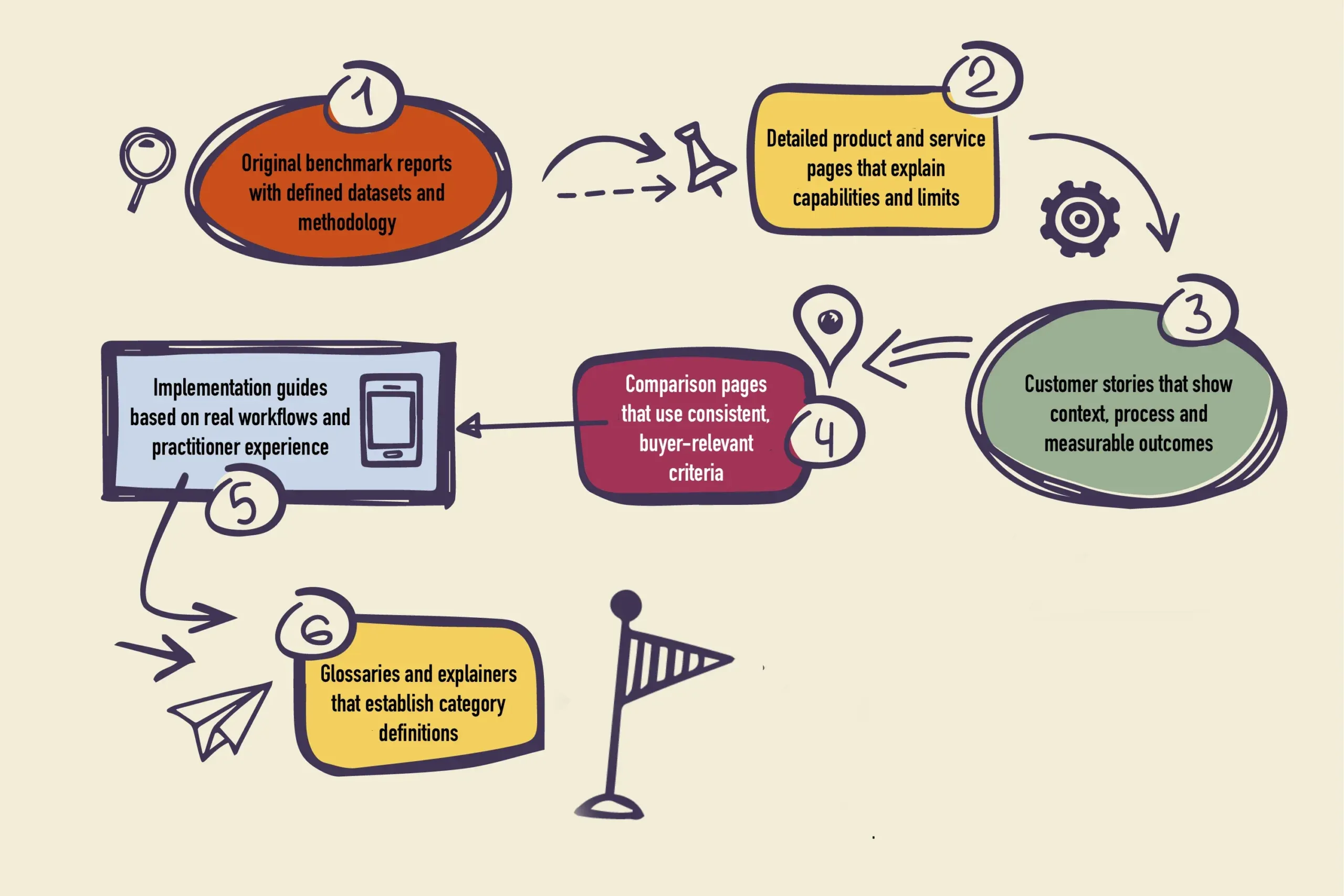
A content calendar built solely around blog posts will rarely win the answer economy. Different prompts require different proof formats. Plan a balanced evidence library that includes:
- Original benchmark reports with defined datasets and methodology
- Detailed product and service pages that explain capabilities and limits
- Comparison pages that use consistent, buyer-relevant criteria
- Implementation guides based on real workflows and practitioner experience
- Glossaries and explainers that establish category definitions
- Customer stories that show context, process and measurable outcomes
The key is not volume. It is coverage of the evidence gaps revealed by your prompt tracking. If competitors are cited for independent-style research, publishing another opinion article will not close the gap. If AI platforms misunderstand your product category, a precise explainer and terminology page may outperform a glossy campaign.
Freshness also depends on the topic. A foundational definition may remain useful for a year. Pricing, regulatory guidance, platform capabilities and market statistics need regular reviews. Build review dates into the plan so your best assets do not become stale sources that AI systems stop trusting.
Measure citations as a performance system
Traditional traffic reporting cannot tell you whether a page influenced an AI answer. A page may receive limited organic visits while becoming a highly cited source for valuable prompts. Equally, a popular blog post may attract traffic but contribute little to generative visibility.
Track performance at three levels. At the brand level, monitor mention frequency, citation rate, AI share of voice and sentiment. At the prompt level, identify where visibility has changed and which competitors gained or lost ground. At the asset level, connect cited URLs and recurring topic clusters to the content you publish or update.
Then turn movement into action. A drop in citations after a competitor launches research may signal a missing data asset. Negative sentiment around a product limitation may require a clearer capability page or support documentation. New mentions without citations could mean your brand awareness is improving while your evidence base remains too thin.
Do not overreact to a single answer. Generative outputs vary by model, location, prompt wording and time. Look for persistent patterns across platforms and repeated prompt sets before reallocating major production resources.
Give every content sprint a decision rule
The fastest teams are not those publishing the most. They are the ones that can decide what to create, refresh or retire without another month of debate. Set a recurring review cadence and require each proposed asset to answer three questions: which revenue-relevant prompt gap does this address, what proof will make it citeable, and what metric will show whether it worked?
That discipline changes content from a publishing function into a visibility engine. Your next high-value asset may not be the biggest report or the cleverest campaign. It may be the page that finally gives an AI system a clear, current and credible reason to put your brand in the answer.
Related Posts
- Generative Search Content Optimisation Guide
This generative search content optimisation guide shows Australian marketing teams how to earn AI citations, lift share of voice and…
Read more about Generative Search Content Optimisation Guide - Citation Tracking Platforms for AI Search
Citation tracking platforms show where AI engines source, mention and recommend your brand, then turn lost visibility into a clear…
Read more about Citation Tracking Platforms for AI Search - GEO Workflow Guide for Winning AI Search Visibility
This GEO workflow guide shows marketing teams how to measure AI visibility, prioritise fixes, and earn more brand mentions and…
Read more about GEO Workflow Guide for Winning AI Search Visibility