
An AI platform tells a customer that your competitor is the best option in your category. Another says your product is ideal for a use case you do not support. A third recommends a content strategy built on a statistic that does not exist.
That is the commercial reality behind how to validate AI recommendations. Generative AI can surface useful patterns at extraordinary speed, but it can also blend stale information, weak sources and confident guesses into an answer that sounds ready for action. For marketers, agencies and growth teams, accepting that answer without checking it is no longer a harmless shortcut. It can send budget, content production and brand positioning in the wrong direction.
The brands winning the answer economy are not treating AI output as fact. They are treating it as a hypothesis, then validating it against evidence that reflects their market, their audience and the live AI search landscape.
Why AI recommendations need a verification process
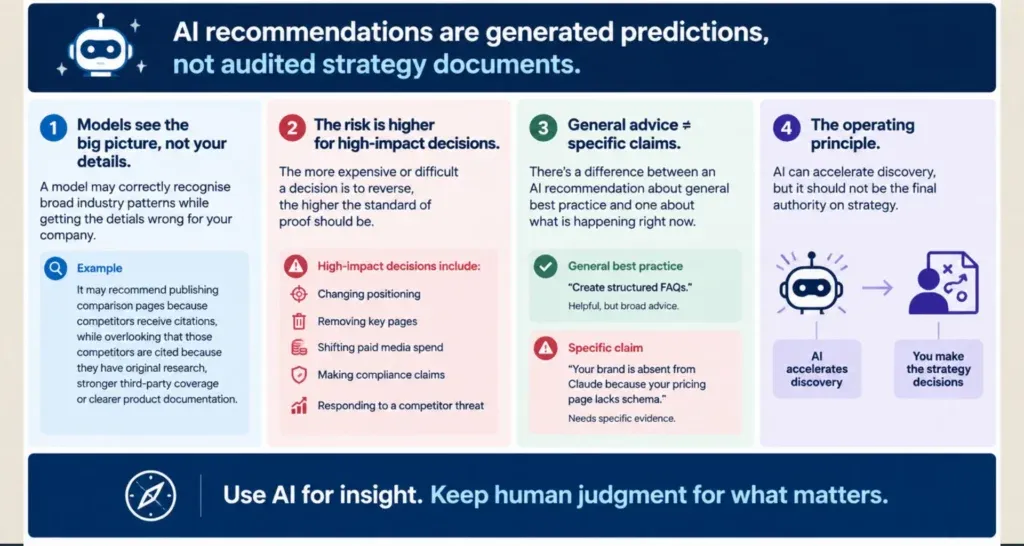
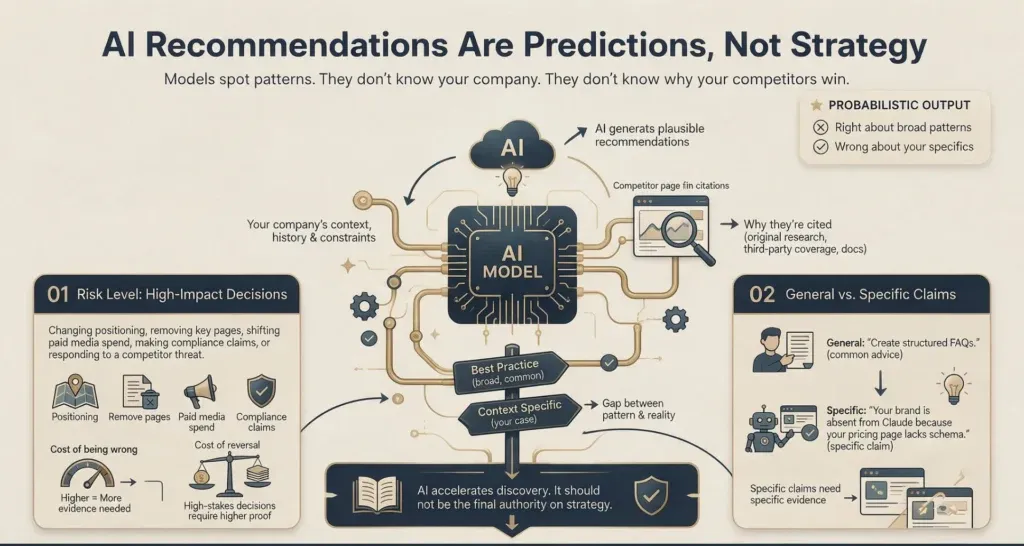
AI recommendations are generated predictions, not audited strategy documents. A model may correctly recognise broad industry patterns while getting the details wrong for your company. It may recommend publishing comparison pages because competitors receive citations, for example, while overlooking that those competitors are cited because they have original research, stronger third-party coverage or clearer product documentation.
The risk rises when a recommendation concerns high-impact decisions: changing positioning, removing key pages, shifting paid media spend, making compliance claims or responding to a competitor threat. The more expensive or difficult a decision is to reverse, the higher the standard of proof should be.
There is also a difference between an AI recommendation about general best practice and one about what is happening right now. “Create structured FAQs” is general advice. “Your brand is absent from Claude because your pricing page lacks schema” is a specific claim. Specific claims need specific evidence.
A useful operating principle is simple: AI can accelerate discovery, but it should not be the final authority on strategy.
How to validate AI recommendations in five moves
Validation does not need to slow your team down. It creates a decision filter that separates actionable insight from plausible noise. Use the following process before turning an AI recommendation into a roadmap item.
1. Turn the recommendation into a testable claim
Vague advice cannot be validated. Break it into a claim with a measurable outcome, a defined audience and a timeframe.
Instead of accepting, “Improve your authority content”, rewrite it as: “Publishing expert-led pages on enterprise data security will increase our citation rate for security-related prompts within 90 days.” Now your team can check whether the premise is true, identify what success looks like and decide whether the expected upside justifies the work.
This step exposes assumptions quickly. What does “authority” mean in this category? Which AI platforms matter to your buyers? Does the recommendation seek more brand mentions, more positive sentiment, higher citation frequency or stronger share of voice against competitors? These metrics are related, but they are not interchangeable.
2. Inspect the evidence, not just the answer
Ask the AI to show its sources, assumptions and reasoning path. Then check whether the cited material actually supports the recommendation. A source may be credible yet irrelevant, outdated or based on a different market.
Pay close attention to dates. Product features change, review sentiment moves, competitors reposition and AI platforms update their retrieval behaviour. A recommendation based on last year’s search environment may be directionally sensible but commercially obsolete.
Source quality matters too. First-party documentation, original research, recognised industry publications and independent customer evidence usually deserve more weight than scraped listicles or anonymous forum posts. If the platform cannot provide sources, label its output as an idea for investigation rather than a finding.
For brand-related claims, search the primary materials yourself. Check your product pages, pricing, documentation, press coverage and review profiles. If an AI says your brand is perceived as expensive, find the language and evidence behind that perception before changing your message or discounting your offer.
3. Triangulate across models and channels
One model is one viewpoint. Different platforms use different retrieval systems, index coverage, citation behaviours and response formats. A recommendation repeated across ChatGPT, Gemini, Claude, Perplexity and Google AI Overviews carries more weight than an isolated answer from a single platform.
That does not mean majority wins automatically. Models can repeat the same flawed web information. What triangulation does reveal is consistency. If every platform names a competitor for a high-value prompt and omits your brand, you have a visibility problem worth investigating. If only one platform does, you may be looking at a platform-specific issue rather than a market-wide weakness.
Use a stable prompt set while testing. Include category prompts, comparison queries, use-case questions, problem-led searches and purchase-intent phrases. Record the full responses, not just whether your brand appears. Context matters: are you recommended positively, cited as a source, listed as an alternative or mentioned only as a caveat?
4. Compare the claim with your own performance data
AI should not override evidence from your funnel. If it recommends a new audience, channel or content theme, check whether your CRM, analytics, search console, sales calls and customer research point in the same direction.
For example, a model might urge you to target a popular broad keyword because it appears frequently in AI prompts. Before commissioning a content series, assess whether that topic leads to qualified traffic, assisted conversions or sales conversations. High visibility without commercial relevance is a vanity metric.
This is where an AI visibility tracker becomes strategically useful. Rather than relying on a handful of manual prompts, measure brand mention frequency, citation rate, AI share of voice, sentiment and competitor visibility over time. You can then compare an AI recommendation against actual baseline performance.
If a recommendation says your competitor dominates a topic, quantify it. Which prompts do they win? On which platforms? Are they cited because of their own content, third-party reviews or publisher coverage? The right response may be a new resource hub, improved product documentation, a digital PR campaign or a correction to inaccurate information. The data should determine the action.
5. Run a controlled test before scaling
A recommendation does not become true because it sounds logical. Put it into a small, time-bound test with a clear success threshold.
If AI suggests that comparison content will improve recommendation visibility, create one high-quality comparison page rather than rebuilding your entire content calendar. Track whether target-platform mentions, citations and qualified visits change against the baseline. Give the test enough time for crawling, indexing and distribution, but set a review date before the work expands.
Controlled tests also protect brand quality. Chasing every format that appears in generative answers can produce thin pages, repetitive FAQs and claims your team cannot substantiate. A smaller test lets you learn whether the opportunity is real without filling your site with content that does not serve buyers.
Watch for the red flags that demand a pause
Some AI recommendations deserve immediate scrutiny. Pause when a recommendation makes precise claims without sources, presents a single platform’s response as market truth, asks you to change regulated or legal wording, relies on competitor allegations, or promises rankings and citations as guaranteed outcomes.
Be equally cautious with recommendations that appear suspiciously generic. “Publish more content”, “use more keywords” and “improve user experience” may be fine starting points, but they are not a plan. A credible recommendation identifies the affected prompts, the visibility gap, the likely cause, the action required and the metric that will prove progress.
The same applies to AI-generated competitor analysis. A model can confuse similar brand names, misstate prices or cite pages that have since changed. Never publish comparative claims or sales enablement material until your team has verified every factual statement.
Build validation into your GEO workflow
The fastest teams make validation routine rather than treating it as a rescue job. Establish a simple decision record for every significant AI-led recommendation: the original claim, supporting sources, current benchmark, owner, test design, expected impact and review date.
This record gives marketing, SEO, content and leadership a shared view of why work is being prioritised. It also creates institutional learning. Over time, you will see which types of AI recommendations reliably produce visibility gains and which repeatedly create noise.
For agencies, this process improves client conversations. Instead of reporting that an AI platform gave a particular answer, you can show the prompt set, competitor benchmark, evidence gap and recommended action. That turns generative search from an abstract threat into a managed performance channel.
aigeo insights is built around this discipline: visibility signals become prioritised actions, not another dashboard your team has to interpret alone. The goal is not to react to every fluctuation. It is to identify the changes most likely to improve how your brand is represented when buyers ask AI for an answer.
AI will keep making recommendations faster than any team can accept them. Your advantage comes from knowing which ones deserve action, which ones need more evidence and which ones belong in the rubbish. Validate the claim, measure the gap, test the intervention and let commercial outcomes make the call.
Related Posts
- Answer Engine Analytics: Measure What AI Says
Answer engine analytics shows where AI mentions, cites and recommends your brand, so your team can act before competitors take…
Read more about Answer Engine Analytics: Measure What AI Says - Generative Search Strategy for Marketers
Build a generative search strategy for marketers that measures AI visibility, earns citations and turns competitive insights into practical, fast…
Read more about Generative Search Strategy for Marketers - Ecommerce Answer Visibility Is Now a Revenue Metric
Ecommerce answer visibility shows whether AI tools recommend your products. Learn what to measure, where competitors win, and how to…
Read more about Ecommerce Answer Visibility Is Now a Revenue Metric