
A buyer asks ChatGPT for the best project management platform for a growing agency, compares accounting software in Gemini, or checks Perplexity before booking a supplier. The answer may mention three brands, cite two sources and exclude dozens of credible alternatives. That is the new discovery moment. Answer engines are no longer a fringe search behaviour. They are becoming a high-stakes channel where brand visibility, reputation and revenue are decided before a prospect reaches your website.
Traditional search gave users a page of options. Generative search gives them a recommendation, a shortlist and often a reason to trust it. For Australian marketers, agencies and growth teams, the question is no longer simply, “Where do we rank?” It is, “Are we included when AI explains the market?”
What are answer engines?
Answer engines are AI-driven platforms that respond to a user’s question with a synthesised answer rather than a conventional list of blue links. ChatGPT, Claude, Gemini, Perplexity or Google AI Overviews are the most visible examples, but the category extends to any interface that retrieves, interprets and presents information on a user’s behalf.
They draw from a changing mix of training data, web content, trusted publications, structured information, product documentation, reviews and live search results. Then they decide what to include, how to frame it and which sources to cite. That means a brand can have strong organic rankings yet receive little or no exposure in AI-generated responses.
This is not SEO with a new label. SEO remains essential because accessible, authoritative content gives systems material to understand and retrieve. But Generative Engine Optimisation, or GEO, asks a different commercial question: can an answer engine recognise your brand as a credible answer for the prompts that influence demand?
Why answer engines change the competitive battlefield
A search result offers several chances to earn the click. An AI answer compresses the field. If an engine names four providers in response to a category query, the brands outside that shortlist can become effectively invisible for that interaction.
This compression makes share of voice more valuable and more volatile. A competitor may gain prominence because it has clearer comparison pages, stronger third-party coverage, well-structured documentation or more consistent reviews. Your team may not see the shift in Google rankings, yet prospects are already hearing a different story about the category.
The risk is not only absence. It is representation. An answer engine can mention your business with outdated positioning, weak product context, incorrect pricing assumptions or a sentiment that does not match the brand you have built. If a platform describes your company as suitable only for small teams while your strategy is enterprise growth, that is a positioning problem with real pipeline consequences.
For agencies, this creates a new reporting gap. Clients want to know whether AI recommends them, why competitors appear more often and which work will improve their visibility. Reporting on impressions and rankings alone cannot answer those questions.
The metrics that reveal whether your brand is winning
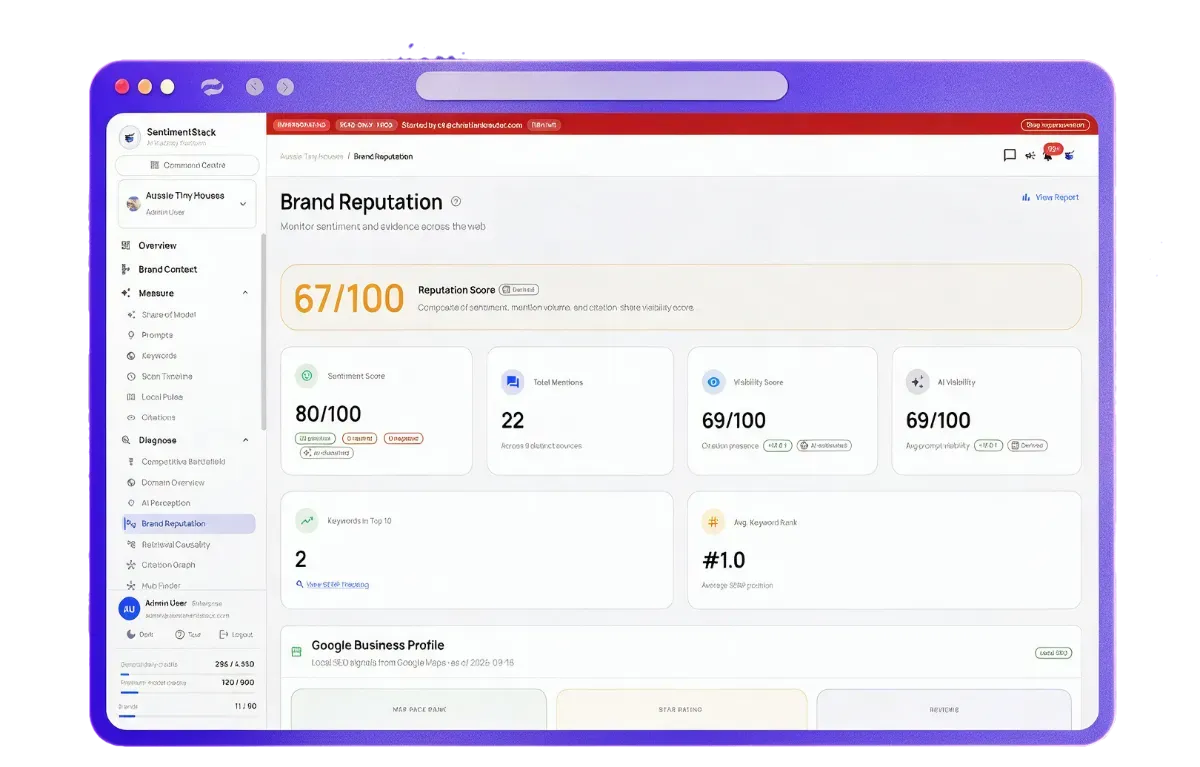
Counting mentions is a useful start, but it is not a complete visibility strategy. A brand named once in a favourable recommendation can matter more than a brand listed repeatedly with no explanation. Teams need a view that connects AI output to market position.
Start with brand mention frequency across priority prompts. This shows how often your company appears when users ask category, comparison, problem-solving and purchase-intent questions. Segment results by platform because performance can vary sharply between ChatGPT, Gemini, Claude, Perplexity and Google AI Overviews.
Next, measure AI share of voice. This compares your presence with direct competitors in the same set of prompts. It replaces vague assumptions with a clear baseline: which brands dominate the conversation, where are they winning and how quickly is that lead changing?
Citation rate matters because cited answers expose the evidence behind a recommendation. If your owned pages, expert commentary or trusted third-party coverage are cited, you can identify the assets building authority. If competitor sources appear consistently, you have a practical content and distribution signal, not just an observation.
Finally, track sentiment and message accuracy. Are answer engines describing your differentiators correctly? Are they connecting your brand with quality, value, support, innovation or another attribute that drives selection? A high mention rate paired with confused messaging is not a win.
These measures should be monitored over time, not pulled once for a board slide. Generative results can shift as platforms update models, retrieval systems and source preferences. The brands that move fastest will spot losses before they become a demand-generation problem.
How to earn more visibility in AI answers
There is no single switch that makes a brand appear in every AI response. Results depend on the platform, prompt, category, available sources and the quality of competing information. But the strongest GEO programmes follow a disciplined pattern: measure the gap, identify the evidence gap, then publish or improve the assets that close it.
Build for the questions buyers actually ask
Start with prompt research, not a generic keyword list. Map the questions buyers use at different stages: defining a problem, evaluating approaches, comparing vendors, checking suitability and validating a final choice. Include Australian market language where it is relevant to your audience, industry and service footprint.
A broad query such as “best CRM software” is useful, but it will not explain the whole opportunity. More revealing prompts include “best CRM for a mid-sized Australian property business”, “HubSpot alternatives for B2B lead tracking” or “how to choose a CRM with local implementation support”. These questions surface the criteria answer engines use to frame the decision.
Create evidence, not filler
Answer engines respond well to clear, specific and verifiable information. Thin pages written to chase a phrase rarely create lasting authority. Instead, publish content that makes your expertise easy to interpret: detailed service pages, accurate product documentation, comparison content, case studies, original research, expert explainers and well-maintained FAQs where they genuinely answer recurring buyer questions.
Structure matters. Use descriptive headings, direct definitions, clear product claims and supporting proof. State who a solution is for, where it is not the best fit and what differentiates it. That level of precision helps both people and machines assess relevance.
Do not manufacture comparison pages solely to attack competitors. Balanced comparisons tend to be more credible because they help users make a decision. If your product is not ideal for a particular use case, say so. Clear trade-offs can strengthen trust and improve the quality of the customers you attract.
Strengthen the signals beyond your website
Owned content is only part of the picture. Answer engines often rely on third-party sources to validate what a business claims about itself. Consistent business profiles, respected editorial coverage, industry directories, customer reviews and expert citations can all shape how a brand is represented.
The goal is not to scatter your name across low-quality sites. It is to establish a coherent, accurate public record. Make sure company descriptions, product categories, leadership information and core claims align across the sources buyers and AI systems are likely to encounter.
Turn monitoring into an operating rhythm
The biggest mistake is treating AI visibility as a one-off audit. An audit tells you where you are. It does not tell you whether your next content sprint improved the result or whether a competitor has taken ground.
Build a regular review around priority prompts, platform-level share of voice, citations, sentiment and competitor movement. Assign an owner for each gap. Some fixes will be editorial, such as updating a weak comparison page. Others will involve product marketing, PR, customer proof or technical improvements to make key information easier to access and understand.
This is where a system such as aigeo insights earns its place. The value is not another dashboard of AI mentions. It is connecting visibility data to a ranked optimisation roadmap, so teams know what to create, update, structure or distribute next.
What not to do as AI search grows
Do not abandon traditional search. High-quality SEO, technical accessibility and a trusted website remain foundational. AI visibility builds on those assets rather than replacing them.
Do not optimise for a single platform either. A brand may be prominent in Perplexity and absent in Google AI Overviews, or well represented in ChatGPT but poorly framed in Gemini. Platform differences are not noise. They are part of the competitive picture.
And do not chase mentions at any cost. Being named for irrelevant prompts can dilute positioning, while exaggerated claims can produce the wrong expectations. The aim is qualified visibility: appearing in the right answers, with the right context, for the buyers most likely to act.
The battle for the answer has begun, and it will not be won by teams waiting for a standard reporting category to catch up. Treat every AI response as a potential brand impression, a competitor comparison and a decision point. Then build the evidence that gives answer engines a compelling reason to choose you.
Related Posts
- Can AI Answers Misquote Brands? Yes, They Can
Can AI answers misquote brands? Learn why generative search gets claims wrong, how to spot risk, and what to do…
Read more about Can AI Answers Misquote Brands? Yes, They Can - Ecommerce Answer Visibility Is Now a Revenue Metric
Ecommerce answer visibility shows whether AI tools recommend your products. Learn what to measure, where competitors win, and how to…
Read more about Ecommerce Answer Visibility Is Now a Revenue Metric - How to Map Brand Entities for AI Search Visibility
Learn how to map brand entities, connect the signals AI uses, find gaps and build a stronger path to citations,…
Read more about How to Map Brand Entities for AI Search Visibility