
When a prospect asks ChatGPT, Gemini or Perplexity for the best provider in your category, a blue-link ranking is not the outcome that matters. The answer is. A serious GEO platform review should therefore ask one hard question: can this tool show where your brand appears in AI answers, why it appears there, and what to do when it does not?
Traditional SEO platforms were built for a results page with positions, clicks and keywords. Generative search works differently. One response can recommend three brands, cite two sources, ignore the market leader and frame every option with a sentiment signal. If your team is measuring only organic rankings, it is watching part of the game while competitors fight for the answer itself.
What a GEO platform must actually measure
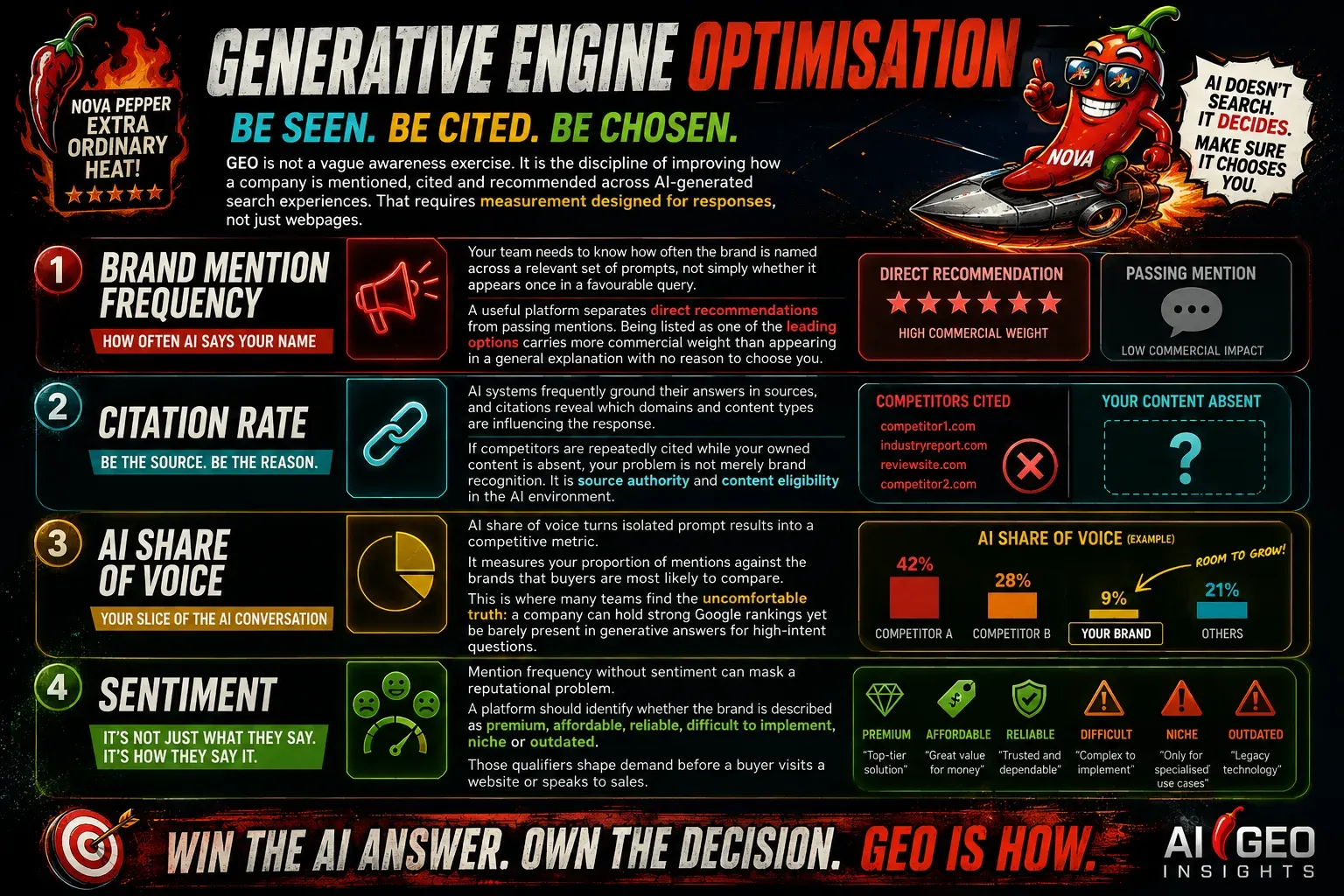
Generative Engine Optimisation is not a vague awareness exercise. It is the discipline of improving how a company is mentioned, cited and recommended across AI-generated search experiences. That requires measurement designed for responses, not just webpages.
Start with brand mention frequency. Your team needs to know how often the brand is named across a relevant set of prompts, not simply whether it appears once in a favourable query. A useful platform separates direct recommendations from passing mentions. Being listed as one of the leading options carries more commercial weight than appearing in a general explanation with no reason to choose you.
Citation rate is equally important. AI systems frequently ground their answers in sources, and citations reveal which domains and content types are influencing the response. If competitors are repeatedly cited while your owned content is absent, your problem is not merely brand recognition. It is source authority and content eligibility in the AI environment.
AI share of voice turns isolated prompt results into a competitive metric. It measures your proportion of mentions against the brands that buyers are most likely to compare. This is where many teams find the uncomfortable truth: a company can hold strong Google rankings yet be barely present in generative answers for high-intent questions.
Sentiment adds the necessary context. Mention frequency without sentiment can mask a reputational problem. A platform should identify whether the brand is described as premium, affordable, reliable, difficult to implement, niche or outdated. Those qualifiers shape demand before a buyer visits a website or speaks to sales.
Finally, reporting must be split by platform. ChatGPT, Claude, Gemini, Perplexity and Google AI Overviews do not behave as one channel. They draw on different sources, return answers in different formats and may present your brand very differently. A combined score is useful for executive reporting, but it cannot replace platform-level diagnosis.
GEO platform review: the difference between data and direction
The weakest GEO tools produce an attractive dashboard and leave the work to your team. They tell you that visibility fell, a competitor gained ground or sentiment shifted, then expect a marketer to reverse-engineer the cause. That is monitoring, not optimisation.
The better question in a GEO platform review is whether the product turns evidence into a prioritised action plan. Can it identify the missing topic, underperforming comparison page, weak entity signal or uncited source that is limiting visibility? Can it suggest whether to create a new asset, update an existing one, improve structure, earn distribution or respond to a reputation issue?
That distinction matters when resources are limited. Most growth teams do not have the capacity to rewrite an entire content library because an AI model overlooked them in ten prompts. They need a ranked roadmap that connects an action to likely visibility impact, effort and the specific platforms or competitor gaps it addresses.
Task scoring is especially valuable here. A recommendation such as “improve authority” is too broad to act on. A recommendation to update a category page with direct buyer questions, evidence-led claims and clear comparative language is operational. It gives content, SEO and brand teams a shared next move.
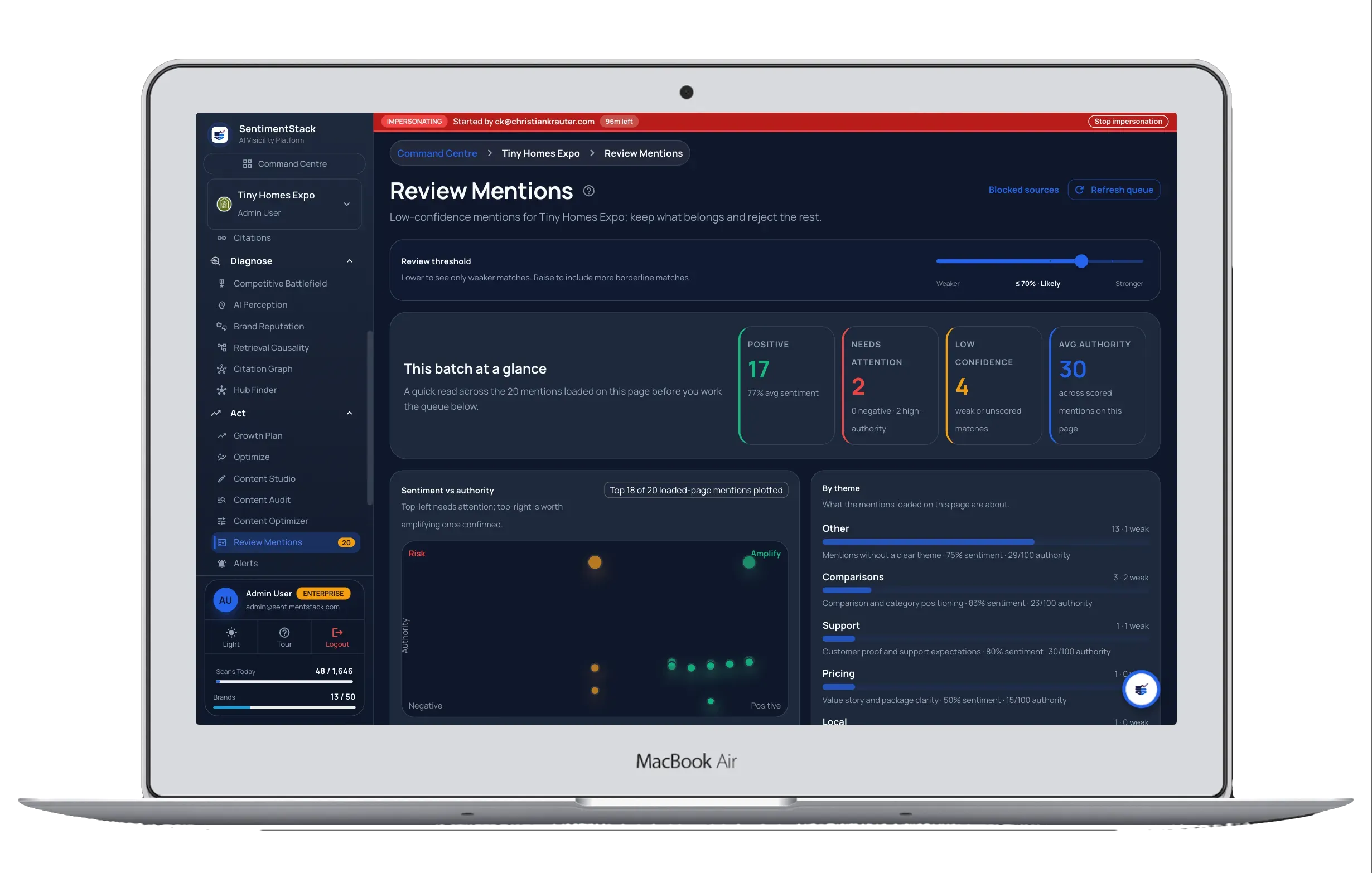
This is the position aigeo insights is built to occupy. Its tracking through SentimentStack monitors mention frequency, citation rate, AI share of voice, sentiment, competitor performance and platform-specific results, then converts those findings into a dynamic optimisation roadmap. The point is not to collect more AI search data. The point is to give teams a system for winning more of the answers that influence demand.
Test the platform against real buying questions
A demo based on generic prompts can make nearly any product look capable. Your evaluation should use the questions that matter to revenue: “best [category] for [use case]”, “[your brand] alternatives”, “how does [brand] compare with [competitor]”, pricing questions, implementation questions and reputation-sensitive queries.
Build a prompt set around the full buyer journey. Early-stage prompts show whether the market knows you exist. Mid-funnel comparisons reveal whether you are considered alongside serious alternatives. Bottom-funnel prompts show whether AI systems present accurate claims about pricing, capability, locations, compliance, integrations or service levels.
Then inspect the result quality rather than chasing one headline score. Does the platform retain the actual answer text and citations so a strategist can understand the context? Does it show which competitor was mentioned in your place? Can the team filter results by product line, audience, region or intent? If an executive asks why share of voice dropped, the system should provide evidence rather than another aggregate chart.
There is a trade-off to manage. A very broad prompt library delivers a more complete market view, but it can dilute focus and slow action. A narrow set of commercial prompts is easier to operate but may miss early-stage visibility gaps. Begin with the queries tied most closely to pipeline, then expand as reporting becomes part of the team’s regular rhythm.
Competitor intelligence should expose the gap
Competitor tracking is not about copying every page a rival publishes. It is about finding the reasons an AI system chooses them when a buyer could have chosen you.
Look for a platform that makes comparison practical. You should be able to see where competitors dominate mentions, which sources are cited in their favour and what themes recur in the language used to describe them. Perhaps they own the “best for enterprises” narrative while your brand is repeatedly positioned as a smaller alternative. Perhaps an independent review, research report or well-structured guide is doing more work for them than their homepage.
Those insights change the brief. Instead of asking the content team to write more articles, you can ask for a specific asset that answers a recurring high-value question and supports it with verifiable proof. Instead of treating distribution as a separate PR activity, you can target credible third-party sources that are already shaping AI citations.
Speed matters. AI visibility can change after a competitor publishes a strong comparison, receives new coverage or gains citations from an authoritative source. Monthly reports are useful for leadership, but growth teams need alerts or frequent checks for material movement in the categories that drive enquiries.
How to judge reporting, governance and value
The best GEO programmes are shared across SEO, content, brand, PR and demand generation. That means reporting must work for both specialists and decision-makers. A technical operator needs prompt-level evidence and source patterns. A marketing leader needs a clear view of share of voice, reputational risk, competitive movement and the next investment decision.
Ask how the platform handles repeatable reporting. Can teams monitor a consistent prompt set over time? Can they distinguish meaningful movement from normal variation in generated outputs? Can competitors be added as the market changes? AI answers are probabilistic, so no tool can promise identical wording on every run. The value lies in a disciplined sampling method, transparent methodology and trends strong enough to guide action.
Price should be assessed against the cost of delayed response. An entry-level subscription can make sense for a lean team proving the channel, while agencies and larger organisations may need more competitors, broader prompt coverage and implementation support. The cheapest tracker is not a bargain if it produces data nobody can translate into work. Equally, an enterprise-grade platform is excessive if a small team cannot maintain the workflow it creates.
Before committing, define ownership. Someone must review movement, approve priorities and ensure recommendations become published, updated or distributed assets. GEO does not replace SEO, content strategy or brand governance. It gives those functions a sharper target: earning the right to be named when AI becomes the interface between a buyer and a decision.
The battle for the answer has already begun. Choose a platform that does more than tell you whether your brand was visible yesterday. Choose one that helps your team decide what to change before tomorrow’s buyer asks the question.
Related Posts
- Citation Tracking Platforms for AI Search
Citation tracking platforms show where AI engines source, mention and recommend your brand, then turn lost visibility into a clear…
Read more about Citation Tracking Platforms for AI Search - How to Benchmark AI Competitors for Growth Teams
Learn how to benchmark AI competitors across ChatGPT, Gemini and more, then turn share of voice, citations and sentiment into…
Read more about How to Benchmark AI Competitors for Growth Teams - Which AI Platforms Cite Websites in 2026?
Which AI platforms cite websites, how their sources differ, and what your brand can do to earn more visible, credible…
Read more about Which AI Platforms Cite Websites in 2026?