
AI search does not return ten blue links and leave buyers to make sense of the options. It forms an answer, selects the sources it trusts, and decides which brands deserve a mention. Learning how to improve answer engine visibility is now a commercial priority for any business that depends on discovery, credibility and demand generation.
The battle is not simply for a ranking. It is for inclusion in the answer a potential customer sees when they ask ChatGPT, Gemini, Claude, Perplexity or Google AI Overviews for a recommendation. If competitors are consistently named and cited while your business is absent, they are shaping the buying decision before a prospect reaches your website.
What answer engine visibility actually measures
Answer engine visibility is the extent to which AI platforms recognise, mention, describe and cite your brand in generated responses. It includes more than whether your website appears in a search result. A brand can rank well in traditional search yet be missing from the AI-generated answer that receives the attention.
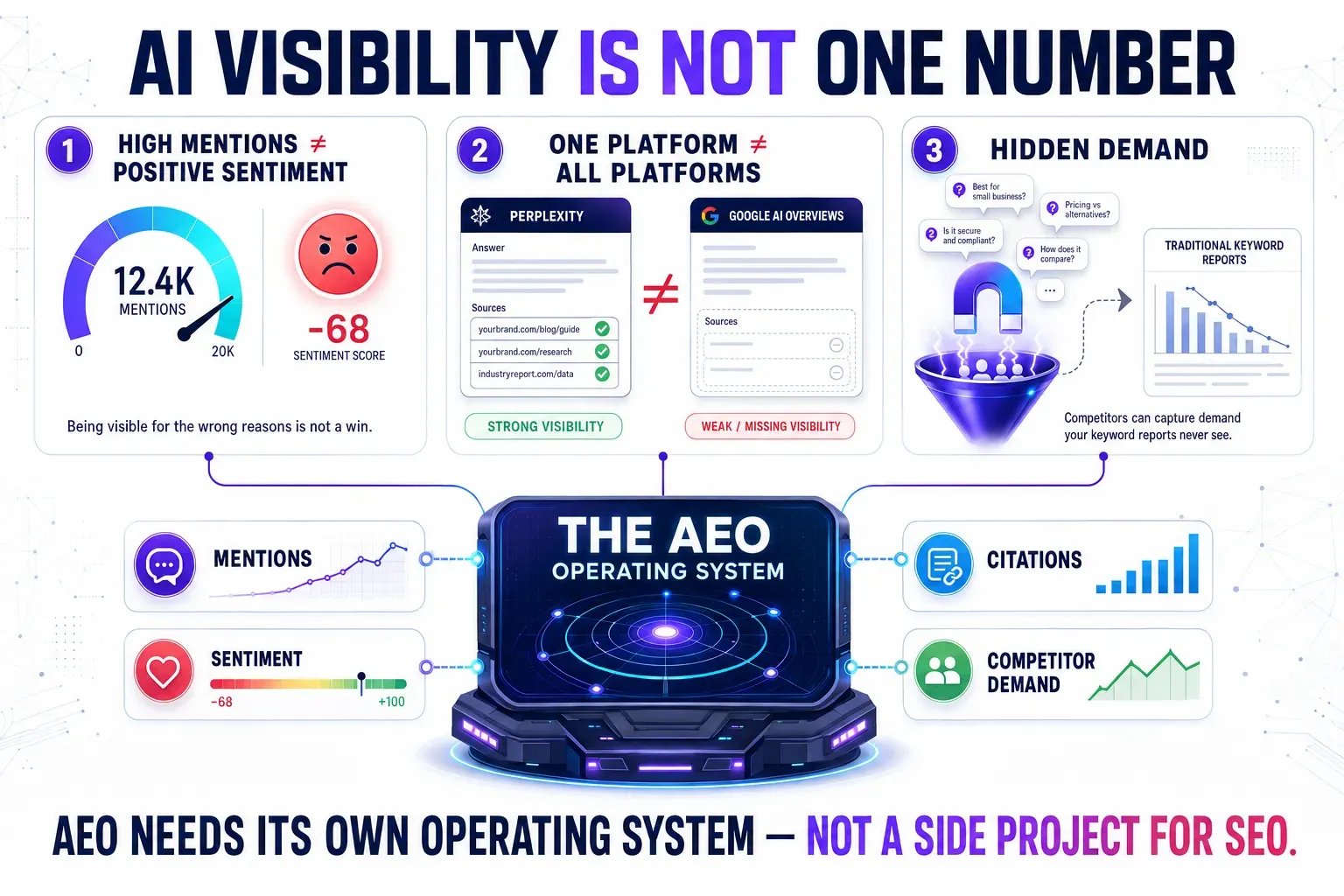
The strongest measurement framework looks at several signals together: brand mention frequency, citation rate, AI share of voice, sentiment, competitor presence and performance by platform. Each metric reveals a different part of the problem.
A high mention rate with poor sentiment is not a win. Strong citations in Perplexity do not guarantee visibility in Google AI Overviews. And a competitor appearing in broad category questions may be taking demand that never shows up in your normal keyword reporting. This is why answer engine optimisation needs its own operating system rather than being treated as a side project for SEO.
Start with the questions that create revenue
Do not begin by publishing generic content about your category. Begin with the questions that buyers ask before they purchase, shortlist suppliers or recommend a provider internally.
For a B2B software company, that might include questions such as “What are the best platforms for AI brand tracking?” or “How can a marketing team measure visibility in generative search?” A local service business may need to appear for comparison, price, location and trust questions. An ecommerce brand may need visibility around product suitability, materials, care and alternatives.
Map queries across the full decision journey: early research, category comparison, implementation, pricing, objections and brand validation. Prioritise questions with commercial intent, but do not ignore educational questions that AI systems use to establish expertise.
The key is specificity. “What is GEO?” may build awareness. “Which GEO platform tracks citations across ChatGPT and Google AI Overviews?” is much closer to a buying decision. Your visibility programme should cover both, with more effort allocated to the questions that move pipeline.
Build source-worthy content, not just keyword pages
Answer engines need clear, credible material they can retrieve and use. Long pages filled with broad claims are harder to interpret than well-structured resources that directly answer the query, explain the evidence and define the conditions behind the answer.
Create content that earns citation because it is useful on its own. This means answering the main question early, using precise terminology, supporting claims with original data or well-explained methodology, and making comparison points easy to verify.
Make every important page unambiguous
AI models can handle nuance, but they cannot fix vague positioning. State what your company does, who it is for, where it operates, what makes it different and which outcomes it delivers. Keep those facts consistent across your website, product pages, company profiles, media coverage and third-party listings.
Contradictory descriptions create uncertainty. If one source calls you an agency, another calls you software, and a third positions you as a consultancy, answer engines may struggle to classify you accurately. Consistency is not glamorous, but it is foundational.
Use structure to reduce interpretation risk
Clear headings, short explanatory paragraphs, comparison tables where they add genuine value, descriptive page titles and relevant structured data all help machines understand a page. They also help people scan it.
Avoid publishing a dozen thin pages aimed at tiny keyword variations. Consolidated, authoritative resources usually give answer engines a stronger source to cite. The trade-off is that comprehensive pages require more maintenance, particularly when products, prices, regulations or market conditions change.
Strengthen the signals beyond your own website
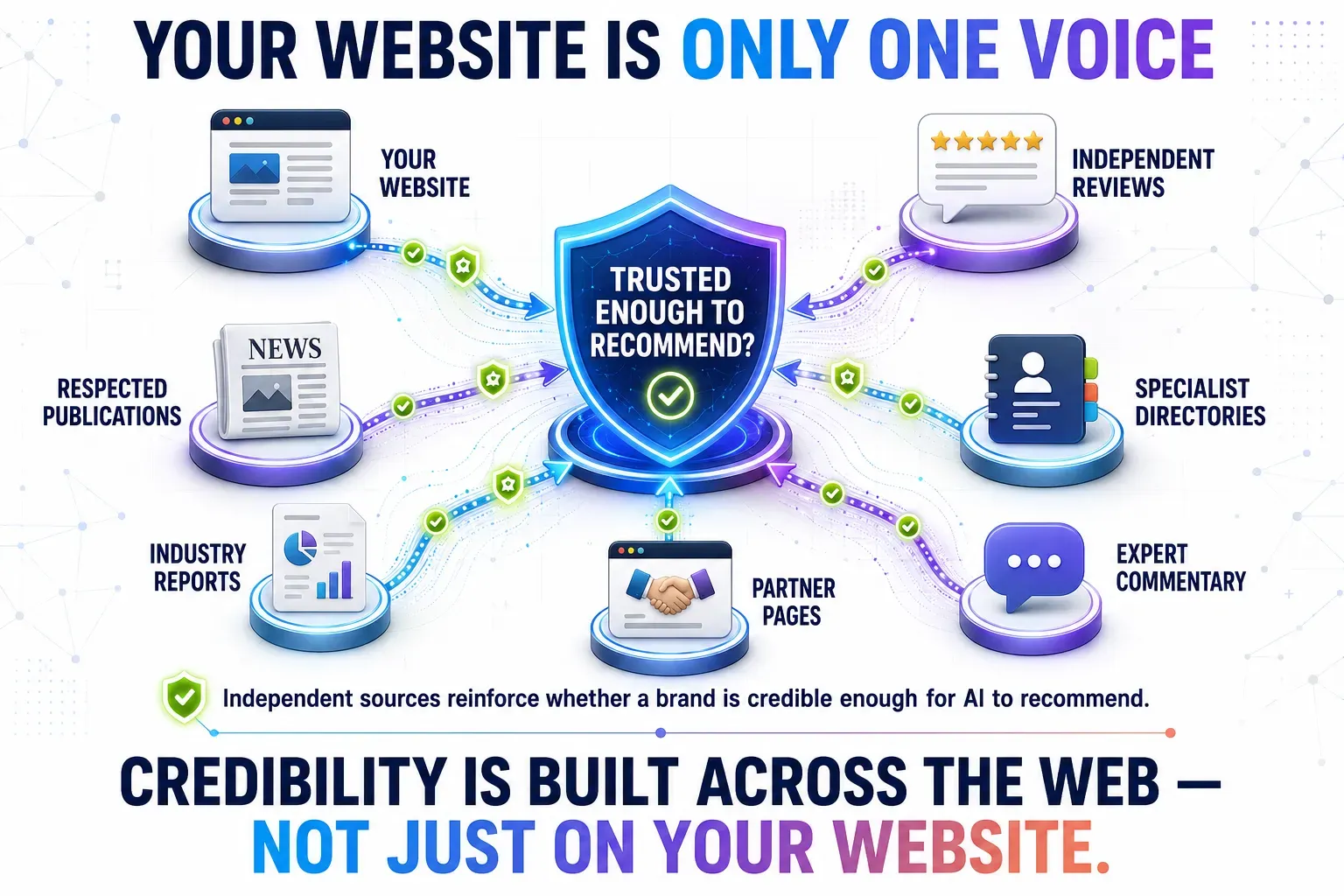
Answer engines assess brands through a broader information environment. Your website matters, but it is only one source. Independent reviews, respected publications, specialist directories, industry reports, partner pages and expert commentary can all reinforce whether a brand is credible enough to recommend.
This does not mean chasing every mention available. Low-quality placements and templated content add noise rather than authority. Focus on relevant third-party sources that a real buyer would trust when evaluating your category.
For agencies and marketing teams, this requires coordination. PR, content, SEO, product marketing and customer success all influence the facts that AI systems encounter. A detailed customer story may be more valuable than another promotional landing page because it supplies context, proof and specific use cases that are easier to cite.
Measure visibility by platform, prompt and competitor
A single score is useful for reporting, but it cannot tell you what to fix. You need to see which prompts trigger mentions, what language the engine uses about your brand, whether a citation accompanies the mention and which competitors appear instead.
Track the same priority questions over time across the platforms that matter to your audience. Categorise results by topic and intent. Then investigate movement rather than reacting to every daily fluctuation. Generative results can change as models, retrieval systems and source sets evolve.
The practical questions are straightforward:
- Where are we absent from high-intent answers?
- Which competitors own the category language?
- Which sources are being cited when our brand is included?
- Is the model describing us accurately and positively?
- Which content gaps are preventing a credible recommendation?
This is where a dedicated platform such as aigeo insights can shorten the path from diagnosis to action. Tracking AI share of voice, citation rate, sentiment and competitor visibility is valuable only when it produces a prioritised roadmap for content updates, new assets and distribution work.
Turn findings into an optimisation backlog
The fastest way to lose momentum is to treat answer engine visibility as a reporting exercise. Every visibility gap should become an owned action with a business reason, expected impact and review date.
If competitors are cited for a comparison query, build or improve a fair comparison resource that defines selection criteria and explains your strengths without making unsubstantiated claims. If the model gets your product capabilities wrong, update the relevant product documentation and supporting pages with direct, plain-language facts. If your category expertise is weak, publish the research, methodology or customer evidence that proves it.
Not every fix belongs on a blog. Sometimes the right action is correcting an outdated directory listing, improving a help centre article, securing authoritative customer reviews or giving your sales team a consistent explanation of a complex feature. The best tactic depends on what source gap the data exposes.
Protect accuracy as visibility grows
More AI mentions are only valuable if they are accurate. A growing share of voice can create risk when platforms repeat old pricing, unsupported claims, incorrect locations or obsolete product details.
Set standards for high-risk information such as pricing, availability, compliance, health claims, financial claims and product specifications. Review the pages that carry these facts regularly, and ensure changes are reflected across the wider brand footprint.
For regulated sectors, involve legal and compliance teams early. Their role should not be to slow every content update. It should be to establish approved language and fast review paths for claims that can affect reputation or customer safety.
Make answer engine visibility a continuous programme
There is no permanent position one in generative search. Models change, competitors publish, reviewers update their opinions and new sources enter the retrieval mix. Brands that measure once a quarter will often spot a loss after competitors have already captured the narrative.
Run a regular cycle: monitor priority prompts, identify material movement, investigate the cited sources, publish or improve the right asset, then measure whether the response changes. Tie the work to commercial metrics where possible, including qualified traffic, branded search demand, demo requests and assisted revenue.
The brands that win the answer economy will not be those producing the most content. They will be the ones that make it easy for answer engines to find accurate evidence, understand their value and confidently recommend them when it counts. Start with the questions your buyers already ask, then make every answer earned.
Related Posts
- How to Improve AI Search Visibility Fast
Learn how to improve AI search visibility with practical GEO tactics that lift mentions, citations, sentiment and share of voice…
Read more about How to Improve AI Search Visibility Fast - Ecommerce Answer Visibility Is Now a Revenue Metric
Ecommerce answer visibility shows whether AI tools recommend your products. Learn what to measure, where competitors win, and how to…
Read more about Ecommerce Answer Visibility Is Now a Revenue Metric - Answer Engines Are Reshaping Brand Discovery
Answer engines are changing how Australians discover, compare and trust brands. Learn what to measure and how to earn visibility…
Read more about Answer Engines Are Reshaping Brand Discovery