
AI platforms do not read your FAQ page like a customer does. They break it into passages, weigh the clarity of each answer, test the credibility of the source and decide whether it helps answer a specific prompt. To structure FAQs for AI retrieval, you need more than a tidy accordion at the bottom of a page. You need answer assets that are precise, verifiable and easy for generative engines to reuse.
That distinction matters because the battle for the answer has begun. When ChatGPT, Gemini, Claude, Perplexity or Google AI Overviews answers a buyer’s question, one clear FAQ can influence whether your brand is mentioned, cited or left out entirely.
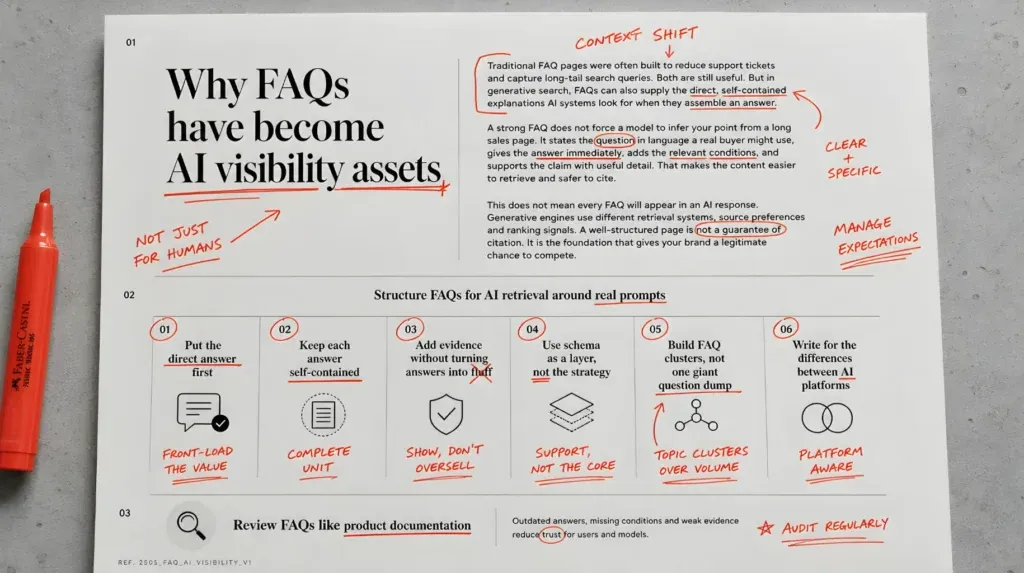
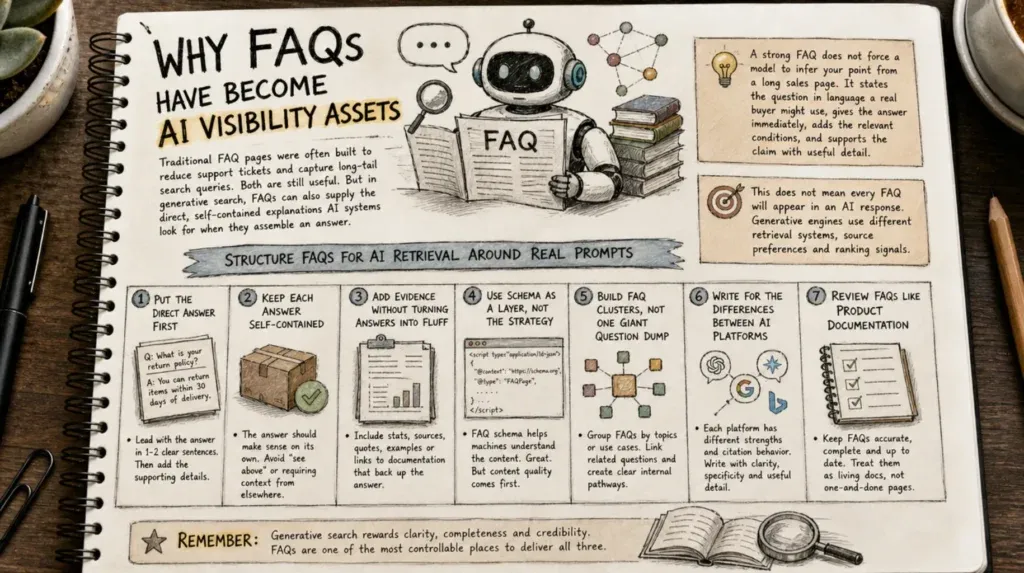
Why FAQs have become AI visibility assets
Traditional FAQ pages were often built to reduce support tickets and capture long-tail search queries. Both are still useful. But in generative search, FAQs can also supply the direct, self-contained explanations AI systems look for when they assemble an answer.
A strong FAQ does not force a model to infer your point from a long sales page. It states the question in language a real buyer might use, gives the answer immediately, adds the relevant conditions, and supports the claim with useful detail. That makes the content easier to retrieve and safer to cite.
This does not mean every FAQ will appear in an AI response. Generative engines use different retrieval systems, source preferences and ranking signals. A well-structured page is not a guarantee of citation. It is the foundation that gives your brand a legitimate chance to compete.
The commercial upside is bigger than traffic alone. A citation or brand mention at the research stage can shape shortlist decisions before a prospect ever reaches a conventional search result. For agencies, growth teams and brand leaders, FAQs are no longer housekeeping content. They are part of the AI share-of-voice strategy.
Structure FAQs for AI retrieval around real prompts
The first rule is simple: write questions that match buyer intent, not internal company language. “What is our advanced solution?” is not a retrieval-friendly question. “How does AI brand visibility tracking work?” is much closer to the way a prospect, journalist or AI user would ask.
Start with the questions already appearing across sales calls, customer support, on-site search, search query data and competitor comparisons. Then separate them by intent. Some questions are definitional, such as “What is generative engine optimisation?” Others are evaluative, such as “How do I measure brand visibility in ChatGPT?” Others are transactional, including pricing, implementation timeframes and feature suitability.
Each intent requires a different answer. A definition should establish the concept in plain language. An evaluation answer should explain the decision criteria and trade-offs. A commercial answer should be direct about scope, limits and next steps. Combining all three into one oversized response makes retrieval harder and weakens the user experience.
Put the direct answer first
Lead with a concise answer of one to three sentences. Do not bury it behind brand positioning, scene-setting or a vague statement such as “It depends”. The nuanced detail can follow, but the opening must resolve the core question.
For example, if the question is “Can FAQ schema increase AI citations?”, a useful answer begins: “FAQ schema can help search systems interpret the question-and-answer relationship on a page, but it does not directly guarantee AI citations.” That is specific, accurate and immediately reusable.
Follow with the conditions: clear on-page copy, credible source material, topical relevance, crawlability and the AI platform’s own source selection process all matter. This approach gives both the model and the reader a clean answer without making inflated promises.
Keep each answer self-contained
A retrievable answer should make sense when lifted from the page. Avoid references such as “as explained above”, “our tool” or “this feature” unless the subject is named in the same passage. AI systems may retrieve one section, not the entire page.
Use the full entity name where it helps comprehension. If you are discussing AI visibility tracking, say that rather than repeating “it”. If the answer refers to a platform, product category, location, audience or methodology, define it clearly.
Self-contained writing also protects against misrepresentation. The less guesswork an AI system needs to do, the less likely it is to combine your claim with unrelated context.
Add evidence without turning answers into fluff
AI retrieval rewards useful specificity, but there is a line between evidence and clutter. The best FAQs explain what is true, how it works and where the boundary sits.
Where relevant, include measurable criteria, timeframes, methodology or examples. A question about reporting frequency could state whether data is updated daily, weekly or on demand. A question about sentiment analysis could clarify the signals assessed and whether results are platform-specific. A question about pricing should state the starting price, inclusions and factors that change the total cost.
Avoid unsupported superlatives. Claims such as “best”, “leading” and “most accurate” create credibility risk unless you can substantiate them on the page. Generative engines are more likely to favour sources that explain their claims than sources that simply repeat them.
The same applies to statistics. Use figures only when they are current, attributable and meaningful to the question. An old industry stat pasted into five FAQs creates duplication, not authority.
Use schema as a layer, not the strategy
FAQPage structured data can help machines recognise the relationship between a question and its answer. It is worth implementing when the visible page genuinely contains those FAQs and the markup accurately reflects the content.
But schema is not a shortcut to generative search visibility. Google has restricted FAQ rich-result eligibility for many sites, and AI platforms do not publicly reveal a universal rule that says FAQ schema equals citation. Markup can improve clarity for crawlers, but content quality, authority and relevance remain decisive.
Treat schema as a technical confirmation of an already strong page. Keep the markup aligned with the visible text, validate it after deployment, and remove it when a question or answer is removed from the page. Mismatched markup introduces noise and can undermine trust.
A practical page structure is straightforward: use a descriptive H2 for the FAQ topic, mark each question with an H3 where appropriate, place the answer directly beneath it, and ensure the page is indexable. If answers are hidden in accordions, make sure they remain available in the rendered page content rather than requiring a user action that prevents crawling.
Build FAQ clusters, not one giant question dump
A 70-question FAQ page might look comprehensive, but it often performs poorly for people and machines. Broad pages mix unrelated intents, create shallow answers and make it difficult to establish topical focus.
Instead, organise FAQs into focused clusters. A GEO platform might have separate question sets for AI visibility measurement, AI citation tracking, competitor benchmarking, sentiment analysis, implementation and pricing. Each cluster can live on the relevant product, solution or resource page, provided it genuinely supports the page’s main purpose.
This creates stronger semantic connections. A page about competitor visibility should answer questions about share of voice, comparable prompts, platform differences and reporting cadence. It should not also attempt to explain every detail of billing and account management.
There is one trade-off: separating FAQs across pages can make content governance more demanding. Teams need a clear owner, a source of truth and a review schedule. The alternative is worse: stale answers that AI systems continue to retrieve long after the business has changed.
Ready to get started?
A one-line nudge that earns the click below.
Write for the differences between AI platforms
No two generative engines behave identically. Perplexity often foregrounds sources. Google AI Overviews can draw heavily from web results and structured, authoritative content. ChatGPT, Claude and Gemini may respond differently depending on the prompt, browsing capability and available sources.
Your FAQ strategy should therefore target consistent clarity rather than trying to game one platform. Write factual, well-scoped answers that can stand on their own across environments. Then test the prompts that matter to your market and monitor whether your brand is mentioned, cited and described accurately.
This is where measurement turns content into an operating system. Track prompt-level visibility, citation rate, sentiment, competitor mentions and platform-level performance. If competitors are repeatedly cited for a question your site answers poorly, the gap is not theoretical. It is a prioritised content task.
Platforms such as aigeo insights can connect those visibility signals to a practical optimisation roadmap, showing teams which FAQs and supporting pages deserve attention first. That is the difference between publishing more content and building content that competes for the answer.
Review FAQs like product documentation
FAQs decay quickly when they cover pricing, policies, product capabilities, integrations or performance claims. Set review dates based on the volatility of the information. Commercial and technical answers may need quarterly checks, while foundational definitions can often be reviewed less frequently.
During each review, check whether the question still matches real user language, whether the first sentence answers it directly, whether the evidence is current, and whether the answer conflicts with any other page. Also look for near-duplicate questions. Consolidating two weak answers into one authoritative response is often better than creating more pages.
The strongest FAQ programme is not the one with the most questions. It is the one that gives buyers and AI systems the clearest possible reason to trust your answer when the moment of selection arrives.
Related Posts
- AI Citations: How Brands Win the Answer Economy
AI citations determine which brands appear in generative answers. Learn what earns them, how to measure performance, and where to…
Read more about AI Citations: How Brands Win the Answer Economy - Brand Positioning in Generative Results That Wins
Brand positioning in generative results is now a measurable growth battle. Learn how to track AI visibility, sharpen proof and…
Read more about Brand Positioning in Generative Results That Wins - How to Validate AI Recommendations Before You Act
Learn how to validate AI recommendations with source checks, live testing and brand visibility data before acting on advice that…
Read more about How to Validate AI Recommendations Before You Act