
A prospect can ask an AI assistant for the best payroll software, a trusted local builder, or a B2B agency with experience in their sector and receive a shortlist without ever opening a conventional results page. That is why leading answer engine platforms have become a high-stakes visibility channel. The question is no longer only whether your website ranks. It is whether your brand appears, is cited and is recommended when AI generates the answer.
For marketers, agencies and growth teams, this shift changes what discovery looks like. Each platform has its own retrieval behaviour, source preferences, interface and commercial influence. Treating AI search as one channel creates blind spots. Winning the answer economy starts with understanding where your audience asks, how each engine responds and what signals make your brand credible enough to include.
What makes an answer engine platform important?
An answer engine interprets a query, assembles information from its training and available sources, then delivers a direct response rather than a simple list of blue links. The leading platforms matter because they sit at different points in the buyer journey. Some are used for research. Some are built into everyday search behaviour. Others support workplace productivity and vendor evaluation.
The key distinction is that visibility is selective. A top organic ranking may help, but it does not guarantee a mention in an AI-generated response. The engine may cite a third-party review, a publisher, a directory, a manufacturer, a government source or a competitor’s better-structured content instead. It may mention brands without linking to them at all.
That makes traditional rank tracking an incomplete scorecard. Teams need to measure brand mention frequency, citation rate, AI share of voice, sentiment, competitor presence and performance by platform and prompt category. Without that baseline, optimisation becomes guesswork.
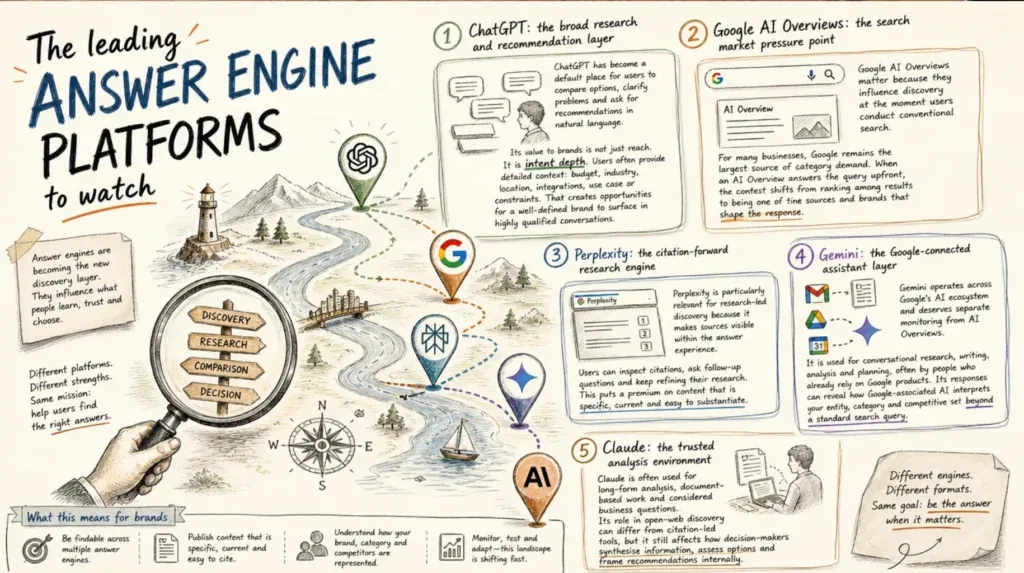
The leading answer engine platforms to watch
ChatGPT: the broad research and recommendation layer
ChatGPT has become a default place for users to compare options, clarify problems and ask for recommendations in natural language. Its value to brands is not just reach. It is intent depth. Users often provide detailed context: budget, industry, location, integrations, use case or constraints. That creates opportunities for a well-defined brand to surface in highly qualified conversations.
The trade-off is variability. Responses can differ based on the prompt, the model version, browsing availability and the context already in the conversation. A brand might appear for one use case but disappear when the user asks for alternatives, pricing guidance or regional options. Monitor clusters of commercially meaningful prompts, not one-off vanity queries.
Content that clearly explains who you serve, the problems you solve, proof of performance and meaningful differentiation is more useful here than generic category copy. Independent validation also matters. If your claims exist only on your own website, the model has less reason to treat them as a dependable recommendation.
Google AI Overviews: the search market pressure point
Google AI Overviews matter because they influence discovery at the moment users conduct conventional search. For many businesses, Google remains the largest source of category demand. When an AI Overview answers the query upfront, the contest shifts from ranking among results to being one of the sources and brands that shape the response.
Google’s ecosystem gives it a different character from chat-first tools. Local relevance, clear entity information, technical accessibility, authoritative pages and supporting third-party sources can all influence how a brand is understood. Search fundamentals still count, but the finish line has moved.
This is especially significant for high-intent searches. If an Overview compares providers, answers a buying question or directs attention to a selected group of sources, brands outside that answer can lose consideration before a searcher reaches the organic listings. Watch which pages are cited, which competitors are named and which questions trigger AI treatment in your category.
Perplexity: the citation-forward research engine
Perplexity is particularly relevant for research-led discovery because it makes sources visible within the answer experience. Users can inspect citations, ask follow-up questions and keep refining their research. This puts a premium on content that is specific, current and easy to substantiate.
For B2B teams, Perplexity can expose a gap between having content and having source-worthy content. A vague services page rarely competes with a detailed comparison, original data point, technical explanation or well-organised guide that answers a precise question. It also highlights the role of external publications. If respected sources discuss your brand accurately, they can become part of the evidence trail.
Do not mistake citation volume for success on its own. A citation that frames your business poorly, or places it behind competitors, is not a win. Measure the surrounding answer: whether the brand is named, how it is described, which use case it is attached to and whether the sentiment supports conversion.
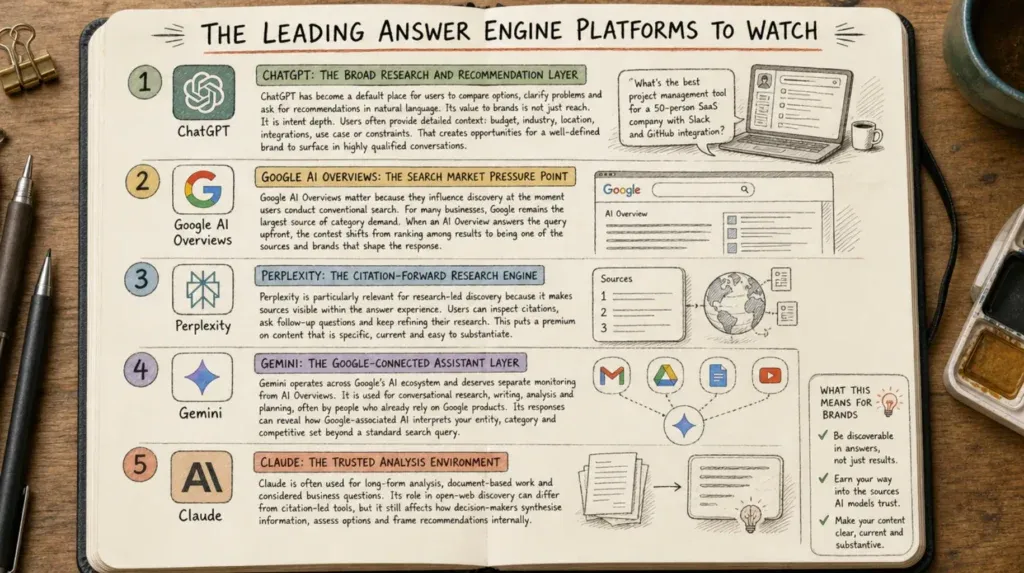
Gemini: the Google-connected assistant layer
Gemini operates across Google’s AI ecosystem and deserves separate monitoring from AI Overviews. It is used for conversational research, writing, analysis and planning, often by people who already rely on Google products. Its responses can reveal how Google-associated AI interprets your entity, category and competitive set beyond a standard search query.
For marketers, the practical issue is consistency. Does Gemini understand your core offer in the same way your website, profiles, media coverage and customer proof describe it? If it repeatedly categorises you incorrectly, names the wrong competitor set or overlooks your defining capability, that is an entity-positioning problem, not merely a content problem.
Correcting it may require better structured first-party pages, clearer terminology, stronger supporting sources and less ambiguity across your digital footprint. The aim is not to force a scripted description. It is to give the platform reliable evidence that supports the position you want to own.
Claude: the trusted analysis environment
Claude is often used for long-form analysis, document-based work and considered business questions. Its role in open-web discovery can differ from citation-led tools, but it still affects how decision-makers synthesise information, assess options and frame recommendations internally.
That makes Claude valuable for testing the clarity of your market narrative. Ask category questions, comparison questions and scenario-based questions that mirror how buyers evaluate a solution. If your brand is absent or its description is thin, inspect the evidence available across owned content and credible third-party sources.
Claude should not be assessed using the exact same expectations as Google AI Overviews or Perplexity. Platform mechanics differ. The strategic requirement remains the same: your company needs an accurate, defensible and differentiated footprint that AI can recognise.
Ready to get started?
A one-line nudge that earns the click below.
How to compare answer engine performance
The wrong approach is to declare one platform the winner and pour every resource into it. The right priority depends on your market, audience and buying motion. A local service business may feel Google AI Overviews first. A SaaS company selling into research-heavy teams may find ChatGPT and Perplexity more commercially revealing. Enterprise brands may need broad coverage because buyer research is fragmented across assistants.
Build a prompt set around real demand, not just category keywords. Include discovery prompts such as “best options for”, comparison prompts such as “X versus Y”, problem prompts, location-based questions and credibility prompts about reviews, security, pricing or implementation. Run them consistently by market and record whether your brand is mentioned, cited, positively framed and positioned ahead of competitors.
The metrics should lead to decisions. If competitors dominate comparison prompts, create an evidence-led comparison asset or strengthen third-party validation. If your brand is mentioned but never cited, improve the depth and structure of source pages. If the platform repeatedly misunderstands your offering, tighten entity language across your site, profiles and published materials. If sentiment is weak, the answer is not more content. It may be a reputation, messaging or product-experience issue.
From AI visibility data to an optimisation roadmap
A dashboard alone does not win anything. The commercial advantage comes from turning platform-level signals into a prioritised work queue. Start with the gaps closest to revenue: prompts with high buyer intent, competitor gains, inaccurate brand descriptions and source pages that are already close to citation potential.
Then assign an action. That might mean updating a product page with direct answers and proof, publishing a use-case guide, improving structured information, earning credible coverage or refreshing outdated claims. Each task should have a reason, an expected visibility impact and a way to verify change over time.
This is where a GEO platform such as aigeo insights earns its place. It tracks how brands appear across ChatGPT, Claude, Gemini, Perplexity and Google AI Overviews, then turns those measurements into practical recommendations. Teams can see where visibility is slipping, what competitors own and which content or authority actions deserve attention first.
The battle for the answer has begun. Treat every important AI response as a new shelf in the market, then make sure your brand has the evidence, clarity and authority to earn its place on it.
Related Posts
- Ecommerce Answer Visibility Is Now a Revenue Metric
Ecommerce answer visibility shows whether AI tools recommend your products. Learn what to measure, where competitors win, and how to…
Read more about Ecommerce Answer Visibility Is Now a Revenue Metric - Answer Engines Are Reshaping Brand Discovery
Answer engines are changing how Australians discover, compare and trust brands. Learn what to measure and how to earn visibility…
Read more about Answer Engines Are Reshaping Brand Discovery - Answer Engine Analytics: Measure What AI Says
Answer engine analytics shows where AI mentions, cites and recommends your brand, so your team can act before competitors take…
Read more about Answer Engine Analytics: Measure What AI Says