A brand can be cited by Perplexity for a product comparison, then disappear entirely from a Google AI Overview for the same commercial query. That is the operational reality behind Perplexity versus Google citations. These platforms may answer similar questions, but they retrieve, present and attribute information differently. Treating them as one channel leaves visibility – and qualified demand – on the table.
For growth teams, the question is not which platform matters more in the abstract. It is where your buyers ask questions, which sources shape the answer, and whether your brand earns a visible, credible role in that answer. The battle for the answer has begun, and citation strategy now needs to be platform-specific.
Perplexity versus Google citations: the core difference
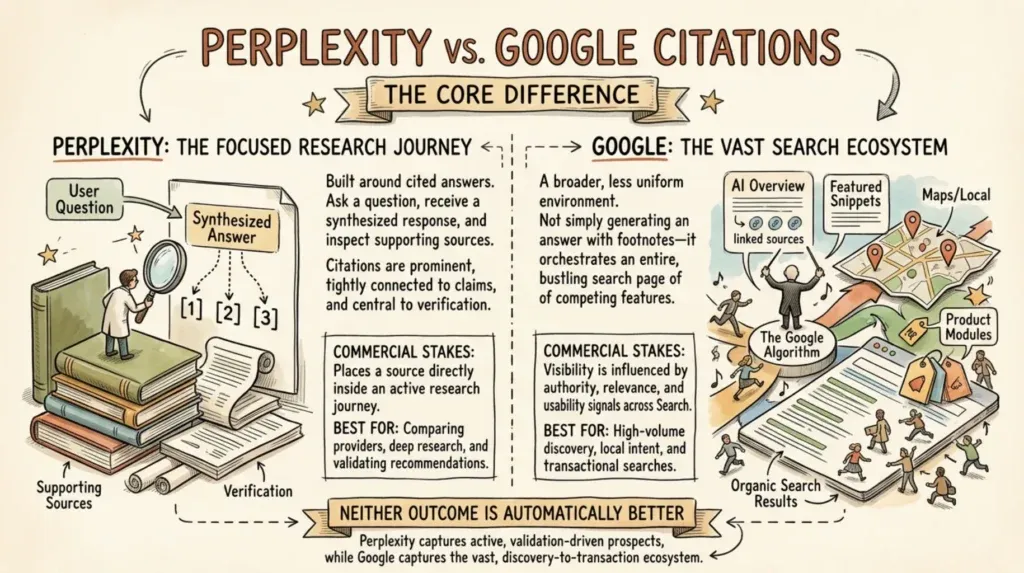
Perplexity is built around cited answers. Its value proposition is straightforward: ask a question, receive a synthesised response, and inspect the supporting sources. Citations are usually prominent, tightly connected to claims in the response, and central to the user’s ability to verify what they are reading.
Google’s citation environment is broader and less uniform. A Google AI Overview can surface linked sources alongside generated content, while standard organic results, featured snippets, product modules, maps results and other search features continue to compete for attention around it. Google is not simply generating an answer with footnotes. It is orchestrating an entire search results page.
That changes the commercial stakes. A Perplexity citation can place a source directly inside a research journey. A Google citation may sit within an AI Overview, but its performance is influenced by the wider authority, relevance and usability signals that determine how a brand appears across Search.
Neither outcome is automatically better. Perplexity can be especially valuable when a prospect is actively researching options, comparing providers or validating a recommendation. Google can deliver broader reach because it captures high-volume discovery, local intent, branded demand and transactional searches across a much larger search ecosystem.
What Perplexity tends to reward
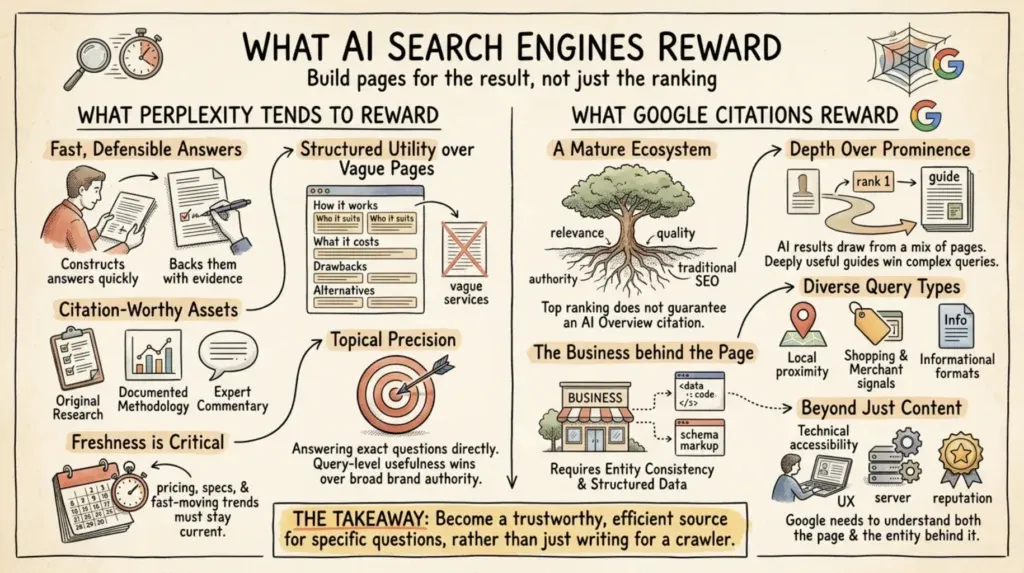
Perplexity needs sources it can use to construct an answer quickly and defend that answer with evidence. Pages that provide clear claims, current facts, direct explanations and genuine expertise have a practical advantage. The goal is not to write for a crawler alone. It is to become an efficient, trustworthy source for a specific question.
A vague services page rarely does that job. A well-structured page explaining how a category works, who it suits, where it falls short, what it costs and how it compares with alternatives is far more useful. Original research, documented methodology, expert commentary and clearly labelled data can also create citation-worthy assets.
Freshness matters where the query demands it. Software pricing, regulations, market statistics, product specifications and fast-moving industry trends should be maintained. An old page can retain authority, but an outdated claim gives an answer engine a reason to select a more current source.
Perplexity also makes topical precision visible. A site may be widely respected, yet lose citations if another source answers the user’s exact question more directly. For marketers, this means separating broad brand authority from query-level usefulness. You need both, but they are not the same metric.
The Perplexity citation test
Ask whether a page can stand alone as evidence. Can a system extract a clear answer from it without guessing? Does it state who made the claim, when the information was updated and what supports the conclusion? Is the language specific enough to cite without qualification?
If the answer is no, rewrite for evidence density. Add definitions, examples, limitations, dates, author credentials and first-party proof where relevant. Do not pad the page with generic commentary. A concise, verifiable answer often has a stronger chance of becoming a source than 2,000 words of recycled advice.
What Google citations tend to reward
Google AI Overviews operate within a mature search ecosystem. The sources it surfaces are likely shaped by relevance, quality, authority and its understanding of the query, alongside the signals that already influence visibility in Google Search. But teams should avoid a simplistic assumption that a top organic ranking guarantees an AI Overview citation.
AI-generated results can draw from a different mix of pages, particularly for complex queries requiring multiple perspectives. A highly ranked category page might not be the best source for a detailed explanation. Conversely, a deeply useful guide may earn an AI citation even if it is not the most prominent blue link for every related query.
Google also has more query types to satisfy. Local searches may privilege proximity and business information. Shopping-oriented searches may surface feeds, product details and merchant signals. Informational searches can trigger AI Overviews, traditional links or neither, depending on the query and available result formats.
The practical implication is that Google citation performance cannot be managed as a content-only programme. Technical accessibility, entity consistency, structured data where appropriate, strong internal information architecture, reputation signals and page experience still matter. Google needs to understand both the page and the business behind it.
Build pages for the result, not just the ranking
For Google, map content to the search result your customer is likely to see. A local service business needs accurate location and service information. An ecommerce brand needs complete product data, useful category copy and credible reviews. A B2B platform needs explanatory pages that resolve complex buying questions, supported by proof from customers, specialists and independent sources.
This is where conventional SEO and GEO reinforce each other. Technical foundations make content available and understandable. Strong topical content makes it usable in generated answers. Brand authority helps Google trust that your company deserves to be shown when the search becomes a recommendation.
Citation volume is not the only metric that matters
A citation is a visibility event, not automatically a business result. It can be buried in a long response, paired with competitors, used only for a minor claim or shown for a query with little commercial value. Counting citations without context creates a false sense of progress.
Track citation rate by platform and query group, then pair it with brand mention frequency, AI share of voice, sentiment and competitor presence. A brand cited in 20 per cent of high-intent comparison prompts may be in a stronger position than one cited in 60 per cent of low-value educational prompts.
You also need to distinguish between being cited and being recommended. A source may support an industry statistic without being named as an option. A recommendation can generate more pipeline, but it carries higher reputational stakes. Negative sentiment, outdated positioning or competitor comparisons can turn prominent visibility into a liability.
This is why a manual spot check is not enough. AI answers vary by prompt, location, time and platform behaviour. A repeatable monitoring system reveals whether a visibility gain is durable, whether competitors are taking ground, and which source pages appear to drive the result.
Ready to get started?
A one-line nudge that earns the click below.
A practical operating model for both platforms
Start with a prompt set based on real buying journeys. Include problem-aware questions, category comparisons, use-case queries, alternatives, pricing questions and trust checks. Avoid vanity prompts that your sales team would never hear from a prospect.
Next, establish a baseline for Perplexity and Google separately. Record whether your brand is mentioned, cited or recommended; which competitors appear; the sentiment of the response; and the source domains used. This exposes the difference between a content gap, an authority gap and a positioning gap.
Then prioritise the pages that can change the outcome. For Perplexity, that may mean publishing a precise comparison, an evidence-led guide or an original data page. For Google, it may mean repairing technical barriers, improving a thin commercial page, strengthening entity information or building supporting content around a high-value topic. Often, one asset can contribute to both platforms, but the reason it succeeds will differ.
Finally, measure the result after each meaningful change. Did citation rate improve for the target prompt cluster? Did the brand move from a passing mention to a recommendation? Did a competitor lose share? If not, do not keep producing content blindly. Use the source patterns in the answers to adjust the next action.
aigeo insights turns that work into a measurable optimisation roadmap, showing teams where brands appear across generative platforms and what to create, update or strengthen next. The value is not another dashboard. It is faster decisions in a market where competitors can win visibility before a buyer ever reaches a website.
The strongest brands will stop asking whether Perplexity or Google is the better citation channel. They will build the evidence, authority and monitoring discipline to earn the answer wherever their customers choose to ask.
Related Posts
- Google AI Overviews Versus Chatbots Compared
Google AI Overviews versus chatbots changes how brands earn visibility. Learn where each platform draws answers from and how to…
Read more about Google AI Overviews Versus Chatbots Compared - AI Overviews versus ChatGPT referrals compared
AI Overviews versus ChatGPT referrals demand different visibility strategies. Learn what each channel measures, where leads come from and how…
Read more about AI Overviews versus ChatGPT referrals compared - How to Structure FAQs for AI Retrieval and Earn Citations
Learn how to structure FAQs for AI retrieval with clear answers, source evidence and schema that help your brand earn…
Read more about How to Structure FAQs for AI Retrieval and Earn Citations