
A prospect asks ChatGPT for the best enterprise software in your category. Your closest competitor is recommended, cited and described with confidence. Your brand is absent, or worse, represented with old positioning and generic claims. That is the commercial problem an enterprise GEO implementation guide must solve. Generative Engine Optimisation is not a content side project. It is the operating system for earning representation inside the answers buyers increasingly trust.
For enterprise teams, the stakes are higher than a lost ranking. AI-generated answers shape shortlists before a buyer reaches your website, speaks to sales or sees a paid campaign. If your company is not present in the answer, it may not make the consideration set at all.
Why enterprise GEO implementation cannot sit with SEO alone
SEO remains essential, but GEO has a different output. Traditional search performance is largely measured through rankings, traffic and conversions. GEO measures whether generative platforms mention your brand, cite your sources, present your claims accurately and recommend you against alternatives.
That requires a broader team. SEO may own technical readiness and content structure. Brand teams need to approve positioning and message accuracy. PR and communications influence the third-party sources AI systems may use to validate your authority. Product marketing supplies proof, use cases and comparison language. Legal, security and subject-matter experts must protect accuracy in regulated or high-consideration categories.
The common failure is treating GEO as a batch of articles. Publishing more content can help, but volume alone does not create AI visibility. Generative systems look for clear entities, useful evidence, consistent claims and credible sources. A thin comparison page will not beat a well-established competitor simply because it uses more keywords.
Set the operating model before you publish anything
Start by appointing one accountable GEO lead. This person does not need to create every asset, but they need authority to prioritise work across content, web, PR and product marketing. Without a clear owner, prompt research lives in a spreadsheet, technical fixes wait in a backlog and competitors keep gaining answer share.
Create a cross-functional working group with a fortnightly review rhythm. The group should assess visibility movement, high-value missed prompts, inaccurate AI claims, completed actions and the next set of assets to produce. Keep the scorecard commercial. A rise in mentions matters most when it occurs in prompts connected to category discovery, solution evaluation, replacement decisions and purchase intent.
Before setting targets, define what a meaningful AI appearance looks like for your brand. A neutral mention in a broad educational answer is useful, but it is not equal to being recommended in a shortlist or cited as evidence in a buyer-facing comparison. Weight these outcomes differently.
Build a baseline across platforms and prompts
You cannot manage AI share of voice through occasional manual checks. Responses change by platform, location, prompt wording, model updates and the sources available at the time. A reliable baseline needs a consistent prompt set, repeatable tracking and competitor context.
Segment prompts into four business-critical groups: category education, use-case discovery, vendor comparison and brand reputation. Then add the language your buyers use when they do not know your product category. A finance leader may ask how to reduce reporting risk, while an operations lead may ask which systems integrate with a particular stack. These are often the prompts where a competitor becomes the default answer first.
For each prompt, track mention frequency, citation rate, recommendation position where available, sentiment, accuracy and the competitors included. Review ChatGPT, Claude, Gemini, Perplexity and Google AI Overviews separately. Their behaviours are not identical. A source that earns citations in Perplexity may have limited influence elsewhere, while Google AI Overviews may be more closely tied to strong search-visible pages.
Use the baseline to find gaps, not to create panic. A low citation rate may point to weak evidence on your site. Low mention frequency across a whole topic cluster may mean your brand lacks category association. Negative or outdated descriptions require a faster reputation response than a routine content refresh.
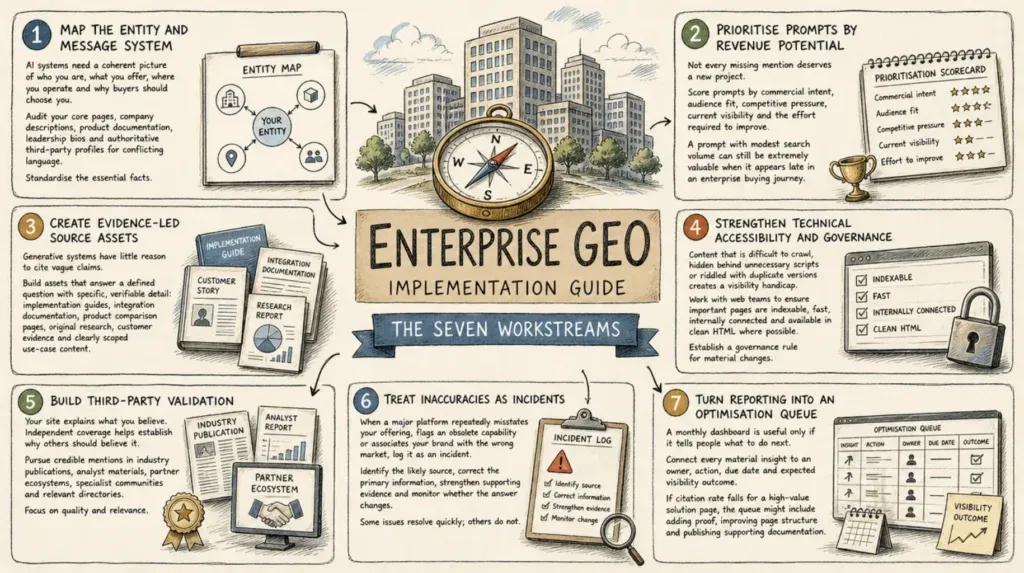
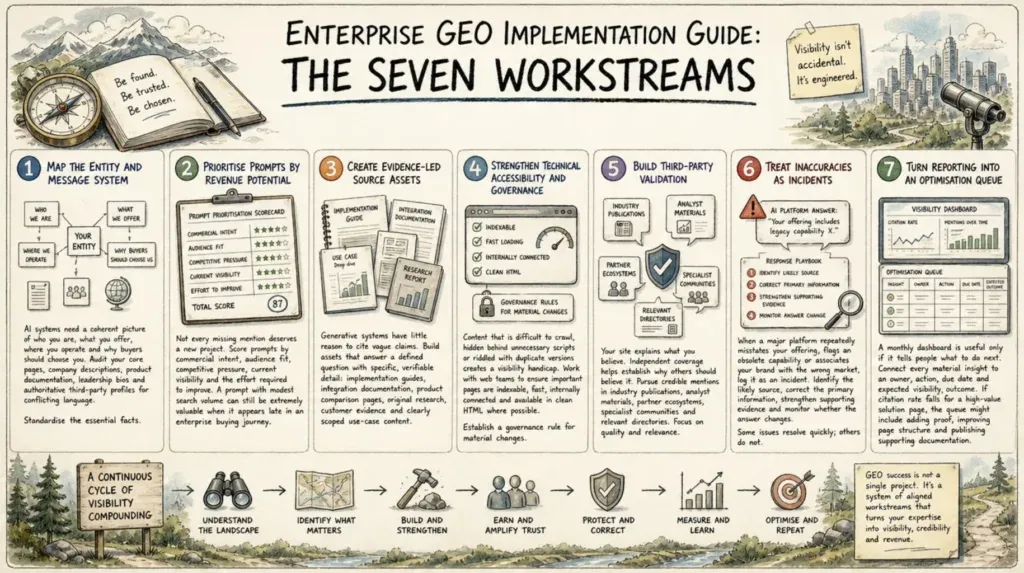
Enterprise GEO implementation guide: the seven workstreams
1. Map the entity and message system
AI systems need a coherent picture of who you are, what you offer, where you operate and why buyers should choose you. Audit your core pages, company descriptions, product documentation, leadership bios and authoritative third-party profiles for conflicting language.
Standardise the essential facts: category, products, audiences, differentiators, proof points, service regions and naming conventions. This is not about repeating marketing slogans everywhere. It is about removing ambiguity. If your company is described as an agency on one page, a platform on another and a consultancy in a directory, you are creating a fragmented entity signal.
2. Prioritise prompts by revenue potential
Not every missing mention deserves a new project. Score prompts by commercial intent, audience fit, competitive pressure, current visibility and the effort required to improve. A prompt with modest search volume can still be extremely valuable when it appears late in an enterprise buying journey.
Choose a manageable first wave. For most teams, 20 to 40 priority prompts is enough to establish focus without diluting production capacity. Build content clusters around the questions behind them rather than producing one isolated page for every variation.
3. Create evidence-led source assets
Generative systems have little reason to cite vague claims. Build assets that answer a defined question with specific, verifiable detail: implementation guides, integration documentation, methodology pages, product comparison pages, original research, customer evidence and clearly scoped use-case content.
Structure matters. Use descriptive headings, direct answers near the top, factual tables where comparison is useful, author attribution and visible update dates. Do not force every page into a rigid template. A technical implementation page should be more detailed than a category explainer, while a buyer comparison needs fair criteria and clear limitations.
4. Strengthen technical accessibility and governance
Content that is difficult to crawl, hidden behind unnecessary scripts or riddled with duplicate versions creates a visibility handicap. Work with web and engineering teams to ensure important pages are indexable, fast, internally connected and available in clean HTML where possible.
Establish a governance rule for material changes. Product releases, pricing shifts, acquisitions, rebrands and policy changes should trigger updates to the pages most likely to inform AI answers. Old information is not merely an editorial issue. It can become an inaccurate recommendation that sales and support teams must later correct.
5. Build third-party validation
Your site explains what you believe. Independent coverage helps establish why others should believe it. Pursue credible mentions in industry publications, analyst materials, partner ecosystems, specialist communities and relevant directories. Focus on quality and relevance, not a scattergun campaign for links or mentions.
For enterprise brands, third-party validation is particularly valuable for claims around security, performance, market leadership and customer outcomes. It also reduces the risk that every AI response relies on a single self-published source.
6. Treat inaccuracies as incidents
When a major platform repeatedly misstates your offering, flags an obsolete capability or associates your brand with the wrong market, log it as an incident. Identify the likely source, correct the primary information, strengthen supporting evidence and monitor whether the answer changes.
Some issues resolve quickly; others do not. You cannot directly edit a model’s answer in most cases, and pretending otherwise wastes time. The practical response is to improve the evidence ecosystem and track the issue over time. Escalate internally when misinformation affects regulated claims, brand safety or active enterprise deals.
7. Turn reporting into an optimisation queue
A monthly dashboard is useful only if it tells people what to do next. Connect every material insight to an owner, action, due date and expected visibility outcome. If citation rate falls for a high-value solution page, the queue might include adding proof, improving page structure and publishing supporting documentation. If a competitor gains recommendation share in comparison prompts, investigate the sources and claims driving that shift before copying their content.
This is where a platform such as aigeo insights earns its place: it connects mention, citation, sentiment and competitor data to a prioritised roadmap, so teams can act on visibility changes rather than simply report them.
Ready to get started?
A one-line nudge that earns the click below.
Measure progress without chasing vanity metrics
The best enterprise GEO programme combines leading and lagging indicators. Leading indicators include completed priority assets, entity consistency, technical fixes, source coverage and citation gains. Lagging indicators include AI share of voice in high-intent prompts, qualified traffic, assisted pipeline, branded search demand and win-rate movement where attribution is available.
Do not promise a universal timeline. Mature categories with dominant incumbents and strict compliance reviews will move more slowly. A challenger with a sharp niche, strong proof and a fast publishing process may gain ground sooner. The objective is not to appear in every answer. It is to become a credible, accurately represented choice at the moments that influence revenue.
The battle for the answer has begun, but execution does not require guesswork. Start with the prompts shaping your pipeline, establish an honest baseline and give every visibility gap an accountable next action. That is how GEO becomes a repeatable growth discipline rather than another dashboard your team stops opening.
Related Posts
- Generative Search Content Optimisation Guide
This generative search content optimisation guide shows Australian marketing teams how to earn AI citations, lift share of voice and…
Read more about Generative Search Content Optimisation Guide - How to Increase AI Citations and Win AI Search
Learn how to increase AI citations with content, entity signals and measurement that put your brand in more AI-generated answers…
Read more about How to Increase AI Citations and Win AI Search - Generative Search Audit Guide for AI Visibility
Use this generative search audit guide to measure AI visibility, expose competitor gaps, and turn citations, sentiment and share of…
Read more about Generative Search Audit Guide for AI Visibility