
A prospective customer asks ChatGPT for the best payroll platform, agency, CRM or supplier in their category. Your brand may have years of SEO investment, strong reviews and a capable sales team. But if the model does not mention you, cite you or describe you accurately, you are absent at the moment the shortlist is formed.
That is the commercial case for LLM visibility monitoring. It measures whether large language models and AI search experiences can find, trust and recommend your brand when real buyers ask category, comparison and problem-led questions. More importantly, it reveals what to change when they cannot.
AI visibility is now a competitive metric
Traditional search reporting was built around rankings, impressions, traffic and conversions. Those metrics still matter. Yet generative search changes the path between research and purchase: users increasingly receive a synthesised answer before they visit a website, and that answer may name only a small set of brands.
This creates a new visibility battle. A business can rank well in Google while receiving little attention in ChatGPT, Gemini, Claude, Perplexity or Google AI Overviews. It can also be mentioned frequently but positioned poorly – for example, as an expensive option, a niche provider or a weak alternative to a competitor.
Monitoring needs to capture both presence and representation. Being named is valuable. Being named in the right context, with supporting citations and a favourable comparison, is where commercial advantage begins.
What LLM visibility monitoring actually tracks
At its best, monitoring is not a vanity count of brand mentions. It is a structured view of how AI platforms respond to prompts that resemble customer research. The prompt set should reflect the questions that influence demand, including category discovery, solution evaluation, product comparisons, use cases, pricing concerns and local or industry-specific requirements.
From those responses, teams can measure several connected signals: brand mention frequency, citation rate, AI share of voice, sentiment, competitor visibility and platform-level performance. Together, they answer questions standard rank tracking cannot.
Are you present in answers for the category you want to own? Which competitors appear more often? Is your website cited as a source, or is the model relying on third-party content? Does the description reinforce your positioning? Are results consistent across platforms, or is one model leaving you out entirely?
These are not theoretical questions. A competitor that gains repeated inclusion in high-intent AI answers can become the default choice before a buyer reaches a search results page or fills out a form.
Why platform-by-platform monitoring matters
It is tempting to treat all AI assistants as one channel. That approach hides risk. Each platform has different retrieval behaviour, source preferences, update cycles and answer formats. A brand with strong visibility in Perplexity may be barely present in Claude. A company cited in Google AI Overviews may not feature in ChatGPT comparison responses.
The right interpretation depends on your audience. If your buyers use Google heavily for initial research, AI Overview performance may matter most. If technical decision-makers use ChatGPT to compare tools, that environment deserves closer attention. Agencies managing multiple clients should separate these patterns rather than reporting one blended score that masks the detail.
There is also volatility to manage. A single answer can change because a model updates, new source material becomes available or the wording of a prompt shifts. That is why one-off testing is useful for discovery but unreliable for strategy. Consistent monitoring across a defined prompt library turns isolated observations into a trend line.
The metrics that turn visibility into action
Not every metric deserves equal weight. Teams should focus on the measurements that connect exposure to a practical optimisation decision.
AI share of voice shows the proportion of relevant AI answers in which your brand appears compared with competitors. It provides the clearest view of who is winning a topic, product category or use case. A low score signals a visibility gap. A falling score can expose a competitor gaining momentum before the loss shows up in pipeline.
Citation rate measures how often the model references your owned content or selected third-party sources when discussing your brand. This matters because citations indicate that specific assets are helping shape the answer. If competitors are repeatedly cited from comparison pages, research reports or authoritative media while your brand has no source presence, the content gap is concrete.
Sentiment and positioning explain the quality of the mention. An answer that says your business is suitable for enterprise buyers but difficult for small teams has a very different commercial effect from a neutral listing. Monitoring should identify the language models use around price, reliability, ease of use, expertise, service and category fit.
Prompt and topic performance identifies where the opportunity sits. Your brand may be visible for branded prompts but missing from non-branded questions such as “best accounting software for construction firms” or “how to choose a cyber security provider”. Those non-branded prompts are often where new demand enters the market.
From dashboards to an optimisation roadmap
Visibility data without a response plan is just another dashboard. The point of LLM monitoring is to convert evidence into work that improves the likelihood of future inclusion and accurate representation.
Start by grouping underperforming prompts. Do not create a separate content asset for every lost query. Look for patterns. If your company is absent across questions about implementation, the missing asset may be a detailed implementation guide, customer proof or clearer service documentation. If models recommend competitors for a niche industry, you may need an industry landing page with substantive expertise, relevant case studies and plain-language explanations of your fit.
Then inspect what is already winning. Analyse the sources and formats cited in strong answers. The answer is not always “write more blog posts”. Models may respond better to a clear comparison page, a well-structured product page, a research-backed explainer, a useful glossary or independent coverage that validates your claims.
Structure matters as much as subject matter. Pages should state what you do, who you serve, how you differ and where you fit in the category without forcing a reader to infer it. Use descriptive headings, direct claims that can be substantiated, consistent terminology and accessible supporting evidence. Conflicting product descriptions across your site, listings and external profiles make accurate AI representation harder.
Distribution is part of the job as well. Even excellent owned content may not earn visibility if credible external sources never discuss, review or reference the brand. The right balance depends on your category. Highly regulated or high-consideration sectors may need stronger proof and authoritative third-party validation; fast-moving software categories may benefit from timely comparison and use-case content.
A practical operating cadence
The most effective teams treat AI visibility as an ongoing growth programme, not a quarterly experiment. Establish a baseline across a focused set of commercially meaningful prompts, then monitor changes at a regular cadence. Weekly checks can suit volatile categories or active campaigns. Monthly reporting may be enough for stable B2B markets.
When a score changes, investigate before reacting. A drop could reflect a genuine competitor gain, a shift in the model’s sources or a prompt that needs better standardisation. Likewise, a rise in mentions is not automatically a win if sentiment deteriorates or citations go to outdated content.
Prioritise fixes by opportunity, not by volume alone. A prompt with moderate frequency but strong purchase intent may be worth more than a broad informational query. Score recommended tasks by the visibility gap, commercial relevance, implementation effort and likelihood of impact. This prevents teams from spending weeks polishing low-value pages while competitors capture the questions closest to a buying decision.
Common mistakes that waste the opportunity
The first mistake is measuring only brand mentions. A mention without context, prominence or trust can create false confidence. The second is treating AI answers as static. Generative platforms evolve quickly, so a report from three months ago is not a strategy.
Another common error is chasing every platform equally. Limited teams should follow buyer behaviour and revenue potential, then expand coverage as their process matures. Finally, do not confuse optimisation with stuffing pages full of model-friendly phrases. Thin, repetitive content may create short-term noise but rarely builds the authority needed to become a reliable source.
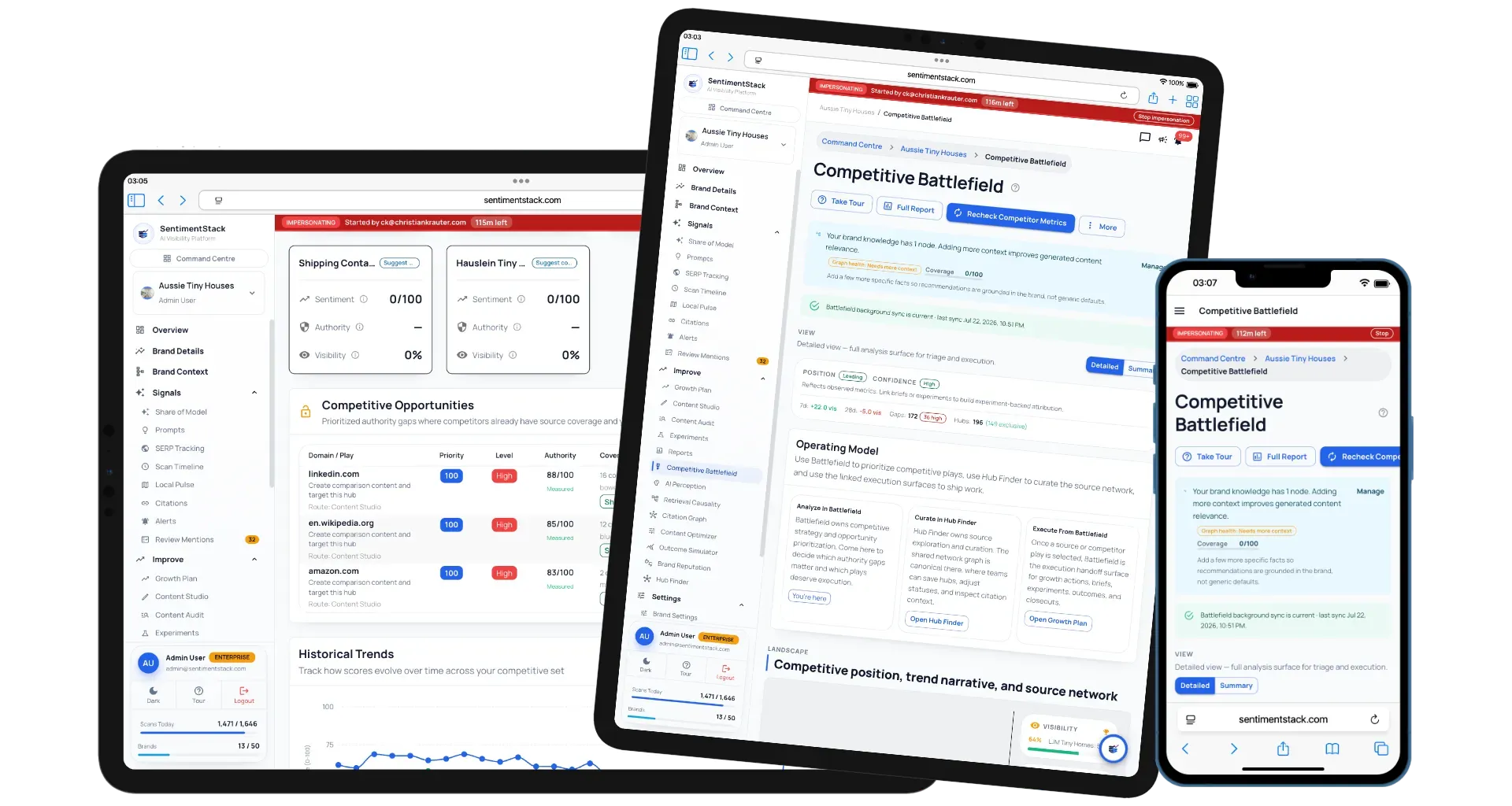
A platform such as aigeo insights can make this operational by tracking visibility signals across major AI environments and turning the gaps into prioritised content, structure and distribution tasks. That bridge between measurement and execution is what separates reporting from growth.
The battle for the answer has begun. Brands that monitor how AI describes them can correct the narrative, strengthen the assets that earn citations and move before competitors become the default recommendation. The next useful step is simple: test the questions your best prospects are already asking and see whether your brand is part of the answer.
Related Posts
- 7 Generative Search Trends Reshaping Brand Visibility
Generative search trends are changing how Australian brands earn mentions, citations and demand. Learn what to measure and where to…
Read more about 7 Generative Search Trends Reshaping Brand Visibility - How to Map Brand Entities for AI Search Visibility
Learn how to map brand entities, connect the signals AI uses, find gaps and build a stronger path to citations,…
Read more about How to Map Brand Entities for AI Search Visibility - GEO Workflow Guide for Winning AI Search Visibility
This GEO workflow guide shows marketing teams how to measure AI visibility, prioritise fixes, and earn more brand mentions and…
Read more about GEO Workflow Guide for Winning AI Search Visibility