
A prospect asks ChatGPT for the best project management platform, a reliable solar installer, or a B2B software provider in their sector. Your brand may have page-one rankings, a strong paid search budget and years of SEO investment. Yet if it is absent, misrepresented or weakly positioned in the answer, you have lost the moment that matters.
Generative search trends are moving discovery from a list of links to a compressed, conversational recommendation layer. For Australian marketers, agencies and growth teams, this changes the job. Ranking is still valuable. But the new competitive question is sharper: when an AI system forms an answer, does it know your brand, trust your evidence and choose to mention you?
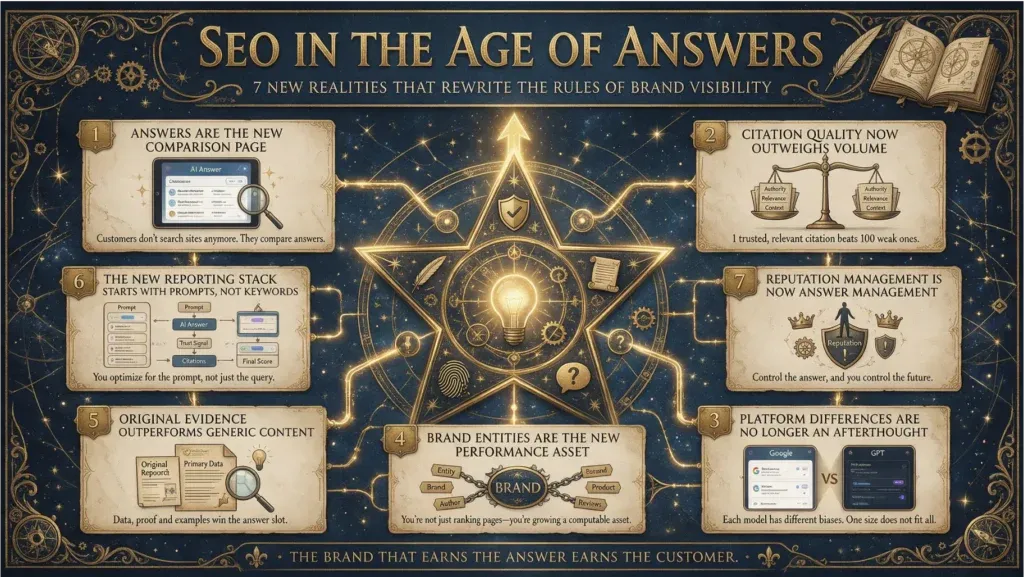
1. AI answers are becoming the new comparison page
Traditional search gave users a results page and asked them to do the comparison work. Generative engines increasingly do the comparison first. They summarise options, name leading providers, explain trade-offs and, in some cases, cite the sources that shaped the response.
That shift is commercially significant because the answer often narrows the consideration set before a user visits a website. A brand mentioned as a credible option begins with an advantage. A brand omitted may never receive the click, enquiry or shortlist opportunity it would have earned in conventional search.
This does not mean organic rankings are finished. Strong search content, recognised expertise and technically accessible pages still feed the wider information ecosystem. The difference is that rankings are no longer the final scoreboard. Brand mentions, citation rate and AI share of voice now reveal whether that work is winning inside the answer itself.
2. Citation quality matters as much as citation volume
A citation is not a trophy. It is evidence of what an AI platform considers useful for a specific question. The next phase of GEO is not simply chasing more citations. It is understanding which assets are cited, for which prompts, on which platforms, and whether the citation supports the brand message you want buyers to see.
A product comparison page might earn citations for feature questions. An original research report may be used for market context. A detailed help article could establish operational credibility. Those are different visibility wins, with different revenue implications.
Teams should assess citations alongside sentiment and message accuracy. If an engine cites your site but frames your pricing as unclear, your service area incorrectly or your product as suitable only for small businesses, visibility alone will not protect demand. The goal is qualified representation: frequent, accurate and favourable inclusion in high-intent answers.
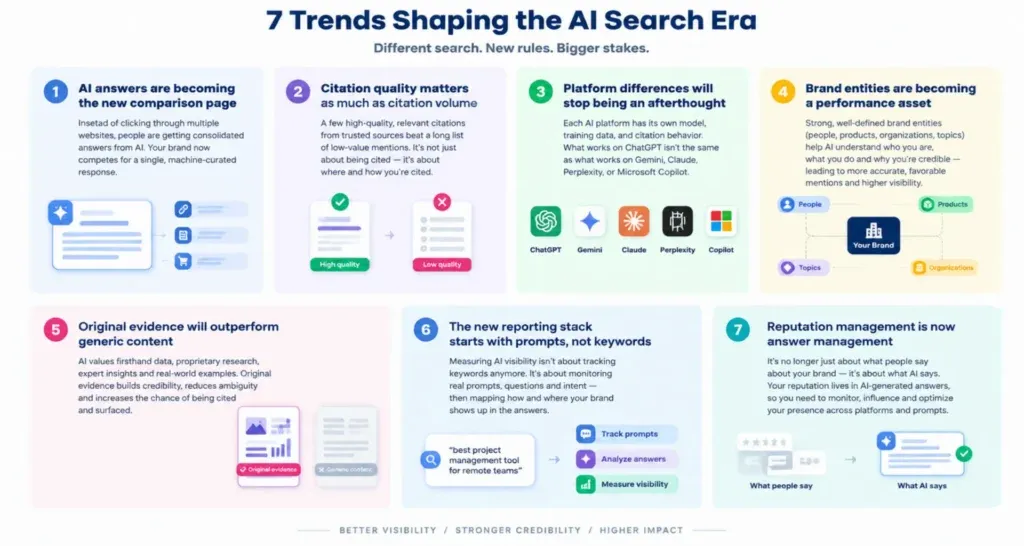
3. Platform differences will stop being an afterthought
ChatGPT, Claude, Gemini, Perplexity and Google AI Overviews do not behave like one channel with different logos. Their source preferences, response formats, citation behaviour and user contexts vary. A brand that appears strongly in one environment can be missing in another.
That makes a single, blended AI visibility score useful but incomplete. Growth teams need platform-level intelligence. Where are competitors being recommended? Which prompts trigger the gap? Are you absent because content coverage is weak, because third-party corroboration is missing, or because the platform is interpreting your category differently?
The practical implication is not to create separate content for every model. It is to build a durable evidence base: clear product pages, authoritative topic coverage, structured information, independent validation and consistently accurate brand facts. Then monitor how each platform converts that evidence into answers.
4. Brand entities are becoming a performance asset
Generative systems need to identify who you are before they can recommend you confidently. That sounds obvious, but many brands still publish fragmented information across websites, directories, social profiles, review platforms and partner pages. Names vary. Offers overlap. Old positioning remains indexed. Key details are buried in PDFs or vague marketing copy.
Entity clarity is the foundation of AI visibility. Your brand should be easy to distinguish from similarly named companies and easy to connect with the products, services, customers, locations and proof points that define it. Consistency matters, but so does specificity.
For example, “we deliver innovative solutions” gives an AI very little to work with. “Australian cybersecurity consultancy for mid-market healthcare and financial services organisations, specialising in incident response and cloud security” creates a far more usable association. The latter helps systems classify the business and helps buyers understand the fit.
5. Original evidence will outperform generic content
AI-generated content has made it easier to publish more. It has not made generic content more persuasive. As the web fills with recycled advice, the pages most likely to earn trust will contain information that cannot be copied from the next search result.
This is where first-party data, customer outcomes, expert commentary, methodology pages, pricing clarity, product documentation and genuinely useful comparisons become strategic assets. The best content does not merely repeat category language. It resolves a real question with proof.
There is a trade-off. Original research and expert-led content take more effort than high-volume production. But the alternative is producing interchangeable pages that offer no reason for an AI engine, journalist, buyer or partner to use them. In the answer economy, distinct evidence is a distribution advantage.
6. The new reporting stack starts with prompts, not keywords
Keywords remain useful for understanding language and demand. But generative discovery is often expressed as a full question, a constraint or a decision scenario. Users ask for the best payroll software for a 50-person business, the most trusted accounting firm for an SMSF, or alternatives to a named competitor with local support.
That means reporting must expand from keyword positions to prompt coverage. Start by mapping the questions that influence awareness, evaluation and conversion. Include category prompts, comparison prompts, use-case prompts, problem prompts and branded prompts. Then measure whether your brand appears, where it is positioned, what claims accompany it and which competitors are included instead.
A useful prompt set is not static. New product releases, customer objections, seasonal demand, industry news and competitor campaigns can all create fresh answer opportunities. Review it regularly, especially for high-value categories where a single recommendation can shape a sizeable pipeline.
Generative search trends demand faster optimisation cycles
The old search playbook often rewarded patience. Publish, wait, rank, refine. Generative search still requires quality and consistency, but market movement can be faster. A competitor can publish a strong comparison asset, gain third-party coverage or clarify a product message and quickly change the answers buyers receive.
This is why passive monitoring is not enough. A dashboard that reports lower AI share of voice without identifying the response is only half a system. Teams need a clear path from signal to action: update the weak page, create the missing asset, strengthen supporting evidence, correct the inaccurate claim or distribute a proof point where it can be independently validated.
Prioritisation matters. Do not react to every low-volume prompt. Score opportunities by commercial intent, current visibility gap, competitor advantage and the effort required to improve. A high-intent comparison prompt where your closest rival is repeatedly recommended deserves more attention than a broad informational question with little buying potential.
This is the operating model behind effective GEO. Measure visibility across relevant AI environments, diagnose why the answer looks the way it does, and turn the finding into a specific task. Platforms such as aigeo insights are built to connect those stages, helping teams track mentions, citations, sentiment and competitor visibility before turning the data into an optimisation roadmap.
7. Reputation management is now answer management
Generative engines can surface a brand’s strengths and weaknesses in the same response. Reviews, outdated pages, forum discussions, analyst commentary and third-party articles all contribute to the wider picture. This raises the stakes for reputation work.
The answer is not to chase every mention or attempt to control the open web. It is to make accurate, credible information easier to find and harder to contradict. Keep product facts current. Address recurring customer concerns directly. Publish useful explanations of limitations and fit. Encourage satisfied customers and respected partners to describe real outcomes in their own words.
Brands that hide behind vague claims create an information vacuum. Competitors, reviewers and AI systems will fill it. Brands that document what they do, who they serve and where they deliver value give the market a stronger basis for recommendation.
The battle for the answer has begun, but the response should be disciplined rather than frantic. Choose the prompts that shape revenue, build evidence that deserves to be cited, and watch the market closely enough to act before absence becomes a habit.
Related Posts
- How to Map Brand Entities for AI Search Visibility
Learn how to map brand entities, connect the signals AI uses, find gaps and build a stronger path to citations,…
Read more about How to Map Brand Entities for AI Search Visibility - How to Measure Brand Visibility in AI Search
Learn how to measure brand visibility across AI search, track share of voice, citations and sentiment, and turn visibility gaps…
Read more about How to Measure Brand Visibility in AI Search - Generative Search Content Optimisation Guide
This generative search content optimisation guide shows Australian marketing teams how to earn AI citations, lift share of voice and…
Read more about Generative Search Content Optimisation Guide