
A first-page ranking no longer guarantees that a prospect will see your brand. When someone asks ChatGPT for the best payroll software, Gemini for a local accounting firm, or Perplexity for a product comparison, the platform may deliver one confident answer without showing a traditional results page at all. That is why GEO reporting versus rank tracking is now a commercial decision, not a reporting preference.
Rank tracking tells you where a URL appears in a list of search results. GEO reporting tells you whether AI systems mention your brand, recommend it, cite your content, frame it positively, and surface competitors instead. Both matter. But they measure different battles, and confusing them can leave a brand optimising for visibility that never reaches the final answer.
Rank tracking measures position in a results list
Traditional rank tracking has earned its place in the marketing stack. It monitors a domain or page position for a keyword, usually across Google and sometimes other conventional search engines. If you rank third for “best project management software Australia”, you can see movement over time, compare performance with competitors, and connect ranking changes to technical fixes, content updates, and link acquisition.
For SEO teams, that signal remains useful. Search rankings can influence organic traffic, branded searches, conversions, and the likelihood that a crawler discovers and values your content. Strong rankings also often support AI visibility because authoritative, accessible pages are more likely to be considered as source material.
The limitation is obvious once the user’s search journey moves into an AI interface. A rank tracker cannot reliably tell you whether ChatGPT recommends your company when asked for alternatives, whether Claude describes your pricing accurately, or whether Google AI Overviews cites a competitor’s guide above your own page. Position is not presence. And presence is not recommendation.
GEO reporting measures your place in the answer
Generative Engine Optimisation reporting is built for the answer economy. Rather than asking, “Where does our page rank?”, it asks, “What does the AI say when buyers ask questions that lead to our category?”
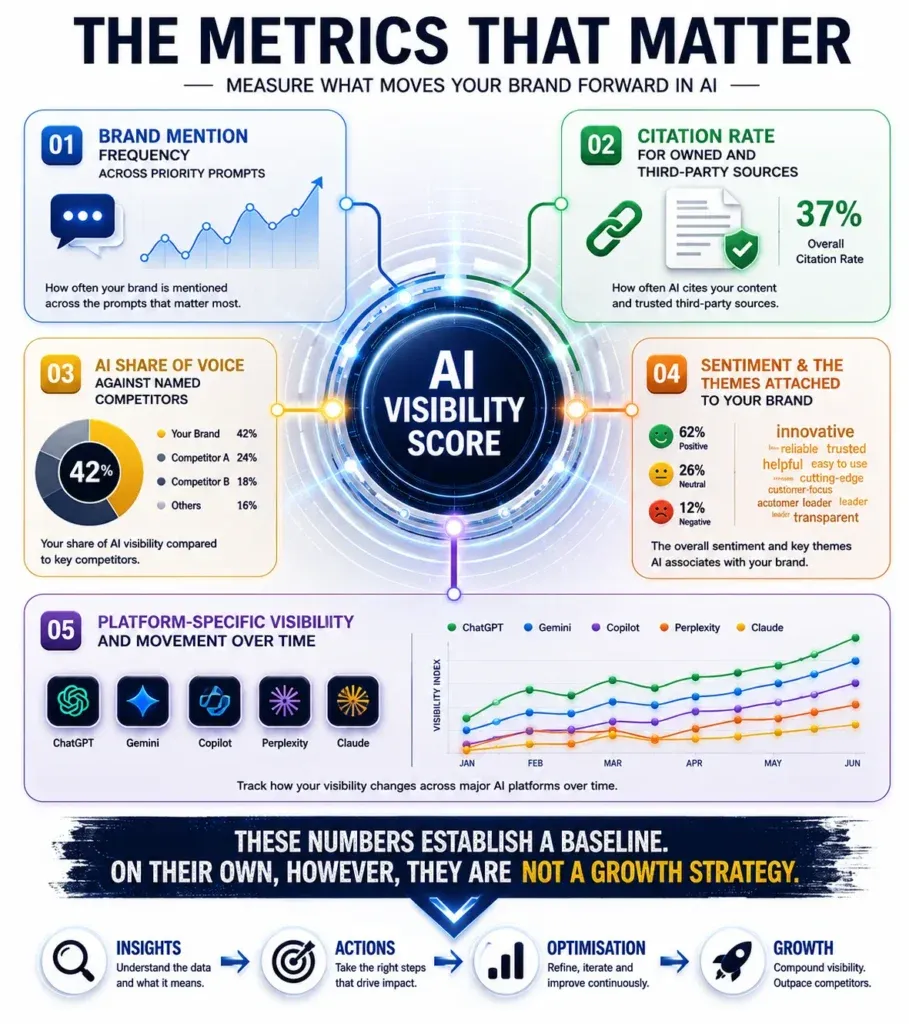
That difference changes the metrics that matter. A serious GEO reporting programme measures brand mention frequency, citation rate, AI share of voice, sentiment, competitor visibility, and performance by platform and prompt category. It should distinguish between a passing mention and a direct recommendation. It should also identify whether the model cites your owned content, a third-party review, a directory profile, news coverage, or nothing connected to your brand at all.
This is the intelligence growth teams need when a buyer asks an AI assistant to shortlist vendors. If your company ranks well organically but is absent from the shortlist, the commercial outcome is clear: you have search visibility, but you do not have answer visibility.
The metrics answer different questions
Rank tracking is strongest when you need to understand search-result exposure. GEO reporting is strongest when you need to understand AI representation. One monitors the shelf position; the other monitors whether the salesperson in the aisle names your product.
A useful operating model separates the two:
- Rankings show whether your pages are competitive in traditional organic search.
- AI mentions show whether generative platforms recognise your brand in relevant conversations.
- Citations show which sources AI systems trust when they explain or recommend.
- AI share of voice shows how often your brand appears against competitors across a defined prompt set.
- Sentiment shows whether the representation helps, harms, or confuses potential buyers.
These signals should not be forced into one vanity number. A brand can hold strong rankings while receiving weak AI mentions. Another may appear frequently in AI answers because of third-party coverage, yet have poor sentiment due to outdated reviews or inaccurate claims. Each scenario calls for a different response.
Why rankings alone can create a false sense of security
Imagine an Australian B2B SaaS company ranking in the top five for several high-intent category terms. Its monthly SEO report looks healthy. Traffic is stable, visibility is up, and key pages have gained positions.
Then the team tests the prompts buyers actually use: “What are the best platforms for [category]?”, “Which tool is best for mid-market teams?”, and “Compare [brand] with its major competitors.” The company is missing from most answers. Where it does appear, it is described using an old positioning statement, while two competitors are recommended with specific proof points and cited comparison pages.
A rank tracker did not fail. It was simply answering a narrower question. The risk comes when leaders treat a keyword position as proof of market visibility across every discovery channel.
Generative platforms build answers from a mixture of sources, model knowledge, retrieval systems, structured information, publisher content, reviews, and entity-level signals. Their outputs vary by platform, query wording, user context, and time. There is no single universal “AI rank” that behaves like Google position one. That makes GEO reporting more complex, but also more valuable when buyers are increasingly asking AI to do the research.
The operational difference: reporting versus action
The best reporting does more than expose a gap. It tells the team what to do next.
With rank tracking, a drop from position four to nine may trigger an SEO investigation: check technical health, refresh the page, assess competitor content, or review backlinks. That workflow is familiar and effective.
With GEO reporting, the diagnosis has to be more specific. If competitors are cited for a comparison query and you are not, the next action may be to build a clear comparison asset with evidence-led claims. If the brand is mentioned but its product category is misunderstood, update core pages, FAQs, schema, supporting articles, and external profiles to reinforce the right entity associations. If your share of voice falls on one platform only, investigate that platform’s cited sources and answer patterns before making broad changes.
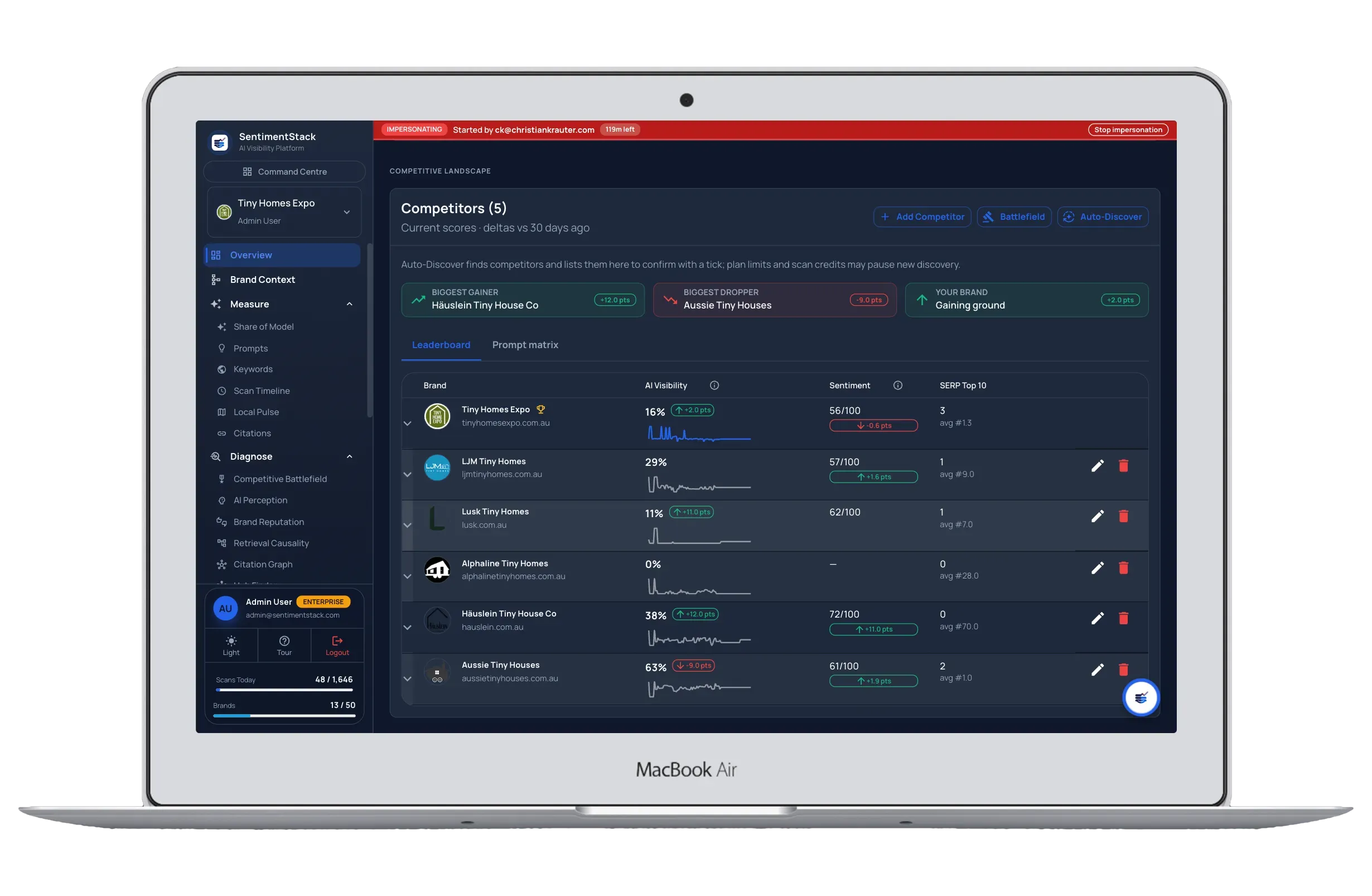
This is where passive dashboards fall short. Teams need a prioritised roadmap that connects each visibility gap to content, structure, distribution, reputation, or entity-strengthening work. aigeo insights is designed around that shift: measuring AI visibility across leading generative platforms, then turning the findings into practical optimisation tasks instead of leaving teams with another chart to interpret.
When rank tracking should still lead
Do not abandon rank tracking because AI search is growing. For many businesses, conventional search still drives substantial traffic and revenue. Ranking data should remain central when your priority is local intent, ecommerce category discovery, high-volume informational traffic, or diagnosing organic performance after a site migration.
It can also be the better primary measure when your audience has not materially adopted AI tools for category research, or when you lack enough prompt coverage to establish a reliable GEO baseline. Measurement quality matters. A small, poorly designed prompt set can produce dramatic-looking but unhelpful swings.
Start with the queries that mirror real buyer language. Include discovery prompts, comparison prompts, problem-solving prompts, brand-versus-brand prompts, and recommendation prompts. Segment them by funnel stage, product line, and market. Then monitor them consistently across the AI platforms your customers actually use.
When GEO reporting needs to lead
GEO reporting should move to the front of the dashboard when your buyers use AI to research providers, compare solutions, validate claims, or seek recommendations before contacting sales. This is especially pressing for SaaS, professional services, finance, health, travel, education, and considered purchases where trust and explanation influence the shortlist.
It should also lead when brand accuracy matters as much as traffic. A misleading AI description can damage consideration even if your website ranks well. A competitor that owns the cited sources for category-defining questions can shape the buyer’s evaluation before your site receives a visit.
For agencies, GEO reporting creates a more credible client conversation. Instead of promising abstract “AI readiness”, you can show which brands are named, which sources are cited, which competitors dominate, and which actions are most likely to shift the outcome. That is a measurable service, not a trend deck.
Build one visibility system, not two competing reports
The practical answer is not GEO reporting versus rank tracking as an either-or choice. It is using each metric for its intended job, then connecting the findings to revenue outcomes.
Track rankings for your priority organic terms and landing pages. Track AI visibility for the prompts that shape awareness, evaluation, and trust. Review competitor movement in both environments. Most importantly, assign an owner and a response process when the data changes. A visibility report without an optimisation workflow is just expensive observation.
The battle for the answer has begun. Keep measuring where your pages sit, but make sure you also know whether your brand is being chosen when AI gives the answer.
Related Posts
- SEO Tools Versus GEO Tools for AI Search
SEO tools versus GEO tools measure different battles: rankings in results and visibility in AI answers. Learn where each fits…
Read more about SEO Tools Versus GEO Tools for AI Search - GEO Versus SEO Strategy for Modern AI Search
Compare GEO versus SEO strategy, learn what each measures, and build a visibility plan that earns rankings, citations and AI…
Read more about GEO Versus SEO Strategy for Modern AI Search - AI Share of Voice Tracking That Matters
AI share of voice tracking shows how often your brand appears in AI answers, who outranks you, and what to…
Read more about AI Share of Voice Tracking That Matters