





A prospect asks an AI assistant which payroll platform suits a growing business, which agency can manage a complex campaign, or which supplier is most reliable in their category. The response may name three brands, explain why each fits, and cite sources to support the recommendation. If your brand is absent, it does not matter that you ranked well for a related keyword last month. The future of answer engine optimisation is about competing for that recommendation.
This is not a minor extension of SEO. It is a change in where commercial decisions are made. Generative platforms are becoming research partners, shortlisting engines and, increasingly, transaction assistants. The brands that win will be the ones AI systems can confidently understand, verify and recommend.
The answer is becoming the new search result
Traditional search created a page of options. Users compared rankings, scanned snippets and decided where to click. Answer engines compress that journey. They interpret the question, retrieve relevant information and present a direct response that can shape the buyer’s shortlist before a website visit happens.
That changes the unit of competition. A number-one ranking is valuable, but it is no longer the only signal that matters. Brands now need to know whether they are mentioned in answers, whether their own content is cited, how their sentiment compares with competitors, and which prompts trigger visibility across ChatGPT, Gemini, Claude, Perplexity and Google AI Overviews.
A brand can have strong organic traffic while losing the answer economy. This often happens when its site is technically sound but vague, its expertise is not well evidenced, or third-party sources give competitors a stronger footprint. AI systems do not reward a logo simply because it is familiar. They assemble answers from the information they can access and trust.
How the future of answer engine optimisation will change
The next phase of answer engine optimisation will be less about chasing a static result and more about managing a living brand representation. AI responses vary by platform, location, wording, recency and the context a user provides. A finance manager asking for enterprise software receives a different answer from a founder looking for an affordable option.
That volatility creates a serious measurement problem. Checking a few prompts manually might reveal a mention, but it cannot show whether that mention is repeatable, favourable or commercially useful. It also cannot reveal whether a competitor is steadily gaining AI share of voice across the questions that drive consideration.
The future will bring three major shifts.
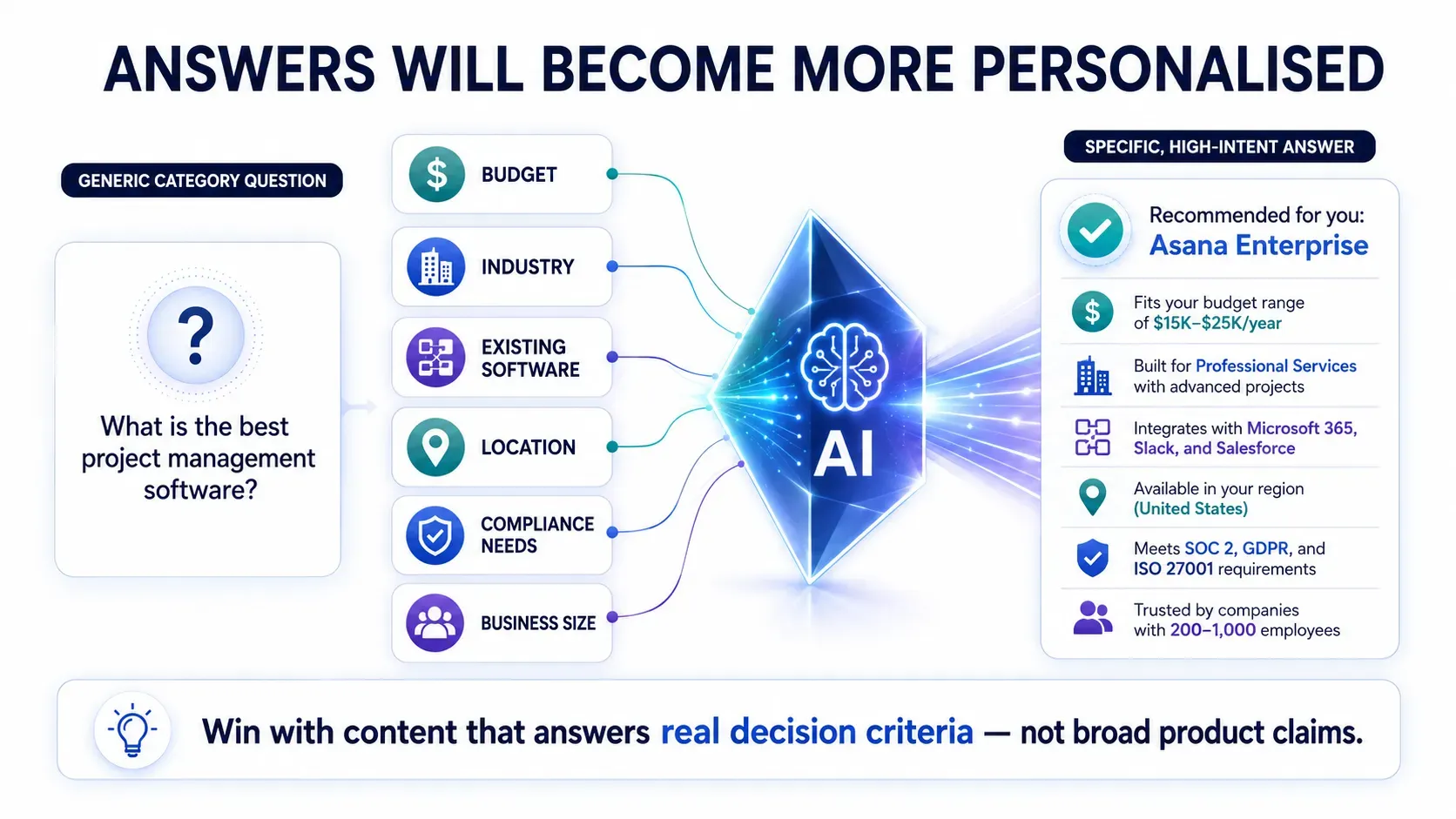
Answers will become more personalised
As AI platforms retain context and connect to more tools, generic category questions will give way to specific, high-intent requests. Users will ask for recommendations based on budget, industry, existing software, location, compliance needs and business size. Brands need content that addresses these decision criteria clearly rather than relying on broad product claims.
Citations will carry more commercial weight
When an answer engine cites a source, it signals confidence in that information. Citation rate will become a practical measure of whether your owned content is being used to support AI answers. But citation volume alone is not the goal. A cited article that attracts irrelevant audiences or presents an outdated offer will not create pipeline. The best assets pair clear facts with genuine buying-stage usefulness.
Reputation signals will move beyond your website
AI models draw on a wider information environment: editorial coverage, reviews, industry directories, customer discussions, expert commentary and structured company data. That means brand representation cannot be owned by the SEO team alone. Content, PR, customer marketing, product and sales all influence the evidence an answer engine sees.
There is a trade-off here. Publishing more content can increase your topical coverage, but thin, repetitive pages rarely build trust. Distribution can earn third-party validation, but only if the underlying claims are accurate and defensible. The objective is not to flood the web with brand language. It is to create a consistent body of evidence that makes your brand easy to describe correctly.
What winning teams will measure
The teams that dominate AI search will treat visibility as a performance discipline, not a once-a-quarter experiment. They will benchmark their presence against direct competitors, separate high-value prompts from vanity queries, and connect visibility shifts to the actions that caused them.
A practical answer engine measurement programme should track:
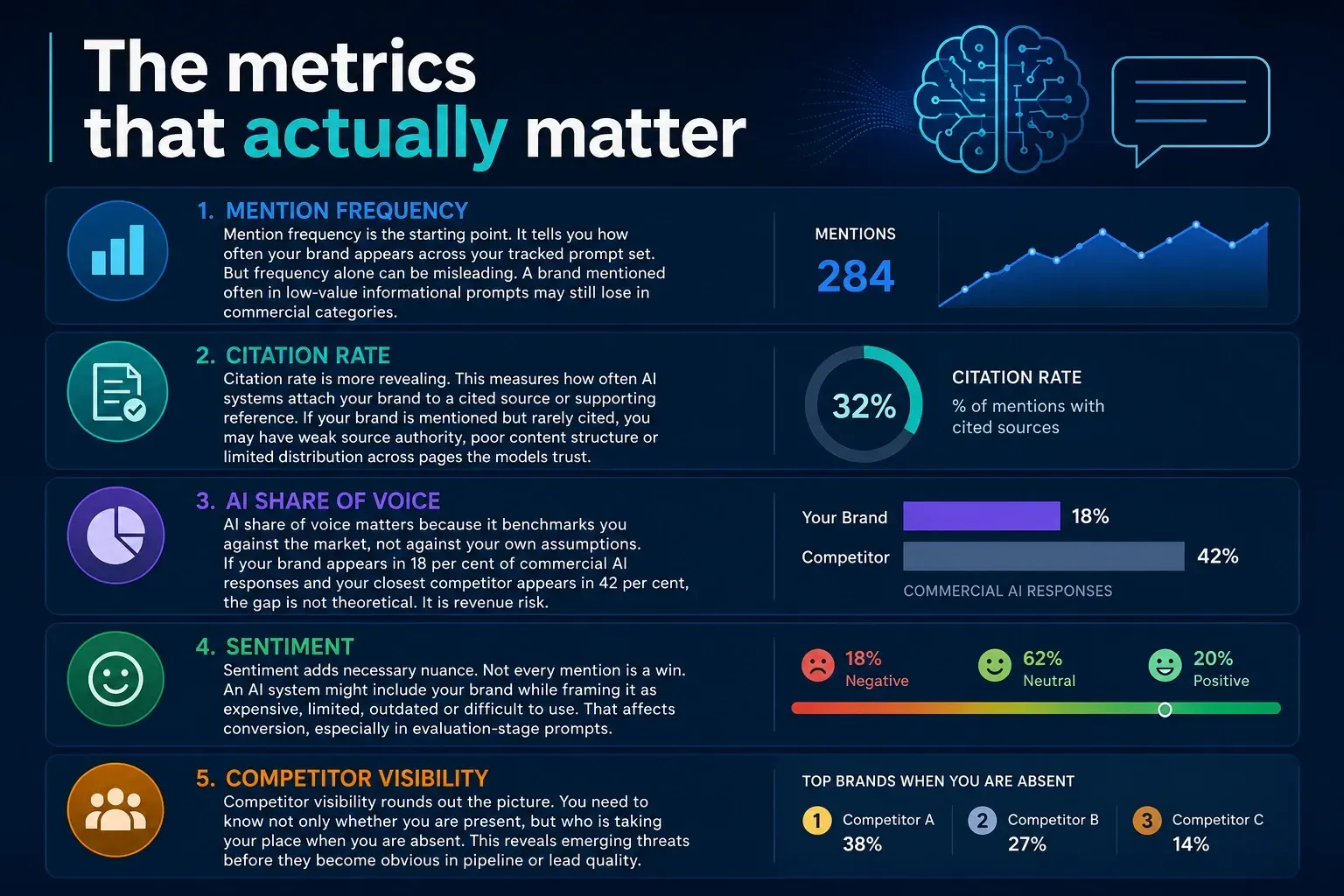
- Brand mention frequency across priority prompts and platforms.
- AI share of voice against the competitors buyers compare most often.
- Citation rate for owned pages, plus the external sources cited alongside them.
- Sentiment and message accuracy, including whether AI describes your offer correctly.
- Platform-level differences, because a strong result in Perplexity does not guarantee visibility in Google AI Overviews or ChatGPT.
These metrics reveal different problems. Low mention frequency can indicate weak topical relevance or a lack of supporting evidence. High mentions with poor sentiment can point to reputation gaps, outdated reviews or confusing positioning. Strong visibility on one platform but not another may show that your source mix is too narrow.
This is where a tracking system matters. aigeo insights designed SentimentStack an AI brand visibility tool that gives teams a way to monitor AI mentions, citations, sentiment and competitive share of voice, then turn those signals into an optimisation roadmap. The value is not another dashboard. It is knowing which page to improve, which subject to cover, which claim to substantiate and where competitors have opened a gap.
Build content for retrieval and recommendation
The content that performs in answer engines is usually not written as a trick for machines. It is written to remove uncertainty for people and systems alike.
Start with the questions buyers actually ask before they contact sales. These are rarely limited to “what is this product?” They include comparisons, implementation concerns, pricing logic, use cases, integrations, risks, alternatives and proof of results. Each question is an opportunity to become a source an answer engine can use.
Make the answer explicit. If your platform supports a particular integration, say so plainly and explain the conditions. If it suits mid-market teams rather than global enterprises, be precise. If your methodology has limits, disclose them. Clear boundaries improve credibility and reduce the chance that AI produces an inflated or inaccurate description of your business.
Structure also matters. Use descriptive headings, concise definitions, well-labelled tables where comparison is necessary, current statistics with source context, and consistent product terminology. Keep important claims close to the evidence that supports them. A buried sentence on page eight of a vague guide is less useful than a direct, well-organised explanation of a buyer’s question.
Freshness matters too, particularly in fast-moving categories. Yet constant rewriting is not always the right move. Update pages when facts, product capabilities, regulations, pricing models or market conditions have changed. Preserve pages that continue to earn citations and improve them carefully rather than replacing their useful structure without reason.
Turn monitoring into an operating rhythm
Visibility data only creates value when it changes decisions. A sensible rhythm begins by defining a prompt set around revenue: category questions, competitor comparisons, solution queries and use-case requests. Review performance frequently enough to spot meaningful movement, but not so often that normal answer variation creates panic.
When a competitor gains visibility, investigate before reacting. Did it publish a genuinely better guide? Is it being cited by a trusted publication? Has it claimed a niche use case your site barely addresses? The right response may be a new page, a stronger customer proof point, an update to an existing asset or a distribution effort that earns independent validation.
Assign ownership across teams. SEO can lead technical quality and content prioritisation. Brand and PR can strengthen message consistency and third-party presence. Product teams can supply the detail that makes content accurate. Sales can expose the objections and comparisons buyers raise every day. Answer engine optimisation works best when these inputs feed one shared visibility plan.

What not to do as AI search grows
Do not treat generative visibility as a reason to abandon conventional search. Strong crawlability, useful pages, trusted links and clear information architecture still help create the source material answer engines rely on. GEO extends SEO; it does not erase it.
Avoid manufacturing authority with exaggerated claims, fake reviews or pages built only to repeat competitor names. These tactics may create short-lived noise, but they weaken trust and expose brands to reputational risk. The goal is durable recommendation, not a fleeting mention.
Most importantly, do not optimise for every possible prompt. Prioritise the questions closest to your commercial reality. A smaller set of high-intent answers where your brand is consistently understood and favourably represented will outperform a scattered presence across thousands of low-value queries.
The battle for the answer has begun, but the opportunity is practical: measure where your brand appears, identify why it is absent or misrepresented, and give answer engines better evidence to work with. Every useful improvement compounds into a clearer case for choosing you.
Related Posts
- 9 best generative engine optimisation tools
Compare the best generative engine optimisation tools for tracking AI visibility, citations, sentiment, and competitor share of voice.
Read more - What Is Generative Engine Optimisation?
What is generative engine optimisation? Learn how GEO helps brands earn mentions, citations and visibility inside AI-generated answers.
Read more - Generative Engine Optimisation Agency Guide
What a generative engine optimisation agency does, how to assess one, and when brands should build GEO capability in-house or…
Read more