A competitor can become the default recommendation in ChatGPT or Google AI Overviews before its traditional rankings move at all. That is why a GEO dashboard comparison cannot stop at attractive charts or a monthly mention count. Your team needs to know where your brand appears, why it appears, who is taking the answers you want, and what to do next.
For Australian marketers, agencies and growth teams, AI visibility is now a measurable performance channel. The best dashboard is not the one with the most widgets. It is the one that turns generative search behaviour into a clear plan to win more citations, recommendations and commercially relevant mentions.
What a GEO dashboard should measure
Generative Engine Optimisation is not traditional rank tracking with a new label. Search rankings show where a page sits in a list. GEO measures whether a generative platform considers your brand useful enough to include in the answer itself.
That distinction changes the metrics that matter. A capable platform should measure brand mention frequency across a defined prompt set, citation rate for your owned content, AI share of voice against competitors, sentiment, and performance by platform. If it combines every AI engine into one headline number, it can hide a serious problem. A brand may be strong in Perplexity, absent from Claude, and losing ground in Google AI Overviews.
The quality of the prompt set matters just as much as the headline metrics. Tracking your brand name alone may produce reassuring data while missing the category, comparison and problem-led questions that influence buying decisions. A useful dashboard tests prompts that reflect actual customer intent: “best accounting software for small businesses”, “agency for B2B SaaS demand generation”, or “how to reduce warehouse operating costs”.
Prioritise commercial visibility over vanity mentions
Not every AI mention creates the same value. A passing reference in a broad explainer is different from being named as one of three recommended providers for a high-intent query. Your dashboard should let you segment prompts by topic, market, funnel stage and commercial priority.
This gives teams a more honest view of progress. If overall mentions rise but your brand is still missing from comparison prompts and purchase-stage recommendations, visibility has improved without necessarily improving pipeline potential. The right reporting keeps attention on the answers that move buyers closer to action.
The critical GEO dashboard comparison criteria
A serious evaluation should focus on how each platform collects, explains and operationalises its data. Reporting depth matters, but actionability is where many tools fall short.
Platform coverage and repeatable methodology
AI search is fragmented. ChatGPT, Claude, Gemini, Perplexity and Google AI Overviews do not retrieve, cite or frame information in identical ways. A dashboard should show results at the platform level, so your team can identify whether a visibility gap is widespread or isolated.
Ask how frequently prompts are run, whether results are stored for trend analysis, and how the platform handles response variation. LLM outputs can change from one run to the next. One-off checks are useful for reconnaissance, but they are not a reliable benchmark. You need repeatable monitoring across a stable prompt framework, with enough history to separate genuine movement from normal variation.
Coverage also needs to match your market. If you sell in Australia, prompts should reflect Australian terminology, customer expectations and local competitors. A US-only prompt library can produce the wrong competitive picture, particularly in regulated, location-led or service categories.
Citation intelligence, not just mention detection
A brand can be mentioned without being cited. It can also be cited through third-party reviews, industry publications, directories or partner content rather than its own website. These are very different visibility scenarios and they require different responses.
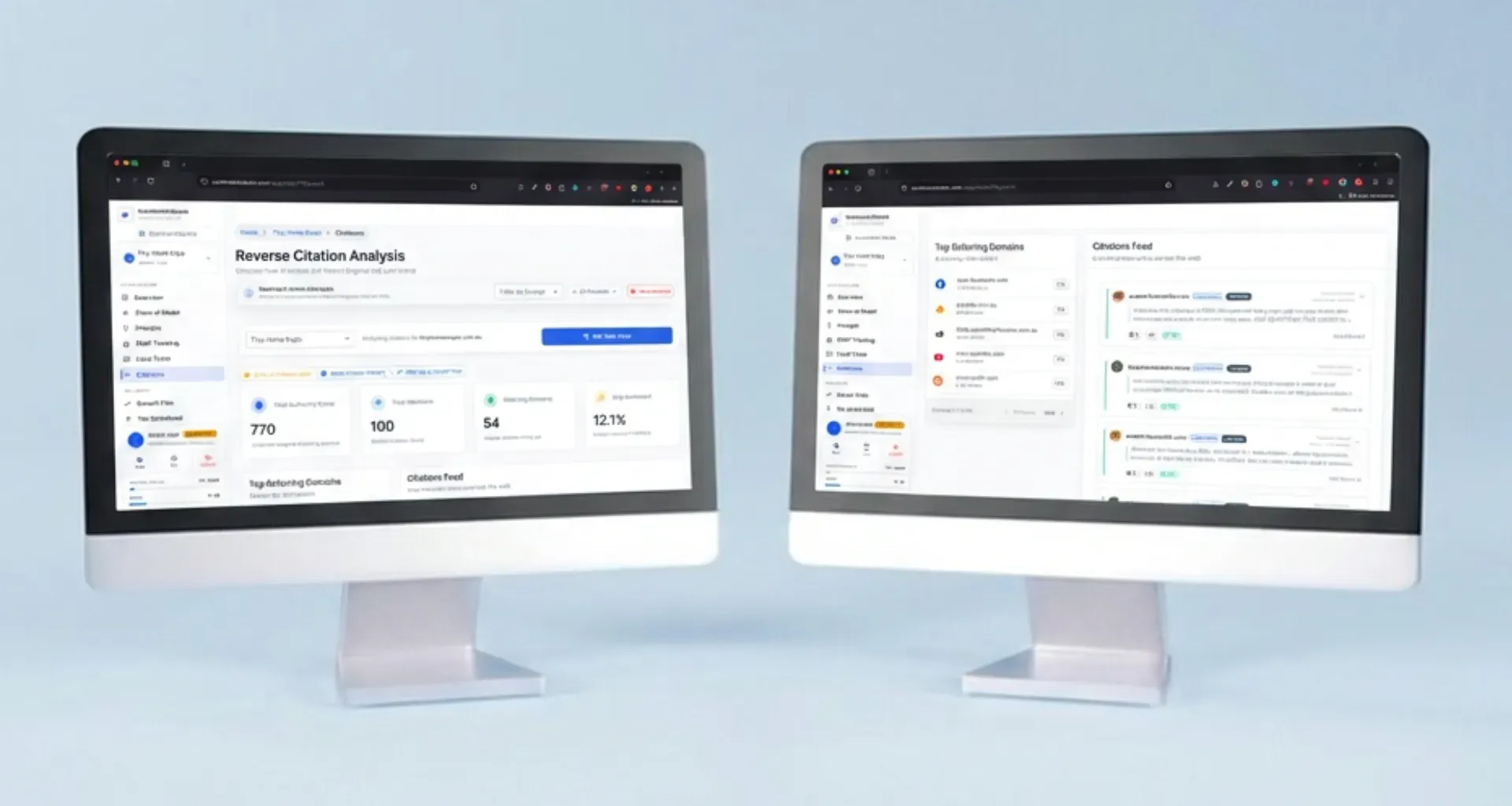
The strongest platforms show the sources associated with AI answers and distinguish owned, earned and competitor sources. That lets your team see which pages or publishers are supporting your inclusion, where competitors are gaining authority, and which content gaps are worth addressing.
For example, if an AI engine repeatedly cites independent comparison pages that exclude your business, publishing another generic service page may not change the outcome. The more effective move might be to improve product documentation, secure credible third-party coverage, or create a clear comparison asset that answers the missing question directly.
Competitive share of voice with context
AI share of voice is one of the most useful GEO metrics, provided it is calculated transparently. It should show how often your brand appears relative to selected competitors across the prompts that matter, rather than simply reporting a broad category score.
Look for the ability to select true commercial competitors, group them by market, and inspect the exact prompts where they outperform you. An enterprise software provider, for instance, may compete against different brands in “best for mid-market” prompts than it does in “best for startups” prompts. A single competitor list rarely captures that nuance.
Context also prevents bad decisions. If a competitor has a high share of voice because it is frequently mentioned in negative examples or low-value informational prompts, its apparent lead may be less threatening than it first appears. Mention volume, sentiment and prompt intent should be read together.
Recommendations that create momentum
Most dashboards can tell you that visibility is down. Far fewer can identify the work most likely to improve it. This is the dividing line between passive analytics and a growth system.
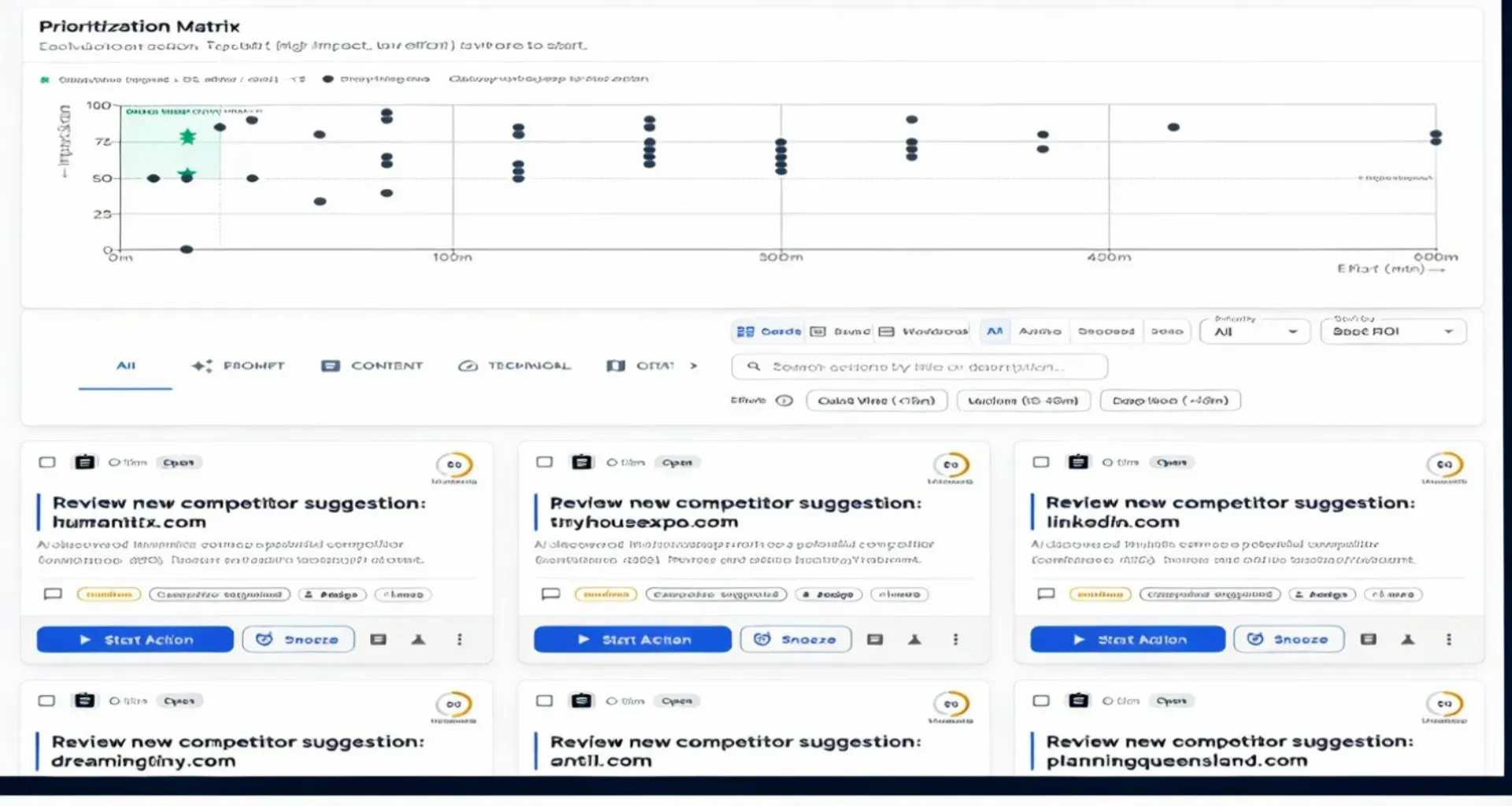
A useful platform should translate findings into prioritised tasks: update a weak page, build content around an uncovered question, add clearer first-party evidence, improve structured information, pursue a specific authority source, or address sentiment themes appearing in AI responses. Each task should connect back to a visibility gap and indicate its likely impact.
This matters for lean marketing teams. Without prioritisation, GEO data becomes another report waiting for someone to interpret it. With a scored roadmap, content, SEO, PR and brand teams can work from the same evidence and move quickly when a competitor gains ground.
Comparing dashboard experiences by team need
There is no single best dashboard for every organisation. The right choice depends on how much internal capability you have and how quickly decisions need to translate into execution.
A lightweight monitoring tool may suit a small business that wants an early warning when its brand disappears from core prompts. It should be simple to set up and inexpensive, but it may offer limited competitor depth, source analysis or guidance.
An enterprise-grade analytics platform can suit larger organisations with dedicated search, data and content teams. These tools may support extensive prompt libraries, multiple markets and detailed exports. The trade-off is often complexity. If insights require a specialist analyst and a quarterly reporting cycle, the business may still react too slowly to AI search changes.
For agencies, the priority is usually scalable client reporting and clear evidence of opportunity. They need separate brand workspaces, competitor benchmarking, trend views and recommendations that can be turned into a client work plan. A dashboard that only reports high-level AI visibility will struggle to prove strategic value.
Platforms such as aigeo insights are built for the middle ground many growth teams need: broad AI visibility tracking paired with a practical optimisation roadmap. Rather than treating SentimentStack data as an endpoint, the system is designed to show where action is required across content, citations, competitor gaps and platform performance.
Questions to ask before committing
Before subscribing, test the dashboard against a real business question. Can it show why your competitor is recommended for an important category prompt? Can it identify the sources shaping that answer? Can it show whether the gap exists across every engine or only one? And can a marketer turn the finding into a task this week?
Also check whether the reporting supports change over time. A baseline is useful, but trend data is what lets you connect work completed to movement in mentions, citations and share of voice. You should be able to see the effect of a new guide, a revised product page or a successful media placement without relying on guesswork.
Finally, assess the commercial fit. Entry-level pricing may be appropriate for monitoring a small set of prompts, while competitor benchmarking, multiple brands and broader market coverage may justify a higher-tier plan. The cheapest dashboard is not a bargain if it leaves your team to manually translate every insight into action.
Build a dashboard process, not a reporting ritual
Once you choose a platform, establish a working rhythm. Review priority prompts regularly, investigate significant competitor changes, assign recommendations to owners, and measure whether completed work changes AI visibility. This turns GEO from a monthly screenshot into an operating discipline.
Keep the first prompt set focused. Start with the category, comparison and problem-led questions that attract your best prospects. Expand only after you can explain what each group of prompts is telling you. More data is valuable only when it improves decisions.
The battle for the answer has begun. Choose a GEO dashboard that does more than show where your brand stands – choose one that tells your team where to move next, then use that clarity before competitors become the answer by default.
Related Posts
- ChatGPT Brand Monitoring That Drives Action
ChatGPT brand monitoring shows how often, where and why your brand appears in AI answers - so you can improve…
Read more about ChatGPT Brand Monitoring That Drives Action - What Drives AI Citations for Brands?
What drives AI citations? Learn which content, signals and entity factors shape brand visibility in AI answers and how to…
Read more about What Drives AI Citations for Brands? - Citation Sources for AI Answers That Win
Learn which citation sources for AI answers shape brand visibility, how models select them, and how to build content that…
Read more about Citation Sources for AI Answers That Win