
A prospect asks ChatGPT for the best payroll platform, a reliable solar installer, or a B2B agency in their market. Your brand may have years of search authority and still be absent from the answer. That is why essential AI visibility metrics now belong beside rankings, traffic and pipeline reporting. They show whether generative engines recognise, cite and recommend your business when buyers are forming a shortlist.
Traditional SEO reporting cannot answer that question. A first-page ranking does not guarantee a ChatGPT mention. A surge in organic traffic does not reveal whether Gemini describes your competitor as the safer choice. The battle for the answer has begun, and teams need a measurement system built for the places where answers are generated.
Why AI visibility needs its own scorecard
Generative search does not return a fixed list of ten blue links. It synthesises an answer from different sources, prompt wording, user context and platform behaviour. Results can vary between ChatGPT, Claude, Gemini, Perplexity and Google AI Overviews – sometimes dramatically.
That variability makes a single vanity score dangerous. A brand can be highly visible for broad category questions but missing when buyers ask comparison, pricing or implementation questions. It can receive citations without a favourable description. It can be recommended frequently in one platform while losing critical commercial prompts in another.
The right scorecard separates presence, authority, perception and competitive position. It also connects every number to a decision: what should be created, improved, structured or distributed next?
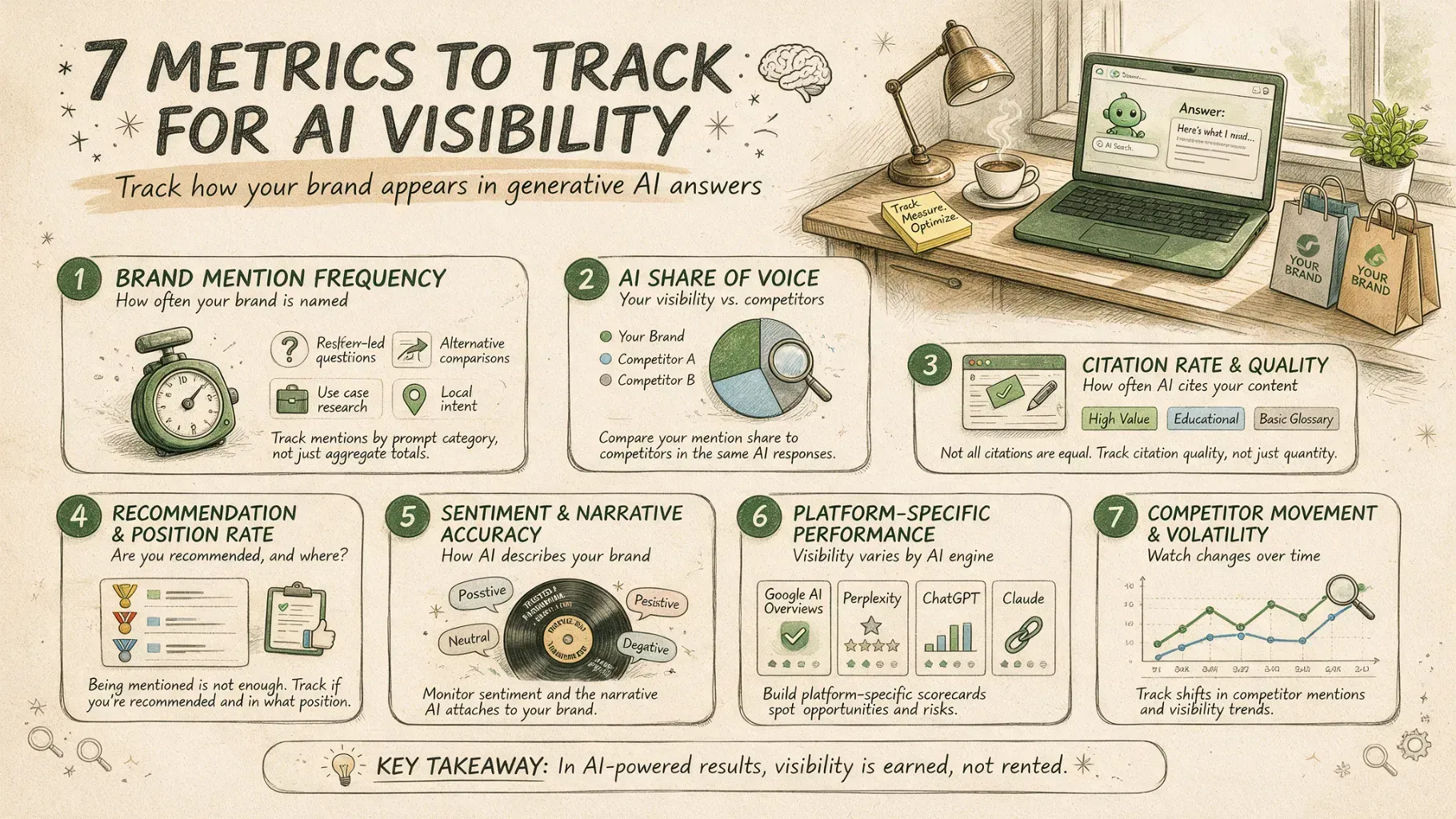
The essential AI visibility metrics to track
1. Brand mention frequency
Brand mention frequency measures how often an AI platform names your company across a defined prompt set. It is the starting point for AI share of voice because a brand cannot influence consideration if it never enters the response.
Track mentions by prompt category, not just as one aggregate total. Category prompts, problem-led questions, alternatives, use cases, local queries and purchase-intent questions all expose a different part of your visibility. For an Australian SaaS brand, “best accounting software for small businesses” and “Xero alternatives for a growing Brisbane agency” may produce entirely different competitive fields.
A rising mention rate is encouraging, but it is not automatically a win. Check whether the mention is a recommendation, a neutral example or a warning. Frequency without context can create false confidence.
2. AI share of voice
AI share of voice compares your mentions with those of competitors in the same tracked responses. If your business appears in 18 of 100 relevant answers while a competitor appears in 46, you have a clear visibility gap even if your own mention count increased month on month.
This metric is most useful when the competitor set is disciplined. Include direct commercial competitors, not every company that happens to appear in a response. A local service business may also need to track directories, marketplaces and publishers that AI engines cite instead of naming providers directly.
Share of voice should be read by topic and platform. A competitor may dominate high-intent comparison queries on Perplexity while you lead educational prompts on Google AI Overviews. That points to a practical allocation decision, not a vague instruction to “make more content”.
3. Citation rate and citation quality
Citation rate measures how often AI responses link or attribute claims to your owned content. It is one of the clearest signals that an engine considers your material useful evidence. For brands investing in GEO, citations show whether their site is participating in the source layer behind generated answers.
But raw citation rate can hide weak outcomes. A citation to an old glossary page may help topical recognition but do little for revenue. A citation to a product comparison page, methodology, original dataset or implementation guide can have much greater commercial value.
Assess citation quality through three lenses: the page being cited, the query that triggered it and the response wording around it. If an engine cites your research but recommends another provider, improve the bridge between proof and proposition. If it cites thin pages for basic definitions, build deeper assets that answer the next buyer question.
Ready to get started?
A one-line nudge that earns the click below.
4. Recommendation and position rate
Being mentioned is not the same as being selected. Recommendation rate measures how often the model actively puts your brand forward when a user asks who they should choose. Position rate adds another layer: where your brand appears within a ranked or ordered answer.
This is particularly valuable for service businesses and crowded software categories. A brand listed fifth in a “best options” answer may technically have visibility, but it is unlikely to capture the same attention as the first two names. Track first-position appearances separately from general inclusion.
Use strict prompt definitions here. “What is [brand]?” is not a recommendation query. “Which platform should a 50-person retailer choose and why?” is. Mixing navigational and commercial prompts will make your performance look better than buyer reality.
5. Sentiment and narrative accuracy
AI sentiment reveals the language models use when describing your company: positive, neutral, negative or mixed. More importantly, it exposes the narrative attached to your name. Are you framed as affordable, premium, complex, innovative, limited, trusted or best suited to a particular customer?
Narrative accuracy matters because generative answers can repeat outdated positioning, incomplete product details or unflattering third-party commentary. A positive mention that calls your enterprise solution “best for sole traders” is still a positioning problem. Likewise, neutral sentiment may be perfectly acceptable for a regulated category where cautious language is appropriate.
Track recurring claims, not merely a positive-to-negative ratio. Repeated factual errors deserve priority because they can affect every later recommendation. Correct them with clear first-party pages, current documentation, expert commentary and credible third-party validation where appropriate.
6. Platform-specific performance
Each answer engine has its own retrieval habits, citation formats and user expectations. Google AI Overviews sits close to conventional search behaviour. Perplexity foregrounds sources. ChatGPT and Claude can vary according to browsing, model version and prompt context. Treating them as one channel masks opportunities and risks.
Create platform scorecards for mention frequency, citations, recommendation rate and sentiment. Then look for patterns. Strong Google visibility paired with weak Perplexity citations may signal that your pages rank but lack the source depth or structure those answers favour. Strong ChatGPT mentions with poor Gemini performance may point to an entity-consistency or coverage issue worth investigating.
Do not chase every platform equally. Weight them by where your audience researches, how close each prompt is to revenue, and where competitors are gaining ground fastest.
7. Competitor movement and visibility volatility
AI visibility is not static. A competitor can publish a well-structured guide, earn a cluster of high-authority citations or become newly relevant to a model’s sources, then appear across prompts that previously belonged to you. Monitoring change matters as much as measuring the current score.
Watch for sudden movement in competitor mention share, top-three recommendation appearances and citations on priority prompt groups. Volatility can be caused by model updates rather than a competitor’s action, so avoid reacting to a single run. Persistent movement across repeated measurements is the signal that deserves a response.
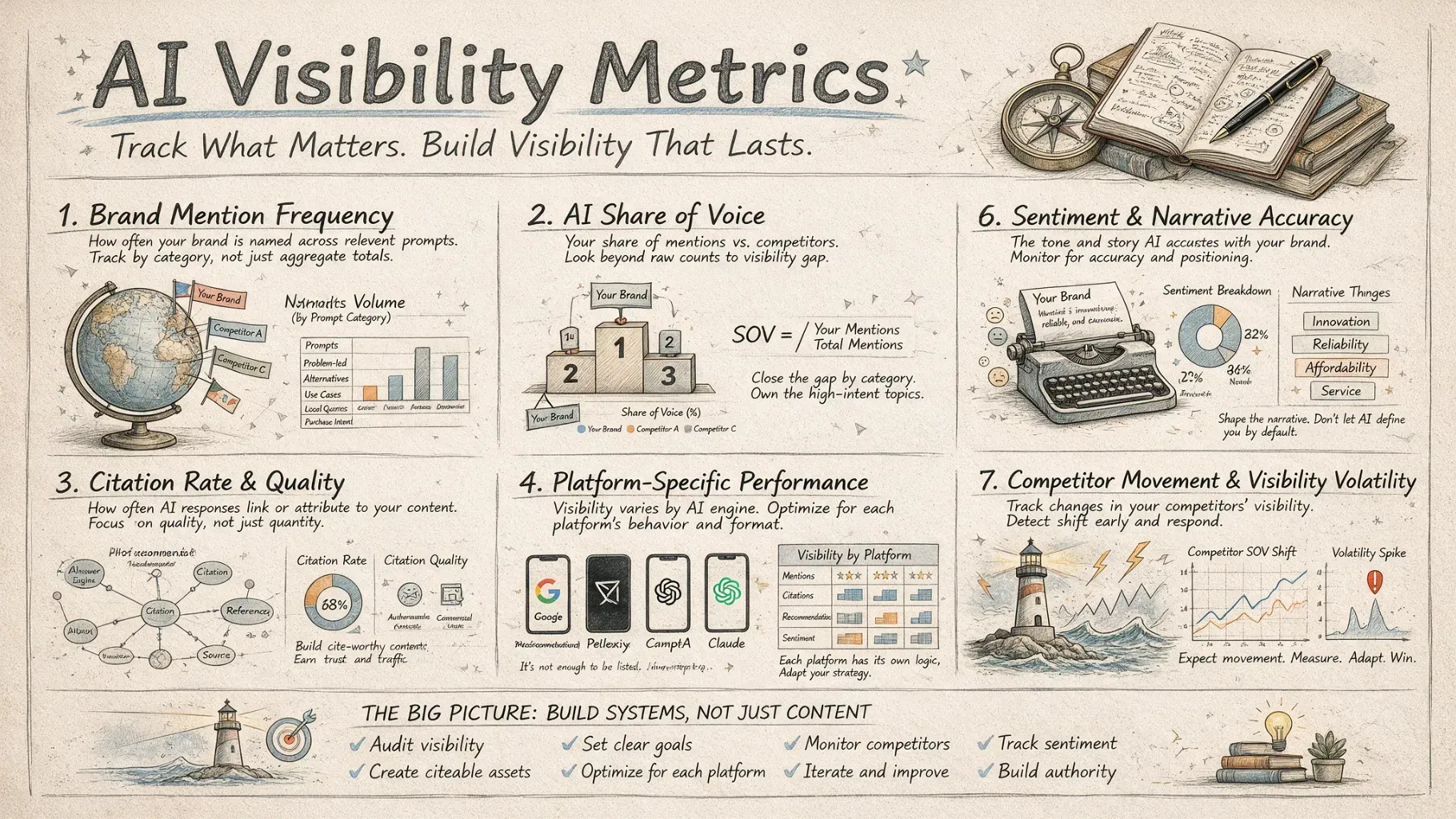
Turn measurement into a GEO operating rhythm
Metrics become commercially useful when every insight creates a next action. Start with a focused prompt library that reflects real buyer language. Include early research, category evaluation, comparison, objections, implementation and local intent. Review it regularly with sales calls, search query data and customer questions so it does not become a static keyword list.
Then prioritise gaps using impact, not volume alone. A missing mention on a high-intent “best alternative” prompt can be more valuable than ten wins on general information queries. Score opportunities by commercial relevance, current visibility gap, competitor strength and the effort required to improve the underlying asset.
The most common GEO actions are usually clear: refresh stale claims, publish evidence-led comparison pages, improve product and service explanations, add original data, clarify entity details, strengthen author expertise and distribute material where credible third parties can reference it. The correct action depends on why visibility is weak. More content is not always the answer; sometimes the existing page needs better facts, clearer structure or stronger proof.
Set a consistent measurement cadence, but resist daily panic. Generative responses fluctuate. Weekly checks can identify major shifts, while monthly reporting is often better for judging direction and deciding what the team should build next. Keep a record of content changes alongside metric movement so you can distinguish correlation from likely impact.
A platform such as aigeo insights can make this operational by tracking brand and competitor performance across answer engines, then translating the gaps into a ranked optimisation roadmap. That matters because dashboards alone do not win visibility. Faster, better decisions do.
Your next buyer may never see the search result you worked hard to rank. They may see one generated answer and act on it. Measure whether your brand is part of that answer, whether it is trusted within it, and what will put you there more often.
Related Posts
- 9 Essential Generative Search Metrics to Track
Track essential generative search metrics to measure AI visibility, citations, sentiment and share of voice, then turn the data into…
Read more about 9 Essential Generative Search Metrics to Track - LLM Monitoring Software for AI Brand Visibility
LLM monitoring software reveals where AI mentions, cites and recommends your brand, so teams can protect share of voice before…
Read more about LLM Monitoring Software for AI Brand Visibility - Generative Search Audit Guide for AI Visibility
Use this generative search audit guide to measure AI visibility, expose competitor gaps, and turn citations, sentiment and share of…
Read more about Generative Search Audit Guide for AI Visibility