
A high-ranking page is no longer the only prize. When a buyer asks an AI assistant for the best software, service provider or product, the answer may contain just a handful of names and sources. Understanding which AI platforms cite websites is now a commercial requirement for brands that want to win visibility where decisions are increasingly made.
The short answer is that Perplexity, Google AI Overviews, Gemini, ChatGPT, Claude and Microsoft Copilot can all surface web sources in some form. The more useful answer is that they do not cite content in the same way, for the same queries or with the same consistency. That difference determines how your team should measure performance and where it should focus its Generative Engine Optimisation efforts.
Which AI platforms cite websites most consistently?
Perplexity is the most citation-forward platform in the mainstream AI search market. Sources are central to its product experience, usually appearing directly beside or beneath claims in a response. Users can open cited pages, inspect the supporting material and continue their research. For publishers and brands, that creates a clearer path from inclusion in an AI answer to referral traffic.
Google AI Overviews also cite websites prominently, typically through linked source cards within or alongside the generated response. The exact layout changes by query, device and market, but Google’s approach is designed to connect an overview back to web results. AI Overviews matter because they sit inside Google Search, where purchase research, local intent and high-volume informational queries already occur.
Gemini can provide web-grounded answers and source links, particularly when it draws on Google Search. Citation behaviour varies by mode, query type and product surface. A Gemini answer may show a set of sources, cite individual statements or produce an answer with limited visible attribution. Treat it as an important visibility channel, but do not assume every mention will include a clickable citation.
ChatGPT can cite websites when search is used. Its answers may include inline citations that connect specific claims to supporting pages, followed by a source list. This is a major shift from the earlier chatbot model, where responses were largely generated from model knowledge without a visible source trail. Search-enabled ChatGPT is now a live discovery environment for comparison, recommendation and research queries.
Claude can search the web and present citations in supported experiences. Its source use is often strongest when users ask for research, current information or verification. As with ChatGPT, the answer can depend on whether web search is available and activated for the user’s plan, location and prompt.
Microsoft Copilot also cites web sources, commonly drawing on Bing-powered search results. It remains relevant for brands with audiences that use Windows, Edge and Microsoft’s broader ecosystem. Its visibility patterns can overlap with traditional Bing performance, but AI-generated recommendations introduce a separate layer of competition.
A platform citation is not the same as a brand mention
This distinction is where many teams lose the plot. An AI platform may mention your brand without linking to your website. It may cite your website while recommending a competitor. Or it may rely on a third-party review, news article, directory or industry publication to describe your business.
All three outcomes matter. A direct citation can send referral traffic and validates your domain as a source. A brand mention builds awareness within the answer itself. Third-party citations can be decisive for reputation, especially in categories where buyers ask for the “best”, “most reliable” or “top-rated” option.
That is why traditional rank tracking cannot explain AI visibility. Ranking position tells you where a page sits in a list of links. Generative search requires you to track whether you are named, how often you appear, which domains are cited, what sentiment surrounds the mention and which competitors own the answer.
Why citation behaviour changes by query
No platform has a fixed list of preferred websites. Citation selection is dynamic. The same platform can cite different domains for a broad educational question, a local commercial search and a product comparison.
For factual questions, AI systems often favour pages with direct, verifiable information: official documentation, government resources, recognised publications and credible first-party sources. For recommendations, they may blend vendor websites with independent reviews, listicles, editorial coverage, community discussions and marketplaces.
Freshness also changes the equation. A current pricing question, regulatory update or software feature comparison creates a stronger need for recent web retrieval. An evergreen definition may be answered with fewer visible sources, or from established model knowledge. Your content strategy needs to account for both conditions.
The hard truth is that technical quality alone will not guarantee a citation. A well-structured page can still lose if it lacks authority, does not answer the question directly, is outdated or is absent from the third-party sources the model trusts for recommendations.
What content earns citations from AI platforms?
AI systems need extractable evidence. Pages that bury the useful answer under vague marketing copy force the model to look elsewhere. The brands that earn more citations make claims easy to identify, validate and reuse.
Start with pages that answer high-intent questions clearly. Product and service pages should explain who the offer is for, what it does, key limitations, pricing approach, differentiators and supporting proof. Comparison pages should be fair and specific. Resource content should state the answer early, then substantiate it with detail rather than making readers hunt for it.
Structure matters because retrieval systems parse pages, not brand intentions. Descriptive headings, concise definitions, tables where genuine comparisons are needed, original research, clear authorship and regularly reviewed facts all improve the odds that a page can support an AI-generated claim.
Off-site evidence matters just as much. If AI answers repeatedly cite review sites, industry publications or partner content in your category, your GEO plan must include those domains. You are not only competing for a citation from your own website. You are competing to be represented accurately across the source ecosystem that informs the answer.
Build a measurement system, not a one-off audit
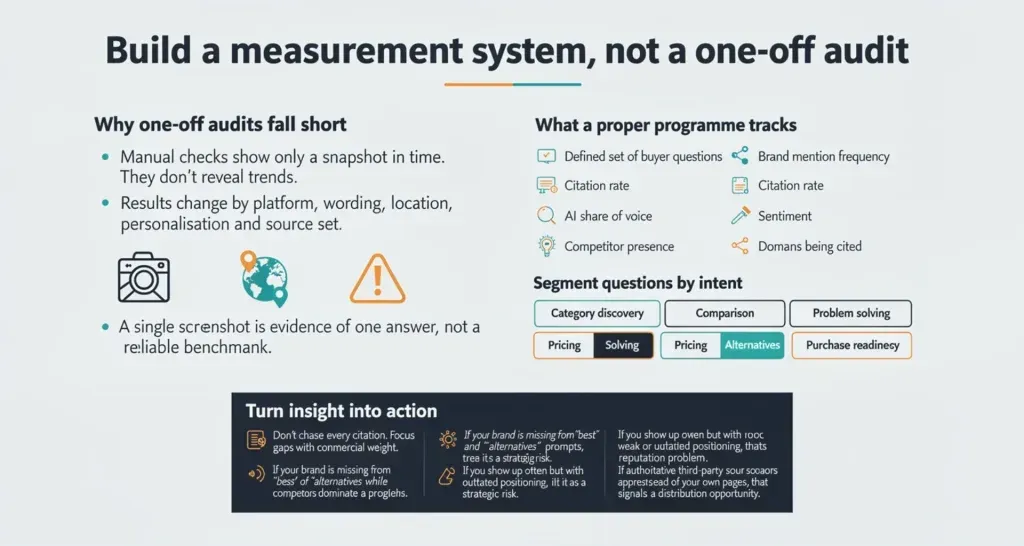
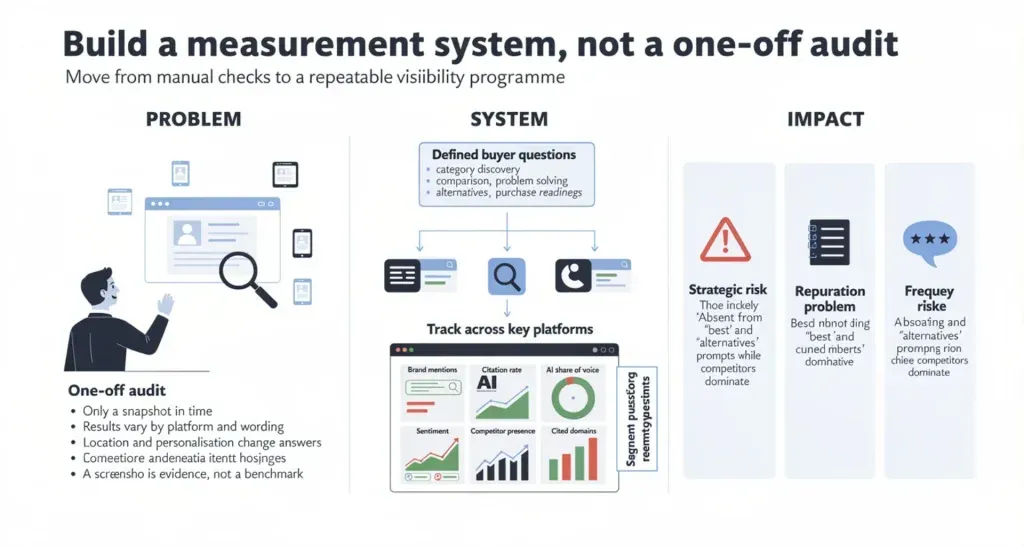
Checking a few prompts manually is useful for spotting opportunities, but it cannot show whether visibility is improving or collapsing over time. Results vary by platform, wording, location, personalisation and the source set available at that moment. A screenshot is evidence of one answer, not a reliable benchmark.
A proper programme tracks a defined set of buyer questions across the platforms that matter to your market. Measure brand mention frequency, citation rate, AI share of voice, sentiment, competitor presence and the specific domains being cited. Segment questions by intent: category discovery, comparison, problem solving, pricing, alternatives and purchase readiness.
The goal is not to chase every citation. It is to identify the gaps with commercial weight. If your brand is absent from “best” and “alternatives” prompts while a competitor dominates, that is a strategic risk. If you appear often but are described with weak or outdated positioning, that is a reputation problem. If authoritative third-party sources are cited instead of your own pages, there is a distribution opportunity.
Platforms such as aigeo insights turn these signals into an optimisation roadmap, so teams can prioritise the pages, proof points and external placements most likely to improve AI visibility rather than working from guesswork.
Ready to get started?
A one-line nudge that earns the click below.
The trade-off: optimise for answers without sacrificing users
Content built solely to be quoted can become thin, repetitive and unhelpful. That is not a winning strategy. The same qualities that make a page useful to an AI system should make it more useful to a prospective customer: direct answers, credible evidence, transparent comparisons and a clear next step.
Avoid manufacturing authority with unsupported claims or publishing dozens of near-identical pages for slight keyword variations. AI platforms are improving at assessing source quality, and audiences can spot empty content immediately. Build assets that deserve to be cited, then make them easy to retrieve.
The battle for the answer has begun. The brands that measure where citations come from, understand how each platform constructs trust and act on the gaps will be the brands customers see first when AI makes the recommendation.
Related Posts
- Citation Tracking Platforms for AI Search
Citation tracking platforms show where AI engines source, mention and recommend your brand, then turn lost visibility into a clear…
Read more about Citation Tracking Platforms for AI Search - 7 Best Content Formats for Chatbots That Get Cited
Learn which best content formats for chatbots earn AI citations, shape recommendations and help your brand win visibility across generative…
Read more about 7 Best Content Formats for Chatbots That Get Cited - Ecommerce Answer Visibility Is Now a Revenue Metric
Ecommerce answer visibility shows whether AI tools recommend your products. Learn what to measure, where competitors win, and how to…
Read more about Ecommerce Answer Visibility Is Now a Revenue Metric