
When a buyer asks ChatGPT which payroll platform suits a growing business, or asks Google which cybersecurity provider is credible, there is no page-one safety net. Your brand is recommended, cited, briefly mentioned, or absent. AI response optimisation is the discipline of influencing that outcome – with evidence, structure and a clear view of what generative platforms already say about you.
For growth teams, this is not a distant search trend. It is a visibility problem with commercial consequences. Traditional rankings still matter, but they no longer tell the full story. A brand can hold strong organic positions and still lose the recommendation inside ChatGPT, Gemini, Claude, Perplexity or Google AI Overviews.
The battle for the answer has begun. Brands that measure their presence and act on the gaps can build an advantage while competitors are still treating AI visibility as an experiment.
What AI response optimisation actually means
AI response optimisation is the process of improving how generative AI systems understand, describe, cite and recommend a brand. It sits within Generative Engine Optimisation, or GEO, but its focus is specific: the quality and frequency of responses where your company appears.
The objective is not to force an AI model to repeat brand messaging. That approach is unrealistic and short-lived. The objective is to make your expertise, products and proof easier for AI systems to find, interpret and use when answering high-intent questions.
That means looking beyond a single keyword. A potential customer may ask, “What is the best fleet management software for small businesses?”, “Which agencies specialise in B2B demand generation?” or “How do I compare employee engagement platforms?” Every prompt creates a new competitive set, a new answer format and a new chance to be excluded.
Strong optimisation connects the questions your market asks with the information your brand publishes and the third-party sources that validate it. It turns AI visibility from a vague reputation issue into an operating metric.
Why search rankings are no longer enough
SEO was built around a familiar model: a user searches, reviews a list of results and chooses where to click. Generative search compresses that journey. The platform evaluates sources, synthesises an answer and often presents only a handful of brands.
That compression creates three commercial risks. First, fewer visible choices mean recommendation concentration. If an AI response names two vendors and your competitor is one of them, that competitor has gained valuable consideration before the buyer has visited a website.
Second, the answer can shape perception even when it does not generate a click. A model may characterise your business as premium, local, enterprise-focused, limited, emerging or hard to compare. If that description is inaccurate or incomplete, it can influence buyer intent at the earliest stage.
Third, visibility changes by platform. A company may be frequently cited in Perplexity because it publishes useful research, yet barely mentioned in ChatGPT for comparison queries. Google AI Overviews may favour a different mix of pages, publishers and structured information. Treating AI search as one channel hides these gaps.
The practical implication is simple: track answer-level performance, not just website traffic and rankings.
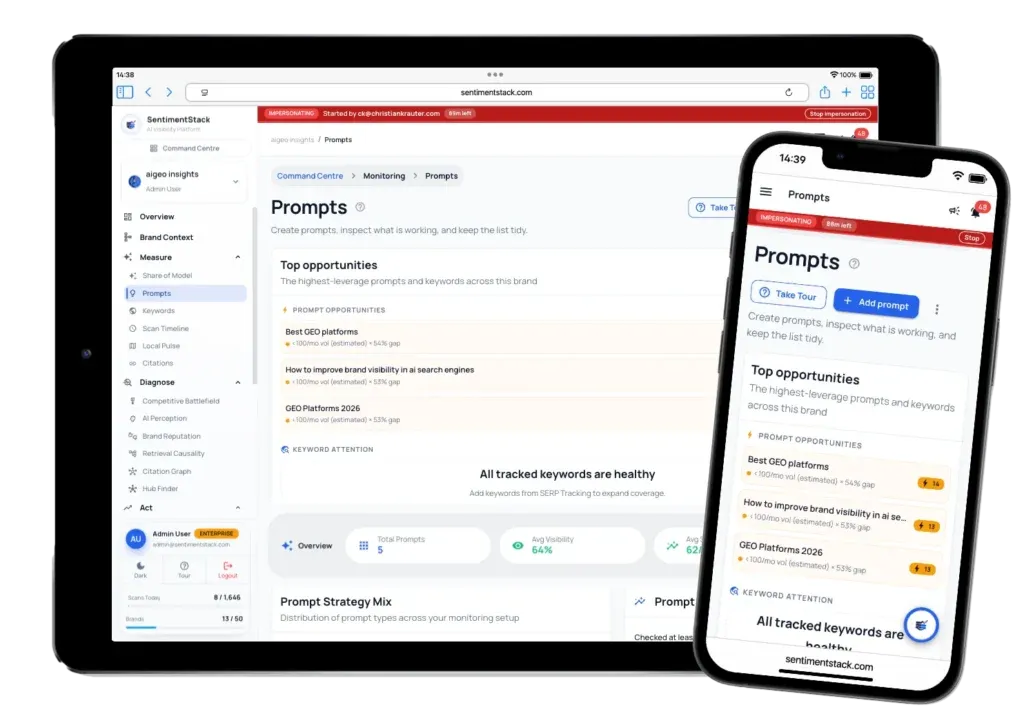
The metrics that reveal whether your brand is winning
AI response optimisation needs a measurement system that reflects how people actually encounter brands in generated answers. Vanity checks such as asking one prompt in one tool are not enough. AI outputs vary by wording, location, platform and time.
Start with brand mention frequency. This shows how often your company appears across a defined set of commercially relevant prompts. A high mention rate indicates visibility, but it does not automatically mean the brand is being positioned well.
Then measure citation rate. When a platform cites your website or an asset you control, it signals that your material is being used as evidence. This is especially valuable because citations can reveal which pages, guides, research and product information are carrying authority.
AI share of voice adds the competitive layer. It compares your presence with competitors across the same prompt set. This matters because an increase in your own mentions may still leave you behind the brands buyers see most often.
Sentiment and answer framing complete the picture. Is the brand described as trustworthy? Is it recommended for the right use case? Does the response surface a weakness that your content does not address? Numbers tell you where the gap is; response language explains what to fix.
A capable tracker should also segment results by platform, category, prompt intent and competitor. Without that detail, teams can mistake broad visibility for genuine category leadership.
How to build an AI response optimisation programme
The strongest programmes are not built on a one-off content sprint. They follow a repeatable loop: establish a benchmark, identify response gaps, improve the evidence available to AI systems, and measure whether the work changed the answer.
Map prompts to buying decisions
Begin with the questions that move prospects towards a shortlist, not only the phrases that bring traffic. Include category questions, alternatives, comparisons, pricing concerns, implementation questions, local or industry-specific needs and problem-led queries.
For example, a HR software company should not only track “HR software”. It should monitor prompts around compliance, onboarding, payroll integrations, distributed teams, costs and the types of businesses it serves best. These prompts expose where AI platforms are assigning category authority.
Group prompts by funnel stage and commercial value. An informational query may support awareness, while a “best alternative to” prompt can directly affect pipeline. Prioritisation matters when resources are limited.
Find the reason competitors appear
Do not respond to a visibility loss by publishing more generic articles. Inspect the answers and competitor sources first. Are competitors winning because they have clearer product pages, independent reviews, original data, stronger comparison content or more specific use-case guidance?
Often, the missing piece is not volume. It is evidence. AI systems tend to favour material that directly answers a question and is supported by clear claims, named methodology, current statistics, expert commentary or credible third-party corroboration.
If competitors are repeatedly recommended for a capability you also provide, check whether your own site states that capability plainly. Marketing language that sounds polished but avoids specifics is difficult for both buyers and AI systems to interpret.
Create assets built to answer
Content should earn its place in an AI response by being useful on its own. Publish clear solution pages, category explainers, comparison resources, implementation guidance, FAQs where they answer real objections, and original research that others can reference.
Structure matters. Give pages descriptive headings, concise definitions, direct answers near the top and supporting detail below. Explain who a solution is for, where it is not the best fit, what it integrates with, how pricing works and what proof supports the claim.
There is a trade-off here. Over-simplified content may be easy to extract but too thin to build trust. Dense content may contain valuable expertise but bury the answer. The best assets provide a clear response first, then substantiate it with depth.
Strengthen external validation
Your website is only part of the information environment. AI systems can draw from editorial coverage, specialist publications, review platforms, partner pages, directories, community discussions and other public sources.
That does not mean chasing mentions everywhere. Focus on credible, relevant places where customers and industry observers would reasonably verify your expertise. Consistent company details, accurate product descriptions and demonstrated authority reduce the chance that outdated or contradictory information becomes the version of your brand that an AI repeats.
Measure, learn and act quickly
Once changes are live, monitor the same prompt set over time. Look for shifts in mention frequency, citations, share of voice, sentiment and competitor movement. A citation gain is useful, but the bigger question is whether the brand has become part of the recommendation set for valuable queries.
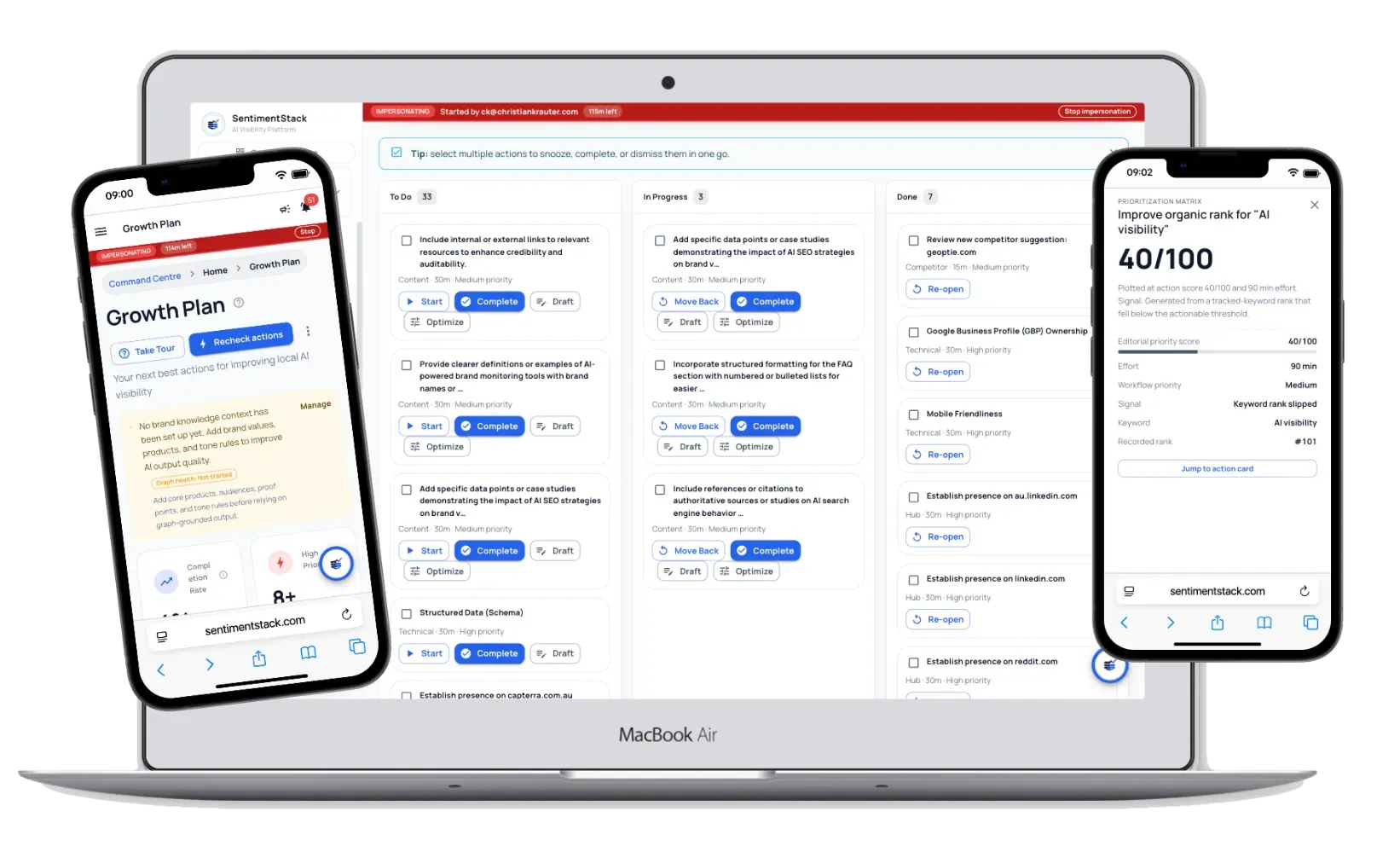
This is where a platform such as Sentimentstack from aigeo insights changes the operating model. Instead of asking teams to manually test scattered prompts, it can connect visibility signals to a prioritised optimisation roadmap: what to create, update, structure or distribute next.
Common mistakes that hold brands back
The first mistake is treating generated answers as static. Models, source selections and answer formats change. A quarterly spot check cannot protect your position in a fast-moving category.
The second is optimising only owned content. If inaccurate third-party information dominates the conversation around your brand, publishing another blog post may not solve the issue.
The third is chasing every prompt equally. High-volume generic questions can look attractive, but a smaller set of decision-stage prompts may carry far more revenue potential. Optimisation should follow commercial intent, not curiosity.
Finally, do not confuse being mentioned with being chosen. A brand can appear in an answer as an alternative, a caution or a niche option. The wording matters as much as the count.
Make every AI answer a competitive signal
AI response optimisation is not about gaming a model. It is about making sure the market can accurately find, understand and validate the value your business delivers. That requires better content, stronger proof, competitive intelligence and a measurement cadence that matches the speed of AI search.
Every answer where your competitor is named and you are not is a signal. Read it, identify the evidence gap, and turn that signal into the next move.
Related Posts
- AI Citations: How Brands Win the Answer Economy
AI citations determine which brands appear in generative answers. Learn what earns them, how to measure performance, and where to…
Read more about AI Citations: How Brands Win the Answer Economy - The Future of Answer Engine Optimisation
See where the future of answer engine optimisation is heading, and how brands can measure citations, sentiment and AI share…
Read more about The Future of Answer Engine Optimisation - Ecommerce Answer Visibility Is Now a Revenue Metric
Ecommerce answer visibility shows whether AI tools recommend your products. Learn what to measure, where competitors win, and how to…
Read more about Ecommerce Answer Visibility Is Now a Revenue Metric