





A prospect asks ChatGPT which provider to choose. Gemini recommends three competitors. Perplexity cites an old third-party review that misrepresents your offer. This is not a future search problem. It is a visibility problem happening every day. Knowing how to audit AI mentions gives your team the evidence to defend brand demand, spot competitive losses and improve the sources AI systems rely on.
Traditional rankings cannot answer the question that now matters most: when an AI engine generates the answer, does your brand make the cut? An AI mention audit turns that uncertainty into a measurable operating system.
How to audit AI mentions across answer engines
An AI mention audit is a structured review of how generative platforms describe, cite and recommend your brand for the prompts that influence buying decisions. It should cover more than whether your name appears. A brand can be mentioned without being recommended, cited without being described accurately, or included in a list where every competitor receives stronger positioning.
Start with the engines your customers are most likely to use. For most Australian businesses with broader English-language demand, that means ChatGPT, Claude, Gemini, Perplexity and Google AI Overviews. Each has different retrieval behaviour, source preferences and response formats. A strong result in one does not guarantee visibility in another.
The goal is not to run a few branded questions and celebrate a passing mention. The goal is to establish a repeatable benchmark for your AI share of voice, citation rate, sentiment and competitive position.
Build a prompt set around commercial intent
Your audit is only as useful as the prompts behind it. Begin with the questions people ask before they buy, compare, shortlist or seek reassurance. Avoid an audit built entirely on your brand name. Branded prompts tell you whether AI knows you exist. Non-branded prompts reveal whether AI introduces you to new buyers.
Organise prompts into practical intent groups: category discovery, problem-solving, product comparison, use cases, location or market relevance, pricing and implementation concerns. A B2B software company might test prompts such as which platform is best for tracking AI search visibility, how to measure brand mentions in ChatGPT, or alternatives to a known competitor. A local service business would add geography and trust signals, such as the best provider for a specific city or service need.
Use the language customers actually use. Sales calls, support tickets, internal site search and paid-search queries are better starting points than jargon-heavy keyword lists. Include a mix of broad and specific prompts because broad category questions shape awareness while detailed questions often decide the shortlist.
Keep the initial set manageable but representative. Around 30 to 50 high-value prompts is enough to expose meaningful patterns for many teams. Larger brands, agencies and multi-product businesses may need separate prompt clusters by audience, product line and market.
Capture more than a yes-or-no mention
Generative answers vary by session, model version and context. That is why a one-off manual check is a snapshot, not an audit. Test prompts consistently, record the full answer and repeat the process over time. Where a platform supports citations, capture every cited domain alongside the response.
For each result, classify the outcome. The core fields should include:
- Whether your brand is mentioned and where it appears in the response
- Whether the mention is a recommendation, a neutral reference or a warning
- Whether your brand is cited directly or supported by credible third-party sources
- Which competitors appear, how often they appear and how they are positioned
- Whether the answer contains inaccurate claims, missing context or outdated information
Placement matters. Being named first in a tightly curated recommendation is materially different from appearing ninth in a long list. So is being described as a category leader rather than a basic option. Score the quality of the mention, not just its existence.
Sentiment deserves the same discipline. AI responses can sound polite while quietly weakening your position through qualifiers such as best for small teams only, limited reporting, or less suitable for complex requirements. Those details influence buyer perception. Record the exact language and identify whether the issue is a genuine product limitation, a positioning gap or an information error that needs correcting.
Measure the metrics that expose the real gap
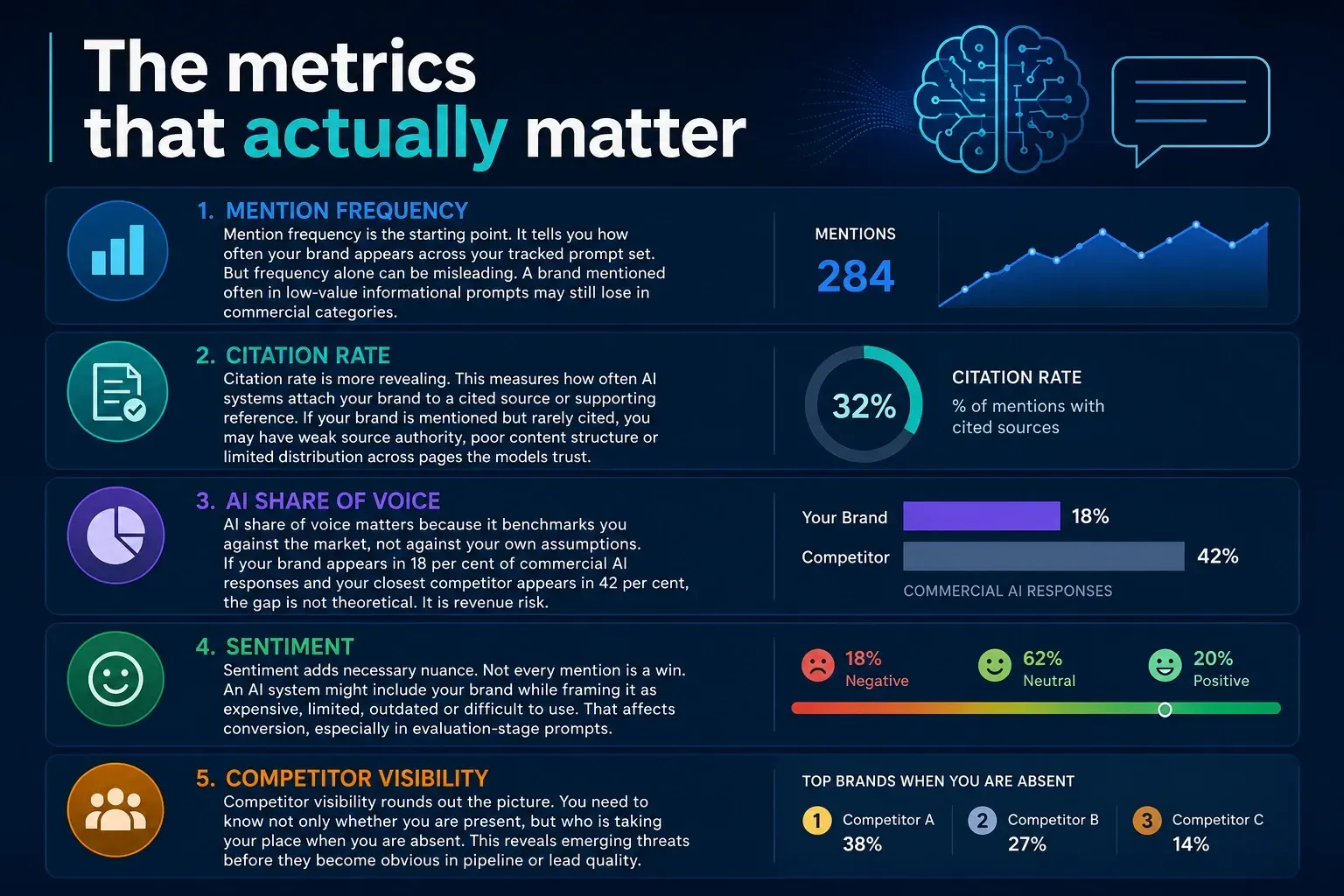
The audit should produce a baseline your growth team can use, not a spreadsheet that gathers dust. Four metrics create a clear starting point.
Mention frequency measures the percentage of tracked prompts where your brand appears. This is the basic visibility signal, but it is not the finish line.
AI share of voice compares your mention frequency with competitors across the same prompt set. If you appear in 25 per cent of category prompts while a competitor appears in 60 per cent, the gap is clear even if you rank well in conventional search.
Citation rate measures how often AI engines cite your own content or authoritative pages that support your brand. Citations matter because they show which information sources are contributing to answers. A high mention rate with no cited presence can be fragile.
Sentiment and recommendation strength reveal whether visibility is producing preference. Track positive, neutral and negative framing, then assess whether AI presents you as a leading choice, a viable alternative or an afterthought.
Review performance by platform and prompt group rather than relying on one blended average. Perplexity may consistently cite your research while ChatGPT omits you from comparisons. Gemini may surface a competitor’s product pages for use-case queries. The remedy depends on the engine and the query, so the reporting needs that level of detail.
Find out why competitors are winning the answer
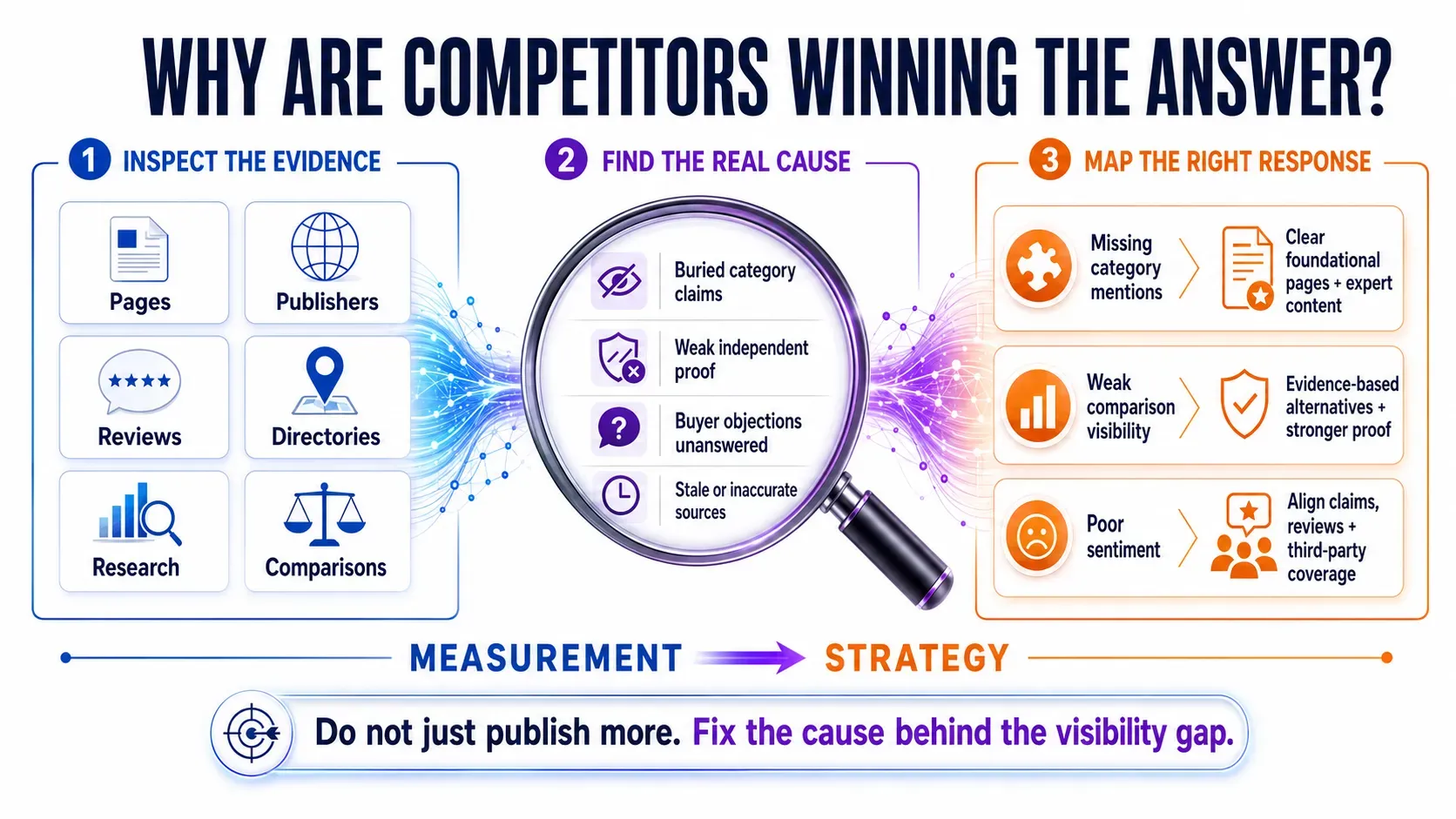
Once the numbers are visible, inspect the evidence behind the leading competitors. Which pages, publishers, reviews, directories, research reports and comparison articles are cited? What claims do those sources repeat? This is where an audit shifts from measurement to strategy.
Do not assume the answer is simply to publish more content. Sometimes competitors win because their website states a category claim clearly and yours buries it. Sometimes they have stronger independent validation. Sometimes their comparison pages answer buyer objections directly, while your content stops at product features. In other cases, AI is relying on stale or inaccurate sources that require a reputation and distribution response rather than a new blog post.
Map each visibility gap to its likely cause. Missing category mentions may call for clearer foundational pages and expert-led educational content. Weak comparison visibility may require fair, evidence-based alternative pages, updated positioning and proof points. Poor sentiment may require fixing contradictory claims across product pages, review profiles and third-party coverage.
Prioritise opportunities by commercial value, current gap and feasibility. A prompt with modest volume but strong purchase intent can deserve more attention than a broad informational question. Equally, a highly competitive category prompt may take sustained work across content, authority and distribution. The best roadmap balances quick corrections with strategic assets that build lasting citation potential.
Turn the audit into a GEO action plan
An audit only creates value when it changes what the team does next. Assign every opportunity a clear action: create, update, restructure, validate or distribute. Then give it an owner, deadline and expected metric movement.
For example, if AI engines mention your brand but describe its offering incorrectly, update the core product and category pages with direct definitions, use cases, limitations and differentiators. If citations favour competitor comparison pages, create a genuinely useful comparison resource built around decision criteria rather than empty claims. If authoritative third-party sources repeatedly drive recommendations, invest in evidence that reputable publishers and industry voices can reference.
Structure is part of the job. Clear headings, specific answers, consistent entity information, named authors with relevant expertise and verifiable claims make it easier for people and systems to understand what your content says. But structured content alone will not overcome weak positioning or a lack of credible proof. GEO is not a technical trick. It is the disciplined work of making your brand the most useful, trustworthy answer.
Platforms such as sentimentstack designed by aigeo insights can reduce the manual workload by tracking mentions, citations, sentiment, competitors and platform-level movement, then translating changes into prioritised optimisation tasks. Whether you use a platform or a manual process, the operating principle is the same: data must lead to a decision.

Re-audit before visibility losses become demand losses
AI search changes quickly. Models update, sources enter and leave retrieval systems, competitors publish new assets and the prompts people use evolve with the market. A quarterly audit is a sensible minimum for stable categories. Fast-moving industries, active campaigns and high-value B2B categories should monitor monthly or more often.
Keep a record of material answer changes, not just dashboard scores. When your share of voice moves, the explanation matters. Did a competitor gain citations from a new review? Did your updated page improve recommendation language? Did an engine change how it handles comparison prompts? These observations sharpen future investment decisions.
The battle for the answer has begun. Brands that audit AI mentions consistently can see where they are absent, misrepresented or outperformed before that invisibility reaches pipeline and revenue. Start with the questions buyers already ask, measure the answers they receive, then give AI systems better reasons to put your brand in the response.
Related Posts
- How to Track Brand Mentions in AI Search
Learn how to track brand mentions in AI search, measure AI share of voice, citations, sentiment and competitor visibility across…
Read more - AI Visibility Reporting for Agencies That Wins
AI visibility reporting for agencies turns ChatGPT, Gemini and AI Overview mentions into client-ready proof, priorities and a plan to…
Read more - How to Increase AI Citations and Win AI Search
Learn how to increase AI citations with content, entity signals and measurement that put your brand in more AI-generated answers…
Read more