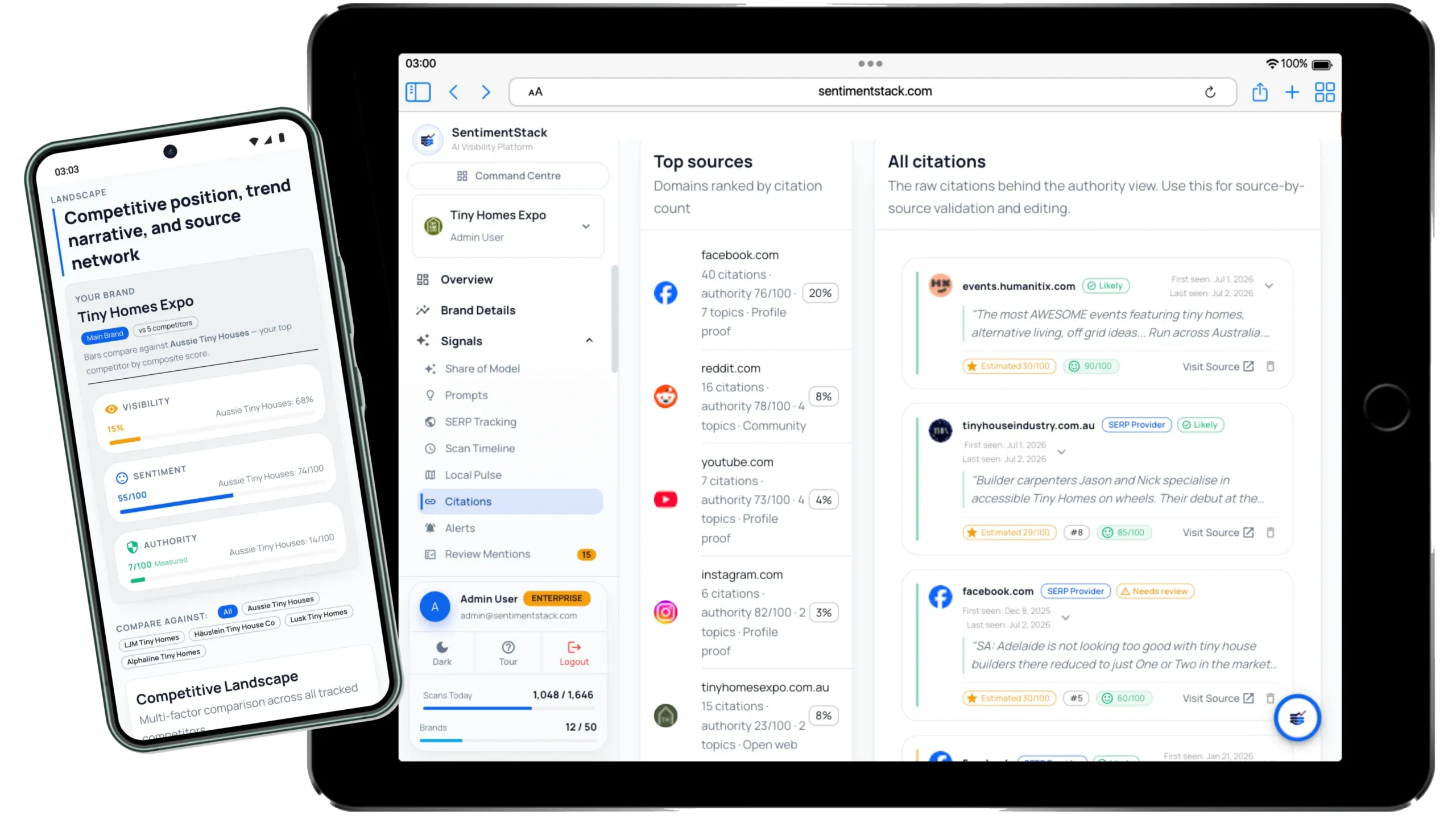
The old search playbook breaks the moment an AI model answers the question before anyone clicks a result. That is why AI share of voice tracking has moved from a nice-to-have metric to a board-level visibility signal. If your brand is absent, misrepresented, or consistently out-cited by competitors in AI-generated answers, you are not just losing traffic. You are losing the recommendation itself.
For marketers, agencies, and growth teams, this changes what visibility means. Rankings still matter, but they are no longer the full story. Buyers now ask ChatGPT, Gemini, Claude, Perplexity, and Google AI Overviews for product comparisons, shortlist recommendations, definitions, suppliers, and strategic advice. The brands that appear inside those answers gain authority before a user even sees a traditional search result.
What AI share of voice tracking actually measures
At its core, AI share of voice tracking measures how often your brand appears across AI-generated responses compared with competitors. But the useful version goes further than simple mention counts.
A serious tracking system looks at mention frequency, citation rate, sentiment, competitor visibility, prompt-level performance, and platform-specific differences. That matters because an AI mention without a citation is not the same as a cited recommendation, and a favourable answer on ChatGPT does not guarantee similar performance on Google AI Overviews.
This is where plenty of teams get it wrong. They assume a few anecdotal prompts tell them how visible they are. They do not. AI outputs vary by query type, model, location, intent, and source confidence. One strong brand mention in a sales demo is not a strategy. You need enough prompt coverage and enough competitive benchmarking to see the pattern.
Why AI share of voice tracking matters now
The battle for the answer has begun, and it is moving faster than most reporting stacks can handle. Traditional SEO tools were built for rankings, backlinks, and on-page signals. They were not built to tell you whether an AI system names your business when a buyer asks for the best software in your category.
That gap creates commercial risk. If a competitor becomes the default recommendation in AI answers, they start shaping buyer preference upstream. By the time a prospect reaches your site, the shortlist may already be set.
There is also a reputation layer to this. AI systems do not just mention brands. They frame them. They summarise product strengths, weaknesses, pricing, use cases, and market positioning. If that framing is inaccurate, outdated, or weaker than a competitor narrative, it can quietly erode conversion before your team sees the impact in pipeline reports.
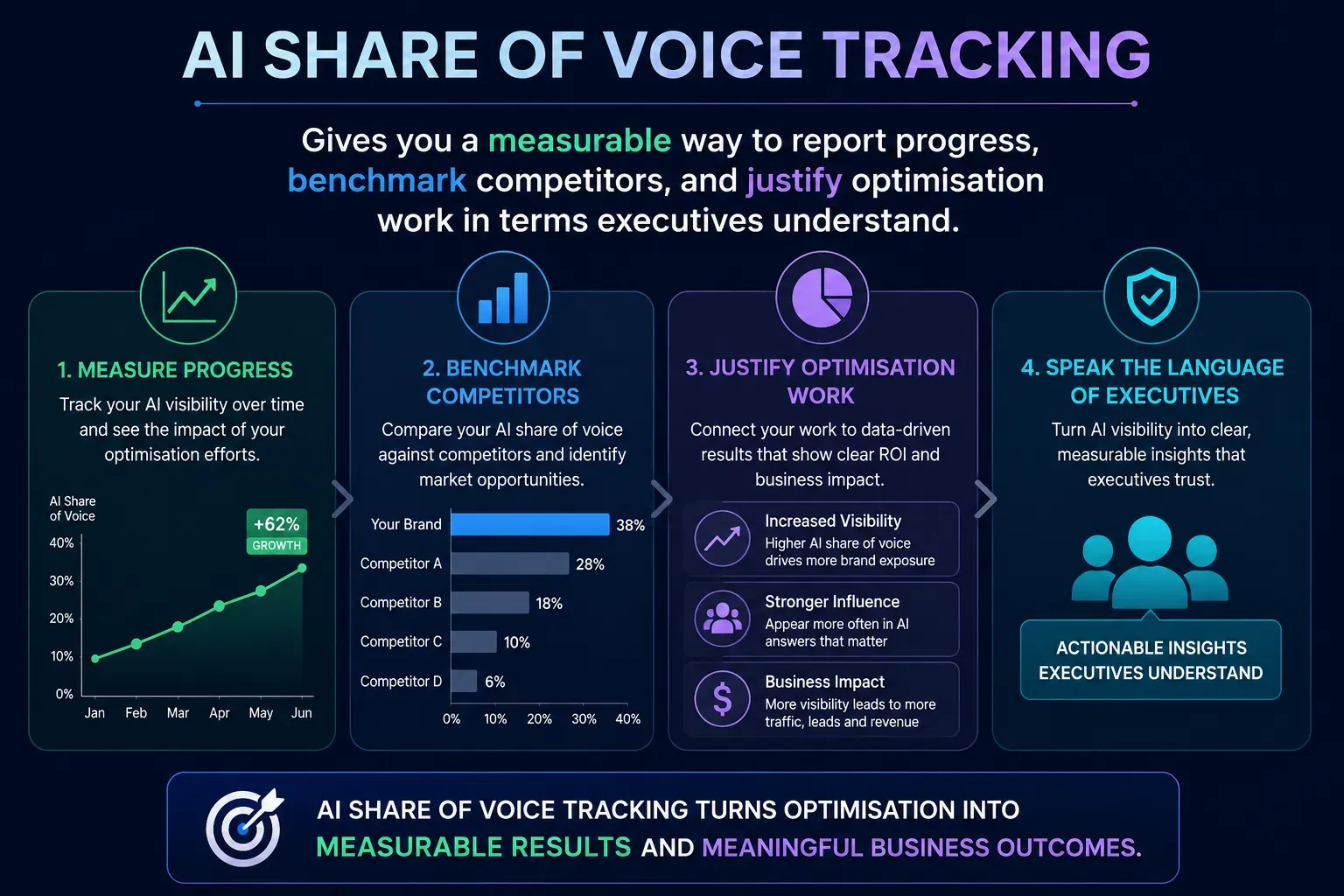
For agencies, the opportunity is just as clear. Clients increasingly want proof that their brand is visible in AI environments, not just organic search. AI share of voice tracking gives you a measurable way to report progress, benchmark competitors, and justify optimisation work in terms executives understand.
The metrics behind useful AI share of voice tracking
Not every dashboard deserves attention. The best AI visibility measurement ties raw observations to action.
Mention frequency tells you how often your brand appears. Citation rate shows whether AI systems are backing those mentions with identifiable sources. Sentiment indicates whether the framing is positive, neutral, or negative. Competitor overlap reveals who is consistently showing up in the same commercial prompts. Platform variance helps you spot whether your brand is strong on one model and weak on another.
Then there is prompt segmentation, which is where the real strategy starts. Branded prompts, comparison prompts, category prompts, problem-solution prompts, and local-intent prompts all behave differently. A strong result on your own brand name is expected. A strong result on non-branded category prompts is where market share is won.
The trade-off is that more granular tracking demands more discipline. You need clear prompt sets, a consistent scoring method, and enough history to identify shifts over time. Without that, teams end up reacting to noise.
What strong AI share of voice tracking should help you do
The point is not to collect more visibility data. The point is to make better commercial decisions.
If your brand is underrepresented in category-level AI answers, you need to know which content gaps are contributing to that problem. If competitors are cited more often, you need to know which assets, pages, third-party mentions, or structured signals are helping them win those citations. If sentiment slips on one platform, you need a fast way to identify whether the issue is weak messaging, poor source coverage, stale content, or negative third-party context.
This is why passive analytics are no longer enough. Good AI share of voice tracking should point directly to the next move. That might mean updating comparison pages, publishing clearer product explainers, strengthening entity consistency, improving digital PR distribution, or refreshing high-authority content that AI models are likely to reference.
A platform like aigeo insights approaches this properly by turning visibility data into an optimisation roadmap. That matters because most teams do not need another graph. They need clarity on what to fix first.
Common mistakes teams make with AI visibility
The first mistake is treating AI visibility as an extension of rank tracking. There is overlap, but the mechanics are different. AI systems synthesise from multiple sources, and they reward clarity, consistency, authority, and citation-worthy content in ways that do not map neatly to a single SERP position.
The second mistake is measuring only one platform. ChatGPT, Claude, Gemini, Perplexity, and Google AI Overviews do not behave identically. If your reporting ignores platform differences, you can miss both risk and upside.
The third mistake is chasing mentions without considering quality. A weak mention, an inaccurate description, or a neutral inclusion in a long list is not the same as being recommended as the best fit. Share of voice without context can create false confidence.
The fourth mistake is failing to benchmark competitors consistently. AI visibility is relative. Your brand can gain mentions and still lose market position if a rival grows faster in the prompts that matter most.
How to use AI share of voice tracking to improve performance
Start with the commercial prompts that influence buying decisions. Think category searches, product comparisons, use-case queries, and problem-led questions your prospects ask before they are ready to convert. Track those prompts across the major AI platforms, then measure your brand against the competitors buyers are actually considering.
Next, look beyond mention counts. Where are you being cited? What content types keep appearing in source patterns? Which competitor pages or third-party references are repeatedly shaping AI answers? This tells you where authority is being built and where your current footprint is too weak.
From there, prioritise action by impact. If your brand is invisible in high-intent comparison prompts, comparison content should move up the queue. If AI platforms mention you but fail to cite your site, your content may need stronger structure, clearer claims, tighter topical focus, or wider distribution. If sentiment is mixed, align product messaging and public-facing content before scaling visibility efforts.
This is where GEO becomes operational rather than theoretical. You are not trying to game a model. You are building the clearest, most credible, most referenceable version of your brand across the web so AI systems can represent you accurately and confidently.
AI share of voice tracking is becoming a core growth metric
Search teams used to ask, where do we rank? The sharper question now is, are we the answer? That shift changes reporting, budget allocation, content planning, and competitive strategy.
For some brands, the immediate goal will be defensive – protecting existing visibility as AI interfaces absorb more discovery behaviour. For others, it is an offensive play – using AI environments to outrun larger competitors with better structured content, stronger positioning, and faster optimisation cycles. Both are valid. It depends on market maturity, category competition, and how quickly buyers in your sector are adopting AI-assisted discovery.
What is no longer credible is ignoring the channel. If customers are asking AI systems who to trust, who to buy from, and which product to choose, then AI share of voice tracking belongs alongside your core search and brand metrics.
The brands that win this shift will not be the ones with the prettiest dashboards. They will be the ones that measure visibility where decisions are now being shaped, act on the data quickly, and keep earning the right to be cited. That is how you move from being searchable to being chosen.

Related Posts
- AI Citation Tracking Software That Wins Answers
AI citation tracking software shows where your brand appears in AI answers, which competitors are cited, and what to improve…
Read more about AI Citation Tracking Software That Wins Answers - Competitor Tracking in Generative Search
Your competitors can outrank you without ranking above you. That is the shift most teams still underestimate. Competitor tracking in…
Read more about Competitor Tracking in Generative Search - GEO Platform Review: What Teams Need to Track
Use this GEO platform review to assess AI visibility tracking, competitor intelligence and optimisation roadmaps before your brand loses the…
Read more about GEO Platform Review: What Teams Need to Track