
A competitor shows up in ChatGPT, Perplexity and Google AI Overviews for the same buying questions your team has targeted for years. Your rankings may still look fine in traditional search, but that is no longer the full picture. If you want to know how to track brand mentions in AI search, you need a measurement system built for generated answers, not just blue links.
AI search has changed what visibility means. Your brand can be absent even when your site performs well in classic SEO. It can also be mentioned without being cited, cited without being framed positively, or outranked by a lesser-known competitor that has simply done a better job of becoming easy for AI systems to reference. That is why tracking brand mentions in AI search is now an operating requirement for marketers, agencies and growth teams.
Why AI mention tracking is different
Traditional search reporting was built around impressions, clicks, rankings and sessions. AI search behaves differently. Users ask broader questions, the model composes an answer, and a handful of brands are surfaced as recommendations, examples or citations. In that environment, visibility is more about inclusion and framing than position alone.
That creates a new set of questions. Is your brand being mentioned at all? In what categories and prompt types? Are you being cited as a source, or merely referenced in passing? Does the model present you as a leader, a budget option, a risky choice or not mention you at all? Which competitors are becoming the default answer?
If you cannot answer those questions, you cannot defend market share in AI search.
How to track brand mentions in AI search properly
The right approach starts with scope. You are not tracking one keyword and one search engine anymore. You are tracking prompts, entities, citations and sentiment across multiple AI environments, each with its own retrieval behaviour and answer style.
Start by defining the commercial prompts that matter. These usually fall into three groups: high-intent buying queries, category comparison queries, and trust-building research queries. For example, a SaaS brand might track prompts such as best project management tools for agencies, alternatives to a named competitor, and which platforms are easiest to implement for a mid-sized team. These are the prompts where AI systems shape perception before a click ever happens.
Next, test those prompts across the platforms your audience actually uses. That usually includes ChatGPT, Claude, Gemini, Perplexity and Google AI Overviews. Do not assume one platform tells the whole story. A brand may dominate in Perplexity because of strong citation patterns yet disappear in Claude if its topical authority is weaker or less clearly structured.
Then measure the outputs in a way that reflects business reality. At minimum, you need to record mention frequency, citation rate, sentiment, AI share of voice, competitor presence and platform-specific performance. Anything less leaves too much guesswork.
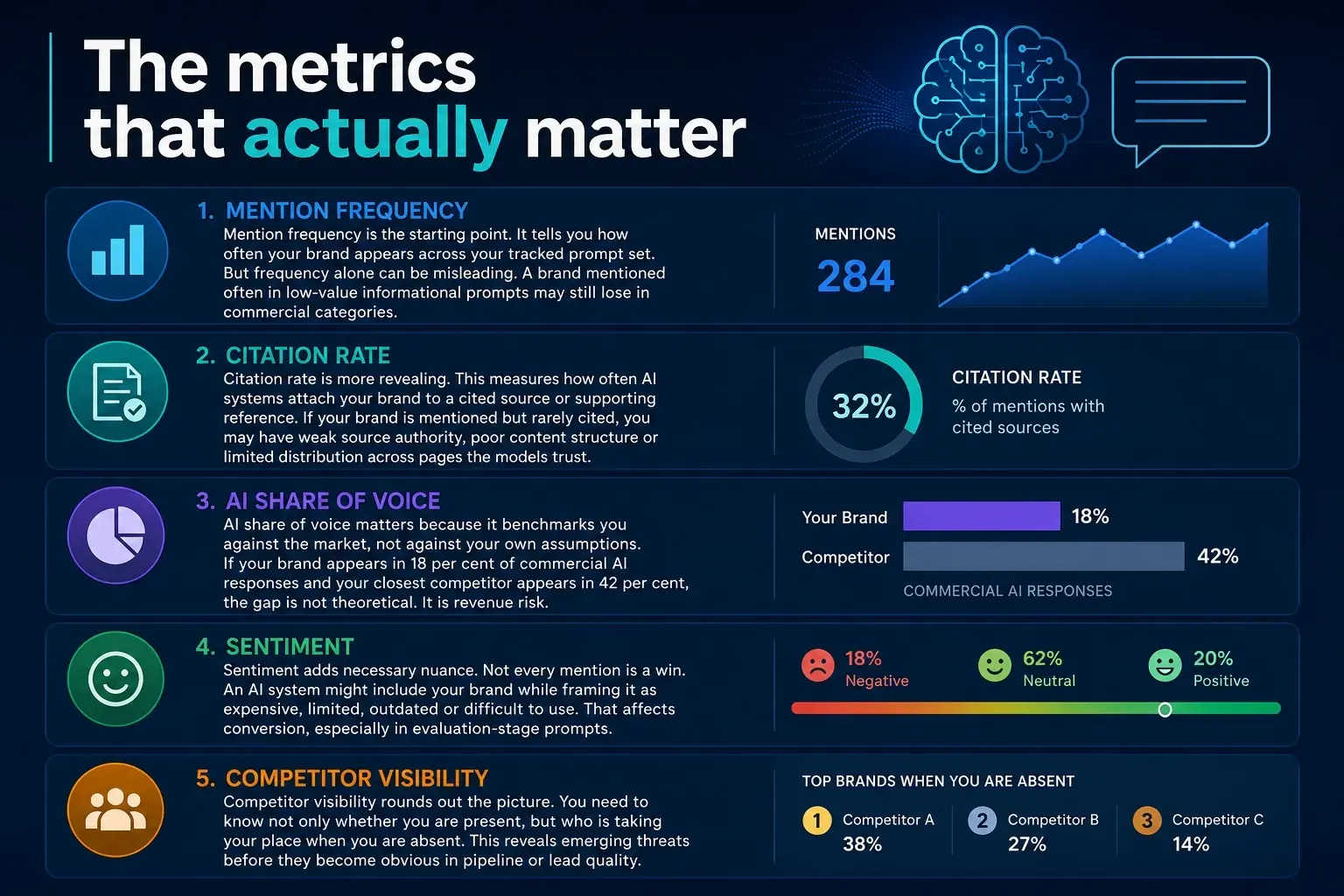
The metrics that actually matter
Mention frequency is the starting point. It tells you how often your brand appears across your tracked prompt set. But frequency alone can be misleading. A brand mentioned often in low-value informational prompts may still lose in commercial categories.
Citation rate is more revealing. This measures how often AI systems attach your brand to a cited source or supporting reference. If your brand is mentioned but rarely cited, you may have weak source authority, poor content structure or limited distribution across pages the models trust.
AI share of voice matters because it benchmarks you against the market, not against your own assumptions. If your brand appears in 18 per cent of commercial AI responses and your closest competitor appears in 42 per cent, the gap is not theoretical. It is revenue risk.
Sentiment adds necessary nuance. Not every mention is a win. An AI system might include your brand while framing it as expensive, limited, outdated or difficult to use. That affects conversion, especially in evaluation-stage prompts.
Competitor visibility rounds out the picture. You need to know not only whether you are present, but who is taking your place when you are absent. This reveals emerging threats before they become obvious in pipeline or lead quality.
Where most teams go wrong
Many teams try to track AI visibility manually. They run a few prompts, take screenshots and build a spreadsheet. That can help at the start, but it breaks fast. AI responses vary by platform, phrasing, location, history and time. Manual checking is too inconsistent to support decisions.
Another common mistake is tracking vanity prompts instead of commercial prompts. It feels good to see your brand appear for your own name or broad educational terms. It matters far more to appear for high-conversion queries where buyers ask for recommendations, comparisons and best-fit options.
The third mistake is stopping at monitoring. Visibility data only matters if it drives action. If your reporting tells you that mentions are down but gives no direction on what to update, publish or distribute, it is not a growth system. It is just a scoreboard.

How to turn tracking into an optimisation engine
This is where the market is splitting. Some teams are still trying to observe AI search. Smarter teams are building a repeatable GEO workflow around it.
Once you know where your brand is mentioned, cited and ignored, patterns start to emerge. You can identify which pages are earning references, which themes AI systems associate with your brand, and where competitors have clearer authority signals. That gives you a roadmap.
If your brand is absent from comparison prompts, you may need better competitor pages, clearer differentiators and structured product content. If citation rates are low, your issue may be source format, internal linking, third-party mentions or weak topical clustering. If sentiment is mixed, your content may not be controlling the narrative around pricing, support, use cases or implementation.
The point is simple: tracking should lead directly to publishing decisions. What content needs to be created? What pages need to be refreshed? Which assets need clearer schema, better sourcing, stronger claims or broader distribution? That is how brands move from AI visibility reporting to AI visibility growth.
How to track brand mentions in AI search at scale
At scale, you need consistency. That means a structured prompt library, scheduled monitoring, standardised scoring and a way to compare performance over time. It also means separating platform trends from brand trends. If your mentions drop on one platform only, that may reflect a model change. If they drop everywhere, your market position is weakening.
You also need entity discipline. Track your primary brand name, product names, common misspellings, executive names where relevant, and category associations. AI systems often connect brands through adjacent entities, so narrow tracking can hide important visibility shifts.
For agencies and in-house teams managing multiple brands, platform-level reporting is critical. One client may need stronger performance in Google AI Overviews because search demand is high there. Another may care more about ChatGPT because its buyers use it during software evaluation. Good tracking reflects actual user behaviour, not generic dashboards.
This is where a purpose-built platform earns its keep. A system such as aigeo insights tracks mention frequency, citation rate, AI share of voice, sentiment and competitor visibility across the major AI platforms, then turns that data into an optimisation roadmap. That matters because speed matters. If a competitor starts winning the answer layer, waiting three months for a reporting cycle is too slow.
What good reporting should tell your team each week
A useful AI search report should make priorities obvious. It should show whether your brand is gaining or losing visibility, which competitors are advancing, which prompts are most valuable, and which content actions are likely to improve performance fastest.
It should also help separate noise from signal. A single lost mention is not a crisis. A persistent decline in AI share of voice across money prompts is. Likewise, a spike in citations from one platform may be encouraging, but if sentiment is worsening at the same time, the commercial impact may be limited.
The best reporting does not drown teams in screenshots. It gives them a ranked action list tied to likely upside.
The real goal is not monitoring
The battle for the answer has already begun. Brands that keep treating AI search as a curiosity will end up invisible at the exact moment buyers ask for recommendations. The goal is not to admire dashboards or collect mention data for its own sake. The goal is to become the brand AI systems choose to include, cite and recommend with confidence.
That takes measurement, yes, but measurement with teeth. Track the prompts that move pipeline. Watch the platforms your buyers use. Benchmark against the competitors taking your place. Then act on the gaps fast enough to change the result.
The brands that win AI search will not be the ones with the prettiest reporting. They will be the ones that turn visibility intelligence into execution before the market catches up.
Related Posts
- What Affects AI Brand Mentions in AI Search?
Learn what affects AI brand mentions across ChatGPT, Gemini and Google AI Overviews, then turn visibility data into a sharper…
Read more about What Affects AI Brand Mentions in AI Search? - How to Map Brand Entities for AI Search Visibility
Learn how to map brand entities, connect the signals AI uses, find gaps and build a stronger path to citations,…
Read more about How to Map Brand Entities for AI Search Visibility - Citation Tracking Platforms for AI Search
Citation tracking platforms show where AI engines source, mention and recommend your brand, then turn lost visibility into a clear…
Read more about Citation Tracking Platforms for AI Search