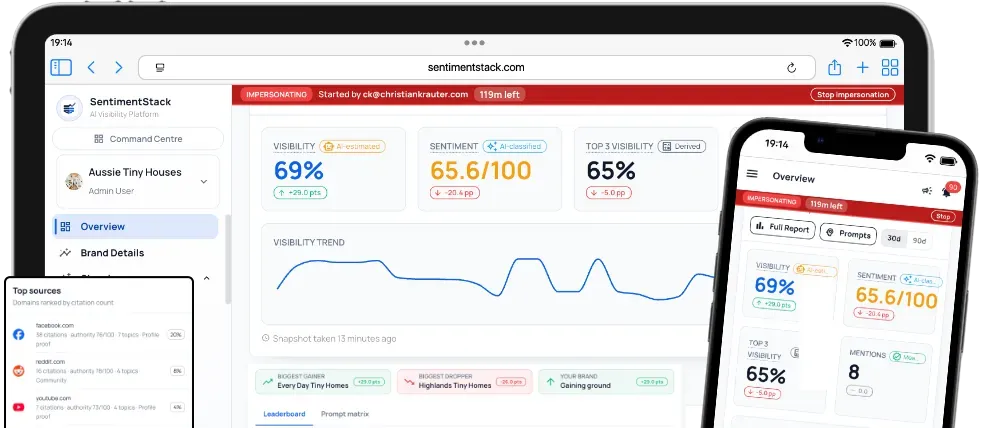
Inside AI-generated answers a brand can still rank well in search and quietly disappear where buying decisions are now being shaped. That is exactly why an AI brand visibility tracker has moved from a nice-to-have dashboard to a serious growth system. If ChatGPT, Gemini, Claude, Perplexity, and Google AI Overviews are recommending your competitors more often than you, you are losing visibility before a prospect ever clicks.
What an AI brand visibility tracker actually tracks
Most teams start with the wrong question. They ask whether AI mentions their brand at all. That is too basic. The commercial question is whether AI platforms mention your brand often enough, in the right context, with the right sentiment, and more often than competing options.
A serious AI brand visibility tracker measures several layers of performance at once. Brand mention frequency shows how often your company appears in AI answers. Citation rate shows whether AI systems are actually drawing from your content or from third-party sources. AI share of voice shows how much of the conversation belongs to you versus competitors. Sentiment adds another layer by revealing whether your brand is framed positively, neutrally, or negatively when it does appear.
That matters because visibility without influence is weak. If a model mentions your brand once in a generic list but repeatedly recommends a competitor with stronger supporting citations, the competitor owns the answer. A useful tracker makes that gap obvious.
Why old search metrics are no longer enough
Traditional SEO still matters, but it no longer tells the full story. Rankings, impressions, and click-through rates were built for ten blue links. Generative search changes the contest. Users now ask longer questions, receive synthesised answers, and often make judgments without visiting multiple sites.
That shift creates a new layer of competition. Brands are no longer only competing to appear on a results page. They are competing to become the source AI systems trust, cite, and recommend. That is a very different game.
An AI brand visibility tracker helps teams see what standard analytics cannot. You might have solid organic traffic while your AI share of voice is sliding. You might be publishing content regularly while another brand is being cited more because its material is clearer, fresher, or better structured for generative retrieval. You might also find that your brand performs strongly on Google AI Overviews but poorly on Claude or Perplexity, which changes how you prioritise your next move.
This is where many teams get caught out. They assume good SEO automatically becomes good GEO. Sometimes it does. Often it does not.
The metrics that separate noise from market position
Not every number deserves attention. The best AI brand visibility tracker focuses on metrics that reveal competitive position and next actions.
Mention frequency is the headline metric, but it is only the start. Citation rate is often more useful because it points to the assets, pages, and content types that are influencing AI outputs. If your brand is getting mentioned but not cited, your authority may be indirect and fragile. If your content is being cited consistently, you have a stronger foundation.
Share of voice is where leadership teams start paying attention. This metric shows whether your brand is dominating category prompts or fading into the background. It works particularly well when benchmarked against named competitors across the same prompt set, because it turns a fuzzy concern into a measurable commercial battle.
Sentiment is another essential layer. AI systems do not just repeat brand names. They frame them. That framing shapes trust. A tracker that measures sentiment across responses helps you spot reputation drift early, especially if product issues, reviews, outdated content, or competitor narratives are starting to influence answer quality.
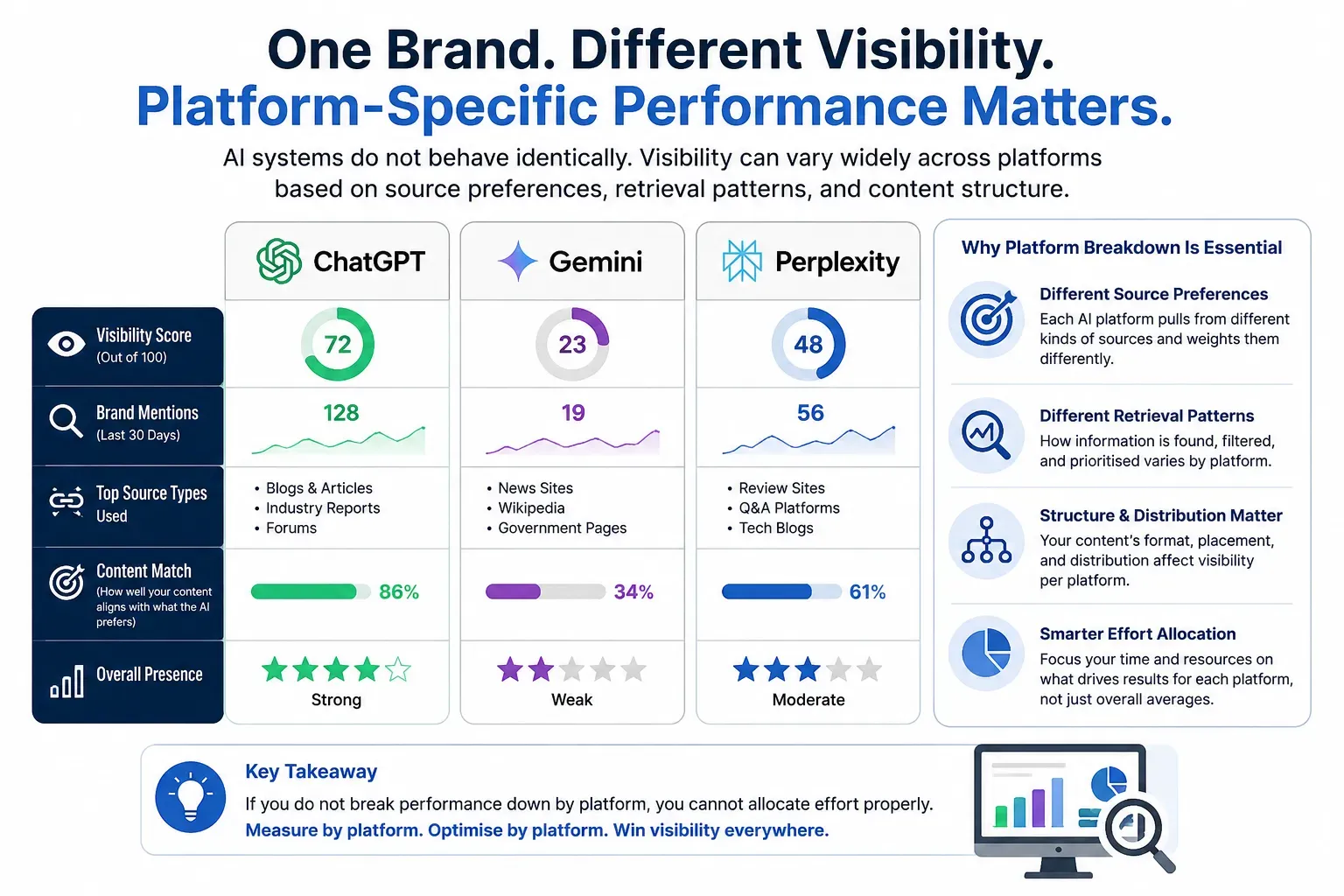
Platform-specific performance matters too. AI systems do not behave identically. A brand may be highly visible in ChatGPT and barely present in Gemini. The difference could come down to source preferences, retrieval patterns, or how your content is distributed and structured. If you do not break performance down by platform, you cannot allocate effort properly.
AI Brand Visibility Tracker Explained: What teams should do with the data
Tracking alone is not strategy. This is where many tools fall short. They show the scoreboard but leave the team guessing about what to fix.
The real value of an AI brand visibility tracker is turning visibility data into a clear optimisation roadmap. That means identifying which pages should be updated, which topics need fresh coverage, which comparison pieces are missing, which entity signals need strengthening, and which assets deserve broader distribution.
For example, if a competitor keeps appearing in prompts around pricing, implementation, or category comparisons, that usually signals a content gap or a framing gap. If your brand is absent in high-intent questions but present in general awareness prompts, your content may be attracting curiosity without building decision-stage authority. If citation rate is concentrated on a few ageing pages, you may need to refresh and expand the assets already carrying your visibility.
This is why action systems matter more than passive reporting. Teams need task prioritisation, scoring, and practical recommendations they can assign this week, not vague advice about improving authority.
Who needs an AI brand visibility tracker most
The short answer is any business that relies on discoverability, category leadership, or inbound demand. But the urgency is highest for brands in competitive sectors where users are increasingly asking AI for recommendations, comparisons, or best-fit options.
That includes SaaS companies, agencies, ecommerce brands, professional services firms, education providers, and local businesses with strong review signals. It also matters for in-house marketing teams and SEO specialists who now need to defend visibility in environments they do not directly control.
Agencies have a particularly strong use case because clients are already asking the question: how often does AI recommend us versus the competition? If you cannot answer that with evidence, someone else will. A tracker for agencies gives a new reporting layer and a new service opportunity at the same time.
For business owners, the appeal is simpler. If AI tools are shaping buyer perception, you need a way to see whether those systems describe your business accurately and favourably. Brand visibility is no longer just a traffic issue. It is a revenue issue.
What to look for in an AI brand visibility tracker
Not all platforms are built for real GEO work. Some are little more than mention checkers. Others produce attractive charts without commercial context.
Look for a system that tracks across major AI environments, not just one model. You need visibility across ChatGPT, Gemini, Claude, Perplexity, and Google AI Overviews because each platform can influence a different part of the customer journey. Look for competitor benchmarking, because raw visibility numbers mean little without comparison. Look for sentiment analysis, citation data, and prompt-level reporting, because these reveal why your brand is appearing or being ignored.
Most importantly, look for a platform that closes the gap between insight and execution. If the output does not tell your team what to create, update, structure, or distribute next, it is only half useful. The market is moving too quickly for interpretation delays.
That is why platforms built around both measurement and optimisation are gaining ground. A system like sentimentstack designed by aigeo insights does not stop at tracking mentions. It translates AI visibility data into a working GEO roadmap so teams can act while the opportunity is still open.
The trade-off: precision versus speed
There is one reality worth stating clearly. AI visibility tracking is not static, and no platform can promise perfect permanence. Models change, prompt behaviour shifts, sources update, and answer patterns evolve. The goal is not to freeze the environment. The goal is to monitor it closely enough to respond faster than the market.
That means teams need a practical balance. If you wait for perfect certainty, you lose time. If you react to every fluctuation, you create noise and waste effort. The best approach is consistent tracking tied to prompt sets that reflect real buyer intent, followed by disciplined optimisation based on patterns, not one-off anomalies.
This is also why reporting cadence matters. Weekly or fortnightly monitoring often makes more sense than occasional spot checks. AI visibility can move quickly, especially when competitors publish aggressively or platforms change how they source responses.
The brands winning the answer economy are not guessing. They are measuring where they appear, where they are cited, how they are framed, and which competitor is taking the prompts that should belong to them. An AI brand visibility tracker gives you that line of sight. What you do next decides whether AI talks about your brand as an option – or the obvious choice.
Related Posts
- How to Map Brand Entities for AI Search Visibility
Learn how to map brand entities, connect the signals AI uses, find gaps and build a stronger path to citations,…
Read more about How to Map Brand Entities for AI Search Visibility - LLM Analytics Review for Brands That Want Visibility
An LLM analytics review for marketers: assess AI visibility, citations, sentiment and competitors, then turn data into actions that grow…
Read more about LLM Analytics Review for Brands That Want Visibility - How to Measure Brand Visibility in AI Search
Learn how to measure brand visibility across AI search, track share of voice, citations and sentiment, and turn visibility gaps…
Read more about How to Measure Brand Visibility in AI Search