A sudden drop in ChatGPT mentions or Google AI Overview citations is not a reporting nuisance. It is a warning that your brand may be losing its place in the answer customers see before they ever reach a search result. To diagnose LLM visibility declines properly, you need to separate normal model variation from a genuine competitive loss, then identify the assets and signals behind it.
Traditional rank tracking cannot answer that question. Large language models do not return one fixed list of ten blue links. They assemble answers from changing sources, query interpretations, retrieval systems and model behaviour. That makes the diagnosis more demanding, but it also makes speed more valuable. The brand that finds the cause first can reclaim the answer.
Start by proving the decline is real
Do not react to one missed mention. AI responses vary by prompt wording, location, session context, model version and the sources available at that moment. A single result is anecdotal. A consistent fall across a controlled prompt set is a visibility trend.
Establish a baseline using the same commercially meaningful prompts every reporting period. Include category queries, problem-led queries, comparison prompts and recommendation queries. For a project management platform, that might mean tracking questions such as “best project management software for construction teams” alongside “alternatives to [competitor]”. These prompts reveal different stages of buyer intent and often produce very different brand lists.
Measure more than whether your brand appears. Track mention frequency, citation rate, AI share of voice, sentiment, recommendation position and competitor presence by platform. A decline in mentions with stable citations suggests a different problem from a decline in both. If your brand is still cited but no longer recommended, the model may recognise your authority while competitors have become more relevant to the prompt.
Check the date range before declaring a crisis. Compare the latest period with a meaningful baseline, not only the previous week. Weekly data is useful for catching sharp shifts, while a four-to-eight-week view is better for confirming direction. The right window depends on prompt volume and your category’s volatility.
Diagnose LLM visibility declines by platform
Treat each generative engine as its own market. ChatGPT, Claude, Gemini, Perplexity and Google AI Overviews can surface different sources and apply different selection logic. A fall everywhere usually points to a brand, content or technical issue. A decline on one platform may reflect a platform update, a changed retrieval pattern or an asset that matters disproportionately to that engine.
Google AI Overviews often have a closer relationship with the indexed web and traditional organic visibility. If your AI Overview citations drop after key pages lose organic rankings, inspect crawlability, indexing, content quality, internal linking and page changes first. The same applies when a previously cited page has been redirected, noindexed, made inaccessible, or substantially rewritten.
Perplexity makes source attribution particularly visible. If your competitors are repeatedly cited there, inspect the pages being referenced. Look for the format, specificity and freshness of those assets. They may have published a clear comparison page, an original data study, a tightly scoped guide or a credible third-party mention that answers the prompt more directly than your content.
For conversational models, visibility can be influenced by a broader set of public information. Your owned site matters, but so do review sites, analyst coverage, industry publications, product directories, community discussion and consistent brand facts across the web. This is why a branded answer can weaken even when your core pages have not changed.
Find the break point in your visibility data
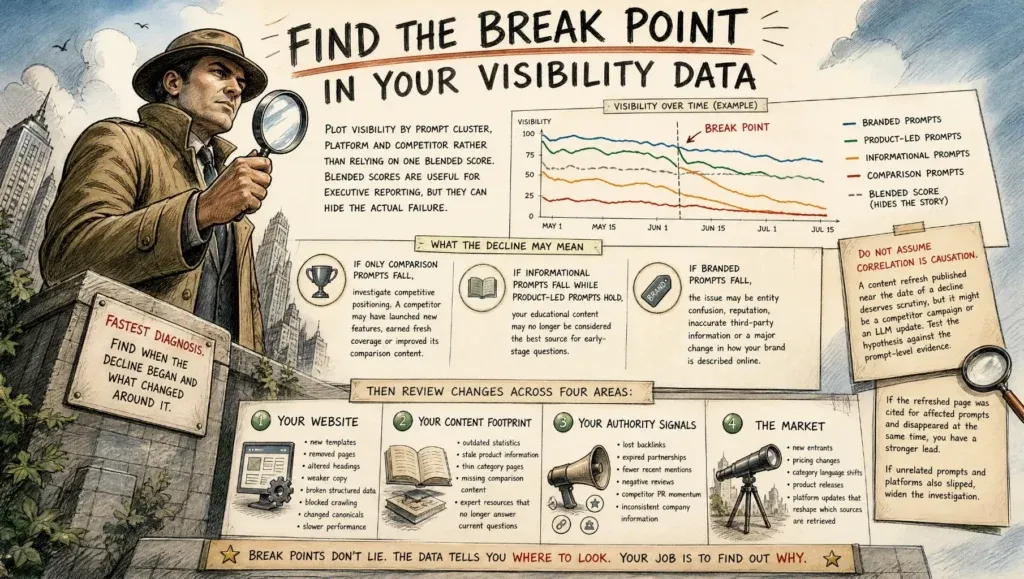
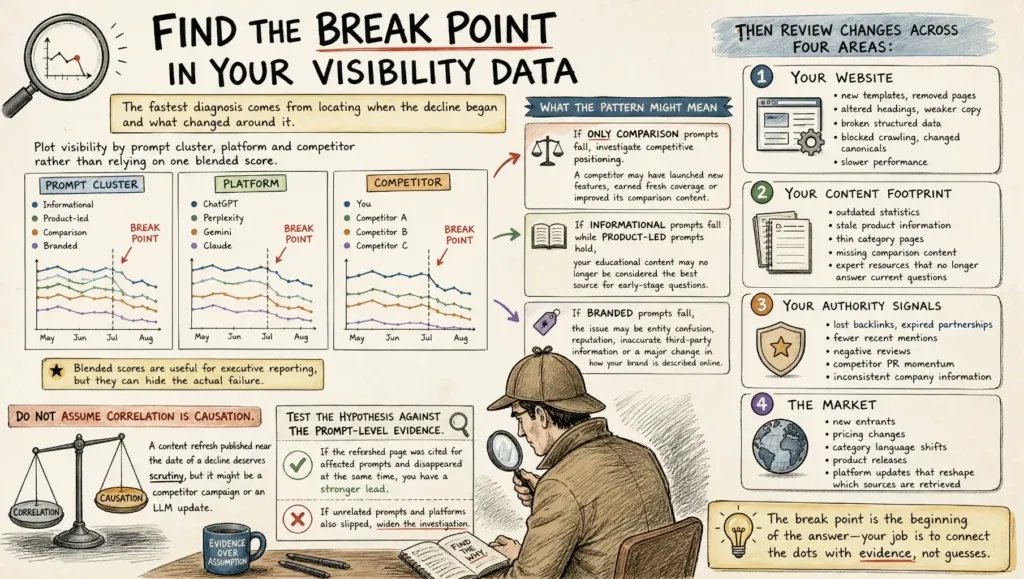
The fastest diagnosis comes from locating when the decline began and what changed around it. Plot visibility by prompt cluster, platform and competitor rather than relying on one blended score. Blended scores are useful for executive reporting, but they can hide the actual failure.
If only comparison prompts fall, investigate competitive positioning. A competitor may have launched new features, earned fresh coverage or improved its comparison content. If informational prompts fall while product-led prompts hold, your educational content may no longer be considered the best source for early-stage questions. If branded prompts fall, the issue may be entity confusion, reputation, inaccurate third-party information or a major change in how your brand is described online.
Then review changes across four areas:
- Your website: new templates, removed pages, altered headings, weaker copy, broken structured data, blocked crawling, changed canonicals or slower performance.
- Your content footprint: outdated statistics, stale product information, thin category pages, missing comparison content or expert resources that no longer answer current questions.
- Your authority signals: lost backlinks, expired partnerships, fewer recent mentions, negative reviews, competitor PR momentum or inconsistent company information.
- The market: new entrants, pricing changes, category language shifts, product releases and platform updates that reshape which sources are retrieved.
Do not assume correlation is causation. A content refresh published near the date of a decline deserves scrutiny, but it might be a competitor campaign or an LLM update. Test the hypothesis against the prompt-level evidence. If the refreshed page was cited for affected prompts and disappeared at the same time, you have a stronger lead. If unrelated prompts and platforms also slipped, widen the investigation.
Inspect what replaced you
The most useful question is not “why did we disappear?” It is “what did the model choose instead, and why?” Capture the brands, claims and cited sources that now occupy your former space.
Read the response as a buyer would. Are competitors winning because they are framed as cheaper, more specialised, easier to use or more trusted? Are they cited from detailed guides while your brand is represented only by a homepage? Is the model answering a specific question that your site answers vaguely?
This step turns LLM visibility monitoring into an optimisation plan. If competitors own “best for small teams” but your messaging focuses only on enterprise capability, the remedy is not another generic blog post. You may need a definitive small-business use-case page, clearer pricing context, customer proof and supporting third-party validation. If the answer favours brands with current research, publish evidence the model can reuse: original benchmarks, methodology-led reports, practical data and quotable expert commentary.
Citation gaps are especially revealing. When a competitor is mentioned but not cited, the model may be drawing on broad entity knowledge. When it is cited repeatedly from specific URLs, those pages are strategic assets. Build a response that matches the intent and depth of those assets without copying their angle or stuffing the page with brand names.
Prioritise fixes by commercial impact
Not every decline warrants the same response. A missed mention on a low-intent educational prompt is less urgent than a loss on “best [category] software” or “[your brand] alternatives”. Score the affected prompts by buyer intent, search demand where available, conversion value, current share of voice and ease of recovery.
Start with pages and claims that are both high-value and clearly under-supported. Strengthen factual accuracy, add direct answers near the top, define who the product is for, show differentiators with evidence and update time-sensitive details. Clear structure helps both human readers and retrieval systems: descriptive headings, concise sections, comparison tables where genuinely useful, author expertise and transparent sourcing all reduce ambiguity.
Distribution matters as much as publishing. A strong owned page may not be enough when the category is decided through third-party consensus. Earn credible mentions in the places your buyers and the wider web already trust. Keep business details, product positioning and key facts consistent across every public profile. Contradictory signals create uncertainty, and uncertain brands are less likely to become the recommended answer.
For teams managing this at scale, aigeo insights connects visibility movement to platform, prompt and competitor evidence, then turns the findings into prioritised GEO actions. That matters because dashboards without a next move only make the problem more visible.
Monitor recovery without chasing noise
After changes go live, keep the prompt set stable long enough to measure movement. Watch leading indicators first: renewed citations, improved sentiment, appearance in secondary recommendations and reduced competitor dominance. Broader share of voice often follows after the underlying evidence becomes more visible and consistently interpreted.
Avoid rewriting every page after a single bad run. Frequent, unmeasured changes make it harder to learn what worked. Make a reasoned change, record the hypothesis, monitor the relevant prompt cluster and compare results against the baseline. If performance does not improve, revisit the replacement sources and test a different explanation.
The answer economy rewards brands that treat visibility declines as intelligence, not bad luck. Every lost mention reveals a question your market is asking and a competitor, source or signal currently answering better. Respond with evidence, clarity and pace, and your brand has a far better chance of being the answer buyers hear next.
Ready to get started?
A one-line nudge that earns the click below.
Related Posts
- Ecommerce Answer Visibility Is Now a Revenue Metric
Ecommerce answer visibility shows whether AI tools recommend your products. Learn what to measure, where competitors win, and how to…
Read more about Ecommerce Answer Visibility Is Now a Revenue Metric - LLM Analytics Review for Brands That Want Visibility
An LLM analytics review for marketers: assess AI visibility, citations, sentiment and competitors, then turn data into actions that grow…
Read more about LLM Analytics Review for Brands That Want Visibility - How to Prioritise GEO Tasks That Drive Visibility
Learn how to prioritise GEO tasks with visibility, citation, sentiment and competitor data, so your team acts on work that…
Read more about How to Prioritise GEO Tasks That Drive Visibility