
A competitor appears in ChatGPT’s answer for a high-intent buying question. Your brand does not. The wrong response is to publish ten new articles and hope one lands. The smarter move is to prioritise generative search tasks according to commercial impact, current visibility gaps and the likelihood of earning a citation or mention.
Generative Engine Optimisation is not a content volume contest. It is a decision-making discipline. Your team needs to know which missing answers, weak pages, reputation signals and competitor gains deserve attention first – and which can wait. That is how brands build share of voice in the answer economy without burning their content budget on low-value activity.
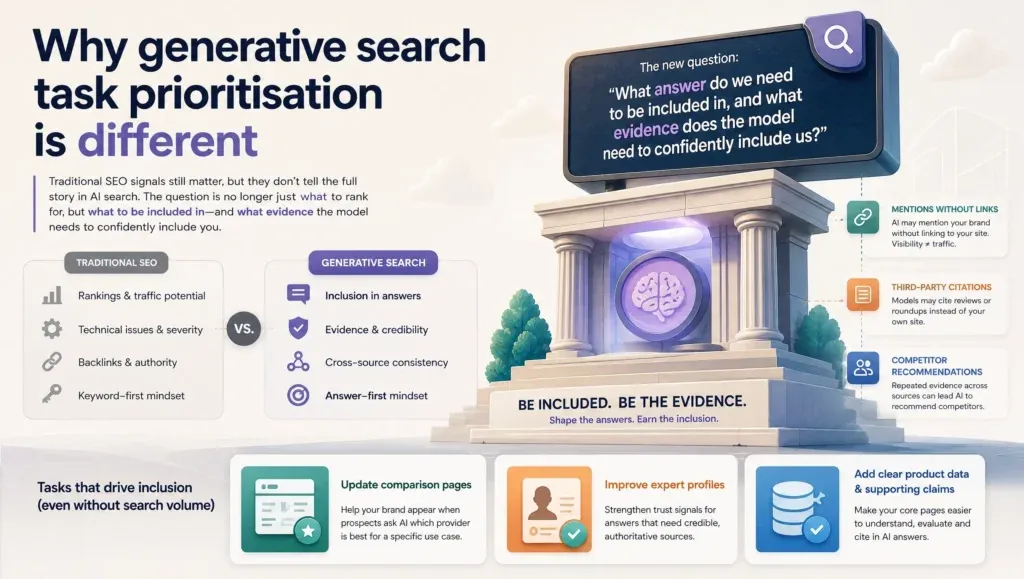
Why generative search task prioritisation is different
Traditional SEO teams often prioritise work around rankings, traffic potential, technical severity and backlinks. Those signals still matter, but they do not tell the full story in AI search. A generative engine may mention a brand without linking to it, cite a third-party review instead of the brand’s site, or recommend a competitor based on repeated evidence found across several sources.
That changes the unit of work. Rather than asking, “What keyword should we rank for?”, ask, “What answer do we need to be included in, and what evidence does the model need to confidently include us?”
A task can be valuable even when it has no obvious search volume. For example, updating a comparison page may help your brand appear when prospects ask Gemini which provider is best for a specific use case. Improving an expert profile may strengthen trust signals for answers that need credible sources. Adding clear product data and supporting claims may make a core commercial page easier to cite in Perplexity or Google AI Overviews.
The objective is not merely to be found. It is to become an answer-worthy source and a recognisable recommendation.
Start with the prompts that drive revenue
Not every AI prompt deserves the same level of effort. Begin by mapping the questions a buyer asks before, during and after evaluating your category. Focus on prompts with a direct relationship to pipeline, conversion or retention.
For a B2B software company, this may include category comparisons, alternatives, pricing and implementation questions, integration queries, security concerns and industry-specific recommendations. A consumer brand may put greater weight on product suitability, ingredient or feature comparisons, local availability and review-led buying questions.
Group prompts by intent rather than treating each one as an isolated opportunity. A single well-structured comparison page can support visibility across dozens of closely related questions. Conversely, a broad educational prompt may generate plenty of mentions but little commercial value.
Give each prompt cluster a business value score. Use your own commercial reality: average deal value, purchase frequency, margin, sales-team feedback and conversion rate. A prompt that influences enterprise shortlist decisions should outrank a generic awareness question, even if the generic question is asked more often.
Score tasks by impact, evidence and effort
The best task queues make trade-offs visible. A task should not rise to the top simply because it is easy, nor because it looks strategically impressive. It needs a clear case for action.
Use a simple scoring model built on four dimensions:
- Commercial impact: How strongly can this prompt, page or asset influence revenue, qualified leads or retention?
- Visibility gap: Is your brand absent, inaccurately represented, poorly positioned or under-cited compared with competitors?
- Evidence potential: Can your team create or improve credible source material that answers the question better than what exists now?
- Effort and speed: How much resource is required, and how quickly could the change affect AI visibility?
A high-impact task is usually one where a commercially important prompt has a material brand gap, a competitor is already winning, and the required evidence can be published or improved within weeks. That might mean refreshing a stale alternatives page, adding substantiated customer outcomes, or creating a definitive guide to a high-value use case.
Do not let ease dominate the model. Updating a meta description may be quick, but it is unlikely to alter how a language model understands your category position. Equally, do not always chase the biggest strategic prize first. A major content hub can take months. If a focused product page update can improve citation eligibility for a valuable prompt cluster now, it may deserve priority.
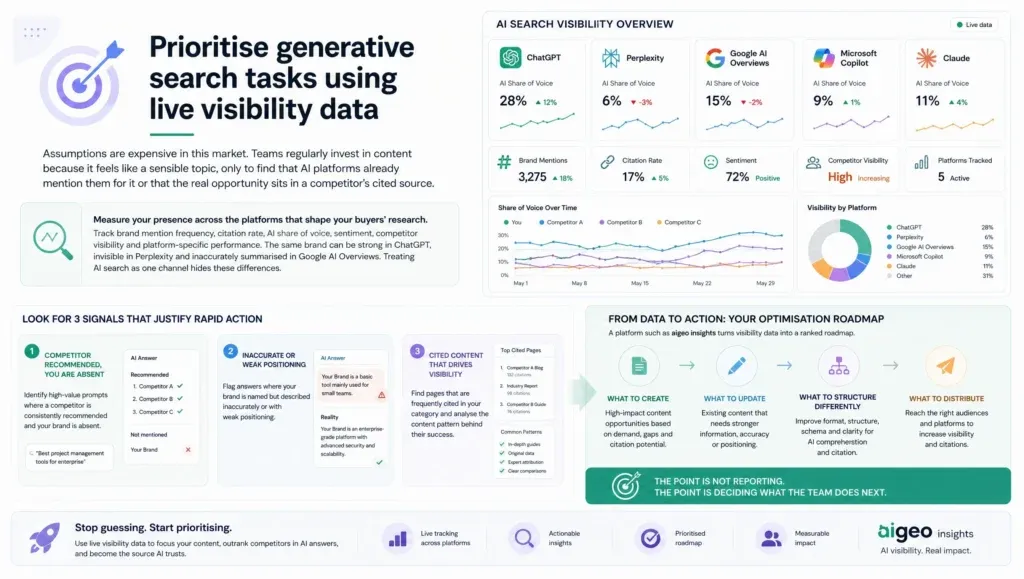
Prioritise generative search tasks using live visibility data
Assumptions are expensive in this market. Teams regularly invest in content because it feels like a sensible topic, only to find that AI platforms already mention them for it or that the real opportunity sits in a competitor’s cited source.
Measure your presence across the platforms that shape your buyers’ research. Track brand mention frequency, citation rate, AI share of voice, sentiment, competitor visibility and platform-specific performance. The same brand can be strong in ChatGPT, invisible in Perplexity and inaccurately summarised in Google AI Overviews. Treating AI search as one channel hides these differences.
Look for three signals that justify rapid action. First, identify high-value prompts where a competitor is consistently recommended and your brand is absent. Second, flag answers where your brand is named but described inaccurately or with weak positioning. Third, find pages that are frequently cited in your category and analyse the content pattern behind their success: depth, structure, original data, expert attribution, comparisons or clear definitions.
This is where a platform such as aigeo insights changes the operating model. Instead of presenting a dashboard full of vanity metrics, the data can be turned into a ranked optimisation roadmap: what to create, what to update, what to structure differently and what to distribute. The point is not reporting. The point is deciding what the team does next.
Choose the right task type for the gap
Not every visibility problem is solved with a new blog post. Match the task to the reason your brand is missing.
If the model lacks a clear explanation of your offer, improve core category and product pages. State what you do, who it is for, where it fits, what distinguishes it and when it may not be the best choice. Clear positioning helps both users and systems resolve ambiguity.
If competitors dominate comparison prompts, build genuinely useful comparison and alternatives content. Avoid empty claims that every competitor is inferior. Explain differences in ideal customer, capability, pricing model, implementation approach and constraints. Balanced content is more credible and more useful to a buyer making a decision.
If your brand is cited less often than competitors despite strong mentions, strengthen source usefulness. Add original research, quantified outcomes, detailed methodologies, expert contributors and direct answers to common questions. Citation is earned when a page provides evidence that improves an answer.
If sentiment is the issue, content alone may not be enough. Product complaints, outdated review narratives or inconsistent public information can influence AI-generated summaries. Prioritise the underlying customer and reputation issue, then publish accurate material that gives the market a better reference point.
Build a weekly GEO operating rhythm
Generative search changes quickly, so task prioritisation cannot be a quarterly exercise. Review your priority prompts weekly, especially those tied to active campaigns, seasonal demand, product launches and competitor moves.
Keep the meeting focused. Review which prompts gained or lost visibility, which competitors changed position, which assets were cited, and whether published work altered the result. Then approve a small number of tasks with named owners and expected outcomes.
A practical weekly queue might include one fast correction, one high-value page upgrade and one longer-term authority asset. This creates momentum without sacrificing strategic work. It also prevents the common pattern where every GEO task is labelled urgent and nothing reaches completion.
Measure outcomes beyond published output. Track whether the brand is mentioned more often, whether citation rate increases, whether sentiment improves and whether AI share of voice rises against the competitors that matter. A beautifully written page that does not alter visibility or buyer understanding may need a different distribution plan, stronger evidence or a sharper angle.
Ready to get started?
A one-line nudge that earns the click below.
Avoid the tasks that create activity without advantage
Three mistakes drain GEO resources. The first is producing generic educational content on topics where your brand already has visibility and no clear commercial gap. The second is copying competitor pages without bringing better evidence, sharper structure or a more useful perspective. The third is chasing every platform equally, even when your audience clearly relies on particular AI environments.
There is no universal task order. A mature brand with weak citations may need source-quality work. A newer entrant may need foundational category positioning. A company with strong visibility but poor sentiment may need to fix the customer experience behind the answer. The right priority is the one that closes the most valuable gap with credible, achievable action.
The battle for the answer has begun. Teams that treat AI visibility as a measurable operating system will move faster than teams still publishing on instinct. Pick the next task that gives your brand the strongest evidence to be recommended, cited and remembered when the buyer asks the question that matters.
Related Posts
- Generative Search Audit Guide for AI Visibility
Use this generative search audit guide to measure AI visibility, expose competitor gaps, and turn citations, sentiment and share of…
Read more about Generative Search Audit Guide for AI Visibility - Generative Search Strategy for Marketers
Build a generative search strategy for marketers that measures AI visibility, earns citations and turns competitive insights into practical, fast…
Read more about Generative Search Strategy for Marketers - Generative Search Content Optimisation Guide
This generative search content optimisation guide shows Australian marketing teams how to earn AI citations, lift share of voice and…
Read more about Generative Search Content Optimisation Guide