
A prospect asks ChatGPT which platform to choose, asks Perplexity for the best provider, or sees a Google AI Overview before scrolling to a single blue link. If your brand is absent from the citation sources for AI answers, your strongest traditional rankings may no longer be enough to win the enquiry.
This is the new visibility fight. Generative engines do not simply return ten websites and let the user compare them. They synthesise a recommendation, frame the category, name the credible players and, in some cases, show the sources that informed the response. The brands cited most often gain authority before a buyer ever visits a website.
Why citations have become a commercial metric
A citation is not just a link with a new label. It is evidence that an AI platform has found a source sufficiently relevant, clear and trustworthy to support an answer. When that source mentions your company, product, expert or data, it creates a path into the answer itself.
That matters because the answer is increasingly the decision point. A user may ask for the best accounting software for a growing Australian business, the most reliable cybersecurity provider, or a comparison of CRM platforms. The model can narrow a crowded market to a short list in seconds. Brands missing from that shortlist lose consideration, even if their website is technically sound and their paid media is performing.
Citation visibility is also more volatile than conventional organic rankings. Different platforms retrieve and weight information differently. Perplexity commonly displays source citations prominently. Google AI Overviews may draw from a mix of pages for each query. ChatGPT, Claude and Gemini can produce different brand recommendations depending on the prompt, model version, location, connected search tools and freshness of available information.
The operational question is not, “What is our rank?” It is, “Which sources are teaching AI systems to include, describe and recommend us?”
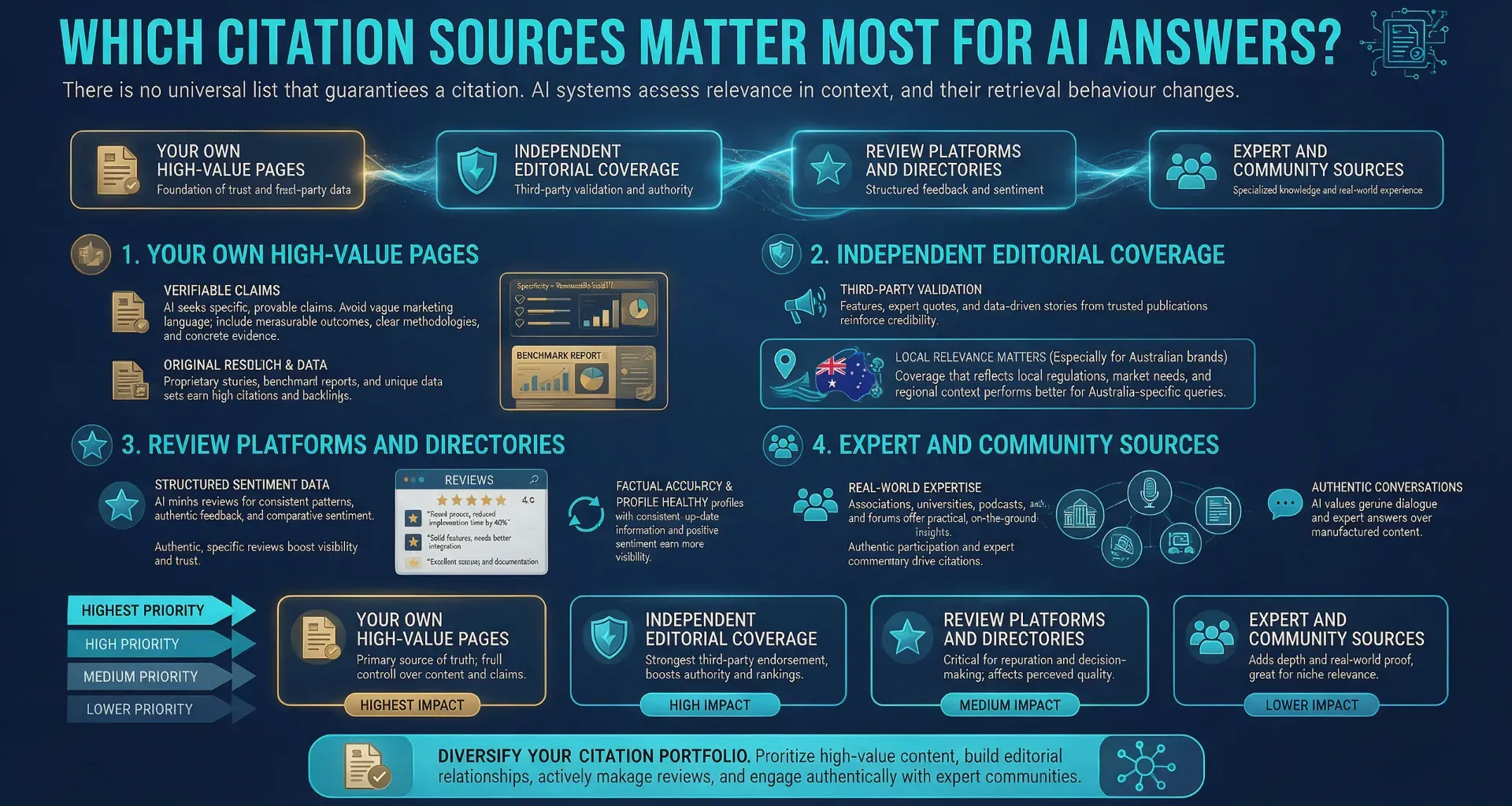
Which citation sources for AI answers matter most?
There is no universal list that guarantees a citation. AI systems assess relevance in context, and their retrieval behaviour changes. Still, a handful of source categories consistently influence how brands appear across generative search.
Your own high-value pages
Your website remains the foundation, but generic marketing copy is rarely enough. AI-ready first-party content directly answers the questions buyers ask. That includes clear product and service pages, comparison pages, implementation guides, technical documentation, pricing explanations, case studies and well-maintained FAQs.
The strongest pages make claims that can be verified. Instead of saying your platform is “industry-leading”, state what it measures, who it is for, which environments it covers and what outcome it helps deliver. Specificity gives retrieval systems material they can use without having to guess.
Original research and proprietary data deserve special attention. A well-structured benchmark report, survey or methodology page can earn citations because it contributes information rather than repeats category language. If your data is genuinely useful, other publishers may reference it too, extending its footprint beyond your domain.
Independent editorial coverage
Trade publications, respected business media and specialist publications can carry significant weight because they offer third-party validation. A thoughtful feature, expert quote, review or data-led story can establish that your brand is part of the category conversation.
This is not a case for chasing every mention. Thin press releases and recycled syndication provide limited strategic value. Prioritise editorial coverage where the publication reaches your buyers and where the article adds useful context about your expertise, market position or customer results.
For Australian brands, local relevance can matter. Coverage that accurately reflects Australian regulations, buying conditions, service areas or customer needs may be more useful for Australia-specific prompts than a broad overseas mention. It depends on the query, but geographic fit should be part of your content and PR planning.
Ready to get started?
A one-line nudge that earns the click below.
Review platforms and directories
Buyers ask AI systems for alternatives, best-in-category options and software comparisons. Review platforms, sector directories and marketplace profiles frequently contain the structured information models need to identify a company: category, features, pricing approach, customer sentiment and competitors.
These profiles can also shape the language used about your brand. An outdated description, inconsistent product category or unresolved run of negative reviews creates an avoidable visibility problem. Treat major profiles as core brand assets, not set-and-forget listings.
The trade-off is control. You can improve your profile and encourage genuine customer feedback, but you cannot write the independent verdict. That independence is precisely why these sources can influence recommendations. The right response is to make sure the facts are accurate and your customer experience supports the reputation you want AI answers to reflect.
Expert and community sources
Industry associations, university resources, conference programmes, expert interviews, podcasts, community discussions and reputable forums can all surface in AI answers. They are particularly relevant for specialised, technical or emerging categories where a buyer needs practical proof rather than a polished brand claim.
Community sources require judgement. They can reveal authentic product experiences, but they are also messy, inconsistent and sometimes wrong. Do not attempt to manufacture discussion. Put knowledgeable people into real industry conversations, answer useful questions and publish expertise that people want to reference.
What makes a source more likely to be used?
Generative engines do not share a single public scoring formula. Yet the patterns are clear: useful sources are easy to interpret, closely aligned with the query and supported by credible signals.
Topical relevance comes first. A strong page about AI visibility tracking is more likely to help answer a specific AI visibility question than a broad corporate homepage. Authority matters too, but authority without direct relevance can lose to a narrower source that answers the user’s exact question.
Freshness matters most where facts change quickly, such as pricing, product capabilities, regulations and market data. Update key pages when the offer changes, show dates where appropriate and remove obsolete claims. Contradictory information across your site and third-party profiles makes it harder for a model to confidently represent you.
Structure is the practical advantage many teams overlook. Use descriptive headings, concise definitions, comparison tables where they genuinely clarify a choice, named authors or experts, plain-language methodology and clear entity details. A model does not need prose that sounds impressive. It needs information it can extract, validate and use.
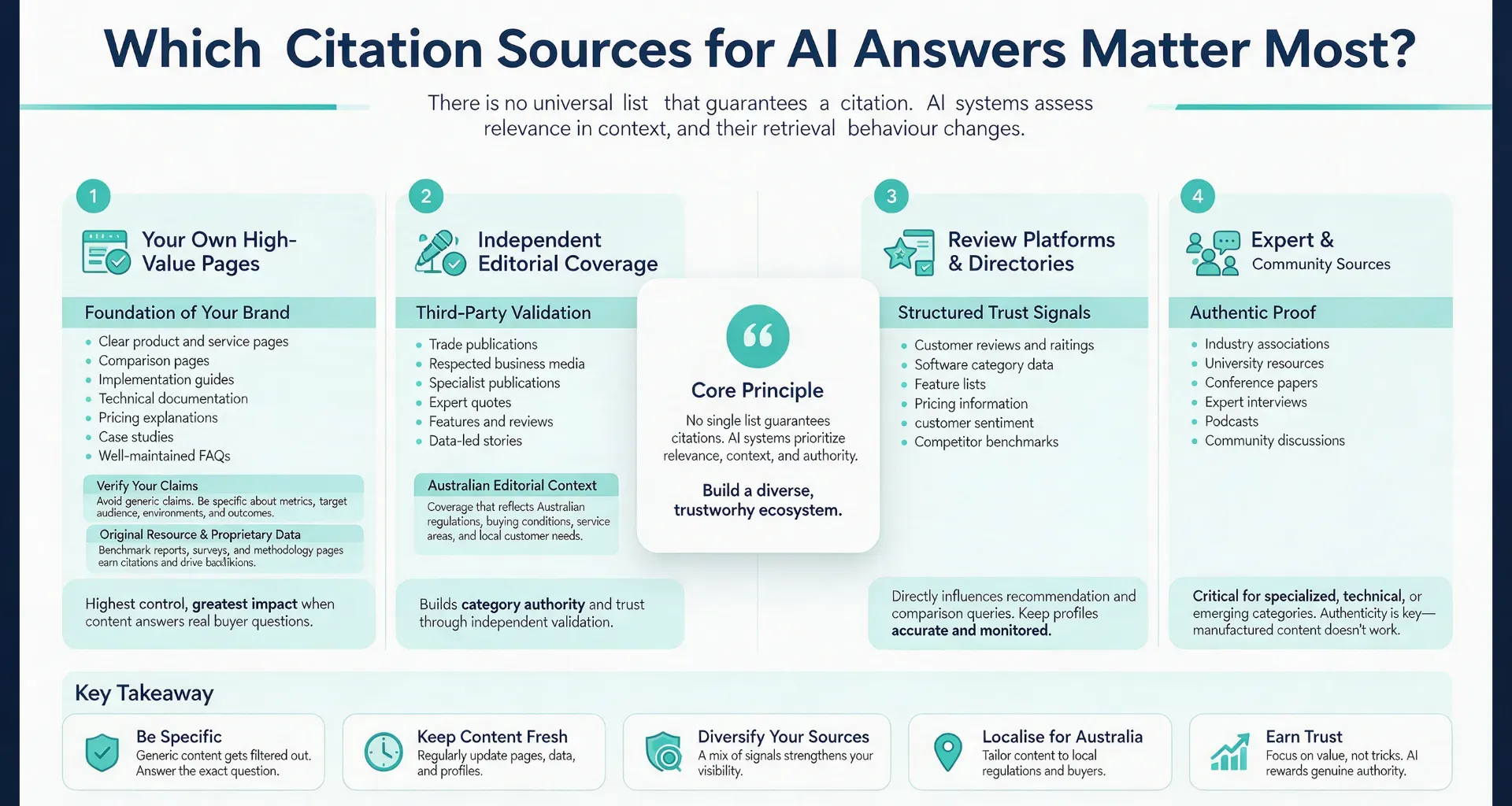
Build a citation strategy, not a content pile
Publishing more articles without a visibility model is expensive guesswork. Start with the prompts that drive commercial discovery: best options, alternatives, comparisons, use cases, local providers, implementation questions and category definitions. Then record which brands appear, which sources are cited and what claims the answer makes.
Look for gaps with revenue potential. If competitors appear in “best” queries because review platforms classify them clearly, fix your category presence and evidence. If they dominate comparison prompts with detailed feature pages, create honest comparison content that helps buyers make a decision. If external articles repeatedly support their authority, identify the publications and expert communities shaping the category.
Next, assign each gap to an action. Some require new first-party content. Some require an update to documentation or reviews. Some require a customer proof point, a data asset or a targeted earned-media programme. The goal is not to force citations from one page. It is to build a consistent evidence network around the brand.
Measure the outcome across platforms and prompts. Track brand mention frequency, citation rate, AI share of voice, sentiment, competitor visibility and source-level patterns. A high citation count is valuable, but not if the cited pages describe you inaccurately or appear only for low-intent questions. Pair volume with query quality, message accuracy and commercial relevance.
This is where a platform such as aigeo insights turns monitoring into action. Visibility data should tell your team which asset to create, refresh, structure or distribute next, not merely confirm that a competitor is ahead.
Avoid the shortcuts that damage trust
Citation building is not a licence for keyword stuffing, fabricated reviews or low-quality guest-post campaigns. Generative systems can retrieve weak sources, but weak sources also expose brands to inaccurate positioning and reputational risk. The short-term spike is rarely worth the long-term mess.
Be careful with claims that lack evidence. AI answers can compress and repeat information at scale. If an exaggerated claim becomes part of the available source set, correcting the record later takes more effort than publishing the accurate version from the start.
The brands that win the answer economy will not be those with the loudest content calendar. They will be the brands with the clearest evidence, the strongest third-party validation and a disciplined view of how AI platforms describe the market. Start with the answers your buyers already seek, then give the engines better reasons to cite you.
Related Posts
- AI Citation Tracking Software That Wins Answers
AI citation tracking software shows where your brand appears in AI answers, which competitors are cited, and what to improve…
Read more about AI Citation Tracking Software That Wins Answers - Can AI Answers Misquote Brands? Yes, They Can
Can AI answers misquote brands? Learn why generative search gets claims wrong, how to spot risk, and what to do…
Read more about Can AI Answers Misquote Brands? Yes, They Can - Citation Tracking Platforms for AI Search
Citation tracking platforms show where AI engines source, mention and recommend your brand, then turn lost visibility into a clear…
Read more about Citation Tracking Platforms for AI Search