
A prospect asks ChatGPT for the best payroll platform, the most reliable solar installer, or a B2B agency with experience in their sector. Your brand may have excellent rankings, strong reviews and a polished website – yet never appear in the response. That is the visibility gap this generative search content optimisation guide is built to close.
Generative engines do not simply return a list of blue links. They assemble an answer from entities, evidence, product information, third-party validation and topical context. The commercial stakes are immediate: if your competitor is repeatedly named, cited and recommended while you are absent, they are shaping buyer preference before a prospect reaches a search results page.
What generative search is actually evaluating
AI search platforms have different retrieval systems, source preferences and answer formats. ChatGPT, Claude, Gemini, Perplexity and Google AI Overviews will not surface the same brands for the same prompt. But they tend to reward a similar set of signals: clear expertise, factual consistency, useful original information, credible corroboration and content that answers a specific question without making the reader work for it.
This changes the optimisation target. Traditional SEO often focuses on ranking a page for a keyword. Generative Engine Optimisation, or GEO, focuses on making your brand and content suitable material for an AI-generated answer. The goal is not merely traffic. It is mention frequency, citation rate, positive sentiment and AI share of voice across the prompts that influence revenue.
A high-ranking page can still fail at GEO if it is vague, thin on evidence or disconnected from the entity behind it. Conversely, a well-structured expert resource may become highly citable even where it does not hold the top organic position. That is why teams need to measure AI visibility directly rather than assume Google rankings tell the whole story.
Start with the questions that create demand
Do not begin by publishing generic pages about AI search. Begin with the prompts your buyers use when they are comparing options, solving a problem or validating a shortlist.
For a B2B software company, those might include questions such as: which platforms integrate with a particular CRM, what tools suit mid-market teams, how much does a solution cost, and what are the alternatives to a known competitor. For a service business, the valuable prompts may be location-led, trust-led or problem-led: who offers a specialist service, what credentials matter, and how do buyers avoid a costly mistake?
Group these prompts by commercial intent. Informational prompts build familiarity, comparison prompts expose competitive gaps, and recommendation prompts can move a buyer towards action. You need all three, but they should not receive equal effort. Prioritise the prompts where a brand mention would put you in a genuine consideration set.
This is also where many teams get GEO wrong. They track a handful of vanity questions, see inconsistent results, then treat generative search as unpredictable. The better approach is to build a repeatable prompt set by product line, audience, location, use case and competitor. Measure it over time, not from one screenshot.
Build content that can be cited, not just read
AI systems need usable evidence. A broad landing page full of persuasive claims may convert human visitors, but it gives a generative engine little to verify or explain. Your content needs clear factual units that can stand on their own.
Create pages that state what you do, who it is for, how it works, when it is a good fit and when it is not. Add specifics where they are defensible: implementation timeframes, supported integrations, service areas, methodology, pricing logic, product limitations, compliance details or measurable outcomes. Specificity is not a stylistic preference. It gives the model material to retrieve and attribute.
Original research, benchmark data, expert commentary and detailed case evidence can be especially valuable because they create information that does not exist elsewhere. A page that only repeats familiar industry advice may help topical coverage, but it is less likely to become a preferred source.
Structure matters too. Use descriptive headings that match real questions. Keep definitions close to the terms they explain. Put the direct answer near the top, then support it with context and proof. Tables can help when buyers need to compare features, eligibility, costs or trade-offs. Avoid hiding core facts inside graphics, sliders or downloadable PDFs where they are harder to interpret.
Strengthen the entity behind the content
Generative engines need confidence that your company is real, relevant and accurately represented. That confidence comes from more than one page on your own site.
Keep your brand name, product names, descriptions, leadership information and core claims consistent across owned channels and credible third-party sources. Resolve outdated listings, duplicate profiles and conflicting descriptions. A mismatch in basic facts may seem minor, but it creates ambiguity at the exact moment an AI system is deciding how to describe your business.
Third-party mentions also matter. Industry publications, partner pages, reputable directories, event bios, customer stories and expert contributions can all reinforce your authority when they are genuine and relevant. The objective is not a scattergun campaign for mentions. It is a coherent footprint that confirms your category, expertise and reputation.
Sentiment deserves equal attention. A brand can be visible in AI answers and still lose the recommendation if the surrounding language is cautious, negative or framed around limitations. Monitor not only whether you are mentioned, but how you are positioned against competitors.
Find the gaps competitors are already exploiting
The battle for the answer is rarely won by producing more content than everyone else. It is won by identifying where competitors have become the default source and responding with a better evidence asset.
Review the answers generated for your priority prompts. Which competitors are named most often? Which sources are cited? Is a competitor winning because they publish clearer comparison content, have stronger third-party validation, cover a niche use case, or simply explain their product more precisely?
Then decide the right response. Sometimes you need a new page. Sometimes an existing page needs a sharper answer, updated proof or better product detail. In other cases, the missing signal is external validation rather than another article on your site. Treat optimisation as a portfolio decision, not a production quota.
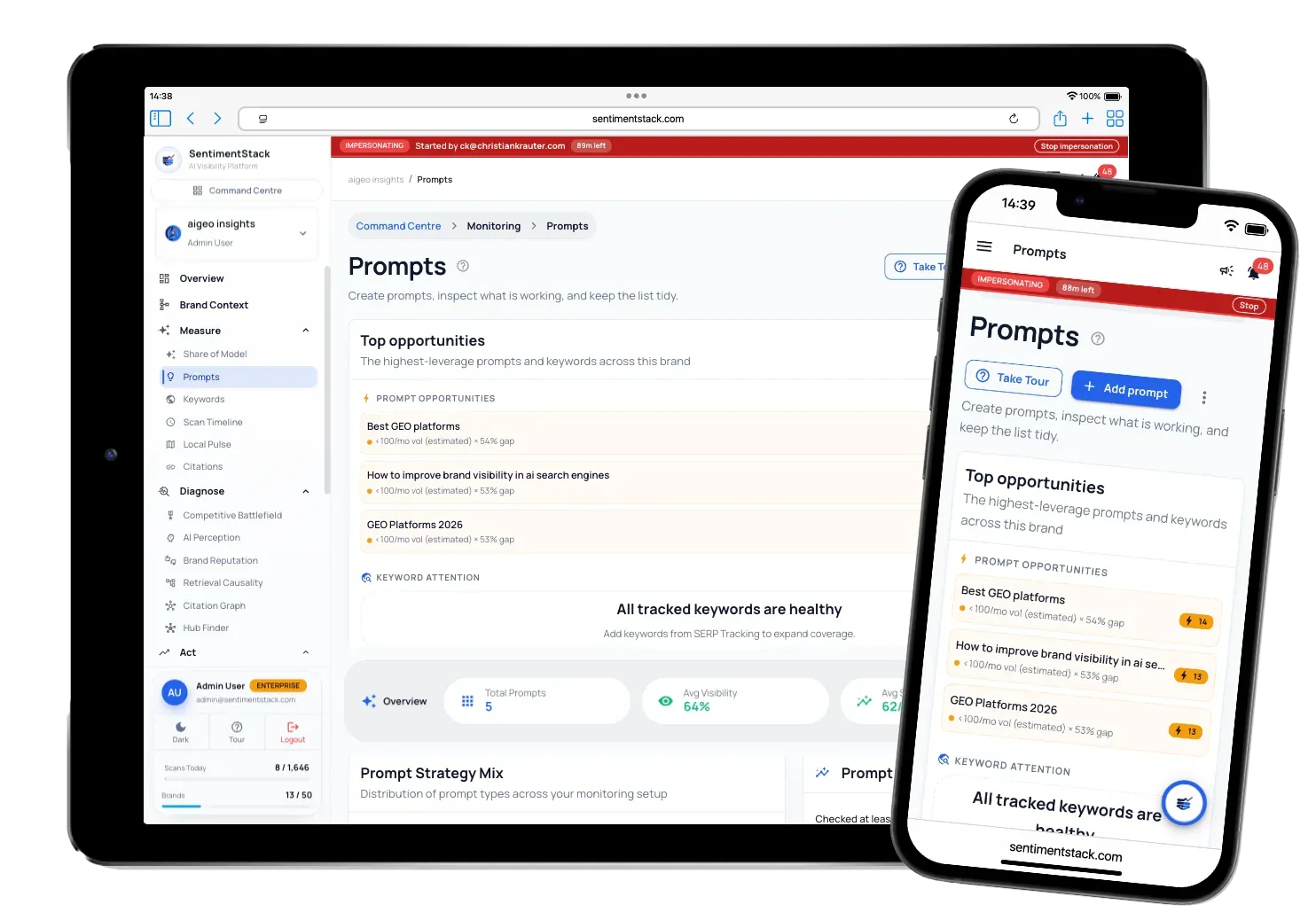
This is where an AI visibility tracker earns its place. aigeo insights connects brand mentions, citations, sentiment, competitor visibility and platform-level performance to an actionable roadmap, so teams can prioritise the work most likely to improve their AI share of voice. Without that layer, GEO can quickly become guesswork dressed up as content strategy.
Optimise for platforms without creating five versions of every page
Platform differences are real, but duplicating content for every model is usually wasteful. Start with a strong source of truth, then use reporting to identify material differences in performance.
Perplexity often makes citations highly visible, making source quality and direct answers especially important. Google AI Overviews are closely connected to the broader search ecosystem, so technical accessibility, topical authority and search intent still carry weight. Conversational assistants may place more emphasis on how clearly a brand can be described in relation to a buyer’s question.
If one platform consistently misses your brand, investigate the cause before rewriting everything. You may have a retrieval issue, weak evidence for a specific claim, poor coverage of a prompt category, or an entity-consistency problem. The remedy depends on the gap.
Turn optimisation into an operating rhythm
GEO is not a one-off content sprint. Models change, source sets shift, competitors publish and buyer language evolves. Teams that win build a monthly operating rhythm: monitor priority prompts, identify movement in share of voice and sentiment, investigate the drivers, then assign high-impact fixes.
Measure outcomes at three levels. First, track visibility: mentions, citations and recommendation inclusion. Second, track competitive position: share of voice by topic, product category and platform. Third, connect those gains to commercial indicators such as branded search demand, qualified traffic, demo requests and pipeline influence. Attribution will not always be perfect, particularly when AI answers reduce clicks, but visibility data still reveals whether your brand is earning a place in the buyer’s shortlist.
Be disciplined about trade-offs. Publishing a comparison page may improve coverage but require legal or brand review. Adding detailed pricing may increase answer relevance but change sales conversations. Creating original research takes more time than refreshing a service page, yet it can produce a stronger citation asset. Prioritise based on potential visibility impact and commercial value, not what is easiest to ship.
The brands that lead generative search will not wait for AI traffic to appear in analytics before acting. They will measure where answers are being formed, fix the evidence gaps that keep them out, and make every high-value prompt a chance to be the brand buyers hear first.
Related Posts
- Generative Search Strategy for Marketers
Build a generative search strategy for marketers that measures AI visibility, earns citations and turns competitive insights into practical, fast…
Read more about Generative Search Strategy for Marketers - AI Overview Optimisation Guide for Brands
This AI overview optimisation guide shows brands how to earn citations, track AI share of voice and turn generative search…
Read more about AI Overview Optimisation Guide for Brands - 9 best generative engine optimisation tools
Compare the best generative engine optimisation tools for tracking AI visibility, citations, sentiment, and competitor share of voice.
Read more about 9 best generative engine optimisation tools