
A competitor can rank below you in traditional search and still become the brand an AI recommends first. That is the new visibility problem. Understanding what affects AI brand mentions is no longer a research exercise for SEO teams. It is a commercial priority for any brand that wants to win leads, trust and category share in the answer economy.
AI platforms do not simply reproduce a search ranking. They interpret a question, weigh available evidence, select sources and generate an answer that may name several brands, one brand or none at all. The result can change with the query wording, user location, platform and the sources the model can access or choose to cite.
That makes AI visibility more complex than a single rank position. It also makes it measurable and improvable when teams focus on the signals that actually influence mention frequency, citation rate, sentiment and AI share of voice.
What affects AI brand mentions most?
AI brand mentions are shaped by a combination of entity confidence, source quality, topical relevance and competitive evidence. A strong brand is not merely visible online. It is consistently understood, validated and easy for an AI system to use when answering a specific question.
Clear brand and entity signals
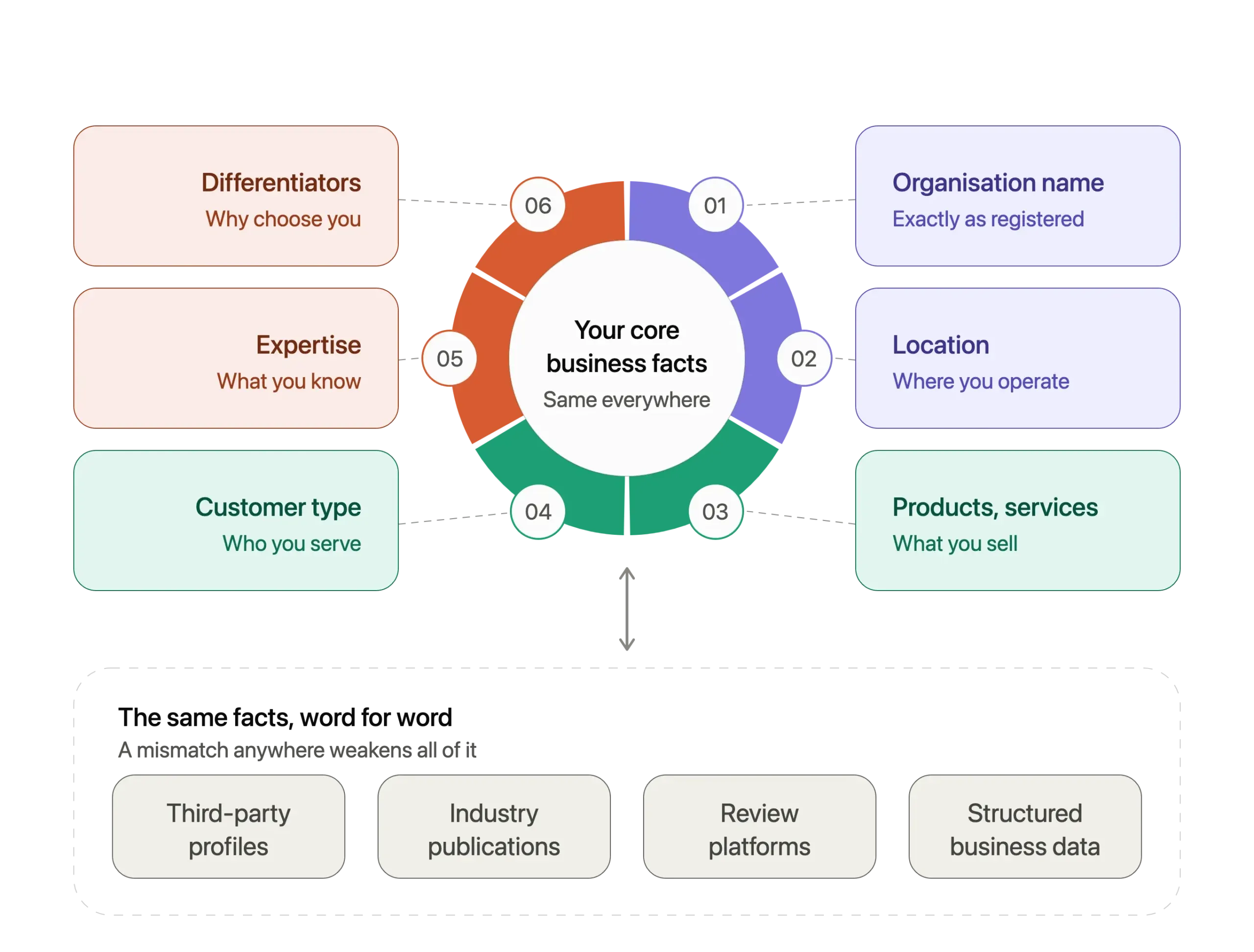
Before an AI can recommend your business, it needs to understand exactly what your business is, what you offer and where you fit in the market. Conflicting company descriptions, outdated locations, duplicate product names and vague category language all create uncertainty.
Your website should make the fundamentals unmistakable: the organisation name, primary products or services, customer type, location, expertise and differentiators. The same facts should appear consistently across credible third-party profiles, industry publications, review platforms and structured business information.
This is especially important for brands with common names, multiple service lines or a recent repositioning. If the web presents three competing versions of your brand, generative engines have less confidence connecting your brand to the right recommendation query.
Relevance to the question, not just the keyword
A page can target a high-value phrase and still fail to earn AI mentions if it does not answer the underlying decision the user is making. Someone asking for the “best payroll software for a growing Australian business” needs a different answer from someone comparing payroll integrations, pricing models or compliance features.
AI systems are designed to resolve intent. They look for content that addresses the question directly, explains the relevant criteria and provides enough context to support a useful answer. Broad product pages often lose to focused comparison pages, use-case guides, expert explainers and clear service pages because those assets answer a narrower question with stronger evidence.
The strategic move is to map priority prompts to the real decisions behind them. Then build or improve the asset that gives an AI a confident reason to mention your brand in that exact context.
Credible, corroborated information
AI-generated answers tend to favour claims that appear credible and can be corroborated across more than one trustworthy source. That does not mean every mention requires a media feature or a top-tier domain. It means unsupported marketing claims are less likely to carry weight than claims backed by evidence.
Original research, customer evidence, independent reviews, expert commentary, awards with clear criteria, product documentation and reputable industry coverage can all strengthen the information environment around your brand. The more authoritative sources that confirm your expertise or product capability, the easier it is for an AI to reuse that fact.
There is a trade-off here. Distribution without substance produces shallow visibility. A large volume of low-quality mentions can create noise, while a smaller number of accurate, relevant sources can have a far stronger effect on recommendation queries.
Content structure and extractability
Generative engines need to locate and interpret useful information quickly. Dense copy, buried answers and pages built entirely around promotional language make that harder. Content does not need to be written for machines at the expense of people, but it does need a logical structure.
Use descriptive headings, concise definitions, specific claims, clear product details and well-labelled sections. Explain who a service is for, where it is available, what problem it solves and how it differs from alternatives. Where appropriate, include tables, pricing context, methodology, FAQs and practical examples.
The goal is not to stuff pages with every possible question. It is to create answer-ready assets. When an AI is evaluating a prompt, a page with explicit, well-supported information is more usable than a polished page that says very little.
Freshness and change management
Stale content can quietly cost AI visibility. Product capabilities change, prices move, leadership teams shift and competitors enter the market. If old pages remain prominent while current information is thin or difficult to find, an AI may repeat outdated claims or skip your brand altogether.
Freshness matters most in categories where information changes quickly, such as software, financial services, health, travel and consumer products. It matters less for genuinely evergreen expertise, although even evergreen pages benefit from periodic validation and improved examples.
Treat high-value AI prompts as a content maintenance programme. Review the pages and external sources connected to those prompts, update factual claims, remove contradictions and publish material that reflects where your business is now.
Why platform behaviour changes AI brand mentions
ChatGPT, Claude, Gemini, Perplexity and Google AI Overviews do not produce identical answers from identical prompts. Their retrieval methods, citation behaviour, model preferences and product experiences differ. A brand that performs well in one environment may be underrepresented in another.
Perplexity may visibly cite sources more often, making source-level analysis straightforward. Google AI Overviews can be strongly influenced by search-visible, query-relevant pages. Conversational assistants may synthesise broader patterns of information and respond differently depending on prompt context.
That is why a single screenshot is not a visibility strategy. Teams need consistent prompt sets, repeatable testing and platform-level measurement. Track whether your brand is mentioned, cited, recommended positively or excluded while a competitor is named. Then look for patterns across many prompts rather than reacting to one answer.
Competitors influence the answer too
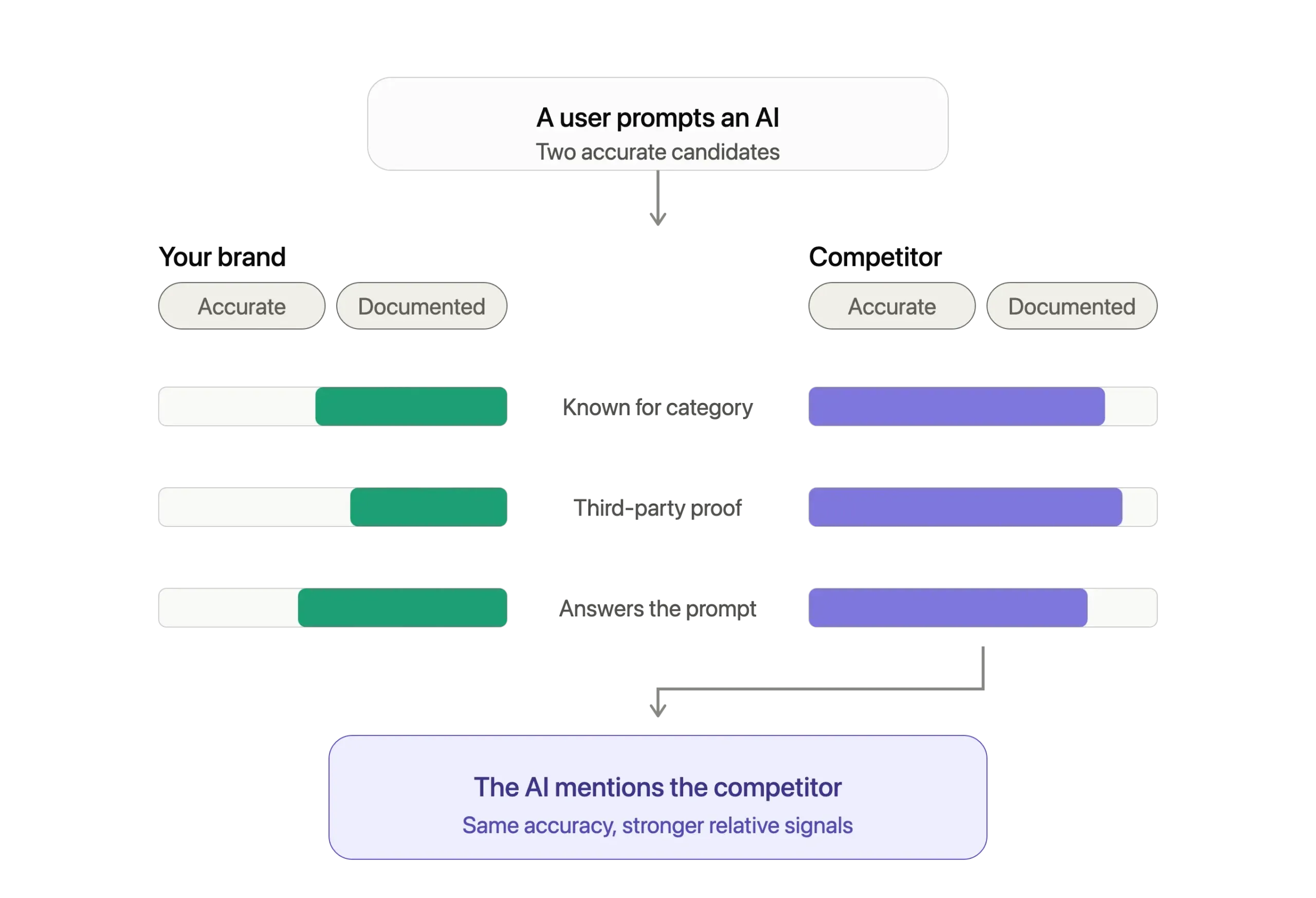
AI visibility is relative. Your brand may be accurate, well documented and still lose mentions because a competitor has more recognisable category associations, stronger third-party validation or content that better answers the prompt.
This is where AI share of voice becomes more useful than isolated brand tracking. If competitors dominate “best”, “alternatives”, “for small business” or “for enterprise” prompts, the issue may not be that your brand has disappeared. It may be that your positioning is not sufficiently evidenced in the query clusters that drive commercial demand.
Study the sources and themes behind competitor mentions. Are they winning because they publish useful comparison content? Because reviewers consistently name a particular capability? Because their documentation makes product fit unusually clear? The answer determines the response. Copying their page titles will not fix a credibility or positioning gap.
Turn visibility signals into a GEO action plan
The most effective GEO programmes connect monitoring to action. Start with the prompts that represent high-intent customer questions, category discovery terms and competitor comparisons. Include variations that reflect how Australians actually ask, such as location-specific, industry-specific and budget-focused queries.
For each prompt cluster, assess four outcomes: mention frequency, citation rate, sentiment and competitor share of voice. A missing mention needs a different response from a negative mention. A mention without a citation may indicate awareness but weak source ownership. A citation to an outdated page signals a maintenance opportunity.
From there, prioritise work by commercial impact and likely gain. A practical roadmap may include refreshing a core solution page, publishing a comparison asset, clarifying a confusing product claim, strengthening expert evidence or placing credible third-party coverage around an underrepresented capability.
Avoid treating every low-performing prompt as a content brief. Some queries are not relevant to your offer. Others are dominated by entrenched sources and require longer-term authority building. Focus on the gaps where your brand has a legitimate right to be part of the answer and clear evidence to support that position.

Measure movement, not just activity
Publishing more content is not the objective. Increased qualified visibility is. Monitor changes in brand mention rate, platform-specific citations, recommendation sentiment and share of voice against named competitors. Connect those shifts to the actions taken so your team can identify which assets and source types are actually moving the needle.
This is the advantage of using an AI visibility platform such as aigeo insights: it turns scattered AI answers into a measurable competitive benchmark and a prioritised optimisation roadmap. Instead of guessing why a competitor appears more often, teams can identify the prompt gaps, source gaps and content tasks most likely to improve representation.
The battle for the answer will not be won by the brand with the loudest claims. It will be won by the brand whose expertise is clearest, most credible and most useful at the moment an AI is deciding what to say. Build that evidence deliberately, measure it across platforms and give every priority prompt a reason to name you.
Related Posts
- How to Track Brand Mentions in AI Search
Learn how to track brand mentions in AI search, measure AI share of voice, citations, sentiment and competitor visibility across…
Read more about How to Track Brand Mentions in AI Search - How to Map Brand Entities for AI Search Visibility
Learn how to map brand entities, connect the signals AI uses, find gaps and build a stronger path to citations,…
Read more about How to Map Brand Entities for AI Search Visibility - Generative Search Strategy for Marketers
Build a generative search strategy for marketers that measures AI visibility, earns citations and turns competitive insights into practical, fast…
Read more about Generative Search Strategy for Marketers